

Howell Puts Heart Into Memorial Meet
August 29, 2013
By Geoff Kimmerly
Second Half editor
An online tribute to Mackenzie Watts describes how she “made the people and world around her better.”
The Howell swimming and diving community continues to work so that her memory makes those who come after her safer as well.
 Watts died in 2005 after suffering a cardiac arrhythmia. She was a 15-year-old sophomore and key cog on her high school team.
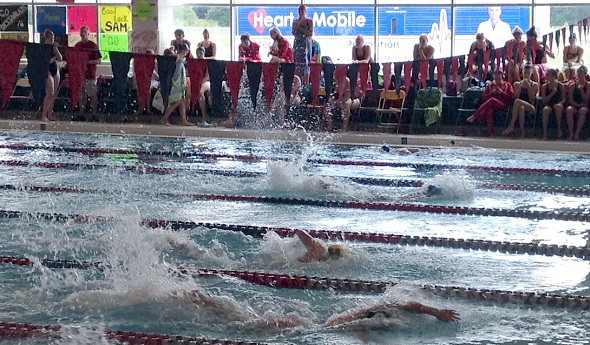
This past weekend, for the sixth straight season, the Highlanders hosted the Kenzie Classic, an invitational that served as a fundraiser for the Howell program and annual Mackenzie Watts scholarship – plus served to promote heart screenings by local National Diagnostic Services in their “HeartMobile” parked outside the pool.
NDS, which also has held screening events at Northville, Canton and Middleville Thornapple Kellogg schools among others, screened 20 students during this Kenzie Classic, said Wellness Director Heidi Enders.
Tests are ultrasound-based and non-invasive, and include an EKG to examine the heart’s electrical system for arrhythmias and an echocardiogram to examine the heart’s structure in case there is a thickening of the muscle (known as hyperthrophic cardiomyopathy). Adults were charged $199 and students $75, with discounted rates for adults in groups and children.
Click to check out coverage of the event from the Livingston County Daily Press & Argus.
Records Revamp
While tracking down 660 football schedules (give or take a few) took up most of the summer, there still was time for a few additions to the MHSAA record book – with more to come.
Track and field fans will notice records from retired yardage events (pre-1982 or earlier depending on the MHSAA class) have been added to the online records here for boys and here for girls.
Cross country fans should check out our lists of top MHSAA Finals times for every division and every class, plus overall top 10 lists for both boys and girls since the race was set to five kilometers in 1980. Click here for girls and here for boys.
Also added or updated were team championship counts for both cross countries, volleyball and girls golf. Click to check out girls golf here and volleyball here.
Fond Football Memories
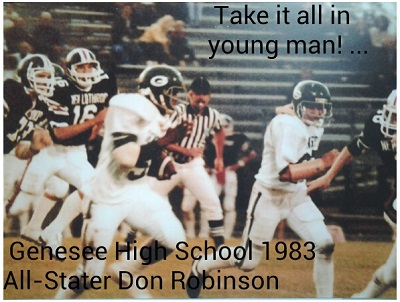
It has been 30 years since former Genesee all-state running back Don Robinson became the fourth player in Genesee County history to run for more than 300 yards in one game – which he did in gaining 317 on Sept. 23, 1983.
 High school football and those memories remain close to his heart even after going on to play at Eastern Michigan University, a stint in the U.S. Navy and a move to Georgia.
He’s paid attention over the years as that “300 club” has grown to 22 players including current New Orleans Saints back Mark Ingram, Jr., and the University of Michigan’s Thomas Rawls.
He’s also a regular reader of Second Half, and asked to send along some words of wisdom to those who will be taking the field to begin the season this weekend:
“When you run out onto the field this season, do me a favor. At least once, pause.
“Look around you. Look at the lights in the sky. See the faces of those that have come to see you play. Listen to the band and the cheerleaders. Look into the eyes of your teammates ...
“Take it all in. When you’re older and miss this amazing game that you are playing, you’ll be glad you did.”
PHOTOS: (Top) A swimmer takes the lead during a race at Saturday's Kenzie Klassic at Howell High School. (Photo courtesy of Howell High School.) (Middle) Genesee graduate Don Robinson runs the ball during the 1983 season. (Photo courtesy of Don Robinson.)

7 Sleeping Tips for Student-Athletes
November 5, 2019

Henry Ford Health System
Many athletes seem to believe time spent not training is time wasted. But, on the contrary.
The time athletes spend resting and sleeping is actually just as important. Take the world’s best female skier, Mikaela Shiffrin, for example. Shiffrin reportedly not only sleeps nine hours each night, but naps at least an hour every day.
So, what does sleeping have to do with her success? When asleep, the body not only has time to recover, but the information that was taken in during the day goes from short-term memory and becomes long term.
“Being an elite athlete is a 24-hour profession, and sleep and recovery are integral to optimal performance,” says Meeta Singh, M.D., a sleep medicine specialist at Henry Ford Health System.
Here are seven tips to help your student athlete catch some Zzzs during the season:
1. Limit caffeine. Caffeine is a popular ingredient in many pre-workout drinks, and many athletes choose to use it for an energy boost. However, having caffeine late in the day may make falling asleep and staying asleep difficult. But, everyone reacts differently to caffeine, so athletes should try logging their intake to determine what time to stop consuming and how much is okay to consume.
2. Maintain a regular sleep schedule. The body has an internal clock that’s largely affected by environment. Going to bed and waking up at approximately the same time each day can add a natural rhythm to the body’s internal clock, which can cause people to feel more awake during the day and fall asleep easily at night.
3. Workout early. Often times, working out later in the day gives people a burst of energy that can keep them up late into the night. For example, exercising after 9 p.m. can boost body temperature, making sleep difficult. However, research shows morning workouts can help achieve deeper sleep, and working out in the afternoon can help reduce insomnia.
4. Unplug. Nothing can keep one up at night like a buzzing smartphone. Additionally, the blue light a phone emits may slow the production of melatonin, making sleep difficult. Advise your children to leave electronics out of reach while they’re sleeping. And as an added bonus: If their phone is their alarm, it will force them out of bed in the mornings.
5. Use essential oils. Essential oils have seen growing popularity in recent years, and this is in part because scent helps trigger memory. Oils can be diffused, rubbed on temples or drops can be spread on pillows. Popular oils for promoting sleep are lavender, valerian root and roman chamomile.
6. Focus on breathing. Focusing on breath can help steady heart rate and relax the body. A popular breathing technique is the 4-7-8 exercise, in which one inhales through the nose for four seconds, holds their breath for seven, and exhales for eight.
7. Keep it dark, cool and quiet. Having the right environment is an important part of falling asleep … and staying asleep.
Ultimately, when it comes to enhancing athletic performance, getting proper sleep, resting and recovering can be just as important as training or hitting the gym.
“Since sleep can modulate reaction time and accuracy, it’s important to ensure an athlete gets his or her Zzzs,” Dr. Singh says.
See also: Is Your Teen Sleep Deprived?
Want to learn more? Henry Ford Health System sports medicine experts are treating the whole athlete, in a whole new way. From nutrition to neurology, and from injury prevention to treatment of sports-related conditions, they can give your athlete a unique game plan.
Visit henryford.com/sports or call (313) 972-4216 for an appointment within 24 business hours.