


Howell Puts Heart Into Memorial Meet
August 29, 2013
By Geoff Kimmerly
Second Half editor
An online tribute to Mackenzie Watts describes how she “made the people and world around her better.”
The Howell swimming and diving community continues to work so that her memory makes those who come after her safer as well.
 Watts died in 2005 after suffering a cardiac arrhythmia. She was a 15-year-old sophomore and key cog on her high school team.
This past weekend, for the sixth straight season, the Highlanders hosted the Kenzie Classic, an invitational that served as a fundraiser for the Howell program and annual Mackenzie Watts scholarship – plus served to promote heart screenings by local National Diagnostic Services in their “HeartMobile” parked outside the pool.
NDS, which also has held screening events at Northville, Canton and Middleville Thornapple Kellogg schools among others, screened 20 students during this Kenzie Classic, said Wellness Director Heidi Enders.
Tests are ultrasound-based and non-invasive, and include an EKG to examine the heart’s electrical system for arrhythmias and an echocardiogram to examine the heart’s structure in case there is a thickening of the muscle (known as hyperthrophic cardiomyopathy). Adults were charged $199 and students $75, with discounted rates for adults in groups and children.
Click to check out coverage of the event from the Livingston County Daily Press & Argus.
Records Revamp
While tracking down 660 football schedules (give or take a few) took up most of the summer, there still was time for a few additions to the MHSAA record book – with more to come.
Track and field fans will notice records from retired yardage events (pre-1982 or earlier depending on the MHSAA class) have been added to the online records here for boys and here for girls.
Cross country fans should check out our lists of top MHSAA Finals times for every division and every class, plus overall top 10 lists for both boys and girls since the race was set to five kilometers in 1980. Click here for girls and here for boys.
Also added or updated were team championship counts for both cross countries, volleyball and girls golf. Click to check out girls golf here and volleyball here.
Fond Football Memories
It has been 30 years since former Genesee all-state running back Don Robinson became the fourth player in Genesee County history to run for more than 300 yards in one game – which he did in gaining 317 on Sept. 23, 1983.
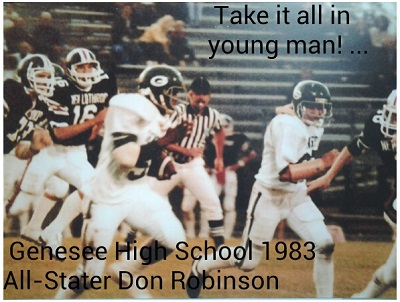 High school football and those memories remain close to his heart even after going on to play at Eastern Michigan University, a stint in the U.S. Navy and a move to Georgia.
He’s paid attention over the years as that “300 club” has grown to 22 players including current New Orleans Saints back Mark Ingram, Jr., and the University of Michigan’s Thomas Rawls.
He’s also a regular reader of Second Half, and asked to send along some words of wisdom to those who will be taking the field to begin the season this weekend:
“When you run out onto the field this season, do me a favor. At least once, pause.
“Look around you. Look at the lights in the sky. See the faces of those that have come to see you play. Listen to the band and the cheerleaders. Look into the eyes of your teammates ...
“Take it all in. When you’re older and miss this amazing game that you are playing, you’ll be glad you did.”
PHOTOS: (Top) A swimmer takes the lead during a race at Saturday's Kenzie Klassic at Howell High School. (Photo courtesy of Howell High School.) (Middle) Genesee graduate Don Robinson runs the ball during the 1983 season. (Photo courtesy of Don Robinson.)

NFHS Voice: No HS Football Link to CTE
October 21, 2019
By Karissa Niehoff
NFHS Executive Director
When it comes to the long-term effects of concussions in sports, there is a wide range of information published – almost on a daily basis. Unfortunately, much of the media coverage as it relates to high school sports – and particularly the sport of football – is misleading.
Last week, the Concussion Legacy Foundation introduced its new public-service announcement that compared youth football dangers to smoking. As the pre-teen football players puff on cigarettes, the voiceover says, “Tackle football is like smoking, the younger I start, the longer I’m exposed to danger.”
The “Tackle Can Wait” campaign by the foundation is an attempt to steer children under the age of 14 into flag football. Although establishing a finite age may be difficult, reducing contact at youth levels is certainly a positive. USA Football is doing just that nationally through its Football Development Model. Likewise, the 51 member state associations of the National Federation of State High School Associations (NFHS) have enacted limitations on contact during preseason and practice sessions.
Our concern is the term “exposed to danger.” These types of messages continue to spread unwarranted fear to parents of high school student-athletes. The “danger” refers to reports that players who incur repeated concussions can develop chronic traumatic encephalopathy (CTE).
A 2017 study from the Journal of American Medical Association (JAMA) linked CTE in the brains of deceased National Football League players. Even if this report is accurate, these are individuals who endured repeated blows to the head for 20 to 25 years BEFORE any concussion protocols were in place.
Less publicized is a study by Dr. Munro Cullum and his colleagues at the Peter O’Donnell Jr. Brain Institute, which is a part of the University of Texas Southwestern Medical Center in Dallas. Cullum’s group studied 35 former NFL players age 50 and older who had sustained multiple concussions throughout their careers. The findings showed no significant association between the length of the individuals’ careers, the number of concussions and their cognitive function later in life.
Two studies, two different conclusions. Regardless of the outcome, however, they are not applicable to kids playing football before and during high school. There is absolutely no linkage to CTE at these levels, and the word “danger” should not be a part of the discussion.
A more applicable and significant study was also published in JAMA in 2017. In a study of about 4,000 men who graduated from Wisconsin high schools in 1957, there was no difference in cognitive function or decline between those who played football and those who did not as they reached 65 years of age. We would assume the majority of these individuals discontinued football after high school.
With more than one million boys – and girls – playing the contact sport of football each year, severe injuries do occur from time to time, but parents should know that efforts to lessen the risk of a catastrophic injury, including head injuries, have never been stronger than they are today.
In fact, new data from the National High School Sports-Related Injury Surveillance Study indicates some positive trends in concussion rates. The study, which was released in the American Academy of Pediatrics online issue of Pediatrics last week, indicated that concussion rates during football practices dropped from 5.47 to 4.44 concussions per 10,000 athletic exposures between the 2013-14 and 2017-18 seasons.
In addition, repeat concussion rates across all sports declined from 0.47 to 0.28 per 10,000 exposures during the same time period.
Concussion laws are in place in every state. All NFHS sports rules books have concussion management protocols. Helmet-to-helmet hits are not allowed in football. Limits on contact in preseason and practice in football are in place in every state.
After considering all the available research, we encourage parents to let their kids play their sport of choice in high school, but we would discourage moving away from football – or any contact sport – solely based on the fear of developing CTE later in life.
Dr. Karissa L. Niehoff is in her second year as executive director of the National Federation of State High School Associations (NFHS) in Indianapolis, Indiana. She is the first female to head the national leadership organization for high school athletics and performing arts activities and the sixth full-time executive director of the NFHS, which celebrated its 100th year of service during the 2018-19 school year. She previously was executive director of the Connecticut Association of Schools-Connecticut Interscholastic Athletic Conference for seven years.