

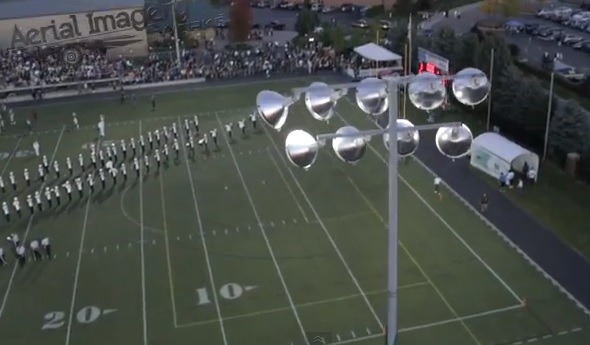
Irish Celebrate Homecoming Sky High
October 4, 2013
By Geoff Kimmerly
Second Half editor
You’ve got to see this – from high in the sky – to believe it.
The disappointing news for Pontiac Notre Dame Prep from its Homecoming game last Friday was that the Fighting Irish fell to Detroit Catholic League AA leader Detroit Loyola by seven points.
 But the Irish will remember fondly (and probably click on frequently) the video of this sky high view of the game including the team’s entrance to the field.
Thanks to a camera attached to a helicopter-like apparatus flown by local Aerial Imagery Works, Notre Dame was able to capture a rarely-seen view. See more by watching the brief video embedded at the bottom of this post.
SLC-TV Rolls 300
It's fair to assume few television stations in Michigan have been as dedicated to the local football team as South Lyon's SLC-TV, which will celebrate a milestone broadcast Oct. 11 when South Lyon faces South Lyon East.
SLC-TV has followed South Lyon football home and away games for 31 years and will broadcast its 300th game that night. SLC-TV’s games appear on WOW network channel 19 and Comcast Southfield channel 90, which reaches 33 communities in metro Detroit.
Sports director Tedd Wallace will have done play-by-play for 298 of those games, and said he believes no station in America has done TV broadcasts of a team’s home and away games as consistently. Check out more about the network’s weekly work on its Facebook page.
Friendly gesture to opponent in need
One of the most heart-warming parts of following high school sports is experiencing the camaraderie among athletes from opposing teams they likely know nothing about except for what they learn during competition.
Concord’s volleyball team shined especially brightly in this way last week.
Amazingly, Union City junior Marissa Mead played in her team’s match against Concord on Sept. 24 despite her home being destroyed by a fire that morning. As told by the Jackson Citizen-Patriot’s Leanne Smith, Concord’s players had heard about the tragic event and were surprised to then see Mead take her place as defensive specialist that night.
On the bus ride home, the Concord players decided they needed to do something to help Mead and her family. As a team, the players collected $80 – and then pushed the total to $300 with the help of teachers, parents and administrators. They delivered the funds in a card to Mead at Union City’s home match two days later.
It’s a gesture that might seem small, but speaks loudly to the awesome way our athletes relate to each other not just on, but off the court as well. Click to read the entire report.
Official of the Year
Marcy Weston, Central Michigan University’s Executive Associate Director of Athletics/Sports Administration and a longtime contributor to MHSAA officiating initiatives, has been named the Naismith Women’s College Official of the Year.
Weston spoke at the 2001 MHSAA Officials Banquet and has served as part of the association's officials committee and with the National Federation of State High School Associations as a liaison to its Basketball Rules Committee.
She also served as NCAA national coordinator of women’s basketball officiating from 1991-2005 after working as a women’s college basketball official from 1964-84. Click to read more from CMUChippewas.com.
Century of School Sports: Why Does the MHSAA Have These Rules?
By
Geoff Kimmerly
MHSAA.com senior editor
September 18, 2024
MHSAA administrators are two trips into their annual seven-stop fall tour that has become a tradition during nearly half of the Association’s “Century of School Sports” – and this year, a focus has been on answering a key question at the heart of educational athletics since long before the MHSAA was formed during the 1924-25 school year.
The MHSAA’s Update meeting series is in its 47th year and includes half-day conferences in seven locations – generally in the Kalamazoo, Metro Detroit, Grand Rapids, Saginaw, northern Lower Peninsula and mid-Michigan areas, and at Northern Michigan University in Marquette. The six Lower Peninsula sessions begin with an athletic director in-service during which MHSAA assistant directors explain recent rules changes and discuss challenges our administrators face on a daily basis (with Upper Peninsula athletic directors participating in a similar in-service during the spring).
Those in-services are followed by a session with executive director Mark Uyl, who speaks to athletic directors, superintendents, principals and school board members on a variety of topics including the MHSAA’s current objectives and ideas for the future, while also reinforcing the longstanding values that remain the bedrock of our daily work.
And that leads to the question he’s presenting across the state this fall:
Why does the MHSAA have these rules?
Frankly, the answer goes back to the beginning of school sports in Michigan – all the way back to 1895, when the first MHSAA predecessor organization was formed.
The first MHSAA Representative Council president Lewis L. Forsythe explained in his book “Athletics in Michigan High Schools – The First Hundred Years” how regulations always have been necessary:
“Eligibility rules are a necessity in interscholastic competition. It was common acknowledgement of this fact that led to the first State inter-school organization in 1895. The rules at first were few, simple and liberal. But with the passing of the years they came to be more numerous, more complex, and more restrictive, again through common acknowledgment of desirability if not of necessity.”
That necessity – and the reasoning behind it – has not changed.
Two main points explain why rules are absolutely imperative for educational athletics to thrive.
► 1. Participation – through providing as many opportunities as possible for students to play – has been the mission of school sports since their start. Rules contribute to the value of participation.
If there are requirements for children to participate in athletics – for example, an academic standard or rules that dissuade students from switching schools every year – then school sports programs mean more to all involved.
If we raise the bar, raise the standards of eligibility and conduct, we raise the value of our school sports programs. If we lower the bar, we lower the value of being part of school sports – because without rules, contest results are meaningless, and the value of participating is diminished.
► 2. We have rules where the stakes are higher, and agreement is lower – because where the stakes are highest, there is the greatest tendency for some people to try to gain an unfair advantage, and the greatest need for rules to curb possible dishonest activity.
This statement goes to the heart of the history, rationale and application of MHSAA rules. Obviously and simply put, school sports mean a lot to those who take part, and that significance is high enough to stoke disagreement – and we need rules to govern those disagreements. We have the most rules for high school sports, where championships are at stake and the possibility of disagreement is greatest.
***
Finally – and perhaps providing the strongest reinforcement of the two points above – is this:
Schools choose to make MHSAA rules their own.
Quite literally, school districts vote annually to be part of the MHSAA – and confirming this voluntary membership comes with the requirement to follow all MHSAA rules.
When schools challenge our rules, they literally are seeking to break the rules they already have committed to uphold.
These rules, and this commitment, are the strength of our organization across 752 member high schools and several hundred more middle schools and junior high schools. They have been constructed on a century of precedents and after considerations by representatives of those same member schools – representatives those schools have voted to elect every school year during the MHSAA’s history.
Previous "Century of School Sports" Spotlights
Sept. 10: Special Medals, Patches to Commemorate Special Year - Read
Sept. 4: Fall to Finish with 50th Football Championships - Read
Aug. 28: Let the Celebration Begin - Read