


Irish Celebrate Homecoming Sky High
October 4, 2013
By Geoff Kimmerly
Second Half editor
You’ve got to see this – from high in the sky – to believe it.
The disappointing news for Pontiac Notre Dame Prep from its Homecoming game last Friday was that the Fighting Irish fell to Detroit Catholic League AA leader Detroit Loyola by seven points.
 But the Irish will remember fondly (and probably click on frequently) the video of this sky high view of the game including the team’s entrance to the field.
Thanks to a camera attached to a helicopter-like apparatus flown by local Aerial Imagery Works, Notre Dame was able to capture a rarely-seen view. See more by watching the brief video embedded at the bottom of this post.
SLC-TV Rolls 300
It's fair to assume few television stations in Michigan have been as dedicated to the local football team as South Lyon's SLC-TV, which will celebrate a milestone broadcast Oct. 11 when South Lyon faces South Lyon East.
SLC-TV has followed South Lyon football home and away games for 31 years and will broadcast its 300th game that night. SLC-TV’s games appear on WOW network channel 19 and Comcast Southfield channel 90, which reaches 33 communities in metro Detroit.
Sports director Tedd Wallace will have done play-by-play for 298 of those games, and said he believes no station in America has done TV broadcasts of a team’s home and away games as consistently. Check out more about the network’s weekly work on its Facebook page.
Friendly gesture to opponent in need
One of the most heart-warming parts of following high school sports is experiencing the camaraderie among athletes from opposing teams they likely know nothing about except for what they learn during competition.
Concord’s volleyball team shined especially brightly in this way last week.
Amazingly, Union City junior Marissa Mead played in her team’s match against Concord on Sept. 24 despite her home being destroyed by a fire that morning. As told by the Jackson Citizen-Patriot’s Leanne Smith, Concord’s players had heard about the tragic event and were surprised to then see Mead take her place as defensive specialist that night.
On the bus ride home, the Concord players decided they needed to do something to help Mead and her family. As a team, the players collected $80 – and then pushed the total to $300 with the help of teachers, parents and administrators. They delivered the funds in a card to Mead at Union City’s home match two days later.
It’s a gesture that might seem small, but speaks loudly to the awesome way our athletes relate to each other not just on, but off the court as well. Click to read the entire report.
Official of the Year
Marcy Weston, Central Michigan University’s Executive Associate Director of Athletics/Sports Administration and a longtime contributor to MHSAA officiating initiatives, has been named the Naismith Women’s College Official of the Year.
Weston spoke at the 2001 MHSAA Officials Banquet and has served as part of the association's officials committee and with the National Federation of State High School Associations as a liaison to its Basketball Rules Committee.
She also served as NCAA national coordinator of women’s basketball officiating from 1991-2005 after working as a women’s college basketball official from 1964-84. Click to read more from CMUChippewas.com.
Track Gaining Speed Toward Future with Electronic Starting Devices
By
Steve Vedder
Special for MHSAA.com
May 23, 2023
Aubrey Greenfield thinks it might be the perfect time to reevaluate 130 years of tradition.
For a number of reasons, from technical to personal, the Oxford senior sprinter believes it makes sense for the crack of a starting pistol to be eliminated from high school track meets.
Because track meets would benefit in various ways from lowering costs to easier setup at meets to the human factor of competitors not having to flinch at the crack of a pistol shot, Greenfield believes the sport has a chance to embrace new technology – electronic starting devices (ESD).
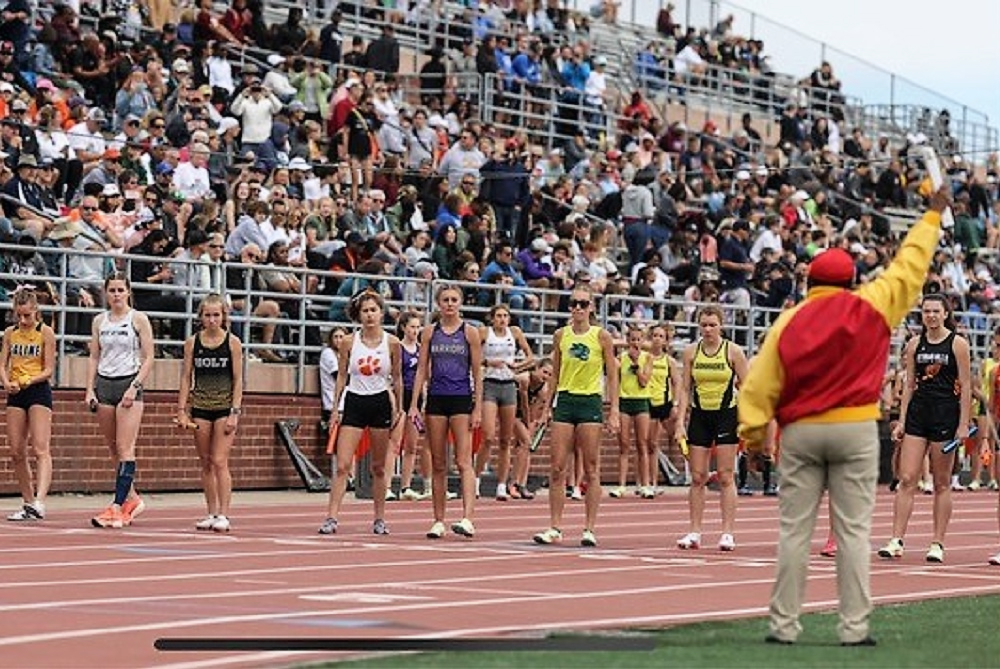
In essence, an ESD replaces the starting pistol with a light flash, tone sound or both to begin a race.
"High school sports should put the athlete first," Greenfield said. "We should promote sports, and eliminating starting pistols promotes health in terms of PTSD or trauma for athletes and spectators and that would be good. I would like to think people would say that's a good idea."
In fact, Greenfield would go as far as to say if there was not an implementation of electronic starting devices, many of her teammates would have considered giving up the sport.
"If it's something that helps us compete safely, we're all for it," she said.
Greenfield's opinion apparently is spreading. Michigan High School Athletic Association senior assistant director Cody Inglis said the use of ESD makes it both affordable for meet starters and sensible for athletes and fans to rethink the use of starting pistols. While the MHSAA is not mandating electronic starting devices, it does promote the use of what Inglis calls "emerging technology." He notes that ESD are becoming the norm for organizations such as USA Track & Field, the NCAA and an increasing number of high schools.
 "I think we have to embrace new technology, and we think this will be something that takes hold," Inglis said.
A key part of embracing ESD is the human element. The tragic Oxford High School shooting Nov. 30, 2021, that took the lives of four students while injuring seven others should not be relived even for a fleeting instance at a high school sporting event. Oxford athletic director Tony DeMare said the school began using ESD at every meet, including the MHSAA Lower Peninsula Division 1 Finals last June. He said that decision was embraced by virtually all schools Oxford encountered.
"We were very convinced that the alternative (of ESD) would promote a healthy attitude," DeMare said. "We were overwhelmed with the positive response. If a school was on the fence about it or might not be for it, I think we've started to see the tide turn in favor of people willing to listen and learn about electronic starting devices."
Inglis said the MHSAA is acutely aware of what the crack of a starting pistol can mean to athletes and fans.
"It's unimaginable what Oxford went through, and this is a small way we can help," he said. "We look at a (starting pistol) and think, ‘Could we do something else?’ It's a way of helping to solve a problem."
Over the last several years, the MHSAA has embraced finding an alternative to starting pistols. Inglis noted the discussion started with the cost and diminishing availability of 32-caliber ammunition that meet starters use. A box of ammunition, if it can be found, is around $75 a box.
In addition to cost, there is potential damage from excessive exposure to 150-plus decibels of sound generated by the traditional 32-caliber blanks. Medical studies show damage to ears caused by decibel levels above 120 dB.
The tragedy at Oxford accelerated the conversation.
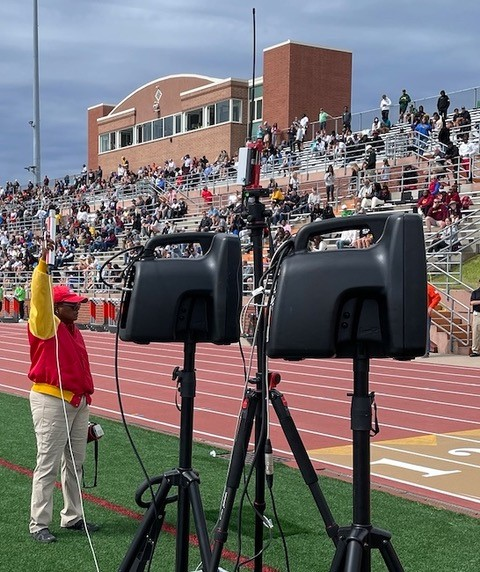
Inglis said the cost of ESD can be likened to a school sinking money into artificial surfaces at football fields. Yes, there is a great cost at first, but over time money is ultimately saved. An ESD system itself ranges between $200 and $500. Speakers also may need to be purchased, but with ESD starting events like the 800 and 1,600-meter relays positioned near the outside lanes 8, 7, 6 and 5 would result in improved hearing by athletes at the start of a race.
There is one challenge with ESD that track administrators are working to overcome – lighting conditions that lessen the ability to see the ESD’s LED light or strobe when the button is pressed by a starter to begin a race. But that vision difficulty resulting from clear blue skies and backgrounds of setting suns can be substantially improved by incorporating a black background with an ESD – something as simple as a starter holding up black cardboard behind the lighting mechanism at the start of an event.
Inglis said when all factors are considered, the use of ESD makes sense.
 "With the climate we live in nowadays, no lookalike guns is good," he said. "We're not mandating this. But people are saying this is affordable."
While switching to ESD would break 130 years of tradition, the timing could be a step forward, said Jeff Hollobaugh, co-author of the book "The Fleet Feet of Spring: Michigan's High School State Championships in Track & Field." He said while no definitive answer is possible, it's likely starting pistols were used at the inaugural state meet at the Jackson Fairgounds in 1895. The meet, which included events like tossing a 16-pound shot put, bike races and a 100-meter sprint, was sponsored by the Michigan Interscholastic Athletic Association (a predecessor to the MHSAA) and comprised mostly of the state's larger schools.
Hollobaugh's sentiments echo what many involved in today's high school track & field believe in terms of making a transition from starting pistols to electronic starting devices.
"It's a change, not necessarily good or bad, just different," he said. "It's not a drastic change, but it will take some getting used to. But it is the future. In the end, we'll all be fine."
DeMare believes the future of high school track will definitely include ESD.
"Our desire is that the practicality and sensibility of this will overcome the alternative," he said. "I think we'll see the automation and electronics taking hold of certain elements in track, and people will embrace it."
PHOTOS (Top) Runners watch official Bertha Smiley as they prepare to begin a race during last season's Lower Peninsula Division 1 Finals at Rockford. (Middle) An electronic starting device provided by VS Athletics was used to start those races. (Below) Smiley sets to begin an event. (Photos provided by David Kuderka/VS Athletics.)