

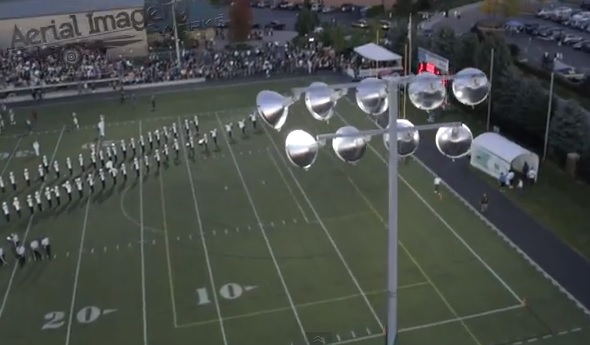
Irish Celebrate Homecoming Sky High
October 4, 2013
By Geoff Kimmerly
Second Half editor
You’ve got to see this – from high in the sky – to believe it.
The disappointing news for Pontiac Notre Dame Prep from its Homecoming game last Friday was that the Fighting Irish fell to Detroit Catholic League AA leader Detroit Loyola by seven points.
 But the Irish will remember fondly (and probably click on frequently) the video of this sky high view of the game including the team’s entrance to the field.
Thanks to a camera attached to a helicopter-like apparatus flown by local Aerial Imagery Works, Notre Dame was able to capture a rarely-seen view. See more by watching the brief video embedded at the bottom of this post.
SLC-TV Rolls 300
It's fair to assume few television stations in Michigan have been as dedicated to the local football team as South Lyon's SLC-TV, which will celebrate a milestone broadcast Oct. 11 when South Lyon faces South Lyon East.
SLC-TV has followed South Lyon football home and away games for 31 years and will broadcast its 300th game that night. SLC-TV’s games appear on WOW network channel 19 and Comcast Southfield channel 90, which reaches 33 communities in metro Detroit.
Sports director Tedd Wallace will have done play-by-play for 298 of those games, and said he believes no station in America has done TV broadcasts of a team’s home and away games as consistently. Check out more about the network’s weekly work on its Facebook page.
Friendly gesture to opponent in need
One of the most heart-warming parts of following high school sports is experiencing the camaraderie among athletes from opposing teams they likely know nothing about except for what they learn during competition.
Concord’s volleyball team shined especially brightly in this way last week.
Amazingly, Union City junior Marissa Mead played in her team’s match against Concord on Sept. 24 despite her home being destroyed by a fire that morning. As told by the Jackson Citizen-Patriot’s Leanne Smith, Concord’s players had heard about the tragic event and were surprised to then see Mead take her place as defensive specialist that night.
On the bus ride home, the Concord players decided they needed to do something to help Mead and her family. As a team, the players collected $80 – and then pushed the total to $300 with the help of teachers, parents and administrators. They delivered the funds in a card to Mead at Union City’s home match two days later.
It’s a gesture that might seem small, but speaks loudly to the awesome way our athletes relate to each other not just on, but off the court as well. Click to read the entire report.
Official of the Year
Marcy Weston, Central Michigan University’s Executive Associate Director of Athletics/Sports Administration and a longtime contributor to MHSAA officiating initiatives, has been named the Naismith Women’s College Official of the Year.
Weston spoke at the 2001 MHSAA Officials Banquet and has served as part of the association's officials committee and with the National Federation of State High School Associations as a liaison to its Basketball Rules Committee.
She also served as NCAA national coordinator of women’s basketball officiating from 1991-2005 after working as a women’s college basketball official from 1964-84. Click to read more from CMUChippewas.com.
Lees Becomes 1st from Detroit Catholic Central to Win 4 Team, 4 Individual Titles
By
Paul Costanzo
Special for MHSAA.com
March 8, 2026
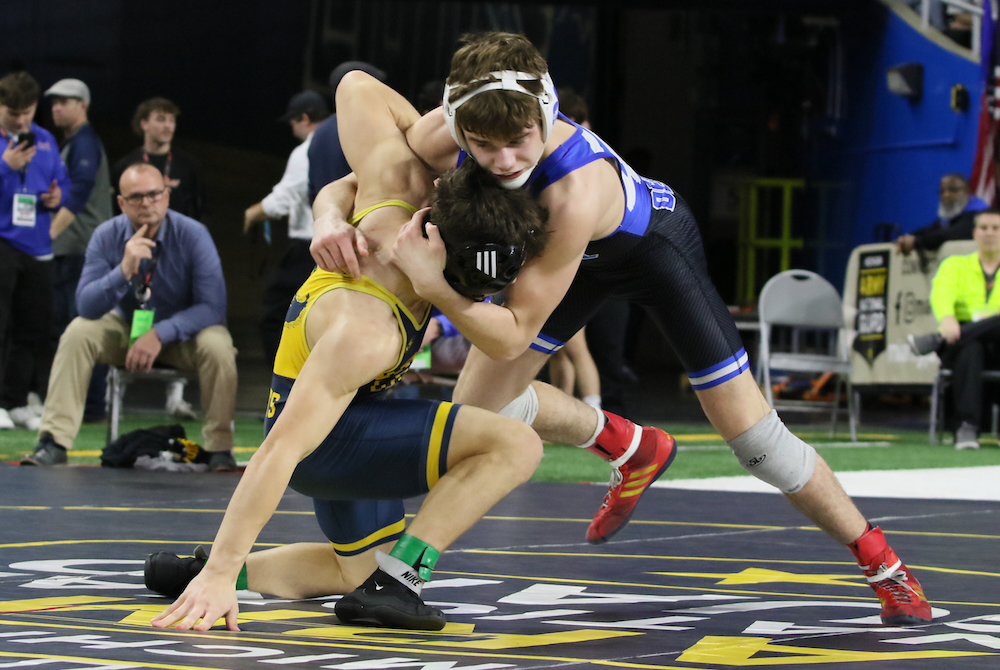
DETROIT – There aren’t many opportunities for wrestlers to become the first to accomplish something at Detroit Catholic Central anymore, but Wyatt Lees found a way.
He defeated Eden Abdo of Grand Ledge 7-1 on Saturday in the 132-pound title match of the Division 1 Individual Wrestling Finals, becoming the first Catholic Central wrestler to win eight Finals titles – four team and four individual – and fourth to win four individual titles, joining Darius Marines (2021-24), Dylan Gilcher (2020-23) and Kevon Davenport (2016-19).
“It’s pretty awesome,” Lees said. “I got to follow Darius, Dylan and Kevon, and now I get to start a new trend of four and four, which hopefully Grayson Fuchs can get next year.”
Lees was one of five wrestlers to win a fourth title Saturday, joining a list of 46 in Michigan history. He is just the ninth wrestler to ever reach eight total titles, as Hudson’s Nicholas Sorrow accomplished the feat just minutes before him.
“Before the match, he was messing with me saying, ‘Hey, whoever finishes their match first gets on the board first – did he finish before me?’” Lees said, before feigning disappointment and laughing when the answer was yes.
Lees previously had won titles at 106, 113 and 120, and this year he pinned his way into the finale. He was able to get an early takedown against Abdo and controlled the match from there.
Lees said he entered the Finals match with a bit of nerves, as he felt the weight of what he was about to accomplish.
“At first, I was doing a pretty good job blocking it out,” Lees said. “But I was kind of warming up and I felt it, it hit me. I said a prayer, ‘God help me. Help me channel my nervousness to good energy.’ Once I was out there, I was fine.”
106
Champion: Brody Compau, Rockford, Fr. (51-0)
Technical Fall (18-2, 3:03) over Grayson Van Valken, Grandville, Fr. (42-6)
Compau finished off a remarkable freshman season with another dominant victory.
“It feels great man,” he said. “Just knowing my work’s been paying off. I wrestled him at District and Regionals, so the plan was the same thing – keep pushing the pace, keep scoring. Just make sure I get the tech.”
Compau had a fall and two technical falls on his way to the championship match, and said he felt no added pressure as an unbeaten freshman.
“I know all the work that I’ve done to get here. I just had to show up and show people,” he said. “I think I can get four. Second one in Rockford after Kyle Waldo, just gotta do that again.”
113
Champion: Cyrus Woodberry, Detroit Cass Tech, Soph. (41-4)
Decision, 4-0, over Jase Sensor, Hartland, Soph. (49-9)
With the city of Detroit on his back – the skyline is literally printed on his singlet – Woodberry again came up big, claiming his second Finals title in as many tries.
“I feel like I’m representing all of Cass Tech, all of Detroit,” he said. “Showing people that Detroit wrestling is on the come-up, and I’m here to lead it.”
Woodberry entered the third period and rode Sensor out to complete the victory.
“Just to keep pressure on him,” Woodberry said. “It took everything out of me to keep him down, and when I finally got up, it felt great.”
Woodberry was the champ at 106 last year.
120
Champion: Layne Martin, Rockford, Jr. (51-0)
Technical Fall (19-4, 5:04) Matthew Quigley, Traverse City West, Jr. (51-1)
Martin dominated this matchup of unbeatens to claim his second-straight title.
“I felt pretty confident,” he said. “I was able to get to my attacks. Those high-Cs and those fireman’s, they were there the whole match.”
Martin claimed the 113-pound title a year ago, and after leading just 3-1 early Saturday, scored 16 points in the second and third periods to close out title No. 2.
“Coming in a little more used to the crowd and everything,” he said. “It’s just a little easier the second time.”
126
Champion: Jamison Gregory, Detroit Catholic Central, Jr. (34-7)
Major Decision, 8-0, over Steve Vaughn, Davison, Jr. (28-12)
Gregory was the first of six Catholic Central wrestlers to hit the mat on the night and set quite a tone by winning his first individual title.
“It felt pretty good,” he said. “I’ve been chasing it for a while. My coaches have been telling me all year that I’m a tone setter, and I just feel so glad that I’m able to set that tone here in this tournament.”
He scored a takedown and escape in both the second and third periods to win by major decision.
“The strategy was just kind of let him come toward me and find my offense,” Gregory said. “Then go out and win the state title.”
138
Champion: Bohdan Abbey, Hartland, Sr. (51-1)
Technical Fall (19-4, 3:18) over Carl Nihranz, Macomb Dakota, Sr. (52-4)
In his fourth Finals appearance, Abbey claimed title No. 3 with a dominant performance.
“It’s fun getting the third state title,” Abbey said. “It’s just another day to give the glory to God for what he’s gifted you with out there on the mat.”
He teched his way through the tournament, closing out an illustrious career. He was champion at 113 as a freshman, second at 126 as a sophomore, and champion at 132 a year ago.
“First one, I had to work for it really hard,” Abbey said. “Then obviously came up short my sophomore year, but the next two you have to find the Lord, and if you’re not wrestling for the Lord, you’re wrestling for yourself, and you can’t do anything by yourself.”
144
Champion: Nate Carter, Clarkston, Sr. (44-3)
Decision, 7-5, over Deacon Morgan, Rochester Adams, Jr. (27-3)
Carter and Morgan battled every second of the six minutes in their title bout, but after claiming his first Finals title, Carter still had plenty of energy.
“I’m feeling great, pumped up, excited,” Carter said. “Went full six minutes, me and my coaches we had a gameplan. We didn’t really strategize too much coming into the state tournament, because it goes match by match, one by one, but we came back right before Finals started and had a gameplan. Just stay basic and fire when it’s open, and that’s what I did.”
Carter hit a big move in the second period to take the lead over Morgan, who was runner-up at 126 a year ago.
“He was just pressuring, and I know I got some of the best hips in the country,” Carter said. “I know if someone is pressure too much, and I got that chance and opportunity – it was on the edge of the mat, so I was like, ‘Why not?’ Worse comes to worse, we go out of bounds.”
150
Champion: Grayson Fuchs, Detroit Catholic Central, Jr. (29-1)
Decision, 8-6, over Deacon MacNeill, Bloomfield Hills Brother Rice, Sr. (48-2)
Fuchs claimed his third individual title and sixth overall while battling through a laundry list of injuries.
“I’m wrestling through a sprained MCL, meniscus, my hand is like a little bit out of place, I’m going to get it fixed up after the season,” Fuchs said. “It’s another stepping stone, battling through adversity. This sport, it teaches you a lot of stuff, and it’s definitely bringing me closer to God, too.”
Fuchs won his first title at 126 pounds as a freshman and his second at 144 a year ago. If he can repeat the feat a year from now, and the Shamrocks can win their fifth-straight Team Finals title, he’ll join Lees and become the state’s 10th eight-time champ.
“That’s the goal next season,” Fuchs said. “Just stick to the process, do what I’ve been doing, get another team title, be a leader again. Just show the younger freshmen and stuff what it takes to be the best. I’m excited for the four and four.”
157
Champion: Dallas Korponic, Hartland, Sr. (54-2)
Decision, 8-4, over Alexander Buskirk, Detroit Catholic Central, Sr. (37-8)
Korponic won title No. 3 and claimed his 200th career victory at the same time. Fittingly, it ended with a takedown in the final seconds, keeping him on top.
“I know it was a close match in the state championship. He’s a great wrestler,” Korponic said. “It just feels good to kind of seal the deal there at the end for the crowd.”
Korponic won at 132 pounds as a sophomore and 150 as a junior, and now joins his teammate Abbey as the only three-time champions in Hartland history.
“Growing up with him, he’s my best friend, we do everything in life together,” Korponic said. “Just being able to complete that with each other is just unreal.”
165
Champion: Jay’Den Williams, Roseville, Sr. (41-1)
Technical Fall (20-3, 2:56) over Anthony Madafferi, Novi, Sr. (49-3)
The king of the technical fall got another one to close out his illustrious career and become a two-time champion. Williams, who holds the state record for most techs in a season (48 in 2024-25), won that way at the Finals for the second-straight year.
“I just know one thing, I worked hard for this,” Williams said. “Throughout this whole week, I’ve been practicing three to four times a day, pushing my stamina to where I get tired, so when I get tired out here I’m used to it. I’ve been here before. I’ve been in this same place multiple times. I just know I gotta push my guy to my standard.”
Williams started relatively slow for his standards, but scored 17 points in 95 seconds to finish off the victory. As his hand was raised, the crowd acknowledged the four-time finalist with an ovation typically reserved for four-time champs.
“I’m thankful for everyone here that’s watching me,” Williams said. “It feels exciting and builds momentum. I know I’m getting in my opponent’s head, too, with them, and it makes it easier for me.”
175
Champion: Braxten Roche, Detroit Catholic Central, Soph. (28-7)
Major Decision, 23-11, over Zach Miracle, Temperance Bedford, Sr. (47-3)
Roche was emotional following his match after sharing a long hug with his grandfather near the edge of the mat.
“It’s been a grind,” he said. “I came from a wrestling family, and all of our goals were to be a state champion and a DI wrestler. Unfortunately we had never became a state champ in my family; I was the first to be a state champ in my family. We’ve had lots of DI wrestlers, but never a state champ. So, it means a lot to me and my family.”
Miracle, who was runner-up at 165 a year ago, took an early 7-0 lead in the match, but Roche hit some big moves himself to get back in it. He also was dealing with a bloody nose that required tape to be wrapped around his face.
“That was very annoying, it definitely was not comfortable,” Roche said. “It’s OK, you have to persevere through, and I had to go through a couple times of adversity in the match. You just have to keep pushing through, and you’ll love the outcome.”
190
Champion: Caden Krueger, Detroit Catholic Central, Jr. (42-4)
Decision, 7-5, over Dominic Nauss, Brighton, Soph. (38-5)
Krueger built a big lead and held off Nauss to claim his first Finals title.
“It feels great,” Krueger said. “It’s unlike anything I’ve ever felt before. I’ve always been stuck at second my whole life at all these tournaments, and to finally get that victory, that was well-deserved.”
Krueger led 7-2 after the second period and played defense in the third, not allowing Nauss to hit any of the big throws for which he’s known.
“I knew he was going to go big – he’s a great thrower, great Greco guy,” Krueger said. “I just had to stay on my defense, stay in good position, with a good base, and I knew he wouldn’t get to me.”
215
Champion: Tyler Meeuwsen, East Kentwood, Jr. (31-1)
Decision, 14-8 (SV), over Hadi Mazraani, Dearborn, Sr. (49-2)
Meeuwsen rallied to force overtime and finished off his first Finals title with a cradle, giving the fans in attendance one last thrill in the final match of the night.
“I just knew that I had to use my hips,” Meeuwsen said. “I saw the cradle opportunity and I wasn’t going to let go. It was a blessing. I’ve worked so hard for this the past few years, and I’m just so happy I was able to get my goal.”
Mazraani built a 7-1 lead during the first period, but Meeuwsen pushed the pace the rest of the way, forcing two stalling calls and two separate grabs of the singlet by his opponent to tie the match.
“We go hard in the room every day,” Meeuwsen said. “I know in matches like this when you go down early and make a mistake, you gotta battle back. I just had to keep fighting through it and battle through adversity, and this time I came out on top.”
285
Champion: Logan Tollison, Grand Ledge, Sr. (55-0)
Major Decision, 8-0, over Jase Fuller, Lapeer, Jr. (49-4)
Tollison capped off an unbeaten senior season, claiming his second-straight Finals title.
“It means a lot,” Tollison said. “I worked hard to get here. It definitely does mean a lot to me.”
Tollison also won at 285 a year ago after finishing as runner-up at 215 the year before. On Saturday, he opened up a scoreless match by getting an escape and a takedown in the second period, adding another takedown in the third for the major decision.
“He wasn’t doing anything on bottom, and got me a little upset,” Tollison said. “But, I just kept wrestling.”
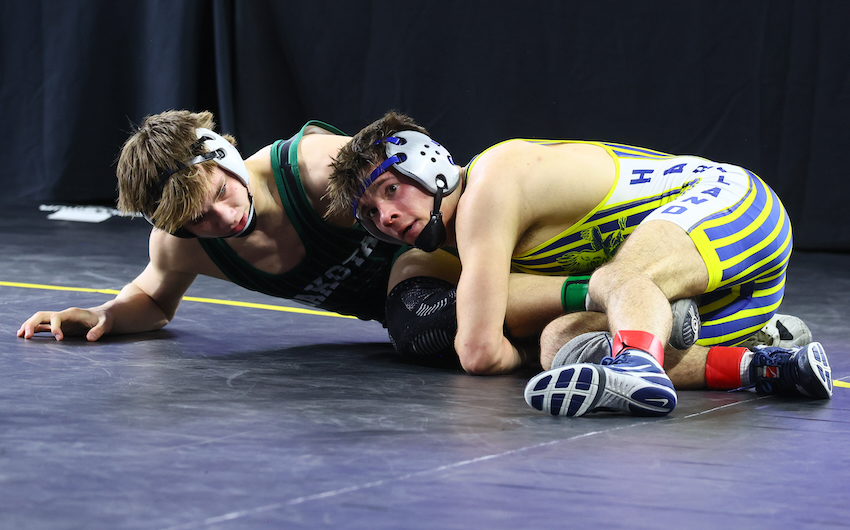
PHOTOS (Top) Detroit Catholic Central's Wyatt Lees, top, locks up Grand Ledge's Eden Abdo during their Division 1 championship match Saturday at Ford Field. (Middle) Hartland’s Bohdan Abbey, right, wraps up the legs of his opponent. (Click for more from High School Sports Scene.)