

Jackson Area Efforts Net New Officials
February 16, 2016
By Geoff Kimmerly
Second Half editor
Recruitment of new high school officials to eventually take the reins from those currently conducting MHSAA events is a challenge faced all over Michigan.
 The Jackson Area Officials Association is working to restock its ranks by recruiting directly from local schools and developing them with help from veteran mentors.
Eight new officials – ages 15 to 24 – who worked a series of youth and middle school games together earlier this month, are among those who have been introduced through a program that begins with a meeting at the end of the high school basketball season between JAOA official Bill Walker and local athletic directors, coaches, fellow officials and other young adults he’s made contact with over the course of a season. From that meeting, Walker builds a list of potential candidates to become officials and then invites them to the annual JAOA Legacy Camp in June.
The camp includes two days of scrimmages between local teams, plus classroom and mechanics teaching. Similar to the MHSAA Legacy program, new officials are paired with veterans, and clinicians evaluate their work during scrimmage play. Walker then keeps in touch with the new officials during the rest of the summer, plugging them in for local youth tournaments and scrimmages, and uses as many as possible while assigning officials for youth tournaments over the winter.
All eight officials who worked the event this month are part of the JAOA legacy partnering, and some of the group already are working games at the junior varsity level – with one, a 19-year-old, recently completing his first varsity game. They come from a variety of Jackson-area schools – Parma Western, Napoleon, Jackson Christian, Michigan Center, Concord and East Jackson. Walker said the recruiting effort has a 60 percent success rate so far. (This June’s legacy camp will be the third.)
“By next season, all (eight) will be official MHSAA registered officials,” he said, noting most currently are registered. “It’s great to have these schools support this program. We all benefit from added, good officiating.”
Passing it forward
Our Battle of the Fans trip to Charlotte on Friday included a conversation about a Feb. 2 game between the Orioles and Mason, which has a pair of athletes fighting cancer. The Charlotte student section dressed in blue that night in support of junior Storm Miller, and during halftime passed buckets to raise money for Miller’s GoFundMe account set up to help pay for his care.
Mason, in turn, provided support Friday to an Owosso alum, 2012 graduate Cody Greger, who remains hospitalized at University of Michigan’s hospital with injuries sustained during a house fire in November. Fans and students collected donations to assist Greger’s family with his care.
“This event was yet another example of the values that school sports teach young people,” Owosso athletic director Dallas Lintner wrote on the school’s website. “And it stands as a testament of the integrity of the young adults that represent our schools and the (Capital Area Activities Conference.)."
100 years of hoops
A decade before the formation of the Michigan High School Athletic Association, Eastern Michigan University – then known as Michigan State Normal College – hosted what is believed to be the first organized high school basketball tournament in state history.
EMU will celebrate this anniversary Saturday in conjunction with the Eagles men’s basketball game against Toledo. Game time is noon at EMU’s Convocation Center, and during a break in play the athletic department will recognize the 12 schools that took part in that 1916 tournament – Marine City, Dundee, Milan, Mancelona, Farmington, Elkton, Royal Oak, Middleville, Lansing, Mount Clemens, Wayne and Saline.
More history, courtesy of EMU:
The game of basketball was developed by James Naismith in 1891 at Springfield College in Massachusetts. As a means of promoting the game throughout the country, physical education professor and EMU's first athletic director Wilber Bowen asked his good friend Naismith to bring the game to the Michigan State Normal College (now known as Eastern Michigan University).
The first basketball game west of the Allegheny Mountains was played at Michigan Normal in 1894 to recognize the new physical education program and to dedicate the new gymnasium on campus.
Then in 1916, Bowen, along with instructors Elmer Mitchell and Lloyd Olds (who was also credited with the introduction of the striped referee jersey), organized the first high school basketball tournament in Michigan. A total of 300 invitations were sent out to all Class B schools in the state. Twelve schools responded, and the first high school boys tournament was held on the Ypsilanti-based campus on March 23-25, 1916.
Entrance to the tournament was free and (the event was) played at the Michigan State Normal School Gymnasium. However, expenses related to transportation, room, and board had to be provided by the participating schools. The MSNC's Physical Education Department made it easier for schools to participate by making arrangements with local residents to provide food at 20 to 25 cents a meal and lodging at 25 cents a night for each player.
That first tournament saw Marine City defeat Dundee in the championship game, 23-22.
The winning team was awarded a silver shield mounted on an oak base. Second prize was a silver cup, and the third place team received a banner. Individual participation awards to all players were also provided. The Ypsilanti Press at the time felt the Normal School "went first class with the awards."
For tickets to Saturday’s game and event, which will be followed by the EMU women’s team taking on Northern Illinois, call the EMU Ticket Office at (734) 487-2282 or visit EMUEagles.com/tickets.
Following up
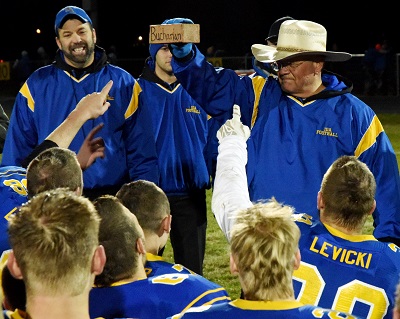 • Second Half’s Chip Mundy this fall wrote a story on the emergence of Ida’s football team on the way to making the Division 5 Semifinals and finishing its best season ever. A theme of that story was Ida’s philosophy of building “brick by brick,” coined by defensive line coach Gary Deland, who himself was building back after emergency triple-bypass heart surgery.
“From that very first practice in the summer to the last game as a senior, everything is built brick by brick,” Deland said for that story. “I can draw a correlation between that and my recovery, what I’ve gone through. It’s the same thing. It’s brick by brick.”
Kim Farver sent along this photo of Deland holding up a brick after the team’s 43-20 Regional Final win over Buchanan.
• We released the last batch of this year’s MHSAA-Farm Bureau Insurance Scholar-Athlete Award winners today, and one of the highlights during the 27 years of the contest came two years ago when we caught up with some of our winners from the first 25 years – including Bloomfield Hills Cranbrook-Kingswood’s Abby Cohen, who has gone on to co-found a company and help develop a smartphone application, Wing, to help asthma patients monitor their lung function.
Here’s a look at a video describing the technology she’s helped create:
Preview: Girls Lacrosse Finals to Match Reigning Champs Vs. Record Holders
By
Geoff Kimmerly
MHSAA.com senior editor
June 4, 2026
Rockford and East Grand Rapids will add to their shared record of 10 MHSAA Girls Lacrosse Finals appearances Friday at Howell Parker, and could also add to their Division-leading championship counts as well.
But a pair of teams moving up the historical charts are eager to continue making their own names among the all-time elite.
Reigning Division 1 champion South Lyon United hasn’t lost in two years and will try to extend that streak against the Rams. Reigning Division 2 champion Detroit Country Day will play in its fifth-straight Final to move into a tie for most championship game appearances in MHSAA girls lacrosse history.
Below is a glance at all four teams playing for titles. Rankings as part of “best wins” are based on the Michigan Power Rating formula. Tickets cost $11 and are good for both games, and may be purchased online only at GoFan.
Both games will be broadcast and available with subscription from MHSAA.tv.
Division 1
ROCKFORD
Record/MPR: 11-8, No. 10
League finish: Third in Ottawa-Kent Conference Tier 1
Coach: Mark Neumen, fifth season (65-35-1)
Championship history: Nine Division 1 titles (most recent 2021), runner-up in 2024.
Best wins: 9-4 over No. 7 Hartland in Semifinal, 16-6 over No. 9 Hudsonville in Regional Final, 18-11 over Division 2 No. 8 Grand Rapids Forest Hills Central, 9-7 over Division 2 No. 2 East Grand Rapids, 7-6 over Division 2 No. 6 Spring Lake.
Players to watch: Ella Larva, sr. M (33 goals, 9 assists); Kiah Kruisenga, jr. M (26 goals, 8 assists); Brooke Gordon, sr. M (39 goals, 22 assists); Ava Wekenman, soph. A (41 goals, 29 assists).
Outlook: After a year away from the Finals, Rockford is back in a familiar spot and riding a five-game winning streak that began by avenging a mid-April loss to Spring Lake. The Rams also avenged their March defeat to East Grand Rapids a month later. Larva made the all-state first team last season, Kruisenga the third team and junior defender Lyla Vogt earned an honorable mention. Seven players total had scored at least 15 goals entering this week, including as well sophomores Avery Maag (25) and Jordyn Coretti (15, 18 assists) and senior Ella Wagenmaker (18/12).
SOUTH LYON UNITED
Record/MPR: 27-0, No. 2
League finish: First in Lakes Valley Conference
Coach: Deanna Radcliffe, 10th season (168-26)
Championship history: Division 1 champion 2025, runner-up 2008.
Best wins: 9-8 and 14-11 (Regional Final) over No. 1 Brighton, 23-8 over No. 8 Bloomfield Hills in Semifinal, 17-10 over No. 3 Lake Orion, 15-2 and 14-5 over No. 6 White Lake Lakeland, 17-3 over No. 5 Grosse Pointe South, 19-5 over No. 4 Birmingham United, 20-5 over Division 2 No. 5 Haslett/Williamston.
Players to watch: Shaelyn Perry, sr. M (78 goals, 23 assists); Cate Cumberland, jr. M/D (33 goals, 20 assists); Gabriela Lucchesi, sr. A (36 goals, 41 assists); Reagan Shields, jr. A (87 goals, 61 assists).
Outlook: South Lyon United has won 48 straight games as it seeks to finish a second-straight perfect season. United also has defeated the other seven top-eight teams in Division 1 by MPR at the end of the regular season, and done so giving up double-digit goals only twice and with an offense that has reached 20 goals eight times. Shields, Perry and Cumberland are returning all-state first teamers, and Lucchesi earned an honorable mention last year. Seniors Alyssa Jakubiec (52 goals/15 assists) and Gianna Lucchesi (51/26) and junior Madison Lukas (49/9) also are among leading offensive contributors.
Division 2
DETROIT COUNTRY DAY
Record/MPR: 14-5, No. 4
League finish: Does not compete in a conference.
Coach: Liz Nussbaum, third season (48-12-1)
Championship history: Division 2 champion 2023 and 2025, runner-up 2005, 2022 and 2024.
Best wins: 23-3 over No. 3 Ann Arbor Father Gabriel Richard in Semifinal, 13-9 over No. 7 Pontiac Notre Dame Prep in Regional Final, 16-2 over No. 11 Rochester Hills Stoney Creek in Regional Semifinal, 11-10 over No. 9 Grand Rapids Catholic Central, 9-3 and 18-8 over Division 1 No. 7 Hartland.
Players to watch: Campbell Lindner, sr. G (126 saves, .490 save %); Charlotte Cook, soph. M (74 goals, 22 assists); Adriana Zuk, sr. M (46 goals, 17 assists); Jackie Calso, jr. M (47 goals, 14 assists).
Outlook: This will be Country Day’s fifth-straight Finals appearance, and the Yellowjackets return with a pair of 2025 all-state second-teamers in Lindner and Cook and honorable mentions in Zuk and Calso. The only in-state losses this season were twice to East Grand Rapids and once to Brighton, and Country Day won its first four postseason games by a combined 70-14. They also have notable victories over Carmel (Ind.) and Chicago St. Ignatius College Prep. Junior Bridget Kenney had added another 21 goals entering the week, and sophomore Maggie Stoller had 15.
EAST GRAND RAPIDS
Record/MPR: 19-2, No. 2
League finish: First in O-K Tier 1
Coach: Kira Schoonveld, first year (19-2)
Championship history: Eight Division 2 titles (most recent 2022), runner-up in 2017 and 2023.
Best wins: 20-6 over No. 5 Haslett/Williamston in Semifinal, 11-2 (Regional Final), 12-7 and 13-8 over No. 6 Spring Lake; 17-5 (Regional Semifinal) and 12-5 over No. 9 Grand Rapids Catholic Central, 9-7 (Regional Quarterfinal), 7-4 and 11-4 over No. 8 Grand Rapids Forest Hills Central; 11-9 and 12-5 over No. 4 Detroit Country Day, 12-5 over Division 1 No. 4 Birmingham United, 11-10 (OT) over Division 1 No. 7 Hartland, 12-10 (OT) over Division 1 No. 10 Rockford.
Players to watch: Avery Albers, jr. G (7.2 goals-against average, 112 saves); Jane Weaver, jr. A (49 goals, 18 assists); Livia Burgess, jr. M (32 goals, 23 assists); Rylee Renker, sr. A (37 goals, 3 assists).
Outlook: Aside from a couple of late losses to Grand Rapids Catholic Central and Rockford by a combined five goals, EGR has been pretty much unstoppable on the way to its first championship game appearance in three years. The Pioneers did end up avenging that CC loss in the Regional Semifinal to finish that season series with a 2-1 edge, and they haven’t given up more than 10 goals in a game – and allowed 10 only twice, both in overtime wins. Albers made the all-state first team last season, Weaver made the second and Burgess and senior Ellen Cross earned honorable mentions. Junior Nora Williams (25 goals/8 assists) and sophomores Ciarra Burns (21/8) and Sarah Cross (15/17) also are among leading scorers this spring.
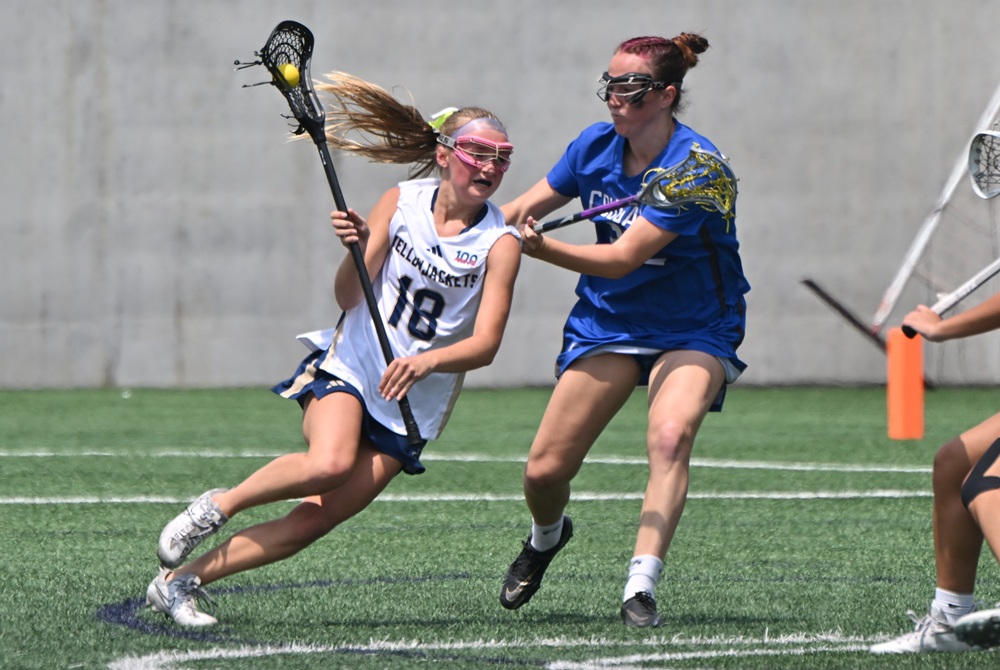
PHOTO Detroit Country Day’s Charlotte Cook (18) attempts to get past a Grand Rapids Catholic Central defender during last season’s Division 2 Final.