


Jackson Area Efforts Net New Officials
February 16, 2016
By Geoff Kimmerly
Second Half editor
Recruitment of new high school officials to eventually take the reins from those currently conducting MHSAA events is a challenge faced all over Michigan.
 The Jackson Area Officials Association is working to restock its ranks by recruiting directly from local schools and developing them with help from veteran mentors.
Eight new officials – ages 15 to 24 – who worked a series of youth and middle school games together earlier this month, are among those who have been introduced through a program that begins with a meeting at the end of the high school basketball season between JAOA official Bill Walker and local athletic directors, coaches, fellow officials and other young adults he’s made contact with over the course of a season. From that meeting, Walker builds a list of potential candidates to become officials and then invites them to the annual JAOA Legacy Camp in June.
The camp includes two days of scrimmages between local teams, plus classroom and mechanics teaching. Similar to the MHSAA Legacy program, new officials are paired with veterans, and clinicians evaluate their work during scrimmage play. Walker then keeps in touch with the new officials during the rest of the summer, plugging them in for local youth tournaments and scrimmages, and uses as many as possible while assigning officials for youth tournaments over the winter.
All eight officials who worked the event this month are part of the JAOA legacy partnering, and some of the group already are working games at the junior varsity level – with one, a 19-year-old, recently completing his first varsity game. They come from a variety of Jackson-area schools – Parma Western, Napoleon, Jackson Christian, Michigan Center, Concord and East Jackson. Walker said the recruiting effort has a 60 percent success rate so far. (This June’s legacy camp will be the third.)
“By next season, all (eight) will be official MHSAA registered officials,” he said, noting most currently are registered. “It’s great to have these schools support this program. We all benefit from added, good officiating.”
Passing it forward
Our Battle of the Fans trip to Charlotte on Friday included a conversation about a Feb. 2 game between the Orioles and Mason, which has a pair of athletes fighting cancer. The Charlotte student section dressed in blue that night in support of junior Storm Miller, and during halftime passed buckets to raise money for Miller’s GoFundMe account set up to help pay for his care.
Mason, in turn, provided support Friday to an Owosso alum, 2012 graduate Cody Greger, who remains hospitalized at University of Michigan’s hospital with injuries sustained during a house fire in November. Fans and students collected donations to assist Greger’s family with his care.
“This event was yet another example of the values that school sports teach young people,” Owosso athletic director Dallas Lintner wrote on the school’s website. “And it stands as a testament of the integrity of the young adults that represent our schools and the (Capital Area Activities Conference.)."
100 years of hoops
A decade before the formation of the Michigan High School Athletic Association, Eastern Michigan University – then known as Michigan State Normal College – hosted what is believed to be the first organized high school basketball tournament in state history.
EMU will celebrate this anniversary Saturday in conjunction with the Eagles men’s basketball game against Toledo. Game time is noon at EMU’s Convocation Center, and during a break in play the athletic department will recognize the 12 schools that took part in that 1916 tournament – Marine City, Dundee, Milan, Mancelona, Farmington, Elkton, Royal Oak, Middleville, Lansing, Mount Clemens, Wayne and Saline.
More history, courtesy of EMU:
The game of basketball was developed by James Naismith in 1891 at Springfield College in Massachusetts. As a means of promoting the game throughout the country, physical education professor and EMU's first athletic director Wilber Bowen asked his good friend Naismith to bring the game to the Michigan State Normal College (now known as Eastern Michigan University).
The first basketball game west of the Allegheny Mountains was played at Michigan Normal in 1894 to recognize the new physical education program and to dedicate the new gymnasium on campus.
Then in 1916, Bowen, along with instructors Elmer Mitchell and Lloyd Olds (who was also credited with the introduction of the striped referee jersey), organized the first high school basketball tournament in Michigan. A total of 300 invitations were sent out to all Class B schools in the state. Twelve schools responded, and the first high school boys tournament was held on the Ypsilanti-based campus on March 23-25, 1916.
Entrance to the tournament was free and (the event was) played at the Michigan State Normal School Gymnasium. However, expenses related to transportation, room, and board had to be provided by the participating schools. The MSNC's Physical Education Department made it easier for schools to participate by making arrangements with local residents to provide food at 20 to 25 cents a meal and lodging at 25 cents a night for each player.
That first tournament saw Marine City defeat Dundee in the championship game, 23-22.
The winning team was awarded a silver shield mounted on an oak base. Second prize was a silver cup, and the third place team received a banner. Individual participation awards to all players were also provided. The Ypsilanti Press at the time felt the Normal School "went first class with the awards."
For tickets to Saturday’s game and event, which will be followed by the EMU women’s team taking on Northern Illinois, call the EMU Ticket Office at (734) 487-2282 or visit EMUEagles.com/tickets.
Following up
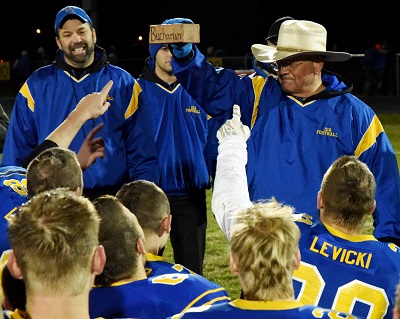 • Second Half’s Chip Mundy this fall wrote a story on the emergence of Ida’s football team on the way to making the Division 5 Semifinals and finishing its best season ever. A theme of that story was Ida’s philosophy of building “brick by brick,” coined by defensive line coach Gary Deland, who himself was building back after emergency triple-bypass heart surgery.
“From that very first practice in the summer to the last game as a senior, everything is built brick by brick,” Deland said for that story. “I can draw a correlation between that and my recovery, what I’ve gone through. It’s the same thing. It’s brick by brick.”
Kim Farver sent along this photo of Deland holding up a brick after the team’s 43-20 Regional Final win over Buchanan.
• We released the last batch of this year’s MHSAA-Farm Bureau Insurance Scholar-Athlete Award winners today, and one of the highlights during the 27 years of the contest came two years ago when we caught up with some of our winners from the first 25 years – including Bloomfield Hills Cranbrook-Kingswood’s Abby Cohen, who has gone on to co-found a company and help develop a smartphone application, Wing, to help asthma patients monitor their lung function.
Here’s a look at a video describing the technology she’s helped create:
Unearthed Recording Will Soon Allow All to Recall Memorable 1971 CHSL Matchup
By
Ron Pesch
MHSAA historian
January 17, 2025
The box, labeled “Property of CC Athletic Department,” sat in the front closet of the Blackwells’ Detroit home for decades.
Contained within was an open reel of tape – unlabeled. Morris Blackwell has no recollection of how he ended up with it. But the lore that surrounds the content has been relayed countless times within the Blackwell family and likely among families with the last names Moreno, Rojas, Simpson, Williams, and Miller.
The details, from a game played on a Sunday night at the University of Detroit in February 1971, also may have even been discussed among those with the surname Tanana, Jonca, LeGarde, Rzonca, Bluitt, and Mei, but the memories may not have been as positive.
Now, thanks to a transfer of the tape, the complete game between Detroit Catholic Central and Detroit Holy Redeemer – a legendary battle for a Detroit Catholic League’s First Division title – can soon be watched by all.
The game was recorded using the EIAJ format – a black and white reel-to-reel standard created in 1969 for early video tape recorders by Japanese electronic manufactures. The high expense of EIJA units meant broadcast organizations and educational institutions primarily owned units. Extremely few individuals owned recorders at home, as cartridge tape systems like Beta and VHS did not come along until the mid-1970s. Hence, the family mostly ignored the box and its likely content.
“It’s pretty cool,” noted Ben Blackwell, Morris’ son, who, after a few failed attempts to transfer the unusual format, tracked down a company in Florida to move what was captured to modern-day media. ”Not perfect, but cool nonetheless.”
Detroit’s Catholic High School League
Organized for baseball in the spring of the 1925-26 school year, the “Greater Detroit Catholic High School League” played for a first league football championship in the fall of 1926, then opened its first basketball season with 12 city and suburban parochial schools participating. Since the league’s creation nearly a century ago, more than 125 schools have been members of the CHSL at one time or another.
That year, Detroit St. Leo and Wyandotte St. Patrick ended the “regular scheduled season tied for first place with identical 9-1 records,” hence a championship game was scheduled to determine a titleholder. Scheduled to start at 8:30 at the University of Detroit gym, according to the Detroit Times, “the largest crowd that ever witnessed a Catholic league game was on hand” for the title game, won by St. Leo, 13-5.
For the 1929-30 season, 25 schools made up what was briefly called the Southern Michigan Catholic High School Basketball League. “This year finds the league almost double its ’29 size when the league was divided into two divisions. A post-season game was held between the two division winners to decide the league championship. … This year a trophy will be awarded to … four divisional winners and a post-season series may be played to decide the city title,” stated the Detroit News.
Indeed, at the end of the season, winners of the Divisions 1 and 2 and Divisions 3 and 4 squared off in a “knockout” round. In the title game Detroit St. Theresa – the Division 1 titleholder and the league’s reigning champion – downed Division 4 victor Royal Oak St. Mary.
Between the 1930-31 and 1954-55 school years, using a post-regular-season playoff format, the league acknowledged champions across three divisions. For several years, playoffs were hosted at the Detroit Naval Armory – home of the University of Detroit’s cage team.
In May 1952, the University opened a new facility on campus – dedicated as the Memorial Building – and hosted its first basketball game at the facility in December of that year. In February 1953, the impressive arena served as a fantastic host for its first Detroit Catholic League triple-header championship. A crowd of 5,860 attended. Today, everyone knows the place as Calihan Hall, named in honor of the late Bob Calihan – athletic director, coach, and the Titans’ first basketball All-American – but that christening didn’t come until the autumn of 1977.
The Catholic League continued to swell in size, with 59 teams sponsoring basketball squads in 1956, broken into eight geographic sections spanning the three divisions built around enrollment and athletic success. Between 1956 and 1962 the league opted to move to a four-round playoff designed to name just one league champion regardless of regular-season Division.
By 1963, population growth, shifts to the suburbs, and hence, distance between schools, were altering makeup of the largest high school league in the country, now totaling 79 teams. The First Division included 32 squads split between four sections (Central, East, West, and AA ), 29 teams spread over four sections in the Second Division (East, West, Northwest, and Southwest), and 18 teams divided into two sections – the Third Division and the Macomb League division, according to the Detroit Free Press. At the beginning of that season, a decision was made to identify First and Second Division basketball champions – via a 16-team, three-round playoff that involved Division and section champions and various runners-up across the four divisions. (Two CHSL titlists have been determined annually through the 2022-23 school year.)
Unforgettable Seasons
By the 1970-71 school year, with closures and consolidations, the CHSL was down to a competitive and still impressive 44 teams. By the first of January, Detroit Catholic Central stood out amongst that crowd. Free Press prep guru Hal Schram had the team ranked No. 1 in his first weekly Class A rankings. Coach Bill Foley, who graduated from DCC in 1942, and who had guided the basketball team since 1952, was happy with the choice.
“Certainly we realize we’re on the spot … everyone will be shooting at us,” Foley said, talking about his Shamrocks, undefeated across five games, “but I’m certain I’ve got a squad that can live up to such a responsibility.
 One day later, DCC dropped an 84-83 thriller to Detroit De La Salle on the Shamrocks’ home court. The Pilots had been quarterfinalists in the MHSAA Class B Tournament that past March. Because of the loss, the Shamrocks had fallen to No. 4 in Schram’s weekly rankings by early February. But the Detroit writer’s confidence in the squad was undeterred.
“The question you hear from all outstate precincts,” he wrote, “‘Who’s the team from Detroit who’ll give us the most trouble in the (MHSAA) March tournament?’” With the Catholic League playoffs about to tip off, Schram stated, “The answer in February remains the same as it was in December.” Detroit Catholic Central now donned a 10-1 record.
“The Shamrocks have height to burn” and remained “the best team in metropolitan Detroit,” according to Schram. “If he chooses, Foley can floor four youngsters 6-foot-7 or better. But only two of these schoolboy giants, 6-foot-8 Chris Rzonca and 6-foot-7 Rick Mei, start. ‘I doubt if any squad has two better guards than Frank Tanana and Ben Bluitt,’ Foley tells you. … Tanana has to be the best ball handler in our league.”
Foley’s Shamrocks had previously won an MHSAA Finals title in 1961, advanced to the MHSAA Semifinals in 1967, and won Catholic League First Division titles under Foley in 1952, 1961, and 1968. Most recently, the Shamrocks finished as league runners-up in 1970.
Other Catholic League entries scattered within Schram’s weekly ratings, each unbeaten, were De La Salle, No. 8 in Class A; Detroit Holy Redeemer at No. 8 in Class B, and Hamtramck St. Ladislaus, No. 6 in Class C. (Redeemer would see its 11-game win streak end on the night those rankings appeared in print, with a 69-67 loss to Detroit Benedictine, then drop another just days before the Catholic League playoffs to Detroit East Catholic. St. Ladislaus, unbeaten in regular-season action, was stunned by Orchard Lake St. Mary’s in the opening round of the Second Division tournament on Sunday, Feb. 7.)
Semifinal Trials
An unexpected crowd of 7,460 showed up for the four-game opening round of the 1971 First Division Catholic playoff, hosted at Memorial the following Sunday. Three of the four contests were blowouts, with 20+ point margins. Only Royal Oak Shrine’s come-from-behind triumph over Redford St. Mary, 65-59 in overtime, provided true excitement.
During Thursday’s semifinal round, DCC survived a major scare in its game with those same Shrine Knights, who held a 9-6 win-loss record. Trailing by seven points in the second quarter, Shrine knotted the game at 32-32 by halftime, and again, 45-45, on a Mickey Evans basket with two seconds remaining in the third quarter. Despite the significant height advantage, the Shamrocks were out-rebounded by Shrine. But Tanana, DCC’s all-state guard, ripped off 12 of his game-high 22 points over the final four minutes of the contest as Catholic Central finished with a 65-57 win over the Knights.
“Before the Shrine collapse in the waning minutes,” stated Detroit News staff writer Ken Williams, “Tanana had shared the applause of 4,233 spectators with rival Mickey Evans, who finished with 18 points.”
On the other side of the bracket, De La Salle was 14-1 on the year, with its only loss delivered by DCC in their regular-season rematch, and the Pilots were favored in their game with Holy Redeemer. The Lions, however, opened an 11-0 lead, and were up by 12 points, 35-23, at the half. The Pilots bounced back, outscoring Redeemer, 20-9, in the third quarter to pull within a point, 44-43, but could not close it out as the Lions held on for a 61-57 victory to advance to the title game.
The Sunday Finale
The First Division championship game between 15-1 Catholic Central and 14-2 Holy Redeemer was scheduled for 8:30 p.m. In that evening’s opening contest, staged at 7 p.m., Orchard Lake St. Mary’s downed previously-unbeaten Hamtramck St. Florian, 57-53, for the League’s Second Division title. St. Mary’s, powered by five juniors, had twice lost to the Lancers during the regular season. The win was the school’s first boys Catholic League tournament championship since the 1943-44 season.
In the First Division title game, significantly smaller in enrollment – and height – Redeemer struggled with Catholic Central. As most expected, DCC quickly opened a 16-4 lead in the first quarter, and according to the Free Press, “with two minutes left in the period it appeared the Shamrocks would chase Redeemer off the court.”
Yet Catholic Central still struggled on the boards, and by the half, the game was tied, 27-27. Nevertheless, by the end of the third quarter, the Shamrocks had opened a five-point advantage. The final frame was an all-out battle, with five ties and four lead changes. In the stretch, “Redeemer tied the score twice, (first) at 57-57 on Morris Blackwell’s field goal with 2:11 to go, and again at the 1:47 mark at 59-59 on a basket by Brigido Rojas. A (Tony) Moreno field goal and Rojas’ free throw eventually gave Redeemer a 62-59 lead,” stated the News.
“Then the pressure built up in the final 30 seconds. CC’s Ben Bluitt cut the deficit to 62-61 on a basket and Mike Miller countered with a free throw for Redeemer at the 16-second mark.”
A fifth personal foul pulled the Lions’ starting forward, Jim Williams, from the game with 11 seconds to play. Bluitt sank both free throws to tie things up, 63-63. That set the stage for a dramatic Hollywood ending.
 Adding value to the taped broadcast is play-by-play provided by a pair of unknown individuals, according to Ben Blackwell. The label on the box is a tip-off to bias gleaned from some of the recorded observations. Their comments, regardless of leaning, are extremely valuable when, “for the lack of better words,” tracking or skewing issues with the tape’s content blurs the image of exactly what is happening on the court.
“With 7,425 fans screaming in ecstasy,” penned the Free Press’ Schram, “Moreno dropped in a 15-foot jump shot with two seconds left to give Holy Redeemer a 65-63 victory over favored Catholic Central.”
Tanana led all scorers with 24 points for CC, followed by Mei with 17 and Bluitt with 16. Rojas paced the Lions’ balanced attack with 17, including making 7 of 9 at the free throw line. Blackwell added 11, Moreno and Mike Miller each finished with 10, followed by Ralph Simpson with nine and Williams with eight.
Redeemer had won its first First Division title in 1964 with coach Joe LaScola, and again in 1969 under the guidance of coach Bill McCartney, later an MHSAA basketball state championship coach at Dearborn Divine Child, then a football assistant coach under Bo Schembechler at the University of Michigan before guiding the University of Colorado to a national championship in football.
It was a sweet victory for Redeemer’s current coach Stan Wegrzynowicz, the school’s football and track coach who added basketball to his duties when McCartney departed for the job at Divine Child in 1969. Wegrzynowicz, who once advised Moreno that he should skip basketball to focus on track after he had run an impressively-fast mile as a freshman, was thrilled his stocky 5-foot-8 guard had ignored his suggestion.
“As of now, the only folks who have viewed this are myself and my father,” stated Ben Blackwell of the recording. “He was over the MOON watching this footage he never really knew existed.” As they watched, the elder Blackwell was telling his son what was about to happen on the screen – more than 50 years ago – before it happened.
Soon after, a message was sent by the Blackwells to Redeemer’s other starters, who are all still around. Within minutes, three responded, asking the Blackwells about setting up a watch party.
Once that happens, Ben’s plan is to share the video of what many consider one of the greatest upsets in Catholic League championship history publicly via YouTube.
Another Surprise that Spring
Adding to the legend that school year, Holy Redeemer downed previously unbeaten Catholic Central in the Catholic League First Division baseball final, 4-0 in extra innings, in a game played at Tiger Stadium that June. Tanana – whose Major League Baseball career would span six teams over 21 years – had struck out eight and walked two, handcuffing Redeemer through four innings, but back muscle pain and a sore arm forced him to switch to first base. Lions’ senior Craig Barlow struck out 12 and walked four while surrendering just five hits across eight innings.
The 1971 pitching matchup had attracted Major League scouts to the game. One year previous, Barlow had pitched a no-hitter as Holy Redeemer downed Harper Woods Bishop Gallagher in the Catholic league title game.
“If Tanana stayed in, we would still be playing,” Morris Blackwell told the Free Press back in 1999 when the paper recalled two prep “Corner Classics” played at Tiger Stadium. “I don’t know who would have gone longer – Craig or Frank.”
Blackwell went on to play football, basketball, and baseball at Wayne State. Beginning in 1974, he hooked up with the Detroit Parks and Recreation Department, coaching baseball and softball to kids in the summer, notably at Detroit’s Clark Park on the West Side. Over the years, he has coached all three sports at college, high school, and youth levels and is still instructing kids today.
Ben Blackwell guesses the tape was passed on to his dad somewhere during his coaching years. The basketball game’s magnetic existence makes him wonder if footage of the baseball game may also have been captured.
“Dad said he has been asked probably 40 times in the past if he played in that basketball game,” Ben Blackwell said. “When he responds, ‘Yes,’ the next question always is, ‘How did you beat them?’”
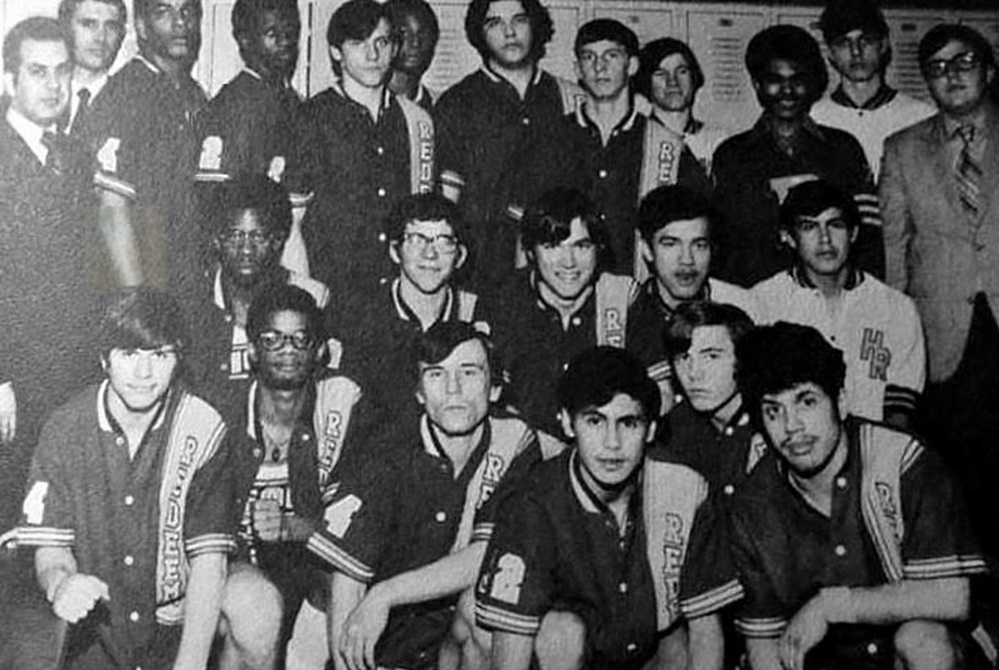
PHOTOS (Top) The 1970-71 Detroit Holy Redeemer boys basketball team pulled off one of the most memorable upsets in CHSL history in a championship matchup with Detroit Catholic Central that season. (Middle) DCC’s Frank Tanana (44) puts up a shot. (Below) A screen shot from the video of that championship game indicates the full crowd surrounding the court. (Photos gathered by Ron Pesch.)