


Jackson Area Efforts Net New Officials
February 16, 2016
By Geoff Kimmerly
Second Half editor
Recruitment of new high school officials to eventually take the reins from those currently conducting MHSAA events is a challenge faced all over Michigan.
 The Jackson Area Officials Association is working to restock its ranks by recruiting directly from local schools and developing them with help from veteran mentors.
Eight new officials – ages 15 to 24 – who worked a series of youth and middle school games together earlier this month, are among those who have been introduced through a program that begins with a meeting at the end of the high school basketball season between JAOA official Bill Walker and local athletic directors, coaches, fellow officials and other young adults he’s made contact with over the course of a season. From that meeting, Walker builds a list of potential candidates to become officials and then invites them to the annual JAOA Legacy Camp in June.
The camp includes two days of scrimmages between local teams, plus classroom and mechanics teaching. Similar to the MHSAA Legacy program, new officials are paired with veterans, and clinicians evaluate their work during scrimmage play. Walker then keeps in touch with the new officials during the rest of the summer, plugging them in for local youth tournaments and scrimmages, and uses as many as possible while assigning officials for youth tournaments over the winter.
All eight officials who worked the event this month are part of the JAOA legacy partnering, and some of the group already are working games at the junior varsity level – with one, a 19-year-old, recently completing his first varsity game. They come from a variety of Jackson-area schools – Parma Western, Napoleon, Jackson Christian, Michigan Center, Concord and East Jackson. Walker said the recruiting effort has a 60 percent success rate so far. (This June’s legacy camp will be the third.)
“By next season, all (eight) will be official MHSAA registered officials,” he said, noting most currently are registered. “It’s great to have these schools support this program. We all benefit from added, good officiating.”
Passing it forward
Our Battle of the Fans trip to Charlotte on Friday included a conversation about a Feb. 2 game between the Orioles and Mason, which has a pair of athletes fighting cancer. The Charlotte student section dressed in blue that night in support of junior Storm Miller, and during halftime passed buckets to raise money for Miller’s GoFundMe account set up to help pay for his care.
Mason, in turn, provided support Friday to an Owosso alum, 2012 graduate Cody Greger, who remains hospitalized at University of Michigan’s hospital with injuries sustained during a house fire in November. Fans and students collected donations to assist Greger’s family with his care.
“This event was yet another example of the values that school sports teach young people,” Owosso athletic director Dallas Lintner wrote on the school’s website. “And it stands as a testament of the integrity of the young adults that represent our schools and the (Capital Area Activities Conference.)."
100 years of hoops
A decade before the formation of the Michigan High School Athletic Association, Eastern Michigan University – then known as Michigan State Normal College – hosted what is believed to be the first organized high school basketball tournament in state history.
EMU will celebrate this anniversary Saturday in conjunction with the Eagles men’s basketball game against Toledo. Game time is noon at EMU’s Convocation Center, and during a break in play the athletic department will recognize the 12 schools that took part in that 1916 tournament – Marine City, Dundee, Milan, Mancelona, Farmington, Elkton, Royal Oak, Middleville, Lansing, Mount Clemens, Wayne and Saline.
More history, courtesy of EMU:
The game of basketball was developed by James Naismith in 1891 at Springfield College in Massachusetts. As a means of promoting the game throughout the country, physical education professor and EMU's first athletic director Wilber Bowen asked his good friend Naismith to bring the game to the Michigan State Normal College (now known as Eastern Michigan University).
The first basketball game west of the Allegheny Mountains was played at Michigan Normal in 1894 to recognize the new physical education program and to dedicate the new gymnasium on campus.
Then in 1916, Bowen, along with instructors Elmer Mitchell and Lloyd Olds (who was also credited with the introduction of the striped referee jersey), organized the first high school basketball tournament in Michigan. A total of 300 invitations were sent out to all Class B schools in the state. Twelve schools responded, and the first high school boys tournament was held on the Ypsilanti-based campus on March 23-25, 1916.
Entrance to the tournament was free and (the event was) played at the Michigan State Normal School Gymnasium. However, expenses related to transportation, room, and board had to be provided by the participating schools. The MSNC's Physical Education Department made it easier for schools to participate by making arrangements with local residents to provide food at 20 to 25 cents a meal and lodging at 25 cents a night for each player.
That first tournament saw Marine City defeat Dundee in the championship game, 23-22.
The winning team was awarded a silver shield mounted on an oak base. Second prize was a silver cup, and the third place team received a banner. Individual participation awards to all players were also provided. The Ypsilanti Press at the time felt the Normal School "went first class with the awards."
For tickets to Saturday’s game and event, which will be followed by the EMU women’s team taking on Northern Illinois, call the EMU Ticket Office at (734) 487-2282 or visit EMUEagles.com/tickets.
Following up
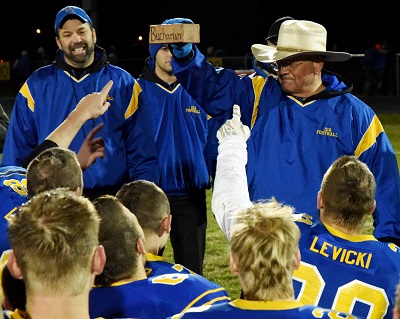 • Second Half’s Chip Mundy this fall wrote a story on the emergence of Ida’s football team on the way to making the Division 5 Semifinals and finishing its best season ever. A theme of that story was Ida’s philosophy of building “brick by brick,” coined by defensive line coach Gary Deland, who himself was building back after emergency triple-bypass heart surgery.
“From that very first practice in the summer to the last game as a senior, everything is built brick by brick,” Deland said for that story. “I can draw a correlation between that and my recovery, what I’ve gone through. It’s the same thing. It’s brick by brick.”
Kim Farver sent along this photo of Deland holding up a brick after the team’s 43-20 Regional Final win over Buchanan.
• We released the last batch of this year’s MHSAA-Farm Bureau Insurance Scholar-Athlete Award winners today, and one of the highlights during the 27 years of the contest came two years ago when we caught up with some of our winners from the first 25 years – including Bloomfield Hills Cranbrook-Kingswood’s Abby Cohen, who has gone on to co-found a company and help develop a smartphone application, Wing, to help asthma patients monitor their lung function.
Here’s a look at a video describing the technology she’s helped create:

- Baseball
- Girls Soccer
- Softball
- Girls Track & Field
- Boys Track & Field
- Boys Tennis
- Girls Tennis
- Girls Golf
- Boys Golf
- Girls Lacrosse
- Boys Lacrosse
- MHSAA News
Lacrosse Finals Move to U-M Among Headlines as Spring Sports Ramp Up
By
Geoff Kimmerly
MHSAA.com senior editor
April 9, 2024
The Girls & Boys Lacrosse Finals will be played at University of Michigan Lacrosse Stadium for the first time, one of the most notable changes for this season as sports ramp up for more than 100,000 athletes anticipated to participate this spring for Michigan High School Athletic Association member schools.
The MHSAA sponsors postseason competition each spring in baseball, girls and boys lacrosse, girls soccer, softball, girls and boys track & field, boys golf (Lower and Upper Peninsula) and girls golf (UP), and girls (LP) and boys (UP) tennis.
The U-M Lacrosse Stadium opened for competition in 2018 and seats 2,000 spectators. The Girls Lacrosse Finals will be played Friday, June 7, with Division 1 at 4 p.m. and Division 2 at 7 p.m. The Boys Lacrosse Finals will be played the following day, June 8, with Division 2 at 11 a.m. and Division 1 at 2 p.m.
Girls lacrosse also has a significant format adjustment this season, as games will be played with four 12-minutes quarters instead of the previous two halves, in part to allow coaches more opportunities to provide direct instruction during a game. Two more rules changes are expected to improve flow of play – players awarded a free position outside of the critical scoring area no longer must come to a stop and settled stance before self-starting, and false start penalties outside the critical scoring area have been eliminated.
Several more rules changes will be noticeable this spring:
In boys lacrosse, a change was made to enhance player safety. Play will stop immediately any time a player’s helmet comes off, and that player may not return until the next dead ball after play continues.
Fair and legal starts are a continued emphasis for track & field, and a rule change will allow for movement before the start of the race as long as a competitor does not leave their mark with a hand or a foot after the “set” command, or make forward motion before the starting device is activated.
A significant rule change in softball alters pitch delivery mechanics. The pitcher may now have both feet off the ground at the same time when releasing the ball as long as both feet remain within the 24-inch width of a pitching plate and the pitcher does not replant the pivot foot before delivering the pitch.
Another change in softball requires that a playbook/playcard be worn on the wrist or kept in a back pocket to reduce distractions. If worn by the pitcher, the equipment must be worn on the non-pitching arm. Similarly in baseball, a wristband with plays or instructions will be permitted but must be a single, solid color, and for pitchers may not contain the colors white or gray or be otherwise distracting. Baseball players must wear this wristband on the wrist or forearm, and pitchers may wear one only on their non-pitching arm.
Also in baseball, a rule change allows for one-way communication devices worn by the catcher to receive instructions from the dugout while on defense, for the purpose of calling pitches. The coach must be inside the dugout/bench area to use the communication device.
Golfers now are required to participate in at least four competitions for the high school team prior to representing that school team in an MHSAA Regional or Final. Those four regular-season competitions may be 9 or 18-hole events.
In tennis, for the first time in Lower Peninsula play, a No. 1 doubles flight from a non-qualifying team will be able to advance from its Regional to Finals competition. To do so, that No. 1 doubles flight must finish first or second at its Regional, and the No. 1 singles player from that team also must have qualified for the Finals individually by finishing first or second in Regional play.
On the soccer pitch, two officiating-related changes will be especially noticeable. Officials now may stop the clock to check on an injured player without that player being required to leave the match – previously that player would have to sub out. Also, categories for fouls have been redefined: careless (which is a foul but does not receive a card), reckless (a foul with a yellow card) and excessive force (foul with red card).
The 2023-24 Spring campaign culminates with postseason tournaments, as the championship schedule begins with the Upper Peninsula Girls & Boys Golf and Boys Tennis Finals during the week of May 27 and wraps up with Girls Soccer, Baseball and Softball Finals on June 15. Here is a complete list of winter tournament dates:
Baseball
Districts – May 23-June 1
Regional Semifinals – June 5
Regional Finals, Quarterfinals – June 8
Semifinals – June 13-14
Finals – June 15
Golf
LP Boys Regionals – May 28-June 1
UP Girls & Boys Finals – May 29, 30, 31 or June 1
LP Boys Finals – June 7-8
Boys Lacrosse
Pre-Regionals – May 10-15
Regionals – May 16-29
Quarterfinals – May 31 or June 1
Semifinals – June 5
Finals – June 8
Girls Lacrosse
Pre-Regionals – May 16-18, or May 20
Regionals – May 22-June 1
Semifinals – June 5
Finals – June 7
Girls Soccer
Districts – May 22-June 1
Regionals – June 4-8
Semifinals – June 11-12
Finals – June 14-15
Softball
Districts – May 23-June 1
Regionals – June 8
Quarterfinals – June 11
Semifinals – June 13-14
Finals – June 15
Tennis
LP Girls Regionals – May 15-18
UP Boys Finals – May 29, 30, 31 or June 1
LP Girls Finals – May 31-June 1
Track & Field
Regionals – May 16-18
Finals – June 1