


Jackson Area Efforts Net New Officials
February 16, 2016
By Geoff Kimmerly
Second Half editor
Recruitment of new high school officials to eventually take the reins from those currently conducting MHSAA events is a challenge faced all over Michigan.
 The Jackson Area Officials Association is working to restock its ranks by recruiting directly from local schools and developing them with help from veteran mentors.
Eight new officials – ages 15 to 24 – who worked a series of youth and middle school games together earlier this month, are among those who have been introduced through a program that begins with a meeting at the end of the high school basketball season between JAOA official Bill Walker and local athletic directors, coaches, fellow officials and other young adults he’s made contact with over the course of a season. From that meeting, Walker builds a list of potential candidates to become officials and then invites them to the annual JAOA Legacy Camp in June.
The camp includes two days of scrimmages between local teams, plus classroom and mechanics teaching. Similar to the MHSAA Legacy program, new officials are paired with veterans, and clinicians evaluate their work during scrimmage play. Walker then keeps in touch with the new officials during the rest of the summer, plugging them in for local youth tournaments and scrimmages, and uses as many as possible while assigning officials for youth tournaments over the winter.
All eight officials who worked the event this month are part of the JAOA legacy partnering, and some of the group already are working games at the junior varsity level – with one, a 19-year-old, recently completing his first varsity game. They come from a variety of Jackson-area schools – Parma Western, Napoleon, Jackson Christian, Michigan Center, Concord and East Jackson. Walker said the recruiting effort has a 60 percent success rate so far. (This June’s legacy camp will be the third.)
“By next season, all (eight) will be official MHSAA registered officials,” he said, noting most currently are registered. “It’s great to have these schools support this program. We all benefit from added, good officiating.”
Passing it forward
Our Battle of the Fans trip to Charlotte on Friday included a conversation about a Feb. 2 game between the Orioles and Mason, which has a pair of athletes fighting cancer. The Charlotte student section dressed in blue that night in support of junior Storm Miller, and during halftime passed buckets to raise money for Miller’s GoFundMe account set up to help pay for his care.
Mason, in turn, provided support Friday to an Owosso alum, 2012 graduate Cody Greger, who remains hospitalized at University of Michigan’s hospital with injuries sustained during a house fire in November. Fans and students collected donations to assist Greger’s family with his care.
“This event was yet another example of the values that school sports teach young people,” Owosso athletic director Dallas Lintner wrote on the school’s website. “And it stands as a testament of the integrity of the young adults that represent our schools and the (Capital Area Activities Conference.)."
100 years of hoops
A decade before the formation of the Michigan High School Athletic Association, Eastern Michigan University – then known as Michigan State Normal College – hosted what is believed to be the first organized high school basketball tournament in state history.
EMU will celebrate this anniversary Saturday in conjunction with the Eagles men’s basketball game against Toledo. Game time is noon at EMU’s Convocation Center, and during a break in play the athletic department will recognize the 12 schools that took part in that 1916 tournament – Marine City, Dundee, Milan, Mancelona, Farmington, Elkton, Royal Oak, Middleville, Lansing, Mount Clemens, Wayne and Saline.
More history, courtesy of EMU:
The game of basketball was developed by James Naismith in 1891 at Springfield College in Massachusetts. As a means of promoting the game throughout the country, physical education professor and EMU's first athletic director Wilber Bowen asked his good friend Naismith to bring the game to the Michigan State Normal College (now known as Eastern Michigan University).
The first basketball game west of the Allegheny Mountains was played at Michigan Normal in 1894 to recognize the new physical education program and to dedicate the new gymnasium on campus.
Then in 1916, Bowen, along with instructors Elmer Mitchell and Lloyd Olds (who was also credited with the introduction of the striped referee jersey), organized the first high school basketball tournament in Michigan. A total of 300 invitations were sent out to all Class B schools in the state. Twelve schools responded, and the first high school boys tournament was held on the Ypsilanti-based campus on March 23-25, 1916.
Entrance to the tournament was free and (the event was) played at the Michigan State Normal School Gymnasium. However, expenses related to transportation, room, and board had to be provided by the participating schools. The MSNC's Physical Education Department made it easier for schools to participate by making arrangements with local residents to provide food at 20 to 25 cents a meal and lodging at 25 cents a night for each player.
That first tournament saw Marine City defeat Dundee in the championship game, 23-22.
The winning team was awarded a silver shield mounted on an oak base. Second prize was a silver cup, and the third place team received a banner. Individual participation awards to all players were also provided. The Ypsilanti Press at the time felt the Normal School "went first class with the awards."
For tickets to Saturday’s game and event, which will be followed by the EMU women’s team taking on Northern Illinois, call the EMU Ticket Office at (734) 487-2282 or visit EMUEagles.com/tickets.
Following up
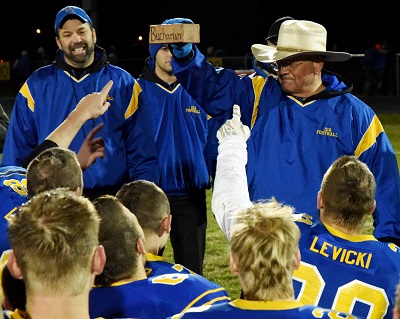 • Second Half’s Chip Mundy this fall wrote a story on the emergence of Ida’s football team on the way to making the Division 5 Semifinals and finishing its best season ever. A theme of that story was Ida’s philosophy of building “brick by brick,” coined by defensive line coach Gary Deland, who himself was building back after emergency triple-bypass heart surgery.
“From that very first practice in the summer to the last game as a senior, everything is built brick by brick,” Deland said for that story. “I can draw a correlation between that and my recovery, what I’ve gone through. It’s the same thing. It’s brick by brick.”
Kim Farver sent along this photo of Deland holding up a brick after the team’s 43-20 Regional Final win over Buchanan.
• We released the last batch of this year’s MHSAA-Farm Bureau Insurance Scholar-Athlete Award winners today, and one of the highlights during the 27 years of the contest came two years ago when we caught up with some of our winners from the first 25 years – including Bloomfield Hills Cranbrook-Kingswood’s Abby Cohen, who has gone on to co-found a company and help develop a smartphone application, Wing, to help asthma patients monitor their lung function.
Here’s a look at a video describing the technology she’s helped create:

Referee Camaraderie: Bloopers, 'Nerding' Out, Lots of Laughs Create Powerful Bond
By
Pam Shebest
Special for MHSAA.com
February 13, 2024
KALAMAZOO — When it comes to blooper highlights, four MHSAA hockey officials don’t hesitate to share their miscues.
 One of them, Bob Corak, even has his pratfalls set to music on an internet site called Zebras with Pucks.
Laughter is the sound of the day when the four gather every Tuesday after their yoga class at Nisker’s Char-Grill & Slap Shot Hockey Bar in Kalamazoo.
The camaraderie between Corak, Corey Butts, Nick Schrippa and Nat Swanson is evident, but the tone gets more serious once the talk turns to officiating.
“We’ve all played, we’ve all coached to some extent, but officiating is just what speaks to us,” Schrippa said. “That’s our niche.
“Every player on the ice has a fan in the stands. Every player on the ice has support on the bench. We’re the only support we have in the arena. We’re the only ones we can lean on. We’re kind of on an island.”
Most times the friends are part of different four-man crews made up of two referees and two linesmen for South Central High School Hockey League games. But that just gives them more to talk about when they get together on Tuesdays.
 “We spend an hour every Tuesday with Bob’s wife (Susan) just kicking the crap out of us and then come to (Nisker’s) to debrief,” Schrippa said. Susan Corak runs Be Well Yoga and Fitness in Kalamazoo.
"We never talk about the workout. Somebody will bust out a phone and we’ll go over a video and we’ll talk about a situation, talk about rule differences,” he continued. “We are nerds to the nth degree, and that’s just how we’re wired.”
Yoga is a good way to keep in shape, the four friends agree.
“I’m a little older than most of the referees I meet,” said Corak, who retired after 35 years with Pfizer in information technology. "It keeps me limber, keeps me in shape to an extent, not a lot of cardio but the strength is there that we get from yoga, especially the core, plus injury prevention.
“If I’m not skating, I’m officiating or I’m working the books for the association (Kalamazoo Ice Hockey Officials Association).”
Corak assists in the scheduling, billing, etc., leading Schrippa to quip: “Remember when Bob said he did information technology? We take full advantage of that. He is, in fact, the glue that holds a lot of our shenanigans together. He really is.”
Referees vs. Linesmen
Butts and Corak prefer wearing the referees’ armbands, while Schrippa and Swanson like working the lines.
“’I’m a smaller guy,” said Butts, who has been officiating for 14 years. “Linesmen typically tend to be 6-foot-5. When you’re smaller than most of the players, it doesn’t work out well.
“I like the freedom to be able to get out of the way. It’s a high traffic area as a linesman.”
When not spending evenings officiating, Butts is the penalty box timekeeper for the ECHL Kalamazoo Wings home games. His day job as a third-party examiner for the state of Michigan means he gives driving tests, and that leads to some interesting conversations.
“I’ve given most of (the players) their driver’s licenses,” he said. “I’ve had a group of players in the middle of a high school hockey game, getting ready to drop the puck at the start of the third period, and they’re trying to schedule a driver’s test for the next day. I’m like, ‘Guys, not now. Talk to me after work.’”
 Swanson is the newest of the quartet, moving to the area three years ago from Syracuse, N.Y., where he started officiating at age 11.
He is a pilot in the U.S. Air Force International Guard in Battle Creek flying MQ-9 Reaper Drones.
“I like refereeing better (than being a linesman) because I like managing the game and look at the big picture,” Swanson said. “Sometimes it’s great to be a linesman because they get to communicate with the players, crack jokes and sometimes throw the referee under the bus, ‘Yeah, I agree that was a terrible call. But you’ve got to move on.’”
All four also officiate college and youth hockey, which can lead to a dilemma.
“Those are all different rule books, so we don’t have to know just one set of rules,” Schrippa said. “None of them are what you see on TV.
“While we have a couple hundred people in the building who are yelling at us that we got it wrong because that’s what they saw on ESPN, that’s not how it works. So not only do we have to know the rules, we have to know the differences in the rules.”
With mentorship programs available, some current prep players are also officials for younger leagues.
“They’re learning, we’re teaching them,” Corak said. “We have games with them as officials, then we’ll officiate their games when they play for their schools.”
Swanson added: “I think that makes them better players because they understand the rules, where they can bend rules and where they can’t.”
 That is what led Schrippa to officiating.
“(Late referee) Mike Martin was officiating a game and pulled me aside,” he said. “I was 22 years old and he asked if I wanted to become a ref.
“‘(Heck) you’ve broken all the rules,’ he told me. ‘You probably know most of them already. He wasn’t wrong. I talked to a couple friends who had done it, and they talked me into doing it 29 seasons ago. I fell in love with it.”
Fun with bloopers
All four laugh as they regale each other with their funniest and most embarrassing moments.
For Schrippa, it was the college game where he made his refereeing debut.
“I was given the rookie lap,” he said. “I was jazzed. I came out of the gate, turned left, went around the back of the net, got to the blue line, caught a toe pick and Supermanned, slid from the blue line to the top of the next faceoff circle and was soaked because the ice hadn’t set yet.
“I got a standing ovation from the few hundred fans that were in the rink. Both my linesmen were doubled over laughing. It was a very cold first period.”
Something similar happened to Swanson.
 “I was taking a hot lap, not seeing they’ve got a carpet out for somebody, hitting the carpet and Supermanning,” he recalled. “Then having a linesman watch you do it as there’s a few hundred people in the stands and give a big washout sign.”
Butts and Swanson had moments that actually delayed the start of a game.
For Butts, “I forgot my pants because I washed them separate and my wife had to bring them to me, and we could not start the game until my pants arrived,” he said, while the others laughed and nodded in agreement.
Swanson actually found himself at the wrong rink one time.
“I’m like, ‘Where is everybody?’” he said. “My phone starts ringing. ‘Hey dude, game starts in 15 minutes. You going to be here? Uh, yes, in 20.’’’
The four agree most officials go through highs and lows, funny times and embarrassing times, and that’s one thing that brings them all together.
“What’s unique about what we do is I could meet another official from Sweden tomorrow who I’ve never met before, and within minutes we’ve already got that relationship,” said Schrippa, who is the Southwest Michigan communications representative for the Michigan Department of Transportation (MDOT).
“That’s something we all share, we all know that feeling, we all understand that bond and it just takes a second. It’s so neat, it’s powerful.”
 Pam Shebest served as a sportswriter at the Kalamazoo Gazette from 1985-2009 after 11 years part-time with the Gazette while teaching French and English at White Pigeon High School. She can be reached at [email protected] with story ideas for Calhoun, Kalamazoo and Van Buren counties.
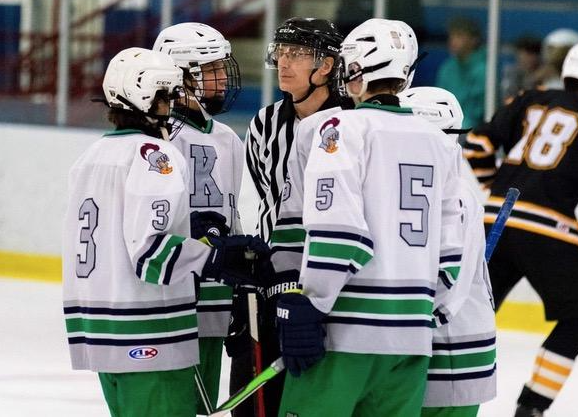
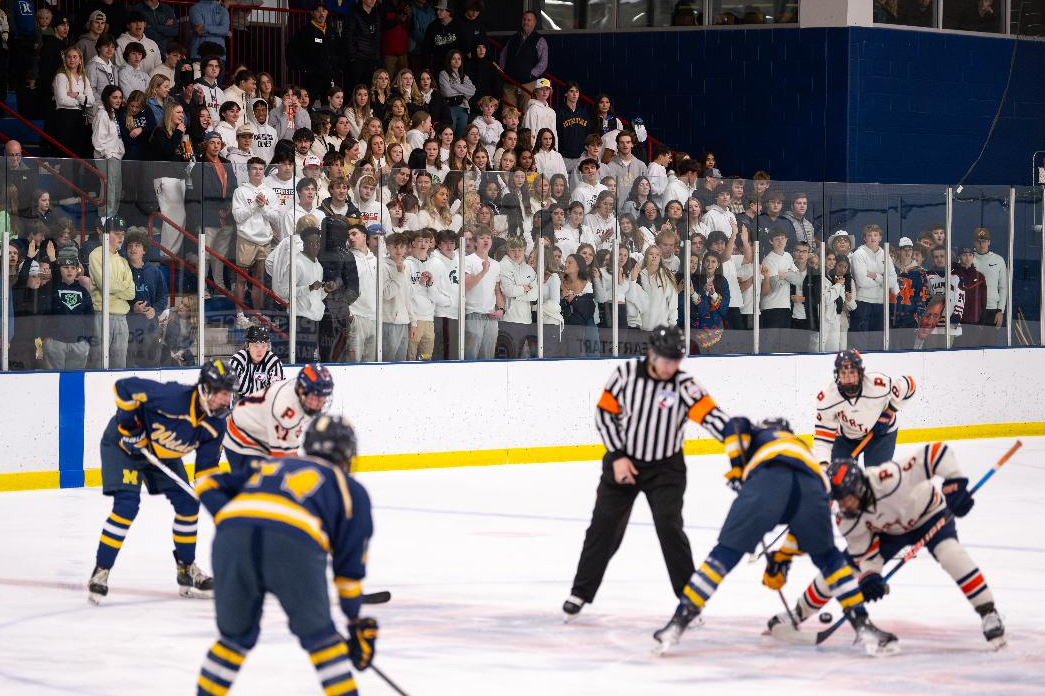
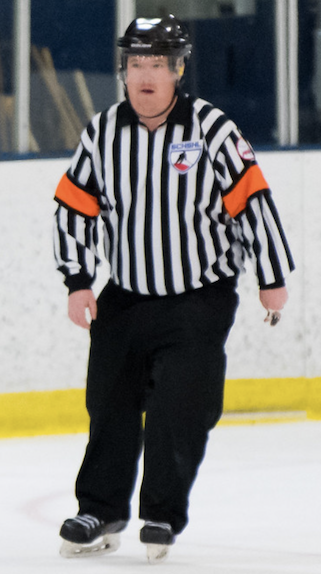
PHOTOS (Top) MHSAA hockey officials, from left: Nick Schrippa, Bob Corak, Nat Swanson and Corey Butts get together recently for one of their weekly hangouts. (2) Schrippa makes a call. (3) Corak, center, confers with a group of players. (4) Swanson prepares to drop the puck. (5) Butts monitors the game action. (Top photo by Pam Shebest; following photos provided by respective officials.)