

Jackson Area Efforts Net New Officials
February 16, 2016
By Geoff Kimmerly
Second Half editor
Recruitment of new high school officials to eventually take the reins from those currently conducting MHSAA events is a challenge faced all over Michigan.
 The Jackson Area Officials Association is working to restock its ranks by recruiting directly from local schools and developing them with help from veteran mentors.
Eight new officials – ages 15 to 24 – who worked a series of youth and middle school games together earlier this month, are among those who have been introduced through a program that begins with a meeting at the end of the high school basketball season between JAOA official Bill Walker and local athletic directors, coaches, fellow officials and other young adults he’s made contact with over the course of a season. From that meeting, Walker builds a list of potential candidates to become officials and then invites them to the annual JAOA Legacy Camp in June.
The camp includes two days of scrimmages between local teams, plus classroom and mechanics teaching. Similar to the MHSAA Legacy program, new officials are paired with veterans, and clinicians evaluate their work during scrimmage play. Walker then keeps in touch with the new officials during the rest of the summer, plugging them in for local youth tournaments and scrimmages, and uses as many as possible while assigning officials for youth tournaments over the winter.
All eight officials who worked the event this month are part of the JAOA legacy partnering, and some of the group already are working games at the junior varsity level – with one, a 19-year-old, recently completing his first varsity game. They come from a variety of Jackson-area schools – Parma Western, Napoleon, Jackson Christian, Michigan Center, Concord and East Jackson. Walker said the recruiting effort has a 60 percent success rate so far. (This June’s legacy camp will be the third.)
“By next season, all (eight) will be official MHSAA registered officials,” he said, noting most currently are registered. “It’s great to have these schools support this program. We all benefit from added, good officiating.”
Passing it forward
Our Battle of the Fans trip to Charlotte on Friday included a conversation about a Feb. 2 game between the Orioles and Mason, which has a pair of athletes fighting cancer. The Charlotte student section dressed in blue that night in support of junior Storm Miller, and during halftime passed buckets to raise money for Miller’s GoFundMe account set up to help pay for his care.
Mason, in turn, provided support Friday to an Owosso alum, 2012 graduate Cody Greger, who remains hospitalized at University of Michigan’s hospital with injuries sustained during a house fire in November. Fans and students collected donations to assist Greger’s family with his care.
“This event was yet another example of the values that school sports teach young people,” Owosso athletic director Dallas Lintner wrote on the school’s website. “And it stands as a testament of the integrity of the young adults that represent our schools and the (Capital Area Activities Conference.)."
100 years of hoops
A decade before the formation of the Michigan High School Athletic Association, Eastern Michigan University – then known as Michigan State Normal College – hosted what is believed to be the first organized high school basketball tournament in state history.
EMU will celebrate this anniversary Saturday in conjunction with the Eagles men’s basketball game against Toledo. Game time is noon at EMU’s Convocation Center, and during a break in play the athletic department will recognize the 12 schools that took part in that 1916 tournament – Marine City, Dundee, Milan, Mancelona, Farmington, Elkton, Royal Oak, Middleville, Lansing, Mount Clemens, Wayne and Saline.
More history, courtesy of EMU:
The game of basketball was developed by James Naismith in 1891 at Springfield College in Massachusetts. As a means of promoting the game throughout the country, physical education professor and EMU's first athletic director Wilber Bowen asked his good friend Naismith to bring the game to the Michigan State Normal College (now known as Eastern Michigan University).
The first basketball game west of the Allegheny Mountains was played at Michigan Normal in 1894 to recognize the new physical education program and to dedicate the new gymnasium on campus.
Then in 1916, Bowen, along with instructors Elmer Mitchell and Lloyd Olds (who was also credited with the introduction of the striped referee jersey), organized the first high school basketball tournament in Michigan. A total of 300 invitations were sent out to all Class B schools in the state. Twelve schools responded, and the first high school boys tournament was held on the Ypsilanti-based campus on March 23-25, 1916.
Entrance to the tournament was free and (the event was) played at the Michigan State Normal School Gymnasium. However, expenses related to transportation, room, and board had to be provided by the participating schools. The MSNC's Physical Education Department made it easier for schools to participate by making arrangements with local residents to provide food at 20 to 25 cents a meal and lodging at 25 cents a night for each player.
That first tournament saw Marine City defeat Dundee in the championship game, 23-22.
The winning team was awarded a silver shield mounted on an oak base. Second prize was a silver cup, and the third place team received a banner. Individual participation awards to all players were also provided. The Ypsilanti Press at the time felt the Normal School "went first class with the awards."
For tickets to Saturday’s game and event, which will be followed by the EMU women’s team taking on Northern Illinois, call the EMU Ticket Office at (734) 487-2282 or visit EMUEagles.com/tickets.
Following up
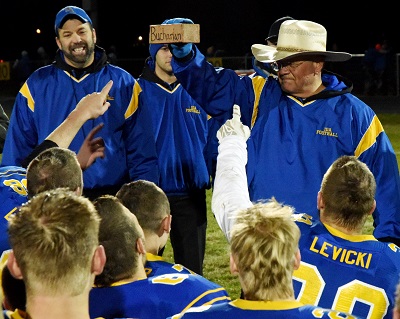 • Second Half’s Chip Mundy this fall wrote a story on the emergence of Ida’s football team on the way to making the Division 5 Semifinals and finishing its best season ever. A theme of that story was Ida’s philosophy of building “brick by brick,” coined by defensive line coach Gary Deland, who himself was building back after emergency triple-bypass heart surgery.
“From that very first practice in the summer to the last game as a senior, everything is built brick by brick,” Deland said for that story. “I can draw a correlation between that and my recovery, what I’ve gone through. It’s the same thing. It’s brick by brick.”
Kim Farver sent along this photo of Deland holding up a brick after the team’s 43-20 Regional Final win over Buchanan.
• We released the last batch of this year’s MHSAA-Farm Bureau Insurance Scholar-Athlete Award winners today, and one of the highlights during the 27 years of the contest came two years ago when we caught up with some of our winners from the first 25 years – including Bloomfield Hills Cranbrook-Kingswood’s Abby Cohen, who has gone on to co-found a company and help develop a smartphone application, Wing, to help asthma patients monitor their lung function.
Here’s a look at a video describing the technology she’s helped create:
Champion Coaches - Including Local Legends - Unite to Restore Ravenna Glory
By
Scott DeCamp
Special for MHSAA.com
October 8, 2026
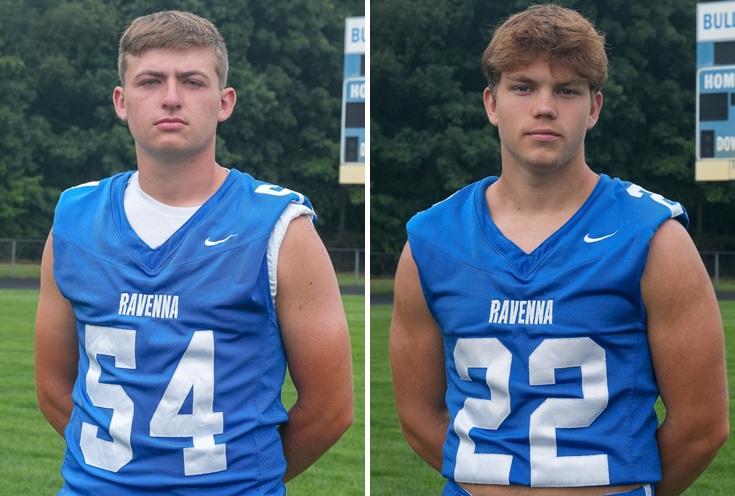
RAVENNA – Whether they want to or not, Ravenna seniors Joel Kantola and Colton Rolison hear about the glory days of Bulldogs football from their fathers.
 Kantola’s dad, Brandon, watches old games from the 1994 season when he was a two-way starter on Ravenna’s first MHSAA Finals championship team.
“He can’t remember very well, but he’ll see a play and he’s like, ‘Oh, I remember doing that play!’” Joel Kantola said. “It’s one of the best things to hear something (from that era). He loves it, too.”
Rolison’s dad, Willy, shares memorable stories from back in the day when he was a dynamic running back on the Bulldogs’ 1997 Class C title squad.
“It’s just insane that he still has all these stories that I’ve never heard. He’s still bringing them up, new ones every day,” Colton Rolison said with a smile.
Three decades have passed since the 1990s heyday of Ravenna football, when the Bulldogs won three of their program’s four Finals titles. But in the small town located on the eastern edge of Muskegon County, the band is back together, one might say.
Steve Czerwon was hired in March as Ravenna’s head football coach, coming from a highly successful 13-year tenure at his Muskegon Catholic Central alma mater where he guided the Crusaders to Division 8 championships all of his first four seasons (2013-16).
One of Czerwon’s first orders of business in Ravenna was securing the commitments of legendary coaches Dusty Fairfield and Randy Helsen – architects of the Bulldogs’ championship teams in 1994, 1996, 1997 and 2003 – to bring their wisdom and serve as a link from the storied era to this current one.
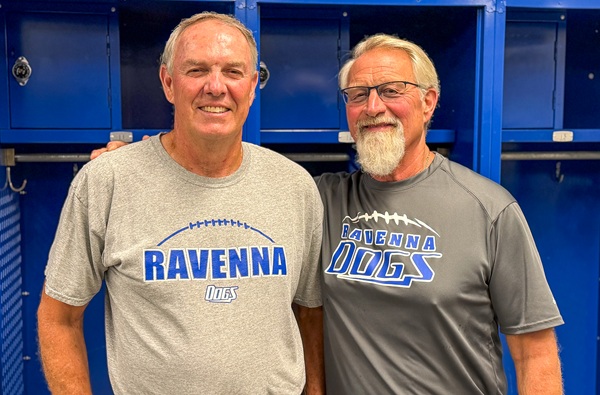
They agreed, others from the old guard hopped aboard, and a couple more experienced coaches joined Czerwon’s staff. Now, entering the final third of the 2026 regular season, the Bulldogs appear to have regained a little traction despite coming off three straight losing campaigns.
Ravenna carries a 5-1 overall record and five-game winning streak into this Friday’s West Michigan Conference Rivers home game against Hesperia.
Next week, Ravenna plays at North Muskegon with at least a share of the WMC Rivers title on the line. Should the Bulldogs win this Friday, they’ll take on the Norsemen for the outright league championship.
Since the WMC expanded and split into two divisions in 2022, North Muskegon has not lost a Rivers football game. Meanwhile, Ravenna has not won a conference title since sharing one with two teams in 2001.
In their football history, the Bulldogs have as many Finals titles as they do conference championships (four), illustrating the enduring strength of the West Michigan Conference.
This pack is hungry to etch its own history: Winning a conference title and making a run in the Division 7 playoffs. But, as Helsen laid out, there’s a price to pay.
“Steve addressed the fact (with the players),” Helsen recalled. “‘You wanted these guys to come back and you wanted what they had in the ’80s through the ’90s into the 2000s, and what it’s going to take is every effort you’ve got and even take it up from where you are. If you want to leave a legacy, that’s what you have to do. These guys (have) a legacy.’”
When Helsen says “these guys,” he’s referring to Fairfield and himself, but also other connections from the days of Ravenna football prominence.
In 20 seasons as Ravenna’s head coach covering two stints – the second ending in 2010 – Fairfield sported a 164-55 record. He’s a Michigan High School Football Coaches Association Hall of Famer.
Helsen served as Ravenna’s defensive coordinator for all of those seasons, and then some. He and Fairfield are both Ravenna Athletic Hall of Famers, their plaques side-by-side on the wall of the high school’s athletic wing.
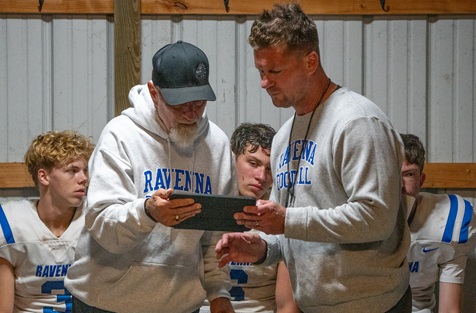
Fairfield and Helsen are both retired and they’re volunteer assistants on Czerwon’s staff. They are not at every practice, but they fill critical roles: The former works with the secondary and quarterbacks, plus he’s on the headset in the press box on game days, while the latter coaches defensive linemen.
“They have so much knowledge, and I think it really does connect the past to the current,” said Czerwon, who did his student teaching at Ravenna in the early 2000s and was a member of the Bulldogs coaching staff during their most recent state title season in 2003. “A lot of kids here, they heard from their uncles and their fathers about some really good teams that Ravenna had in the ’90s and early 2000s, and those guys are the actual link.
“I talk to Dusty daily, and he just reinforces the importance of relationships you have with the kids,” Czerwon added. “He’s second to none at that, and it reinforces to me the importance of that.”
Geoff Nelson, who was a starting lineman on Ravenna’s 1994 team, coaches the offensive line. Neil Sladick, who helped the Bulldogs win Finals titles in 1996 and 1997, works with linebackers. Mark Jacobs, who starred on Ravenna’s first Finals group in 1988, helps coach defensive backs.
Canaan Groff is Ravenna’s defensive coordinator, and Nate Smith specializes in offense. Both bring experience to the table, including as head coaches. Czerwon, Groff, Sladick, and Smith all work in Ravenna school buildings, which is an advantage for coaches.
“I think that we’re bringing back a lot of accountability. I think we don’t settle,” Nelson said about Ravenna’s coaching staff. “This has been a great group. We had to break a lot of bad habits, but they’re starting to form new habits and starting to go in the right direction.”
Ravenna got a reality check to start the season in a 33-7 loss to Division 8 top-ranked Beal City, a perennial small-school power. Czerwon admitted he may have asked too much of his players right away in terms of new schemes and such.
Since then, the Bulldogs have exhibited gradual improvement, including winning a couple of one-point games, and now they’re starting to establish an identity of physical football. That was at its peak in last week’s 28-0 win at Mason County Central, which by the way is coached by Ravenna alumnus David Smith, a former Bulldogs head coach who was a member of Class C championship teams in 1994 and 1996.
Things are moving in the right direction for Ravenna.
“There hasn’t really been a lot of drama or anything like that. We love each other. That wins games,” said Rolison, a linebacker who suffered a fractured collarbone in Week 3. Chances of a return this season are up in the air, he said.
“(The coaches have all) worked together before and nobody motivates like Dusty Fairfield – there’s not a single person out there who does,” Rolison added. “Coach Randy Helsen, he knows his stuff. He knows more than I probably ever will about football.”
According to Helsen, getting to know young people at the ground level is Fairfield’s specialty: Types of music they like, their hunting spots, etc.
In terms of accountability, everybody is responsible for that.
“We get after them if they’re not getting it done,” Helsen said. “Kids that were not getting after it five, six weeks ago and kind of rolling their eyes at me when I’m coaching them on scout defense, they’re now in the starting lineup. I said, ‘You’re getting coached by a guy that coached defense here for 27 years. I’m giving you the same coaching that our all-staters and all-conference players got.’”
Fairfield’s goal in returning was to help lay building blocks for current and future success. He believes the overall health of football in Ravenna is strong considering participation numbers from high school to youth levels, especially at a time when similarly small communities across the state are canceling varsity seasons or not fielding enough players to form junior varsity squads.
“It’s been a good experience, and it’s made me realize, you know, what we did in the past really meant something, and it made me realize how hard we worked because I’m totally invested in the team right now. It is fun with the camaraderie with not just the boys but also the coaches,” Fairfield said.
“You know, it’s my last hurrah where I get to experience what I did for a living for over 30 years. I get to experience it one more time before I, you know, go off into the sunset,” he added with a chuckle.
For families such as the Kantolas and Rolisons, things are coming full circle – and they could not be more excited. Brandon Kantola is enjoying his son’s senior season while also reminiscing about the good ol’ days.
“I think he was invested back then,” said Joel Kantola, Ravenna’s starting center, “but he’s more excited for us than I think he was back then.”

Scott DeCamp has worked more than 25 years in sports media, including 21 at MLive Media Group as a reporter and editor. He is founder and owner of DeCamp Creative Solutions. Email him at [email protected] with story ideas for Lake, Mason, Mecosta, Muskegon, Newaygo, Oceana, and Oceola counties.
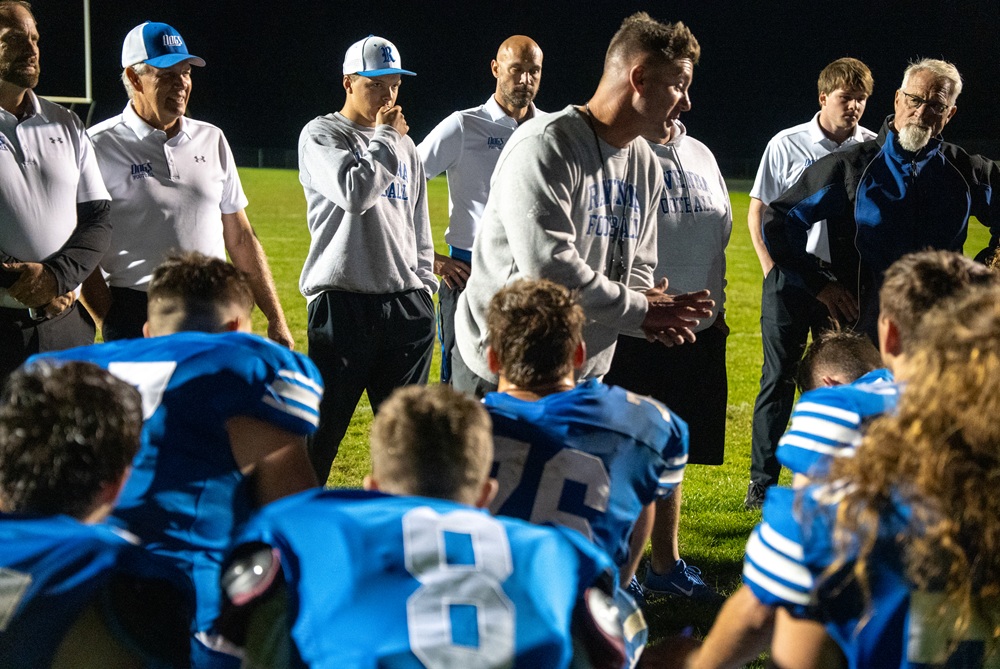
PHOTOS (Top) Ravenna head coach Steve Czerwon addresses the team following a 28-14 victory over Shelby on Sept. 25. (2) Ravenna assistant coaches Randy Helsen, left, and Dusty Fairfield are pictured in the Bulldogs' locker room in August. (3) Joel Kantola, left, is a senior center for the Ravenna football team, and Colton Rolison is a senior linebacker. (4) Fairfield, left, and Czerwon look at an iPad during halftime of a 28-0 victory over Mason County Central on Friday. (Photos by Scott DeCamp.)