


Keep on Coaching
February 1, 2013
By Geoff Kimmerly
Second Half editor
A few weeks ago, I finally got my first chance this season to watch a friend coach his basketball team. After guiding some others at the lower levels, this is his first time running the varsity – something he wasn't sure he wanted to do with a 1-year-old just learning to walk, but a challenge he ended up taking on to the benefit of all those involved.
Simply put, he’s good. I've seen a lot of teams and a lot of coaches over the past 15 years, and although I wouldn't know much of what to do if I were walking the sideline, I felt pretty qualified in telling him I was impressed – even if he didn't buy that I was offering an unbiased opinion. The best news is he’s gone from not sure about this a few months ago to talking about next season.
We know, at least anecdotally, that coaching continues to get more challenging. The time commitment has grown substantially to make running a program a year-round endeavor in a lot of sports at a lot of schools.
That commitment – especially for coaches with children of their own – was a main reason referred to in a New Haven Post-Chronicle story Saturday that noted 23 football coaching openings in Connecticut at one point this offseason. That state has 146 football teams – meaning roughly 15 percent will have new leaders this fall.
And that got me thinking about my friend, about how glad I am he’s given this a shot, and how I've seen so many others either not do so, or not stick around long despite having some pretty nice success.
A study published last winter in Interscholastic Athletic Administration magazine – a product of the National Interscholastic Athletic Administrators Association – noted some predictable results of a study that sought to determine the biggest challenges faced by first-year high school coaches.
The toughest according to the study was balancing the demands of coaching and teaching, experienced by nearly half the respondents – 98 percent of which coached high school teams and 81 percent of which are teachers.
The next six reasons all were noted by at least 30 percent of those in the study – personal fatigue, securing community support, securing and caring for facilities and equipment, parental contact, keeping non-starting players motivated, dealing with schedule interruptions and motivating athletes to achieve consistent, peak performance.
Nothing there is earth-shaking, and most if not all of these challenges are faced by high school coaches regardless of how long they've been in the field. But I got a little more perspective from some of the 32 items that ranked as least challenging to the first-year leaders – keeping in compliance with state and league regulations, dealing with substance abuse issues, teaching sport skills and creating a positive team atmosphere – things that seem most important, and yet appear to be easiest to do. I’m not sure what that tells us – but I think it tells us something.
Click to check out the entire three-page breakdown of the study, plus the researchers’ recommendations to remedy some of what first-year coaches face.
Giving back to Saginaw
I love reading about high-level athletes – like a star-studded group of alums from Saginaw – giving back to where they got their starts.
Pittsburgh Steelers star LaMarr Woodley made a big impact before the start of this school year by donating $60,000 to cover all participation fees for athletes in his former school district. The Saginaw News’ Hugh Bernreuter writes today about how Woodley (Saginaw High), the Philadelphia 76ers’ Jason Richardson (Saginaw Arthur Hill) and former Oakland Raiders standout Stu Schweigert (Saginaw Heritage) have combined to give more than $865,000 back to their home communities.
Bernreuter also mentions the non-monetary contributions of the Golden State Warriors’ Draymond Green (Saginaw High) and former Indianapolis Colts receiver Blair White (Saginaw Nouvel).
Click to read more about it.
Quote(s) of the Week
While rifling through more papers on my desk, I found an article from the Washington Post from Sept. 2011 titled “How high school sports save our schools.” I was drawn to it in part because I spent more than a decade in a newsroom, and it was a piece by a reporter covering education who instead of reporting on school boards and the like, delved into the importance of interscholastic athletics to education as a whole.
He spoke of how participation continues to grow even as resources dwindle, and of data supporting that extracurriculars like sports are more effective than academic classes in teaching leadership, teamwork, time management and “other skills crucial for success in the workplace.” Later, he mentioned a study noting that those who participate in extracurriculars earned more a decade later.
Click here to read the entre piece. These passages struck me most.
“Coaches might be the only faculty members still allowed by our culture and educational practice to get tough with students not making the proper effort. They have the advantage of teaching what are essentially elective non-credit courses. They can insist on standards of behavior that classroom teachers often cannot enforce because the stakes of dismissing or letting students drop their courses are too high. …
“Students do better in activities they choose. If we provide more of them, led by committed adults … that can make a difference. We know the bad news about education. Dropout rates are high. Achievement scores are stagnant. But sports participation is going up, despite pressure to cut it back. Let’s cheer about that and look for a way to draw in more students.”
Century of School Sports: Everything We Do Begins with Participation
By
Geoff Kimmerly
MHSAA.com senior editor
March 5, 2025
For 100 years the MHSAA and its member schools have trumpeted the many benefits of educational athletics. The list of positive reasons to play has only grown.
But every idea and effort to make school sports excellent starts with one underlying theme that has served as a primary motivation from the beginning:
Participation.
The MHSAA long has been driven by a desire to see as many students participate in sports as possible, within a framework of rules that intentionally makes that opportunity so valuable that playing for the school team becomes the dream for thousands of kids all over our state.
And MHSAA member schools have a long history of succeeding at that mission.
A few comparisons and a decent share of context are necessary to explain how. We will dive into some numbers, but these two points sum up the story:
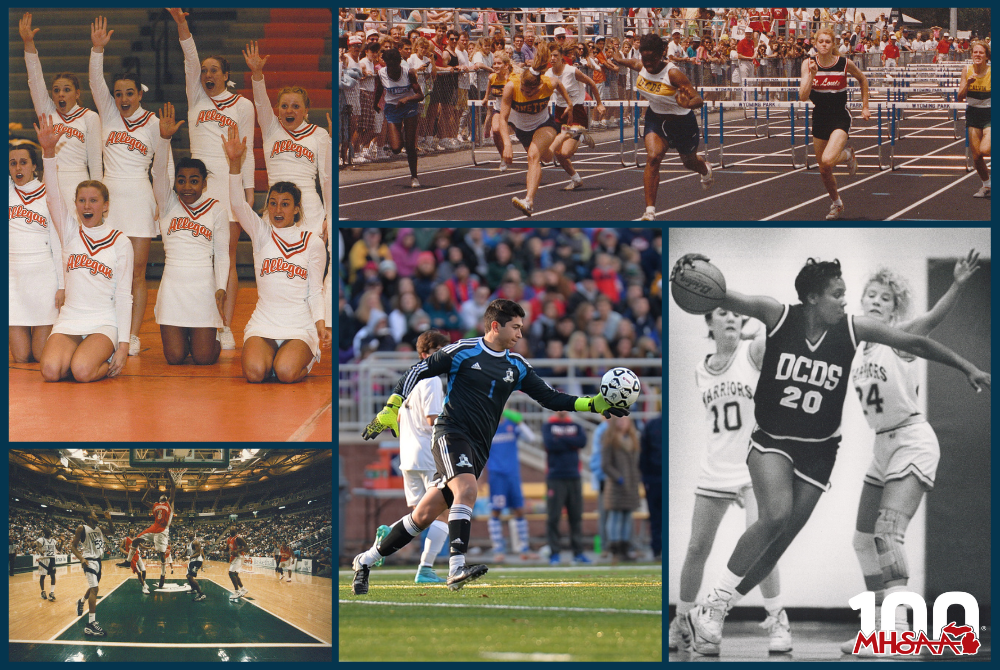
The total number of high school students in Michigan has been shrinking annually over several years – high-school aged population in this state is down 21 percent since 2006-07. But the numbers of students playing sports at MHSAA schools has grown three straight years and has declined by only 13.5 percent over the same stretch of time.
Michigan participation in high school sports annually outpaces where it ranked nationally in high school-aged population. We may have fewer students than some states, but more of them are playing more sports for their schools.
How do we know all this?
Every spring since 1971, the MHSAA has reported how many athletes from member schools participate – by sport – as part of a survey from the National Federation of State High School Associations (NFHS). Those numbers are crunched by the NFHS for all 50 states and Washington, D.C., and over the last several years the MHSAA has taken that data and then compared how Michigan participation stacks up to state populations of people aged 14-17.
(The NFHS collects data on all school sports, whether they receive state association sponsorship or not. Participants also are counted once for every sport they participate in, so two-sport athletes are counted twice, three-sport athletes are counted three times, etc.).
For this narrative’s sake, let’s start with the 1977-78 school. By then, several girls sports had begun to receive MHSAA sponsorship and also had a few years to get established and grow. For that school year, the MHSAA reported 242,616 participants. Just under a decade later, for 1985-86, that total had grown to 265,227 (and a few more girls sports had been added), and those totals continued to rise during the 1990s reaching 295,858 in 2000-01.
A key high point came in 2006-07, when the MHSAA reported 320,479 total participants in all sports at member schools including 313,093 in MHSAA-sponsored sports. The grand totals then shifted downward slowly once again – but in proportion to falling student enrollment at MHSAA member schools, which has dropped nearly 113,000 students (21 percent) since that notable year. It’s also fair to make an educated guess – because students are counted once for every sport played – that a trend toward sport specialization also affected those numbers to some degree.
Fast forward to today. For the 2023-24 school year, there were 270,664 participants in MHSAA sports, plus another 19,920 in sports not sponsored by the association (weight lifting, etc.). So while Michigan hasn’t approached 300,000 participants in more than a decade, the total for MHSAA sports this past year was only 13.5 percent fewer than that 2006-07 season – again, compared to 21-percent fewer students at those schools. And the even better news? Participation has increased three straight years coming out of the COVID-19 pandemic.
Another telling comparison is how Michigan participation continues to compare nationally.
Going back to at least the 2012-13 school year – not counting 2019-20 and 2020-21, when the NFHS survey was suspended because of COVID-19’s effect on school sports – Michigan consistently has ranked either seventh or eighth in participation nationally, falling past that ranking only once to ninth. For 2023-24, Michigan ranked eighth for participation.
Meanwhile, Michigan ranked ninth nationally for high school-aged population from 2012-13 through 2015-16 before sliding into its current 10th spot on that list. So for this past school year, participation at MHSAA member schools ranked two spots ahead of its ranking for high school-aged population.
The first step to receiving the benefits of school sports is getting out there and playing them. And Michigan high schoolers are continuing to do so – both at rates that compare well historically over the last 50 years, and compared to states across the country of similar sizes. This has long been a point of MHSAA pride, and will continue to be a primary focus of its work.
Previous "Century of School Sports" Spotlights
Feb. 25: Slogans & Logos Remain Unforgettable Parts of MHSAA History - Read
Feb. 19: MHSAA Tickets Continue to Provide Fan-Friendly Value - Read
Feb. 11: We Recognize Those Who Make Our Games Go - Read
Feb. 4: WISL Conference Continues to Inspire Aspiring Leaders - Read
Jan. 28: Michigan's National Impact Begins at NFHS' Start - Read
Jan. 21: Awards Celebrate Well-Rounded Educational Experience - Read
Jan. 14: Predecessors Laid Foundation for MHSAA's Formation - Read
Jan. 9: MHSAA Blazes Trail Into Cyberspace - Read
Dec. 31: State's Storytellers Share Winter Memories - Read
Dec. 17: MHSAA Over Time - Read
Dec. 10: On This Day, December 13, We Will Celebrate - Read
Dec. 3: MHSAA Work Guided by Representative Council - Read
Nov. 26: Finals Provide Future Pros Early Ford Field Glory - Read
Nov. 19: Connection at Heart of Coaches Advancement Program - Read
Nov. 12: Good Sports are Winners Then, Now & Always - Read
Nov. 5: MHSAA's Home Sweet Home - Read
Oct. 29: MHSAA Summits Draw Thousands to Promote Sportsmanship - Read
Oct. 23: Cross Country Finals Among MHSAA's Longest Running - Read
Oct. 15: State's Storytellers Share Fall Memories - Read
Oct. 8: Guided by 4 S's of Educational Athletics - Read
Oct. 1: Michigan Sends 10 to National Hall of Fame - Read
Sept. 25: MHSAA Record Books Filled with 1000s of Achievements - Read
Sept. 18: Why Does the MHSAA Have These Rules? - Read
Sept. 10: Special Medals, Patches to Commemorate Special Year - Read
Sept. 4: Fall to Finish with 50th Football Championships - Read
Aug. 28: Let the Celebration Begin - Read