


Keep on Coaching
February 1, 2013
By Geoff Kimmerly
Second Half editor
A few weeks ago, I finally got my first chance this season to watch a friend coach his basketball team. After guiding some others at the lower levels, this is his first time running the varsity – something he wasn't sure he wanted to do with a 1-year-old just learning to walk, but a challenge he ended up taking on to the benefit of all those involved.
Simply put, he’s good. I've seen a lot of teams and a lot of coaches over the past 15 years, and although I wouldn't know much of what to do if I were walking the sideline, I felt pretty qualified in telling him I was impressed – even if he didn't buy that I was offering an unbiased opinion. The best news is he’s gone from not sure about this a few months ago to talking about next season.
We know, at least anecdotally, that coaching continues to get more challenging. The time commitment has grown substantially to make running a program a year-round endeavor in a lot of sports at a lot of schools.
That commitment – especially for coaches with children of their own – was a main reason referred to in a New Haven Post-Chronicle story Saturday that noted 23 football coaching openings in Connecticut at one point this offseason. That state has 146 football teams – meaning roughly 15 percent will have new leaders this fall.
And that got me thinking about my friend, about how glad I am he’s given this a shot, and how I've seen so many others either not do so, or not stick around long despite having some pretty nice success.
A study published last winter in Interscholastic Athletic Administration magazine – a product of the National Interscholastic Athletic Administrators Association – noted some predictable results of a study that sought to determine the biggest challenges faced by first-year high school coaches.
The toughest according to the study was balancing the demands of coaching and teaching, experienced by nearly half the respondents – 98 percent of which coached high school teams and 81 percent of which are teachers.
The next six reasons all were noted by at least 30 percent of those in the study – personal fatigue, securing community support, securing and caring for facilities and equipment, parental contact, keeping non-starting players motivated, dealing with schedule interruptions and motivating athletes to achieve consistent, peak performance.
Nothing there is earth-shaking, and most if not all of these challenges are faced by high school coaches regardless of how long they've been in the field. But I got a little more perspective from some of the 32 items that ranked as least challenging to the first-year leaders – keeping in compliance with state and league regulations, dealing with substance abuse issues, teaching sport skills and creating a positive team atmosphere – things that seem most important, and yet appear to be easiest to do. I’m not sure what that tells us – but I think it tells us something.
Click to check out the entire three-page breakdown of the study, plus the researchers’ recommendations to remedy some of what first-year coaches face.
Giving back to Saginaw
I love reading about high-level athletes – like a star-studded group of alums from Saginaw – giving back to where they got their starts.
Pittsburgh Steelers star LaMarr Woodley made a big impact before the start of this school year by donating $60,000 to cover all participation fees for athletes in his former school district. The Saginaw News’ Hugh Bernreuter writes today about how Woodley (Saginaw High), the Philadelphia 76ers’ Jason Richardson (Saginaw Arthur Hill) and former Oakland Raiders standout Stu Schweigert (Saginaw Heritage) have combined to give more than $865,000 back to their home communities.
Bernreuter also mentions the non-monetary contributions of the Golden State Warriors’ Draymond Green (Saginaw High) and former Indianapolis Colts receiver Blair White (Saginaw Nouvel).
Click to read more about it.
Quote(s) of the Week
While rifling through more papers on my desk, I found an article from the Washington Post from Sept. 2011 titled “How high school sports save our schools.” I was drawn to it in part because I spent more than a decade in a newsroom, and it was a piece by a reporter covering education who instead of reporting on school boards and the like, delved into the importance of interscholastic athletics to education as a whole.
He spoke of how participation continues to grow even as resources dwindle, and of data supporting that extracurriculars like sports are more effective than academic classes in teaching leadership, teamwork, time management and “other skills crucial for success in the workplace.” Later, he mentioned a study noting that those who participate in extracurriculars earned more a decade later.
Click here to read the entre piece. These passages struck me most.
“Coaches might be the only faculty members still allowed by our culture and educational practice to get tough with students not making the proper effort. They have the advantage of teaching what are essentially elective non-credit courses. They can insist on standards of behavior that classroom teachers often cannot enforce because the stakes of dismissing or letting students drop their courses are too high. …
“Students do better in activities they choose. If we provide more of them, led by committed adults … that can make a difference. We know the bad news about education. Dropout rates are high. Achievement scores are stagnant. But sports participation is going up, despite pressure to cut it back. Let’s cheer about that and look for a way to draw in more students.”
Record-Setting Scorer Kerby Eager to Take Frankfort on Another Tournament Run
By
Tom Spencer
Special for MHSAA.com
February 7, 2025
Three months ago, Carter Kerby’s football season ended by injury – and it left him and his coaches wondering about his basketball future.
 But now everyone clearly knows the outcome – and it’s everything they could have desired.
Kerby immediately underwent surgery following the practice injury that prevented him from fulfilling his role as the starting quarterback for Frankfort in the MHSAA Football Playoffs. The injury was a clean break of his left collarbone. Seven pins and a plate were implanted into his shoulder.
He was told he could start shooting a basketball four weeks after surgery. Fast-forward to today, and the right-handed Kerby is shooting with surgical precision – and with high hopes of leading Frankfort to Breslin Center for the Divisions 4 Final.
Frankfort, which plays at Gaylord on Saturday, sports a strong supporting cast for Kerby, and younger players have gained invaluable experience.
“We have a pretty well-stacked team, and we have some young sophomores and juniors,” Frankfort coach Dan Loney said. “They’re getting a ton of experience, and I think that’s going to pay off down the stretch for us.”
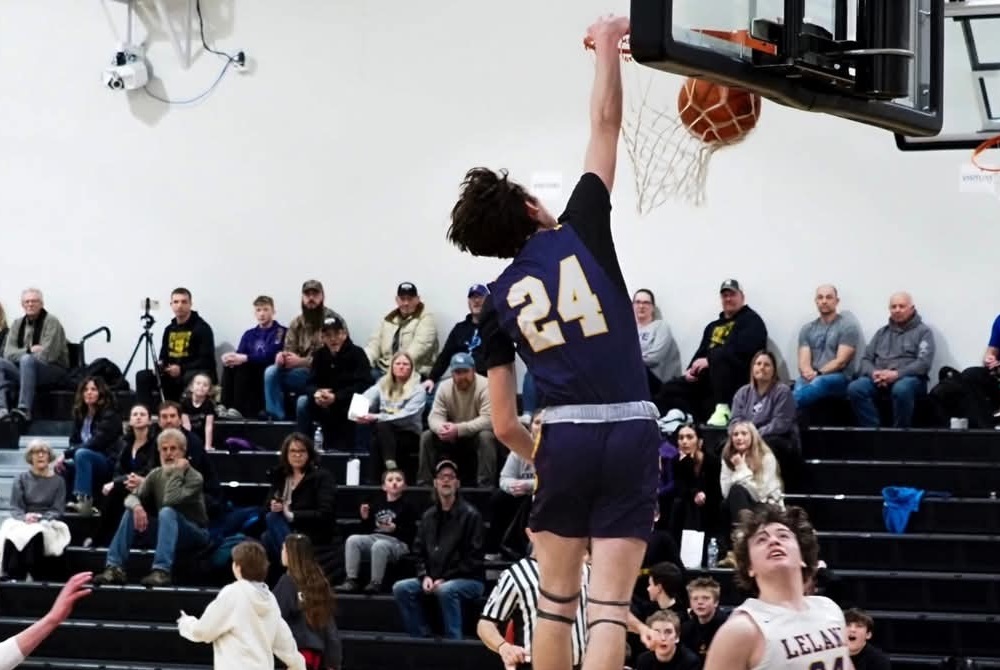
Kerby, a 6-foot-3 guard, is ready to finish off the regular season and begin his fourth postseason run with the Panthers. Last year Frankfort fell 44-42 in the District Final to Maple City Glen Lake, which went on to reach the Quarterfinals. In Kerby’s sophomore year, the Panthers reached the Semifinals, and his freshman season ended in the Regional.
“The goal is to go back to the Bres,” said Kerby, who tied the single-game school record of 46 points last month. “I try not to look too far ahead. We have finish off the regular season before anything, and it’s all going to come down to defense, rebounding and just grit.”
Frankfort is 9-7 and out of the Northwest Conference race this season. But the Panthers are well-known for their ability to make a playoff run.
They’re coming off a 49-37 win over Brethren on Thursday during which Kerby had 13 points and 10 rebounds. Tristin Griffin, who averages 12 points per game, added eight and collected 10 rebounds as well.
“It’s the same thing that happens most years, if I am being honest,” acknowledged Kerby, who is averaging 21 points per game. “We’re not always a regular-season team.”
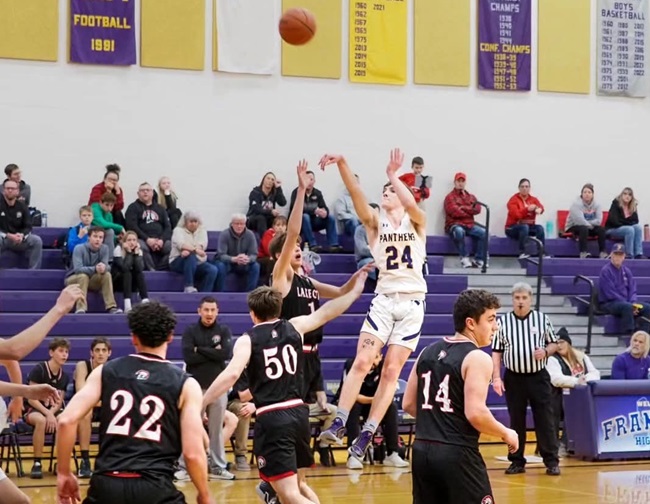 Loney, in his seventh season as the Panthers head coach, agrees with his senior star. Win-loss records don’t accurately show the strength of his team, he notes.
“Our conference is tough,” Loney said. “I think we have the pieces to string together some postseason wins.”
Frankfort’s tournament run will begin and possibly end in Suttons Bay. The Panthers’ District features Buckley and Leelanau St. Mary – teams with similarly-strong histories of recent postseason runs. Add in Traverse City Christian, which is eyeing a potential first District championship, and the ever-improving host Norsemen.
The Panthers are anxiously awaiting the Feb. 16 release of District pairings.
“It’s a tough District,” Looney noted. “We’re definitely going to have to come to play. That’s why we’re trying to work the kinks out, get on a roll and figure out what we have to do to win these tight games.”
Four of Frankfort’s losses were by six points or fewer, including two four-point setbacks to Benzie. The Panthers won one and lost one to Glen Lake. St. Mary topped Frankfort by 10. The other loss was a lopsided one courtesy of Division 2 Grand Rapids South Christian December after the Panthers had started 5-0.
“Our record doesn’t quite show what we really are,” Loney said. “We need to find a way to win those close games down the stretch.”
Kerby, who would trade his individual school record for another deep postseason run, hasn’t ruled out topping his 46-point effort. He’s had 43 in a game this year as well.
“I would love to go for more, and it feels great putting in the time and effort and seeing things come out of it,” said Kerby, who also reached 1,000 points for his career in late January. “But I just want us to get rolling and get in a good groove – I’d give anything up for that.”
Kerby scored 28 points in a 62-52 season-opening win over Suttons Bay after being cleared the night before. He hadn’t even seen the practice floor.
The injury happened as the Panthers were practicing a potential trick play prior to their football playoff opener. Kerby was hurt attempting to catch a pass. He had surgery two days later, on his birthday.
“The ball was just a little overthrown, and the ball hit me in the hands and hit the ground,” Kerby recalled. “I stepped on the ball and flipped, landing shoulder first.”
The Panthers faced Beal City, a familiar football postseason opponent, but without their starting QB. Beal City won that matchup 47-0 and went on win the Division 8 championship four weeks later.
Loney recalls getting the message his star shooter had been injured in football practice, and that his ability to play basketball this winter had become uncertain.
“It’s definitely not the text message I wanted to see the last week of football,” Loney said. “After surgery, we started sizing up when he would be back, and we were at peace with it.”
 Tom Spencer is a longtime MHSAA-registered basketball and soccer official, and former softball and baseball official, and he also has coached in the northern Lower Peninsula area. He previously has written for the Saginaw News, Bay County Sports Page and Midland Daily News. He can be reached at [email protected] with story ideas for Manistee, Wexford, Missaukee, Roscommon, Ogemaw, Iosco, Alcona, Oscoda, Crawford, Kalkaska, Grand Traverse, Benzie, Leelanau, Antrim, Otsego, Montmorency, Alpena, Presque Isle, Cheboygan, Charlevoix and Emmet counties.
PHOTOS (Top) Frankfort’s Carter Kerby throws down a dunk against Leland. (Middle) Kerby (24) launches a jump from the top of the key against Lake City. (Photos by Nick Cooper.)