


Keep on Coaching
February 1, 2013
By Geoff Kimmerly
Second Half editor
A few weeks ago, I finally got my first chance this season to watch a friend coach his basketball team. After guiding some others at the lower levels, this is his first time running the varsity – something he wasn't sure he wanted to do with a 1-year-old just learning to walk, but a challenge he ended up taking on to the benefit of all those involved.
Simply put, he’s good. I've seen a lot of teams and a lot of coaches over the past 15 years, and although I wouldn't know much of what to do if I were walking the sideline, I felt pretty qualified in telling him I was impressed – even if he didn't buy that I was offering an unbiased opinion. The best news is he’s gone from not sure about this a few months ago to talking about next season.
We know, at least anecdotally, that coaching continues to get more challenging. The time commitment has grown substantially to make running a program a year-round endeavor in a lot of sports at a lot of schools.
That commitment – especially for coaches with children of their own – was a main reason referred to in a New Haven Post-Chronicle story Saturday that noted 23 football coaching openings in Connecticut at one point this offseason. That state has 146 football teams – meaning roughly 15 percent will have new leaders this fall.
And that got me thinking about my friend, about how glad I am he’s given this a shot, and how I've seen so many others either not do so, or not stick around long despite having some pretty nice success.
A study published last winter in Interscholastic Athletic Administration magazine – a product of the National Interscholastic Athletic Administrators Association – noted some predictable results of a study that sought to determine the biggest challenges faced by first-year high school coaches.
The toughest according to the study was balancing the demands of coaching and teaching, experienced by nearly half the respondents – 98 percent of which coached high school teams and 81 percent of which are teachers.
The next six reasons all were noted by at least 30 percent of those in the study – personal fatigue, securing community support, securing and caring for facilities and equipment, parental contact, keeping non-starting players motivated, dealing with schedule interruptions and motivating athletes to achieve consistent, peak performance.
Nothing there is earth-shaking, and most if not all of these challenges are faced by high school coaches regardless of how long they've been in the field. But I got a little more perspective from some of the 32 items that ranked as least challenging to the first-year leaders – keeping in compliance with state and league regulations, dealing with substance abuse issues, teaching sport skills and creating a positive team atmosphere – things that seem most important, and yet appear to be easiest to do. I’m not sure what that tells us – but I think it tells us something.
Click to check out the entire three-page breakdown of the study, plus the researchers’ recommendations to remedy some of what first-year coaches face.
Giving back to Saginaw
I love reading about high-level athletes – like a star-studded group of alums from Saginaw – giving back to where they got their starts.
Pittsburgh Steelers star LaMarr Woodley made a big impact before the start of this school year by donating $60,000 to cover all participation fees for athletes in his former school district. The Saginaw News’ Hugh Bernreuter writes today about how Woodley (Saginaw High), the Philadelphia 76ers’ Jason Richardson (Saginaw Arthur Hill) and former Oakland Raiders standout Stu Schweigert (Saginaw Heritage) have combined to give more than $865,000 back to their home communities.
Bernreuter also mentions the non-monetary contributions of the Golden State Warriors’ Draymond Green (Saginaw High) and former Indianapolis Colts receiver Blair White (Saginaw Nouvel).
Click to read more about it.
Quote(s) of the Week
While rifling through more papers on my desk, I found an article from the Washington Post from Sept. 2011 titled “How high school sports save our schools.” I was drawn to it in part because I spent more than a decade in a newsroom, and it was a piece by a reporter covering education who instead of reporting on school boards and the like, delved into the importance of interscholastic athletics to education as a whole.
He spoke of how participation continues to grow even as resources dwindle, and of data supporting that extracurriculars like sports are more effective than academic classes in teaching leadership, teamwork, time management and “other skills crucial for success in the workplace.” Later, he mentioned a study noting that those who participate in extracurriculars earned more a decade later.
Click here to read the entre piece. These passages struck me most.
“Coaches might be the only faculty members still allowed by our culture and educational practice to get tough with students not making the proper effort. They have the advantage of teaching what are essentially elective non-credit courses. They can insist on standards of behavior that classroom teachers often cannot enforce because the stakes of dismissing or letting students drop their courses are too high. …
“Students do better in activities they choose. If we provide more of them, led by committed adults … that can make a difference. We know the bad news about education. Dropout rates are high. Achievement scores are stagnant. But sports participation is going up, despite pressure to cut it back. Let’s cheer about that and look for a way to draw in more students.”
Memories Don't Fade for 1st MHSAA Class A Champion Franklin
By
Brad Emons
Special for MHSAA.com
November 8, 2024
Even after 50 years, Tim Hollandsworth recalls Livonia Franklin’s run to the first MHSAA Class A football playoff championship like it was yesterday.
Before 5,506 fans at Western Michigan University’s Waldo Stadium, the unranked Patriots capped a season for the ages by upending heavily favored Traverse City for the 1975 title, 21-7.
“It was a once in a lifetime event, and I guess it just brings back great feelings winning that game obviously,” said Hollandsworth, who went on to become an all-Mid-American Conference linebacker at Central Michigan. “What I remember most was carrying that trophy around on the field. Myself, Jim Casey and the whole team ... we paraded it out Stanley Cup-style in front of our fans, and everybody was going crazy. Just a happy time.”
The championship game was played on a frigid Nov. 22 afternoon in Kalamazoo, just 12 years following the assassination of President John F. Kennedy.
“When I think about that game, the first thing that comes to mind is that it was a cold, cloudy day before the game,” Hollandsworth said. “And as the game started, the sun came out; it was really bright. It turned out to be a bright, sunny day, and we didn’t feel the cold at all. The adrenalin was pumping.”
No. 2-ranked Traverse City, coached by Jim Ooley, entered with a high-powered offense averaging 34 points per game. The Trojans featured the running back tandem of Rick Waters (1,300 yards) and Bruce McLachlan, along with tight end Mark Brammer, a two-time All-American at Michigan State who later played five seasons for the Buffalo Bills in the NFL.
Franklin took a 7-0 lead in the first quarter when Dennis Smith, the holder on a 30-yard field goal attempt by Sam Williams, couldn’t secure the snap from center but alertly got up and tossed a 17-yard TD pass to Rick Lee.
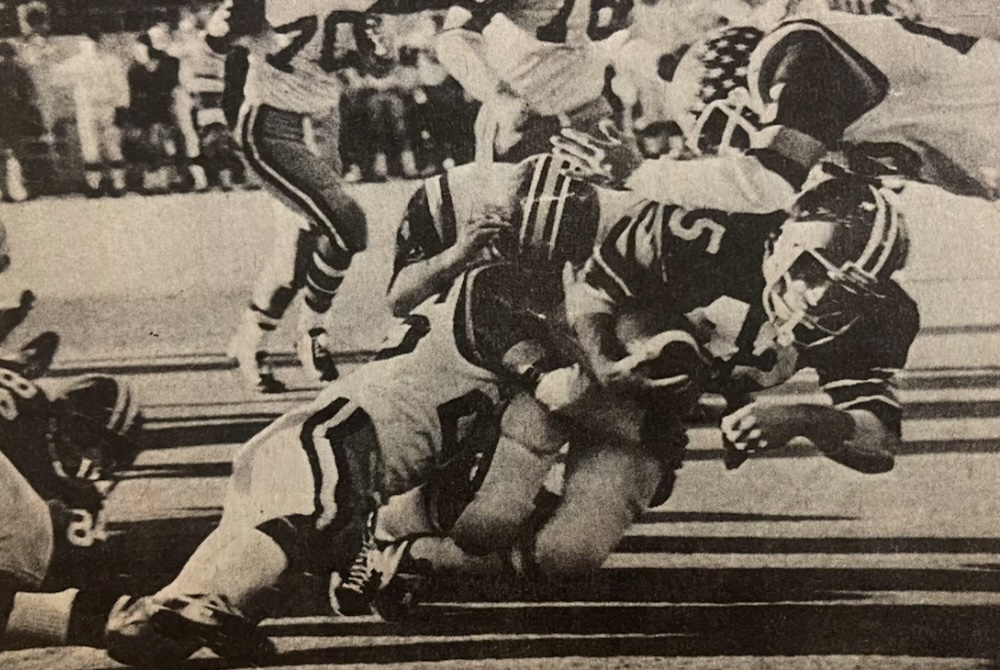
The Patriots then went up 14-0 in the second quarter on a 3-yard TD run by Casey, who went on to play four seasons at Ball State as a defensive back.
Traverse City cut the deficit to 14-7 before halftime on a 2-yard TD run by McLachlan, but the Patriots put it away in the final quarter on a 9-yard TD run by Casey, who finished the game with a hard-earned 105 yards on 24 carries.
Hollandsworth, who also starred in the backfield with Casey, severely twisted his ankle in the first half and was limited to playing only defense for the remainder of the game. Fortunately for Franklin, Tom Smith took his place and helped continue the offensive surge.
 “It was just the fact that everybody was just stepping up when they had to have them,” Casey said. “I think it kind of exemplified everything we did throughout the year to get there. That’s what was so cool about the whole deal.”
Meanwhile, Waters – who later became Hollandsworth’s friend and teammate at CMU – led the Trojans’ rushing attack with 85 yards rushing on 19 carries.
Franklin’s defense played a pivotal role in the win with four interceptions – one each by Hollandsworth, Chuck Hench, Jerry Pollard and Casey (his 10th of the season).
Williams, the Patriots’ star tight end and middle linebacker and the son of former Detroit Lions “Fearsome Foursome” defensive end Sam Williams Sr., also batted down a key fourth-down pass in the end zone to thwart a Traverse City scoring threat.
“It’s funny about the whole game ... you forget about the details, it’s crazy,” Casey said. “It was everybody coming together. There may have been some mistakes along the way. That just happens during the game and we hung in there, did what it took to score enough points to win.”
The game was played on artificial turf, not real grass, which was also a first for both teams.
“I think it had been raining the day before ... anyhow, the field was soaked,” Casey said. “And all it takes is to fall on a field that is soaked on an Astroturf field and everything, and all your clothes are soaked. I remember in the first half – I couldn’t wait for halftime to go inside and warm up.”
During the practice week prior to the title game, the Patriots were able to get acclimated when athletic director and assistant coach George Lovich made a deal to practice on the University of Michigan’s artificial surface.
“We had to get new shoes because nobody had played on artificial turf in high school back then,” Casey said. “They had a bunch of used shoes from the (U-M) team. They threw them in a big old box and they let us practice one night on their Astroturf. We went in and got our shoes and we were ready to play – excited about that. It was just different compared to regular grass. It felt super-fast.”
With only four spots per Class up for grabs in the inaugural MHSAA playoffs, five unbeaten Class A teams did not make the postseason including Warren Fitzgerald and Mount Clemens Chippewa Valley from Region 1, Trenton in Region 3, and Grand Rapids Union and Marquette from Region 4.
On the final Saturday of the regular season at Eastern Michigan’s Rynearson Stadium, No. 1-ranked Birmingham Brother Rice (Region 2) was upset in the Catholic League championship, 7-0, by Dearborn Divine Child, which went on to claim the Class B title.
That allowed the 8-1 Patriots, who had lost to rival Livonia Stevenson 13-9 in Week 2, to sneak into the playoffs just ahead of the previously-unbeaten Warriors.
“We were all in the stands watching that game,” Hollandsworth said. “And our coach, Armand Vigna, had all our points figured out right to the point where he said if Brother Rice were to lose, we were in. So, we’re sitting in the stands and Detroit Southwestern is off to our right a little bit higher in the stands. When Divine Child won that game, we were just going crazy and you could see Southwestern wondering who we were and what was going on.”
During the build-up to the Class A Semifinal game against Franklin, Southwestern coach Joe Hoskins was quoted in the Detroit newspapers as saying, “Livonia who?”
Southwestern was led by all-state QB Mike Marshall (MSU), along with junior tackle Luis Sharpe (UCLA), an eventual first-round NFL pick who played 13 seasons with the St. Louis, Phoenix and Arizona Cardinals.
And in that Semifinal at Pontiac’s Wisner Stadium before 5,000 fans, Franklin upended the No. 3-ranked Prospectors, 12-9, as Casey ran for 145 yards on 27 carries. Hollandsworth added a 1-yard TD to cap a nine-play, 72-yard drive and give his team the lead 9-7 at the half.
Southwestern got an 18-yard TD pass from Marshall to Andrew Williams and scored on a two-point safety when the Patriots fumbled the kickoff to start the second half.
Williams, however, booted a pair of field goals, including the game-winning 28-yarder to break a 9-9 deadlock for the Patriots after they were aided by a pass interference call followed by an unsportsmanlike conduct penalty, which took the ball to the Southwestern 18.
In protest, Hoskins took his team off the field and had to be coaxed by MHSAA officials to bring his players back to finish the game.
“I think we were excited about the playoffs because we were undefeated the year before, so were looking forward to getting into the playoffs,” Hollandsworth said. “It was deflating when we lost; it was low-scoring, tough battle versus Stevenson. All the Livonia games (vs. Churchill and Bentley) were tough battles. It was the first game that Sam Williams was out. He got hurt in the (Dearborn) Fordson game before that (the opener) and Sam was not only our tight end, and starting middle linebacker, but he was also our punter and kicker. I think we passed up some field goals in that Stevenson game because we were so unsure of our kicking game.”
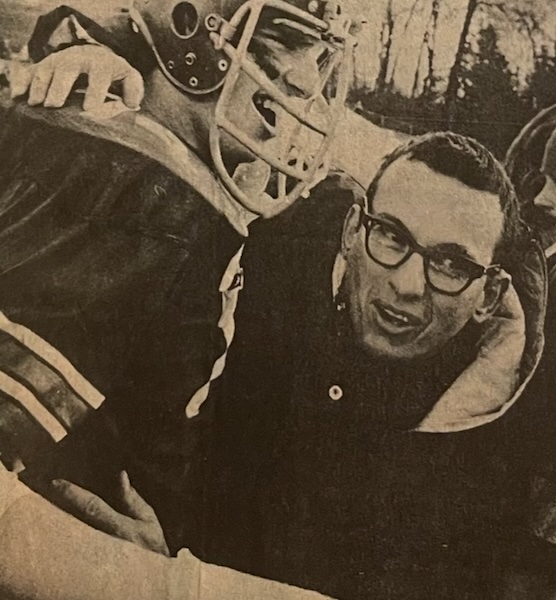
PHOTOS (Top) Livonia Franklin’s Jim Casey (45) plows ahead during the 1975 Class A Final as Traverse City tacklers converge. (Middle) Franklin coach Armand Vigna, right, shares an embrace with lineman Rick Kruger in the moments after their team’s championship victory. (Photos courtesy of Hometown Life, which includes the former Livonia Observer).