


Keep on Coaching
February 1, 2013
By Geoff Kimmerly
Second Half editor
A few weeks ago, I finally got my first chance this season to watch a friend coach his basketball team. After guiding some others at the lower levels, this is his first time running the varsity – something he wasn't sure he wanted to do with a 1-year-old just learning to walk, but a challenge he ended up taking on to the benefit of all those involved.
Simply put, he’s good. I've seen a lot of teams and a lot of coaches over the past 15 years, and although I wouldn't know much of what to do if I were walking the sideline, I felt pretty qualified in telling him I was impressed – even if he didn't buy that I was offering an unbiased opinion. The best news is he’s gone from not sure about this a few months ago to talking about next season.
We know, at least anecdotally, that coaching continues to get more challenging. The time commitment has grown substantially to make running a program a year-round endeavor in a lot of sports at a lot of schools.
That commitment – especially for coaches with children of their own – was a main reason referred to in a New Haven Post-Chronicle story Saturday that noted 23 football coaching openings in Connecticut at one point this offseason. That state has 146 football teams – meaning roughly 15 percent will have new leaders this fall.
And that got me thinking about my friend, about how glad I am he’s given this a shot, and how I've seen so many others either not do so, or not stick around long despite having some pretty nice success.
A study published last winter in Interscholastic Athletic Administration magazine – a product of the National Interscholastic Athletic Administrators Association – noted some predictable results of a study that sought to determine the biggest challenges faced by first-year high school coaches.
The toughest according to the study was balancing the demands of coaching and teaching, experienced by nearly half the respondents – 98 percent of which coached high school teams and 81 percent of which are teachers.
The next six reasons all were noted by at least 30 percent of those in the study – personal fatigue, securing community support, securing and caring for facilities and equipment, parental contact, keeping non-starting players motivated, dealing with schedule interruptions and motivating athletes to achieve consistent, peak performance.
Nothing there is earth-shaking, and most if not all of these challenges are faced by high school coaches regardless of how long they've been in the field. But I got a little more perspective from some of the 32 items that ranked as least challenging to the first-year leaders – keeping in compliance with state and league regulations, dealing with substance abuse issues, teaching sport skills and creating a positive team atmosphere – things that seem most important, and yet appear to be easiest to do. I’m not sure what that tells us – but I think it tells us something.
Click to check out the entire three-page breakdown of the study, plus the researchers’ recommendations to remedy some of what first-year coaches face.
Giving back to Saginaw
I love reading about high-level athletes – like a star-studded group of alums from Saginaw – giving back to where they got their starts.
Pittsburgh Steelers star LaMarr Woodley made a big impact before the start of this school year by donating $60,000 to cover all participation fees for athletes in his former school district. The Saginaw News’ Hugh Bernreuter writes today about how Woodley (Saginaw High), the Philadelphia 76ers’ Jason Richardson (Saginaw Arthur Hill) and former Oakland Raiders standout Stu Schweigert (Saginaw Heritage) have combined to give more than $865,000 back to their home communities.
Bernreuter also mentions the non-monetary contributions of the Golden State Warriors’ Draymond Green (Saginaw High) and former Indianapolis Colts receiver Blair White (Saginaw Nouvel).
Click to read more about it.
Quote(s) of the Week
While rifling through more papers on my desk, I found an article from the Washington Post from Sept. 2011 titled “How high school sports save our schools.” I was drawn to it in part because I spent more than a decade in a newsroom, and it was a piece by a reporter covering education who instead of reporting on school boards and the like, delved into the importance of interscholastic athletics to education as a whole.
He spoke of how participation continues to grow even as resources dwindle, and of data supporting that extracurriculars like sports are more effective than academic classes in teaching leadership, teamwork, time management and “other skills crucial for success in the workplace.” Later, he mentioned a study noting that those who participate in extracurriculars earned more a decade later.
Click here to read the entre piece. These passages struck me most.
“Coaches might be the only faculty members still allowed by our culture and educational practice to get tough with students not making the proper effort. They have the advantage of teaching what are essentially elective non-credit courses. They can insist on standards of behavior that classroom teachers often cannot enforce because the stakes of dismissing or letting students drop their courses are too high. …
“Students do better in activities they choose. If we provide more of them, led by committed adults … that can make a difference. We know the bad news about education. Dropout rates are high. Achievement scores are stagnant. But sports participation is going up, despite pressure to cut it back. Let’s cheer about that and look for a way to draw in more students.”

Referee Camaraderie: Bloopers, 'Nerding' Out, Lots of Laughs Create Powerful Bond
By
Pam Shebest
Special for MHSAA.com
February 13, 2024
KALAMAZOO — When it comes to blooper highlights, four MHSAA hockey officials don’t hesitate to share their miscues.
 One of them, Bob Corak, even has his pratfalls set to music on an internet site called Zebras with Pucks.
Laughter is the sound of the day when the four gather every Tuesday after their yoga class at Nisker’s Char-Grill & Slap Shot Hockey Bar in Kalamazoo.
The camaraderie between Corak, Corey Butts, Nick Schrippa and Nat Swanson is evident, but the tone gets more serious once the talk turns to officiating.
“We’ve all played, we’ve all coached to some extent, but officiating is just what speaks to us,” Schrippa said. “That’s our niche.
“Every player on the ice has a fan in the stands. Every player on the ice has support on the bench. We’re the only support we have in the arena. We’re the only ones we can lean on. We’re kind of on an island.”
Most times the friends are part of different four-man crews made up of two referees and two linesmen for South Central High School Hockey League games. But that just gives them more to talk about when they get together on Tuesdays.
 “We spend an hour every Tuesday with Bob’s wife (Susan) just kicking the crap out of us and then come to (Nisker’s) to debrief,” Schrippa said. Susan Corak runs Be Well Yoga and Fitness in Kalamazoo.
"We never talk about the workout. Somebody will bust out a phone and we’ll go over a video and we’ll talk about a situation, talk about rule differences,” he continued. “We are nerds to the nth degree, and that’s just how we’re wired.”
Yoga is a good way to keep in shape, the four friends agree.
“I’m a little older than most of the referees I meet,” said Corak, who retired after 35 years with Pfizer in information technology. "It keeps me limber, keeps me in shape to an extent, not a lot of cardio but the strength is there that we get from yoga, especially the core, plus injury prevention.
“If I’m not skating, I’m officiating or I’m working the books for the association (Kalamazoo Ice Hockey Officials Association).”
Corak assists in the scheduling, billing, etc., leading Schrippa to quip: “Remember when Bob said he did information technology? We take full advantage of that. He is, in fact, the glue that holds a lot of our shenanigans together. He really is.”
Referees vs. Linesmen
Butts and Corak prefer wearing the referees’ armbands, while Schrippa and Swanson like working the lines.
“’I’m a smaller guy,” said Butts, who has been officiating for 14 years. “Linesmen typically tend to be 6-foot-5. When you’re smaller than most of the players, it doesn’t work out well.
“I like the freedom to be able to get out of the way. It’s a high traffic area as a linesman.”
When not spending evenings officiating, Butts is the penalty box timekeeper for the ECHL Kalamazoo Wings home games. His day job as a third-party examiner for the state of Michigan means he gives driving tests, and that leads to some interesting conversations.
“I’ve given most of (the players) their driver’s licenses,” he said. “I’ve had a group of players in the middle of a high school hockey game, getting ready to drop the puck at the start of the third period, and they’re trying to schedule a driver’s test for the next day. I’m like, ‘Guys, not now. Talk to me after work.’”
 Swanson is the newest of the quartet, moving to the area three years ago from Syracuse, N.Y., where he started officiating at age 11.
He is a pilot in the U.S. Air Force International Guard in Battle Creek flying MQ-9 Reaper Drones.
“I like refereeing better (than being a linesman) because I like managing the game and look at the big picture,” Swanson said. “Sometimes it’s great to be a linesman because they get to communicate with the players, crack jokes and sometimes throw the referee under the bus, ‘Yeah, I agree that was a terrible call. But you’ve got to move on.’”
All four also officiate college and youth hockey, which can lead to a dilemma.
“Those are all different rule books, so we don’t have to know just one set of rules,” Schrippa said. “None of them are what you see on TV.
“While we have a couple hundred people in the building who are yelling at us that we got it wrong because that’s what they saw on ESPN, that’s not how it works. So not only do we have to know the rules, we have to know the differences in the rules.”
With mentorship programs available, some current prep players are also officials for younger leagues.
“They’re learning, we’re teaching them,” Corak said. “We have games with them as officials, then we’ll officiate their games when they play for their schools.”
Swanson added: “I think that makes them better players because they understand the rules, where they can bend rules and where they can’t.”
 That is what led Schrippa to officiating.
“(Late referee) Mike Martin was officiating a game and pulled me aside,” he said. “I was 22 years old and he asked if I wanted to become a ref.
“‘(Heck) you’ve broken all the rules,’ he told me. ‘You probably know most of them already. He wasn’t wrong. I talked to a couple friends who had done it, and they talked me into doing it 29 seasons ago. I fell in love with it.”
Fun with bloopers
All four laugh as they regale each other with their funniest and most embarrassing moments.
For Schrippa, it was the college game where he made his refereeing debut.
“I was given the rookie lap,” he said. “I was jazzed. I came out of the gate, turned left, went around the back of the net, got to the blue line, caught a toe pick and Supermanned, slid from the blue line to the top of the next faceoff circle and was soaked because the ice hadn’t set yet.
“I got a standing ovation from the few hundred fans that were in the rink. Both my linesmen were doubled over laughing. It was a very cold first period.”
Something similar happened to Swanson.
 “I was taking a hot lap, not seeing they’ve got a carpet out for somebody, hitting the carpet and Supermanning,” he recalled. “Then having a linesman watch you do it as there’s a few hundred people in the stands and give a big washout sign.”
Butts and Swanson had moments that actually delayed the start of a game.
For Butts, “I forgot my pants because I washed them separate and my wife had to bring them to me, and we could not start the game until my pants arrived,” he said, while the others laughed and nodded in agreement.
Swanson actually found himself at the wrong rink one time.
“I’m like, ‘Where is everybody?’” he said. “My phone starts ringing. ‘Hey dude, game starts in 15 minutes. You going to be here? Uh, yes, in 20.’’’
The four agree most officials go through highs and lows, funny times and embarrassing times, and that’s one thing that brings them all together.
“What’s unique about what we do is I could meet another official from Sweden tomorrow who I’ve never met before, and within minutes we’ve already got that relationship,” said Schrippa, who is the Southwest Michigan communications representative for the Michigan Department of Transportation (MDOT).
“That’s something we all share, we all know that feeling, we all understand that bond and it just takes a second. It’s so neat, it’s powerful.”
 Pam Shebest served as a sportswriter at the Kalamazoo Gazette from 1985-2009 after 11 years part-time with the Gazette while teaching French and English at White Pigeon High School. She can be reached at [email protected] with story ideas for Calhoun, Kalamazoo and Van Buren counties.
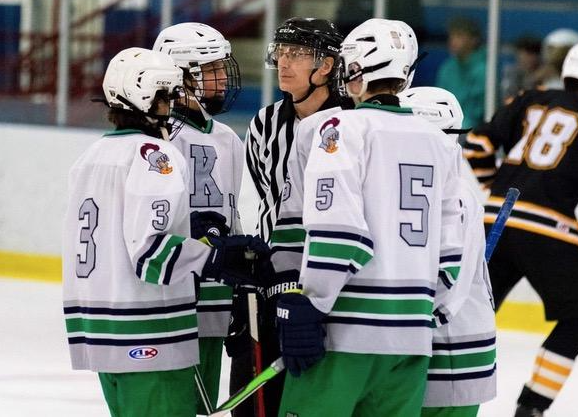
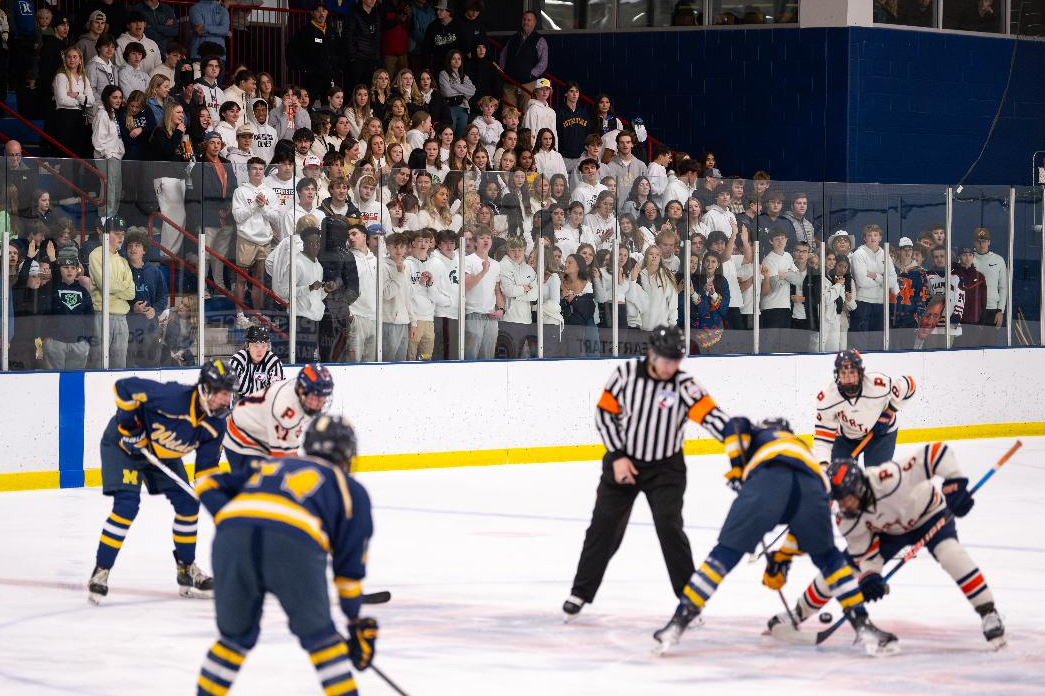
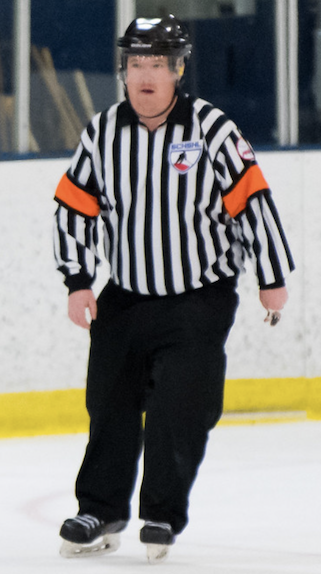
PHOTOS (Top) MHSAA hockey officials, from left: Nick Schrippa, Bob Corak, Nat Swanson and Corey Butts get together recently for one of their weekly hangouts. (2) Schrippa makes a call. (3) Corak, center, confers with a group of players. (4) Swanson prepares to drop the puck. (5) Butts monitors the game action. (Top photo by Pam Shebest; following photos provided by respective officials.)