


Keep on Coaching
February 1, 2013
By Geoff Kimmerly
Second Half editor
A few weeks ago, I finally got my first chance this season to watch a friend coach his basketball team. After guiding some others at the lower levels, this is his first time running the varsity – something he wasn't sure he wanted to do with a 1-year-old just learning to walk, but a challenge he ended up taking on to the benefit of all those involved.
Simply put, he’s good. I've seen a lot of teams and a lot of coaches over the past 15 years, and although I wouldn't know much of what to do if I were walking the sideline, I felt pretty qualified in telling him I was impressed – even if he didn't buy that I was offering an unbiased opinion. The best news is he’s gone from not sure about this a few months ago to talking about next season.
We know, at least anecdotally, that coaching continues to get more challenging. The time commitment has grown substantially to make running a program a year-round endeavor in a lot of sports at a lot of schools.
That commitment – especially for coaches with children of their own – was a main reason referred to in a New Haven Post-Chronicle story Saturday that noted 23 football coaching openings in Connecticut at one point this offseason. That state has 146 football teams – meaning roughly 15 percent will have new leaders this fall.
And that got me thinking about my friend, about how glad I am he’s given this a shot, and how I've seen so many others either not do so, or not stick around long despite having some pretty nice success.
A study published last winter in Interscholastic Athletic Administration magazine – a product of the National Interscholastic Athletic Administrators Association – noted some predictable results of a study that sought to determine the biggest challenges faced by first-year high school coaches.
The toughest according to the study was balancing the demands of coaching and teaching, experienced by nearly half the respondents – 98 percent of which coached high school teams and 81 percent of which are teachers.
The next six reasons all were noted by at least 30 percent of those in the study – personal fatigue, securing community support, securing and caring for facilities and equipment, parental contact, keeping non-starting players motivated, dealing with schedule interruptions and motivating athletes to achieve consistent, peak performance.
Nothing there is earth-shaking, and most if not all of these challenges are faced by high school coaches regardless of how long they've been in the field. But I got a little more perspective from some of the 32 items that ranked as least challenging to the first-year leaders – keeping in compliance with state and league regulations, dealing with substance abuse issues, teaching sport skills and creating a positive team atmosphere – things that seem most important, and yet appear to be easiest to do. I’m not sure what that tells us – but I think it tells us something.
Click to check out the entire three-page breakdown of the study, plus the researchers’ recommendations to remedy some of what first-year coaches face.
Giving back to Saginaw
I love reading about high-level athletes – like a star-studded group of alums from Saginaw – giving back to where they got their starts.
Pittsburgh Steelers star LaMarr Woodley made a big impact before the start of this school year by donating $60,000 to cover all participation fees for athletes in his former school district. The Saginaw News’ Hugh Bernreuter writes today about how Woodley (Saginaw High), the Philadelphia 76ers’ Jason Richardson (Saginaw Arthur Hill) and former Oakland Raiders standout Stu Schweigert (Saginaw Heritage) have combined to give more than $865,000 back to their home communities.
Bernreuter also mentions the non-monetary contributions of the Golden State Warriors’ Draymond Green (Saginaw High) and former Indianapolis Colts receiver Blair White (Saginaw Nouvel).
Click to read more about it.
Quote(s) of the Week
While rifling through more papers on my desk, I found an article from the Washington Post from Sept. 2011 titled “How high school sports save our schools.” I was drawn to it in part because I spent more than a decade in a newsroom, and it was a piece by a reporter covering education who instead of reporting on school boards and the like, delved into the importance of interscholastic athletics to education as a whole.
He spoke of how participation continues to grow even as resources dwindle, and of data supporting that extracurriculars like sports are more effective than academic classes in teaching leadership, teamwork, time management and “other skills crucial for success in the workplace.” Later, he mentioned a study noting that those who participate in extracurriculars earned more a decade later.
Click here to read the entre piece. These passages struck me most.
“Coaches might be the only faculty members still allowed by our culture and educational practice to get tough with students not making the proper effort. They have the advantage of teaching what are essentially elective non-credit courses. They can insist on standards of behavior that classroom teachers often cannot enforce because the stakes of dismissing or letting students drop their courses are too high. …
“Students do better in activities they choose. If we provide more of them, led by committed adults … that can make a difference. We know the bad news about education. Dropout rates are high. Achievement scores are stagnant. But sports participation is going up, despite pressure to cut it back. Let’s cheer about that and look for a way to draw in more students.”
We Will Always Remember Trojans, Lumberjacks as 114-Year-Old Rivalry Nears End
By
Ron Pesch
MHSAA historian
February 9, 2024
The MHSAA basketball record book still lacks a rivalries category. The state’s football record book offers clues to likely candidates, but without deep research, the participants and sequencing of such lists will remain unknown.
Certainly, among the candidates would be the annual boys basketball battles between Saginaw’s east side and west side – Saginaw High vs. Saginaw Arthur Hill. Come Friday, Feb. 16th, 2024, twilight falls on one of Michigan’s most intense. Because of its significance, the game will be hosted outside of a high school gymnasium.
Saginaw’s Dow Event Center will stage the final regular-season showdown between the Trojans and Lumberjacks. Titled the ‘Game of Legends,’ all 5,000 tickets for the celebration were snapped up in 20 minutes. After years of discussions, at the end of the school year, Saginaw High and Arthur Hill will combine to finalize the formation of Saginaw United High School.
Based on the research of Dave Slaggert, the series between schools began during the 1910-11 season at the Saginaw Manual Training School gymnasium. Head varsity boys basketball coach at Arthur Hill from 1996 through 2001, Slaggert spent five years compiling a book documenting the rivalry. Much of the manuscript has already been committed to paper. That includes a chapter penned by Michigan State University coaching legend Tom Izzo, who highlights the uniqueness of the crosstown rivalry, the crazy fans, and the talent that brought him regularly to town. Titled “Remember the Trojans & the Lumberjacks,” the concluding chapter awaits the results of the 2024 season.
The Beginnings
In 1889, Michigan’s State Legislature consolidated the cities of East Saginaw and Saginaw City into what we know today as Saginaw.
East Side High School opened in 1865. In 1901, West Side High School was renamed Arthur Hill, in honor of a former school board president and mayor of Saginaw City.
Football teams from Saginaw High (sometimes called Saginaw Eastern) and Arthur Hill High first met on the gridiron in 1894. In 1904, both joined Flint (Central) and two schools from Bay City to form the Saginaw Valley League. During the 1910-11 season, the boys squads from the Saginaw schools squared off on the basketball court for the first time.
 “Saginaw High easily defeated the Arthur Hill High school basketball players … in the first game of the interscholastic series,” stated the Saginaw Daily News, “the final score standing 60 to 17. … (Bill) Steckert contributed 12 field baskets for the winners. … (Leo) Vondette starred for the losers.”
Perhaps it was a typo – it’s impossible to know – but the final score differed in the 1911 Saginaw yearbook – “The Aurora” – when published in the spring. “Before a large crowd of enthusiastic fans, Arthur Hill was decisively defeated in the local gym, the final count being 69 to 17, with the East Siders on the heavy end.”
The author concluded with flair and flourish: “Steckert starred for Saginaw, getting 24 points to his credit, while Vondette was the celestial light for the vanquished quintet. Dancing was enjoyed after the game.”
A week later, the Saginaw girls basketball team opened its season against the west siders. According to the yearbook, “Saginaw out-played Arthur Hill and defeated them by the score of 41-4.” The newspaper credited Leona Buck as the leading scorer, with a phenomenal 29 points.
The Inevitable Finale
The doors open at 3 p.m. for the 2024 festivities at The Dow next Friday. Fittingly, the Saginaw girls team will tip off the action on the court at 5 o’clock. The girls programs already have consolidated, and the Phoenix of Saginaw United will face Flint Carman-Ainsworth – a school that consolidated in 1986. The Hill and High contest is scheduled for 7 p.m.
“It’s really going to be a big deal,” said Slaggert, thrilled by the prospect. “Saginaw’s going all out for this. They’re trying to do it up in style.”
The wrap-up comes a decade after what, initially, looked like the end.
On Feb. 15, 2014, Detroit Free Press sportswriter Mick McCabe wrote about the expected unification.
“Saginaw and Saginaw Arthur Hill likely met for the last time ever in the regular season Friday,” he wrote. Saginaw had just knocked off the Lumberjacks, the No. 2 team in McCabe’s weekly ranking of the state’s top teams.
“The Saginaw-Arthur Hill basketball rivalry is the best in the state, so you shouldn’t be surprised when the underdog wins. But Saginaw (11-6) was coming off consecutive losses to Midland and Midland Dow for maybe the first time ever.”
The school district was expected to announce the closure of Saginaw High that following Monday, merging its students into Arthur Hill. The move would mean a new school name, new school colors, and a new nickname.
Like many urban centers across the country, outbound migration of both jobs and people, combined with plunging birth rates, had altered the demographics of cities, and the education landscape.
“In just five decades, the city's population dropped from nearly 100,000 in the 1960s to fewer than 52,000 by the 2010 census,” stated the Saginaw News in 2014. “To say it another way, Saginaw lost 48 percent of its residents during the last 50 years.”
McCabe cut to what that meant to enrollment numbers at the two schools: “In 1987, Saginaw High had over 1,800 students; it is now down to about 600. Arthur Hill had 2,395 students in ’85; it now has 973.”
 Despite the defeat, McCabe predicted Arthur Hill to be among the final four Class A teams still standing that season when the annual MHSAA Tournament shifted to Michigan State’s Breslin Center. But in the craziness of March, the Trojans again took down Arthur Hill in the Districts, 53-51.
Adding to the madness, the expected consolidation didn’t happen. A recommendation by a Saginaw interim superintendent to close Saginaw High found no school board support.
With the potential consolidation still hovering, one year later sportswriter Bill Khan recalled other recent departures from Michigan’s classic basketball landscape in an article for the StateChamps! Sports Network:
“The Saginaw-Arthur Hill rivalry is at risk of going the way of other great urban rivalries – such as Flint Central-Flint Northern, Pontiac Central-Pontiac Northern, Lapeer East-Lapeer West, Detroit Cooley-Detroit Southwestern, Detroit Mackenzie-Detroit Redford, Detroit Kettering-Detroit Northeastern, Detroit Miller-Detroit Northern and Detroit Southeastern-Detroit Eastern, that have ended in years past due to school closures and consolidations.”
Arthur Hill downed the Trojans twice during the 2014-15 regular season league action, and again in postseason District play, before finishing the year as Class A runner-up, and the holding pattern of the planned school merger continued.
Enrollment numbers continued to drop at both schools and after much community and school board debate, construction on a brand-new five-story Saginaw United High School began in 2022.
A Celebration of Statistics
The state basketball tournament kicked off in 1917. Over 107 years, on only two occasions – in 1943 during World War II, and in 2020, due to COVID-19 – the tournament was not completed.
Slaggert breaks down the City of Saginaw School District’s incredible basketball history in a quick series of numbers.
“47-36-18-8,” said Slaggert, stressing a bullet point of a well-rehearsed pitch, breaking out the incredible success of the two schools come tournament time.
“During those 105 tournaments, 47 times, Saginaw High (starting in 1919) or Arthur Hill (beginning in 1930) made it into the state Quarterfinals – the final eight.
“That’s almost half of the 105 possible years. And in most cases throughout that rivalry, they would have played each other in the Districts. So how many more times would they have made it if they were coming in different brackets or different directions? “
To take that further, he noted, 36 times one of those teams made it into the final four. On 18 occasions, one of the two schools reached the state title game, and on eight occasions, they emerged as MHSAA state champions.
Six of those titles were won by Saginaw High (1942, 1962, 1996, 2007,2008, 2012). Arthur Hill’s championships were won in 1944 and 2006.
“That's a pretty incredible stat for two schools in the same town, don’t you think?” Slaggert asked.
 That history also points out another Slaggert challenge. As illustrated, come March the schools could, in theory, bump into each other one more time come the postseason. This year, the teams are in different Districts, and could potentially cross paths in an MHSAA Regional.
A Parade of All-Staters
Between 1938 and 2023, a combined total of 106 players from the two schools – 10 or more in each decade from the 1940s to the 2010s – have earned all-state basketball honors from The Associated Press and/or one or more of the Detroit newspapers: the Free Press, News or Times.
Since the introduction of Michigan’s Mr. Basketball award in 1981, honoring the best-of-the-best from the state’s top high school seniors, 10 players from the two schools have landed among the top five in voting: Eric Davis (AH –‘15), Maurice Jones (AH –‘10), Draymond Green (S –‘08), Dar Tucker (AH –‘07), Anthony Roberson (S –‘02), Eugene Seals (S –’00, and head coach of the United girls basketball team), Jason Richardson (AH-‘99), Jessie Drain (S –‘91) and Daryl Reed (S –‘87). Richardson won the award. Davis, Green, Tucker, Roberson, and Seals all finished second in the annual voting.
Tony Smith (S -‘74), Craig Dill (AH -‘63), Ernie Thompson (S -‘62), Webster Kirksey (S -‘51), Dick Rifenburg (AH -‘44), and Larry Savage (S -‘42) were all honored by the Basketball Coaches Association of Michigan with their Retro Mr. Basketball Award when the organization sought to honor the great seniors in Michigan high school basketball from the years 1920 through 1980. Seven others – James Koger (S -‘79), Lovell Humes (S – ’63), Bill Agre (AH -‘47), Gene Glick (AH -’46), Jack Mott (AH -’45), Eddie Johnson (S – ’43) and Stanley Paskiewicz (S -’38) – were among the candidates for that award.
Based on research by Orchard Lake St. Mary’s Robin Goddard, Saginaw High is likely the state’s winningest basketball program, trailed by Benton Harbor, Kalamazoo Central and Orchard Lake St. Mary’s.
Initially, Saginaw dominated the crosstown series with the Lumberjacks. But by the 1920s Arthur Hill overcame the deficit, and by the mid-1950s the Hill had opened a wide 25-game lead in wins versus losses. But by 1975, the gap had narrowed with the Trojans just six games back in the series. And yet, the exact status of the rivalry is still unknown, as the capture of game scores is spotty going forward.
The digging to capture those missing scores continues, as does the race to game day.
Slaggert has committed to printing 1,000 copies of his book. His challenge to date has been selling copies of something that does not yet, physically, exist. As it stands, currently there are 772 pages in the book. It includes a mind-blowing 800+ photos dating as far back as 1905. The sale price is fixed at $40. That currently means the production cost per copy exceeds the retail price, so Slaggert continues to chase sponsorships to defray the printing expense.
“It’s a non-profit effort,” he noted. “If there are any profits, they go to scholarships for the new high school. All money is run through the Saginaw Community Foundation,” which makes sponsorships tax-deductible.
His favorite memory from the series is his last victory as an Arthur Hill coach. It comes from 2001.
“Saginaw High defeated us 90-37 in the second game of that season and finished with a 17-5 season record that year,” he retold. “We had a modest 10-10 season record heading into the Districts but showed lots of improvement through the season. We met again in the District Finals. Saginaw High was led by Anthony Roberson, LaMarr Woodley, Michael Thomas and Tanoris Shepard and was ranked seventh in the state. In front of a sold-out Heritage High School crowd, our kids played their hearts out and, led by Devaundre Whitson, Omar Linder, and Freddy Jackson, pulled out a 68-66 overtime win! (It’s) my greatest thrill in coaching, and most of the old-timers say it’s the greatest upset in the rivalry.”
Slaggert retired from coaching after that season, and in the years to follow, found a desire to record the history of the series.
“I have nine living coaches from Saginaw and Arthur Hill that have written a chapter for me. I have eight others that I've written on Larry Laeding, Chuck Fowler, and different coaches that are deceased,” he said. “My intent is to give something back to my community. I didn’t do this for money. I wanted this story to be passed down to future generations – people 100 years from now about Jason Richardson, Draymond Green, Ernie Thompson, Craig Dill, and all the great ones.
“It’s a labor of love for me, I’ve really enjoyed it.”
 To order Slaggert's book, click for the Facebook link or visit the Saginaw Community Foundation website, click "Give Now" and select the book title as Fund. Cost is $40 with an option including shipping for $52.
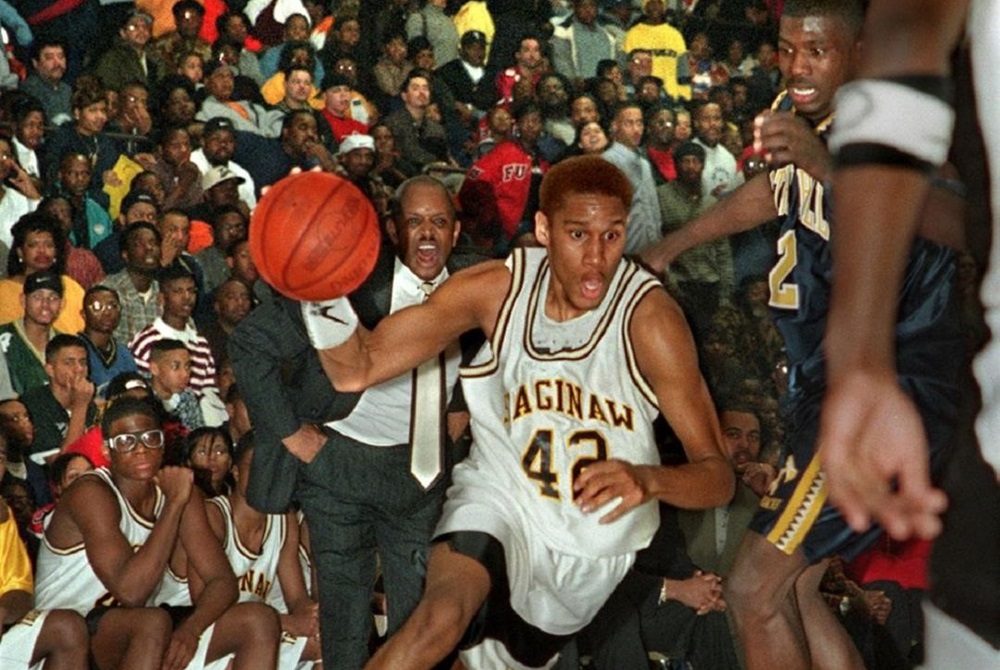
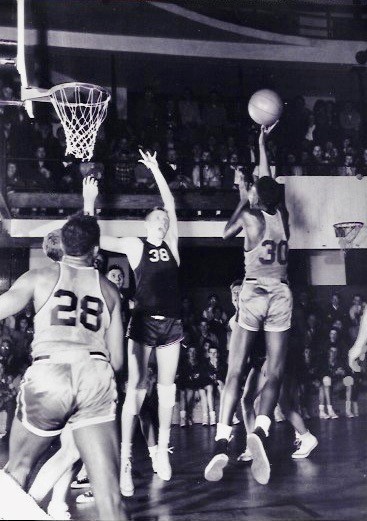
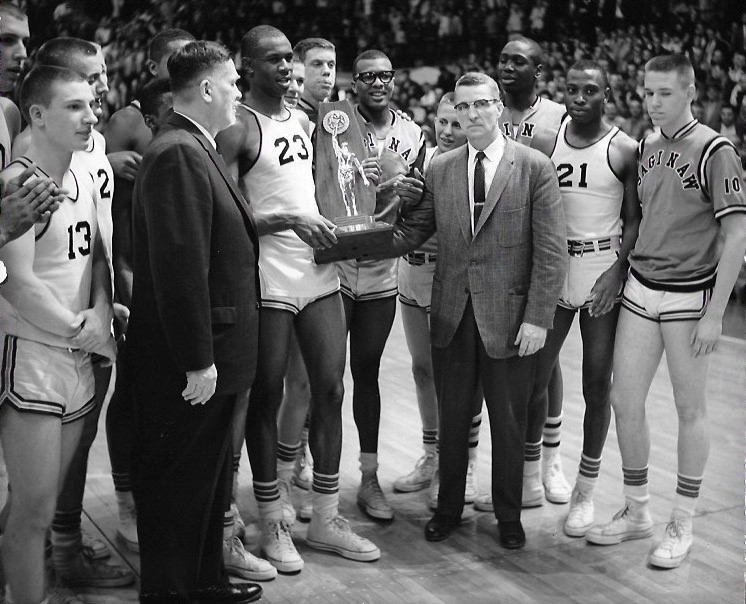
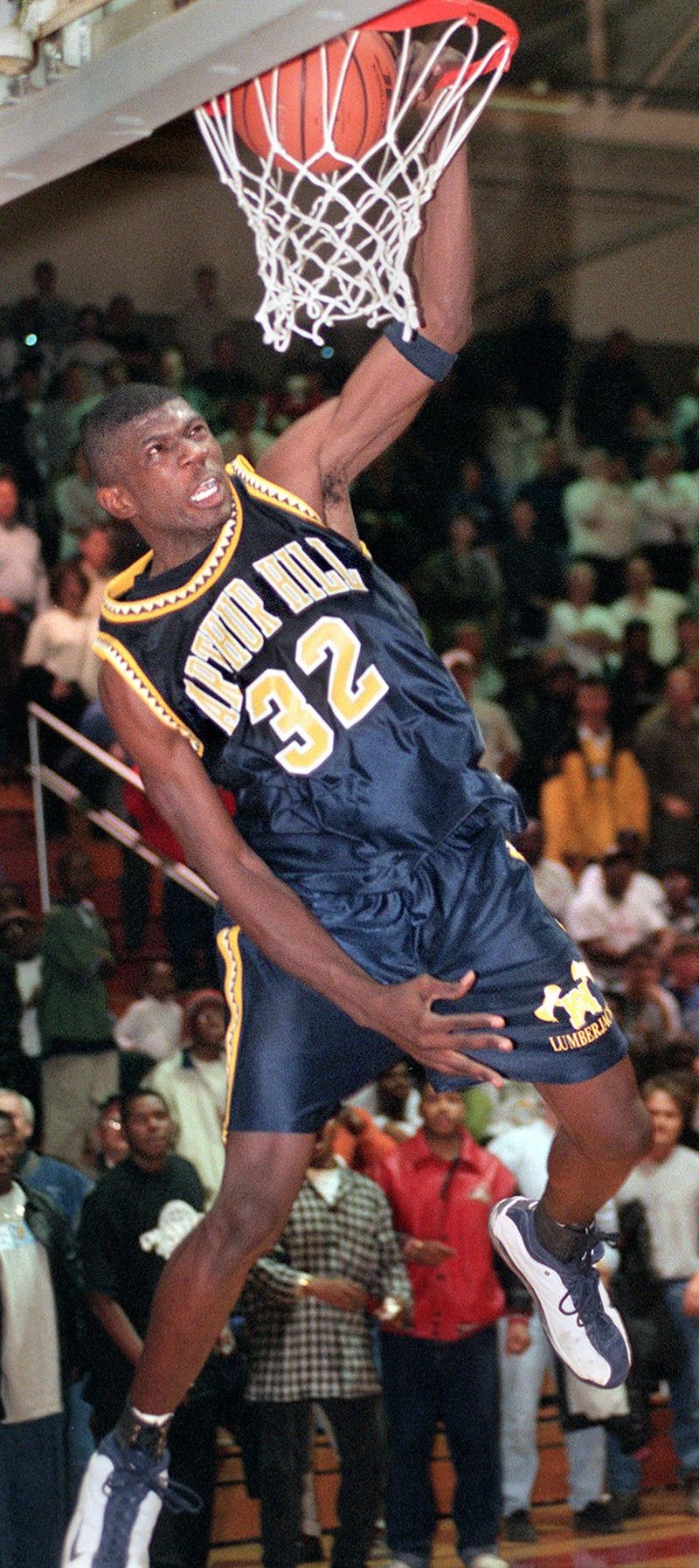
PHOTOS (Top) Saginaw Eugene Seals drives against Arthur Hill’s Jason Richardson – with coach Marshall Thomas in the background – during a sold-out 1999 game at the Saginaw Civic Center. (2) Arthur Hill’s Ernie Thompson and coach Larry Laeding accept the 1962 Class A championship trophy. (3) Saginaw High’s Webster Kirksey (30) puts up a shot; he graduated in 1951. (4) Richard dunks at the final buzzer as Arthur Hill downs top-ranked Flint Northwestern in a 1999 Class A Regional matchup. (Photos collected by Dave Slaggert. Top photo courtesy of Saginaw News/MLive.)