


Keep on Coaching
February 1, 2013
By Geoff Kimmerly
Second Half editor
A few weeks ago, I finally got my first chance this season to watch a friend coach his basketball team. After guiding some others at the lower levels, this is his first time running the varsity – something he wasn't sure he wanted to do with a 1-year-old just learning to walk, but a challenge he ended up taking on to the benefit of all those involved.
Simply put, he’s good. I've seen a lot of teams and a lot of coaches over the past 15 years, and although I wouldn't know much of what to do if I were walking the sideline, I felt pretty qualified in telling him I was impressed – even if he didn't buy that I was offering an unbiased opinion. The best news is he’s gone from not sure about this a few months ago to talking about next season.
We know, at least anecdotally, that coaching continues to get more challenging. The time commitment has grown substantially to make running a program a year-round endeavor in a lot of sports at a lot of schools.
That commitment – especially for coaches with children of their own – was a main reason referred to in a New Haven Post-Chronicle story Saturday that noted 23 football coaching openings in Connecticut at one point this offseason. That state has 146 football teams – meaning roughly 15 percent will have new leaders this fall.
And that got me thinking about my friend, about how glad I am he’s given this a shot, and how I've seen so many others either not do so, or not stick around long despite having some pretty nice success.
A study published last winter in Interscholastic Athletic Administration magazine – a product of the National Interscholastic Athletic Administrators Association – noted some predictable results of a study that sought to determine the biggest challenges faced by first-year high school coaches.
The toughest according to the study was balancing the demands of coaching and teaching, experienced by nearly half the respondents – 98 percent of which coached high school teams and 81 percent of which are teachers.
The next six reasons all were noted by at least 30 percent of those in the study – personal fatigue, securing community support, securing and caring for facilities and equipment, parental contact, keeping non-starting players motivated, dealing with schedule interruptions and motivating athletes to achieve consistent, peak performance.
Nothing there is earth-shaking, and most if not all of these challenges are faced by high school coaches regardless of how long they've been in the field. But I got a little more perspective from some of the 32 items that ranked as least challenging to the first-year leaders – keeping in compliance with state and league regulations, dealing with substance abuse issues, teaching sport skills and creating a positive team atmosphere – things that seem most important, and yet appear to be easiest to do. I’m not sure what that tells us – but I think it tells us something.
Click to check out the entire three-page breakdown of the study, plus the researchers’ recommendations to remedy some of what first-year coaches face.
Giving back to Saginaw
I love reading about high-level athletes – like a star-studded group of alums from Saginaw – giving back to where they got their starts.
Pittsburgh Steelers star LaMarr Woodley made a big impact before the start of this school year by donating $60,000 to cover all participation fees for athletes in his former school district. The Saginaw News’ Hugh Bernreuter writes today about how Woodley (Saginaw High), the Philadelphia 76ers’ Jason Richardson (Saginaw Arthur Hill) and former Oakland Raiders standout Stu Schweigert (Saginaw Heritage) have combined to give more than $865,000 back to their home communities.
Bernreuter also mentions the non-monetary contributions of the Golden State Warriors’ Draymond Green (Saginaw High) and former Indianapolis Colts receiver Blair White (Saginaw Nouvel).
Click to read more about it.
Quote(s) of the Week
While rifling through more papers on my desk, I found an article from the Washington Post from Sept. 2011 titled “How high school sports save our schools.” I was drawn to it in part because I spent more than a decade in a newsroom, and it was a piece by a reporter covering education who instead of reporting on school boards and the like, delved into the importance of interscholastic athletics to education as a whole.
He spoke of how participation continues to grow even as resources dwindle, and of data supporting that extracurriculars like sports are more effective than academic classes in teaching leadership, teamwork, time management and “other skills crucial for success in the workplace.” Later, he mentioned a study noting that those who participate in extracurriculars earned more a decade later.
Click here to read the entre piece. These passages struck me most.
“Coaches might be the only faculty members still allowed by our culture and educational practice to get tough with students not making the proper effort. They have the advantage of teaching what are essentially elective non-credit courses. They can insist on standards of behavior that classroom teachers often cannot enforce because the stakes of dismissing or letting students drop their courses are too high. …
“Students do better in activities they choose. If we provide more of them, led by committed adults … that can make a difference. We know the bad news about education. Dropout rates are high. Achievement scores are stagnant. But sports participation is going up, despite pressure to cut it back. Let’s cheer about that and look for a way to draw in more students.”
Jacques to Receive Forsythe Award for Local Leadership, Peninsula & Statewide Service
By
Geoff Kimmerly
MHSAA.com senior editor
February 1, 2024
Serving as athletic director at Michigan’s northernmost high school, Calumet’s Sean Jacques has impacted student-athletes not only in his community, but across the Upper Peninsula and all the way to the state’s southern borders as a member of the Michigan High School Athletic Association’s Representative Council. To recognize his far-reaching contributions across several leadership roles, Jacques has been selected as the 2024 honoree for the MHSAA’s Charles E. Forsythe Lifetime Achievement Award.
The annual award is in its 47th year and named after former MHSAA Executive Director Charles E. Forsythe, the Association's first full-time and longest-serving chief executive. Forsythe Award recipients are selected each year by the MHSAA Representative Council, based on an individual's outstanding contributions to the interscholastic athletics community at the local, regional and statewide levels. Jacques will be honored during the MHSAA Girls Basketball Finals on March 23 at Michigan State University’s Breslin Center.
A 1985 graduate of Calumet, Jacques taught for one year at Lansing Everett before returning to his alma mater in 1992, when he began teaching primarily technology and metal shop until becoming the athletic director and an assistant principal in 2008. He served in those administrative roles through the end of the 2021-22 school year and currently is an instructor for the Calumet-Laurium-Keweenaw school district’s Upper Peninsula Virtual Academy.
During his tenure as athletic director, Calumet added junior varsity hockey, junior varsity and varsity softball, and varsity baseball, bowling and gymnastics teams. He led facility upgrades including the addition of a turf football field, new locker rooms and an additional gymnasium, creating a home not only for Copper Kings athletes and coaches but for those from all over the northern UP as Calumet is a frequent host of MHSAA District and Regional events plus Coaching Advancement Program (CAP) sessions.
Also under his direction, Calumet became the first Upper Peninsula school to join the MHSAA School Broadcast Program, and he created the high school’s Athletic Hall of Fame in 2012. In 2016, Calumet became the only Upper Peninsula school to earn the prestigious Michigan Exemplary Athletic Program honor from the Michigan Interscholastic Athletic Administrators Association (MIAAA).
“When I became athletic director, my goal was number one, we were going to run a classy program. We were going to do it right. We weren’t going to be lazy about anything, not take the easy road. I wanted to do right for the kids, the school district and the community,” Jacques said. “We went after a lot of different things. It’s very cliché, but we really did try to put kids first. Every decision we made, we always tried to make decisions with that in mind – what’s best for the kids – and worked hard to be innovative and try to run a quality, classy program.”
His impact hardly has been contained to the Keweenaw Peninsula. He served as president of both the Keweenaw Area Athletic Directors group and Upper Peninsula Athletic Directors Association from 2014-22, in addition to serving as commissioner for the Western Peninsula Athletic Conference from 2012-22 and the Great Lakes Hockey Conference from 2009-22. He began his tenure on the Upper Peninsula Athletic Committee in 2014, when he also was first elected to the MHSAA Representative Council as the delegate for Class C and D schools in the Upper Peninsula. He is serving on the MHSAA’s Audit and Finance Committee currently, and will conclude his tenure on Council in December.
Jacques also served as an MIAAA regional representative for more than a decade and was named Regional Athletic Director of the Year by the MIAAA in 2013 and 2016. The Upper Peninsula Athletic Directors Association named him its Upper Peninsula Athletic Director of the Year in 2019.
Jacques also currently is among eight mentors to new athletic administrators across the state as part of the MHSAA’s first-year AD Connection Program. In this role, Jacques directly works with 16 recently-hired athletic directors as they navigate the job’s many and various responsibilities.
“Sean Jacques brings knowledge of so many aspects of school sports, not only the work done day-to-day as an athletic director but as an innovator who developed an athletic department recognized and respected across the state,” MHSAA Executive Director Mark Uyl said. “His community, the Upper Peninsula and Michigan as a whole continue to benefit from his dedication and leadership – and we’re fortunate he’s sharing that expertise with the next generation of athletic directors as part of our mentorship program.”
Jacques has contributed nearly as significantly on the field of play. He has been an MHSAA registered official for 35 years, in hockey for the entirety and adding track & field in 1994-95 and cross country in 2009-10. He officiated at the MHSAA Hockey Finals in 2016 and has served as a board member for the Copper Country Hockey Officials Association, including as its scheduler for 14 years. He has 40 years as a registered official with USA Hockey, serving as officiating supervisor for the Michigan Amateur Hockey Association (MAHA) for 20 years and as Michigan’s referee-in-chief from 2006-15, and he was a member of USA Hockey’s national instructor staff from 1997-2019. An accomplished college official as well, he worked in that capacity for more than 25 seasons, including 15 at the Division I level in the Western Collegiate Hockey Association (WCHA) and Central Collegiate Hockey Association (CCHA).
His time at Calumet has included stepping into many more roles to help provide student-athletes with the fullest possible experience. He served as public address announcer for football for 16 seasons and Calumet hockey for more than a decade. He also lent his voice to radio broadcasts for Calumet volleyball and coached freshman football at the school for two seasons.
Jacques has served on the boards for the Calumet Hockey Association, Calumet All-Sports Booster Club and Calumet High School Band Parents Club, the latter two as treasurer. He remains president of the Hall of Fame board.
“I’m a Calumet grad, and when you’re the athletic director at the school you’re from, I think it’s something a little bit different,” Jacques said. “You bleed the school colors and put that extra effort in because it’s home.”
Jacques played football as a student at Calumet and served as the hockey team’s student equipment manager as a senior. He earned a bachelor’s degree in industrial education in 1989 from Northern Michigan University, and then a master’s in educational administration from NMU in 2000. He received his certified master athletic administrator (CMAA) designation in 2020 from the National Interscholastic Athletic Administrators Association (NIAAA) – becoming the only Upper Peninsula athletic director to achieve that accomplishment.
Jacques also has served his community as a volunteer firefighter since 1991 and as assistant fire chief since 1998.
Past recipients
1978 - Brick Fowler, Port Huron; Paul Smarks, Warren
1979 - Earl Messner, Reed City; Howard Beatty, Saginaw
1980 - Max Carey, Freesoil
1981 - Steven Sluka, Grand Haven; Samuel Madden, Detroit
1982 - Ernest Buckholz, Mt. Clemens; T. Arthur Treloar, Petoskey
1983 - Leroy Dues, Detroit; Richard Maher, Sturgis
1984 - William Hart, Marquette; Donald Stamats, Caro
1985 - John Cotton, Farmington; Robert James, Warren
1986 - William Robinson, Detroit; Irving Soderland, Norway
1987 - Jack Streidl, Plainwell; Wayne Hellenga, Decatur
1988 - Jack Johnson, Dearborn; Alan Williams, North Adams
1989 - Walter Bazylewicz, Berkley; Dennis Kiley, Jackson
1990 - Webster Morrison, Pickford; Herbert Quade, Benton Harbor
1991 - Clifford Buckmaster, Petoskey; Donald Domke, Northville
1992 - William Maskill, Kalamazoo; Thomas G. McShannock, Muskegon
1993 - Roy A. Allen Jr., Detroit; John Duncan, Cedarville
1994 - Kermit Ambrose, Royal Oak
1995 - Bob Perry, Lowell
1996 - Charles H. Jones, Royal Oak
1997 - Michael A. Foster, Richland; Robert G. Grimes, Battle Creek
1998 - Lofton C. Greene, River Rouge; Joseph J. Todey, Essexville
1999 - Bernie Larson, Battle Creek
2000 - Blake Hagman, Kalamazoo; Jerry Cvengros, Escanaba
2001 - Norm Johnson, Bangor; George Lovich, Canton
2002 - John Fundukian, Novi
2003 - Ken Semelsberger, Port Huron
2004 - Marco Marcet, Frankenmuth
2005 - Jim Feldkamp, Troy
2006 - Dan McShannock, Midland; Dail Prucka, Monroe
2007 - Keith Eldred, Williamston; Tom Hickman, Spring Lake
2008 - Jamie Gent, Haslett; William Newkirk, Sanford Meridian
2009 - Paul Ellinger, Cheboygan
2010 - Rudy Godefroidt, Hemlock; Mike Boyd, Waterford
2011 - Eric C. Federico, Trenton
2012 - Bill Mick, Midland
2013 - Jim Gilmore, Tecumseh; Dave Hutton, Grandville
2014 - Dan Flynn, Escanaba
2015 - Hugh Matson, Saginaw
2016 - Gary Hice, Petoskey; Gina Mazzolini, Lansing
2017 - Chuck Nurek, Rochester Hills
2018 - Gary Ellis, Allegan
2019 - Jim Derocher, Negaunee; Fredrick J. Smith, Stevensville
2020 - Michael Garvey, Lawton
2021 - Leroy Hackley Jr., Byron Center; Patti Tibaldi, Traverse City
2022 - Bruce Horsch, Houghton
2023 - Karen Leinaar, Frankfort
The MHSAA is a private, not-for-profit corporation of voluntary membership by more than 1,500 public and private senior high schools and junior high/middle schools which exists to develop common rules for athletic eligibility and competition. No government funds or tax dollars support the MHSAA, which was the first such association nationally to not accept membership dues or tournament entry fees from schools. Member schools which enforce these rules are permitted to participate in MHSAA tournaments, which attract more than 1.4 million spectators each year.
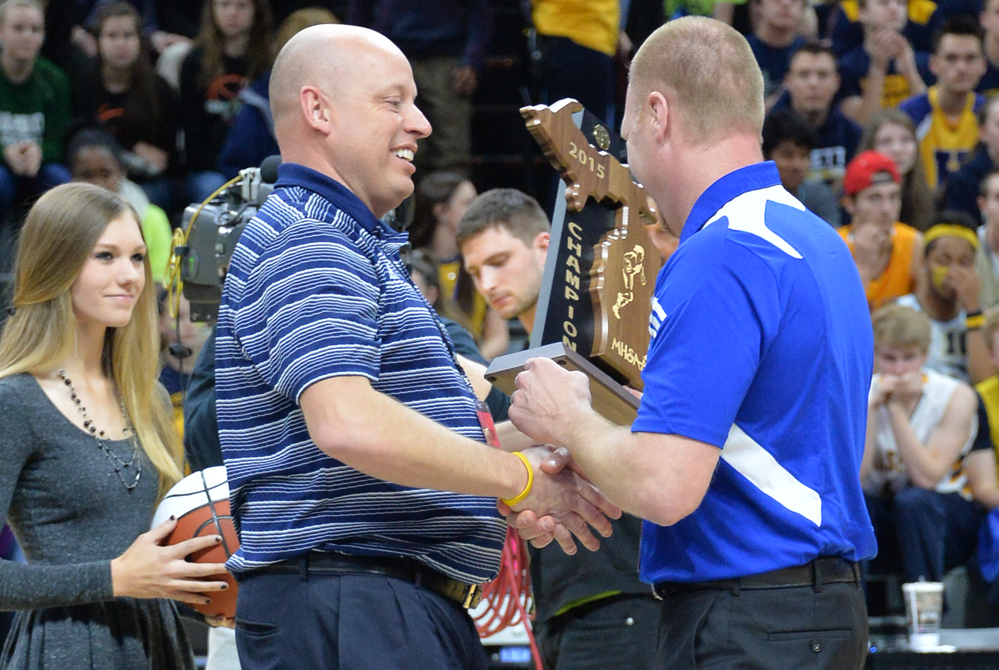
PHOTO Calumet athletic director Sean Jacques, second from left, presents the Class C girls basketball championship trophy to Copper Kings coach Jeff Twardzik in 2015.