


Keep on Coaching
February 1, 2013
By Geoff Kimmerly
Second Half editor
A few weeks ago, I finally got my first chance this season to watch a friend coach his basketball team. After guiding some others at the lower levels, this is his first time running the varsity – something he wasn't sure he wanted to do with a 1-year-old just learning to walk, but a challenge he ended up taking on to the benefit of all those involved.
Simply put, he’s good. I've seen a lot of teams and a lot of coaches over the past 15 years, and although I wouldn't know much of what to do if I were walking the sideline, I felt pretty qualified in telling him I was impressed – even if he didn't buy that I was offering an unbiased opinion. The best news is he’s gone from not sure about this a few months ago to talking about next season.
We know, at least anecdotally, that coaching continues to get more challenging. The time commitment has grown substantially to make running a program a year-round endeavor in a lot of sports at a lot of schools.
That commitment – especially for coaches with children of their own – was a main reason referred to in a New Haven Post-Chronicle story Saturday that noted 23 football coaching openings in Connecticut at one point this offseason. That state has 146 football teams – meaning roughly 15 percent will have new leaders this fall.
And that got me thinking about my friend, about how glad I am he’s given this a shot, and how I've seen so many others either not do so, or not stick around long despite having some pretty nice success.
A study published last winter in Interscholastic Athletic Administration magazine – a product of the National Interscholastic Athletic Administrators Association – noted some predictable results of a study that sought to determine the biggest challenges faced by first-year high school coaches.
The toughest according to the study was balancing the demands of coaching and teaching, experienced by nearly half the respondents – 98 percent of which coached high school teams and 81 percent of which are teachers.
The next six reasons all were noted by at least 30 percent of those in the study – personal fatigue, securing community support, securing and caring for facilities and equipment, parental contact, keeping non-starting players motivated, dealing with schedule interruptions and motivating athletes to achieve consistent, peak performance.
Nothing there is earth-shaking, and most if not all of these challenges are faced by high school coaches regardless of how long they've been in the field. But I got a little more perspective from some of the 32 items that ranked as least challenging to the first-year leaders – keeping in compliance with state and league regulations, dealing with substance abuse issues, teaching sport skills and creating a positive team atmosphere – things that seem most important, and yet appear to be easiest to do. I’m not sure what that tells us – but I think it tells us something.
Click to check out the entire three-page breakdown of the study, plus the researchers’ recommendations to remedy some of what first-year coaches face.
Giving back to Saginaw
I love reading about high-level athletes – like a star-studded group of alums from Saginaw – giving back to where they got their starts.
Pittsburgh Steelers star LaMarr Woodley made a big impact before the start of this school year by donating $60,000 to cover all participation fees for athletes in his former school district. The Saginaw News’ Hugh Bernreuter writes today about how Woodley (Saginaw High), the Philadelphia 76ers’ Jason Richardson (Saginaw Arthur Hill) and former Oakland Raiders standout Stu Schweigert (Saginaw Heritage) have combined to give more than $865,000 back to their home communities.
Bernreuter also mentions the non-monetary contributions of the Golden State Warriors’ Draymond Green (Saginaw High) and former Indianapolis Colts receiver Blair White (Saginaw Nouvel).
Click to read more about it.
Quote(s) of the Week
While rifling through more papers on my desk, I found an article from the Washington Post from Sept. 2011 titled “How high school sports save our schools.” I was drawn to it in part because I spent more than a decade in a newsroom, and it was a piece by a reporter covering education who instead of reporting on school boards and the like, delved into the importance of interscholastic athletics to education as a whole.
He spoke of how participation continues to grow even as resources dwindle, and of data supporting that extracurriculars like sports are more effective than academic classes in teaching leadership, teamwork, time management and “other skills crucial for success in the workplace.” Later, he mentioned a study noting that those who participate in extracurriculars earned more a decade later.
Click here to read the entre piece. These passages struck me most.
“Coaches might be the only faculty members still allowed by our culture and educational practice to get tough with students not making the proper effort. They have the advantage of teaching what are essentially elective non-credit courses. They can insist on standards of behavior that classroom teachers often cannot enforce because the stakes of dismissing or letting students drop their courses are too high. …
“Students do better in activities they choose. If we provide more of them, led by committed adults … that can make a difference. We know the bad news about education. Dropout rates are high. Achievement scores are stagnant. But sports participation is going up, despite pressure to cut it back. Let’s cheer about that and look for a way to draw in more students.”
Brogan Finishes School Sports Career by Teaching Lesson in Perspective
By
Geoff Kimmerly
MHSAA.com senior editor
June 22, 2023
Baylor Brogan admittedly broke down for a moment or two. Who could blame him? Six months of unpredictable lows and highs to finish his senior year of high school sports had just taken another unexpected dive.
 In December, the Lansing Christian senior tore his right ACL playing basketball, ending his hoops season after it had just started. Nine months of anticipated recovery were expected to wipe out his entire golf season too – and after he’d finished eighth in Lower Peninsula Division 4 as a junior in helping the Pilgrims to their first team Finals championship.
But wait. Brogan made it back to the golf course in mid-May after just five months. He played one practice round, and the next day finished fifth individually at his team’s Regional at Ella Sharp Park in Jackson, advancing to the MHSAA Final as the third of three individual qualifiers.
His recovery was remarkable. The story just kept getting better. And if he would have gone on to win the Finals championship two weeks ago, or even place top-10 again, the ending would have been extraordinary.
Instead, he faced another completely unscriptable scenario – but the difficult decision he made launched the latest dip into the highest of notes as he ended his Pilgrims career.
Brogan headed to Battle Creek’s Bedford Valley for the weekend of June 9-10 to finish off his comeback. He thought he’d shot a 79 during Friday’s first round that tied him for 13th – well within range of a potential top-five finish. In golf, playing partners keep track of each other’s scores – and after Brogan’s group finished its 18 holes, he and his partners that round attested to what had been counted on their scorecards, and Brogan figured that was it until Saturday.
But there was a problem.
As he and his two coaches talked through the round after, they realized what had been reported for hole No. 15 was incorrect. It should have included another stroke. His total score should have been 80.
And yet, no one would have known except for those three. But that wouldn’t have sat well with Brogan or his coaches. As soon as they realized the mistake, they contacted the tournament director and rules official.
“For him to say, ‘Hey Coach, I just want to do the right thing,’ and knowing the right thing would potentially DQ you,” Pilgrims head coach Jason Block explained, “I just said, ‘Hey, we’re a Christian school. We have Jesus to answer to.’ I just think putting our heads on the pillow at night knowing we made the right decision for us felt good, and he agreed with that.”
Brogan figured they would just put in the lower score – after all, it was a stroke worse, and the other competitors couldn’t be mad about that. But because Brogan had already attested to the 79 – and by his own admission should have been monitoring his card after every hole while his round was being played – by rule he was disqualified and would have no score for the first round of play.
“When my head coach called me and told me, that’s when the sadness … I definitely cried a little bit,” Brogan said.
But here’s why his weekend will be recalled down the road as the games go on and others every once in a long while find themselves in a similar spot.
Brogan could have gotten angry. He could have blamed his coaches, or his partners, or anyone else supporting him on the course that day for not catching the mistake. He could have questioned the rule, called the disqualification unfair. He could have thrown a fit, made a scene. This was the last event of his high school career, and after he’d already battled back just to get here.
 Instead, he chose grace. He just went back out and played. He would no longer have a chance to place with a two-round score, but also by rule he could still finish the weekend with Saturday’s 18 holes.
“To get DQ’d senior year was kind of a bummer. But in the end it didn’t really matter that much, because they let me play, and my name was still on the leaderboard,” Brogan said. “That’s really all I cared about, is that I could go out and even though it wouldn’t count if I did well, I still wanted to go out and compete. Because that’s what I missed so much from being injured, and that’s all I wanted to do – is still play.
“I just went back out to the range that night. They said I could still play. That was the one thing I could be grateful for. I just went back out and practiced again, and woke up at 6 a.m. the next morning to go play.”
It’s guaranteed Brogan will be sure to monitor every hole on his scorecard as his golf career continues at Wheaton College (Ill.) these next few years. But like his coach, Brogan credited his faith for guiding how he managed this situation. There was an unintentional mishap, and it happens. He needed to accept it and report it, and that’s how he approached it.
Still, Brogan now would have to fill people in on what happened – and that seemed worst of all.
So he sent a group text to his team. Then he waited for his parents to get home from a date night – and they definitely were curious because Block had texted them how sorry he was about the tough news. They had no idea what that meant until Baylor explained – and they told him how proud they were of him for making the right decision.
Brogan’s dad Eric then texted the rest of the family – Baylor is eighth oldest of 10 siblings – and others who had been supporting him. That helped a lot. And the next day, Brogan went out and shot an 80 – a pretty big personal win after missing all but a few weeks of a season, and after the disappointment of the evening before.
“As a coach, he missed the whole season, he comes back like he comes back, and then to have this happen, it would have been very easy to go, ‘Man, can we just forget about it? Can we just not say anything?’” Block said.
But that was never a conversation.
Now, about the hat.
During a spring break trip to Florida six years ago, Brogan and his grandfather Dr. George Bettman were on the golf course. Brogan hadn’t really started playing golf at that point, but he accompanied his grandpa as Bettman shot below his age – 90.
A week later, Dr. Bettman died. Sometime after that, as the family was looking through some of his things, Brogan found the hat. It was way too big for Brogan at that point, but by junior year he was able to wear it with a washcloth lining the inside to make it fit more snugly.
There aren’t a lot of straw hats to be found at Michigan high school golf events, so it’s definitely been something of a Brogan signature as well as a reminder of his grandpa.
“It’s his hat, and I feel like he would love seeing me have some success in golf,” Brogan said, “and probably love even more that I would turn myself in for a mistake.”
 Geoff Kimmerly joined the MHSAA in Sept. 2011 after 12 years as Prep Sports Editor of the Lansing State Journal. He is a senior editor of MHSAA.com's editorial content and has served as MHSAA Communications Director since January 2021. Contact him at [email protected] with story ideas for the Barry, Eaton, Ingham, Livingston, Ionia, Clinton, Shiawassee, Gratiot, Isabella, Clare and Montcalm counties.
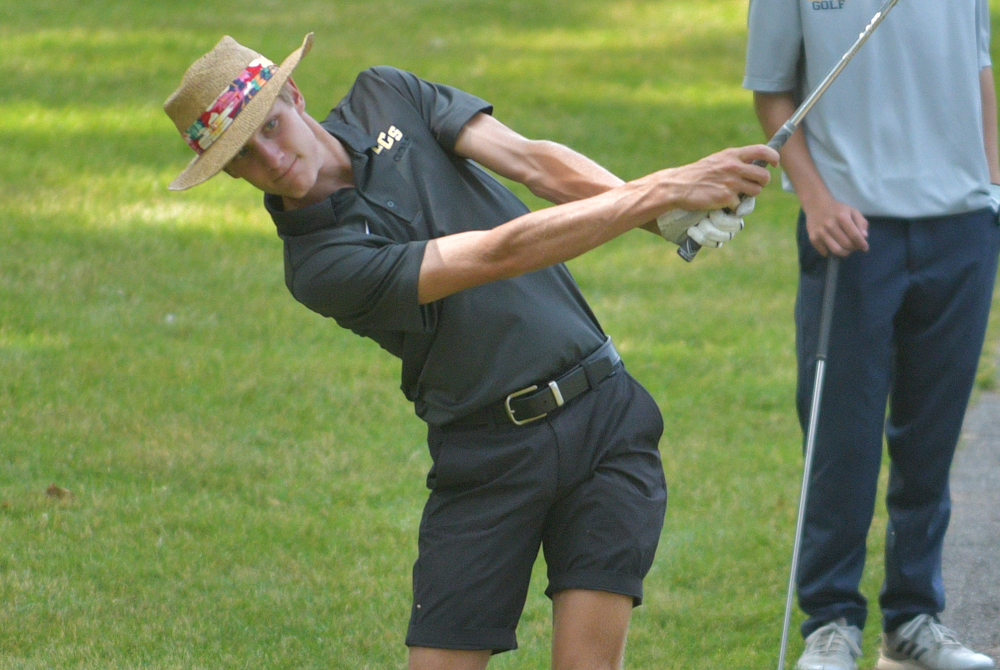
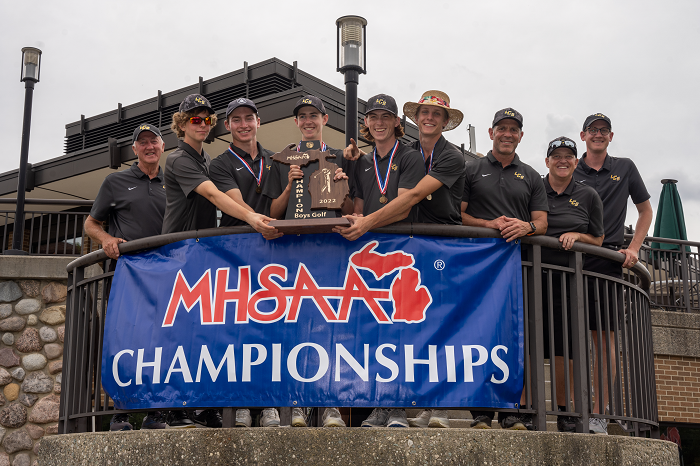
PHOTOS (Top) Lansing Christian's Baylor Brogan follows an approach shot during the LPD4 Final at Bedford Valley. (Middle) Brogan, in the straw hat, celebrates his team's 2022 championship. (Click for more from High School Sports Scene.)