


Keep on Coaching
February 1, 2013
By Geoff Kimmerly
Second Half editor
A few weeks ago, I finally got my first chance this season to watch a friend coach his basketball team. After guiding some others at the lower levels, this is his first time running the varsity – something he wasn't sure he wanted to do with a 1-year-old just learning to walk, but a challenge he ended up taking on to the benefit of all those involved.
Simply put, he’s good. I've seen a lot of teams and a lot of coaches over the past 15 years, and although I wouldn't know much of what to do if I were walking the sideline, I felt pretty qualified in telling him I was impressed – even if he didn't buy that I was offering an unbiased opinion. The best news is he’s gone from not sure about this a few months ago to talking about next season.
We know, at least anecdotally, that coaching continues to get more challenging. The time commitment has grown substantially to make running a program a year-round endeavor in a lot of sports at a lot of schools.
That commitment – especially for coaches with children of their own – was a main reason referred to in a New Haven Post-Chronicle story Saturday that noted 23 football coaching openings in Connecticut at one point this offseason. That state has 146 football teams – meaning roughly 15 percent will have new leaders this fall.
And that got me thinking about my friend, about how glad I am he’s given this a shot, and how I've seen so many others either not do so, or not stick around long despite having some pretty nice success.
A study published last winter in Interscholastic Athletic Administration magazine – a product of the National Interscholastic Athletic Administrators Association – noted some predictable results of a study that sought to determine the biggest challenges faced by first-year high school coaches.
The toughest according to the study was balancing the demands of coaching and teaching, experienced by nearly half the respondents – 98 percent of which coached high school teams and 81 percent of which are teachers.
The next six reasons all were noted by at least 30 percent of those in the study – personal fatigue, securing community support, securing and caring for facilities and equipment, parental contact, keeping non-starting players motivated, dealing with schedule interruptions and motivating athletes to achieve consistent, peak performance.
Nothing there is earth-shaking, and most if not all of these challenges are faced by high school coaches regardless of how long they've been in the field. But I got a little more perspective from some of the 32 items that ranked as least challenging to the first-year leaders – keeping in compliance with state and league regulations, dealing with substance abuse issues, teaching sport skills and creating a positive team atmosphere – things that seem most important, and yet appear to be easiest to do. I’m not sure what that tells us – but I think it tells us something.
Click to check out the entire three-page breakdown of the study, plus the researchers’ recommendations to remedy some of what first-year coaches face.
Giving back to Saginaw
I love reading about high-level athletes – like a star-studded group of alums from Saginaw – giving back to where they got their starts.
Pittsburgh Steelers star LaMarr Woodley made a big impact before the start of this school year by donating $60,000 to cover all participation fees for athletes in his former school district. The Saginaw News’ Hugh Bernreuter writes today about how Woodley (Saginaw High), the Philadelphia 76ers’ Jason Richardson (Saginaw Arthur Hill) and former Oakland Raiders standout Stu Schweigert (Saginaw Heritage) have combined to give more than $865,000 back to their home communities.
Bernreuter also mentions the non-monetary contributions of the Golden State Warriors’ Draymond Green (Saginaw High) and former Indianapolis Colts receiver Blair White (Saginaw Nouvel).
Click to read more about it.
Quote(s) of the Week
While rifling through more papers on my desk, I found an article from the Washington Post from Sept. 2011 titled “How high school sports save our schools.” I was drawn to it in part because I spent more than a decade in a newsroom, and it was a piece by a reporter covering education who instead of reporting on school boards and the like, delved into the importance of interscholastic athletics to education as a whole.
He spoke of how participation continues to grow even as resources dwindle, and of data supporting that extracurriculars like sports are more effective than academic classes in teaching leadership, teamwork, time management and “other skills crucial for success in the workplace.” Later, he mentioned a study noting that those who participate in extracurriculars earned more a decade later.
Click here to read the entre piece. These passages struck me most.
“Coaches might be the only faculty members still allowed by our culture and educational practice to get tough with students not making the proper effort. They have the advantage of teaching what are essentially elective non-credit courses. They can insist on standards of behavior that classroom teachers often cannot enforce because the stakes of dismissing or letting students drop their courses are too high. …
“Students do better in activities they choose. If we provide more of them, led by committed adults … that can make a difference. We know the bad news about education. Dropout rates are high. Achievement scores are stagnant. But sports participation is going up, despite pressure to cut it back. Let’s cheer about that and look for a way to draw in more students.”
Retired NHL-er Back on Ice to Answer Call - By Making Them
By
Rob Kaminski
MHSAA benchmarks editor
March 16, 2023
The most accomplished skater on the ice during Friday’s triple-overtime MHSAA Division 1 Semifinal hockey thriller between Hartland and Brighton was not wearing the school colors of either team.
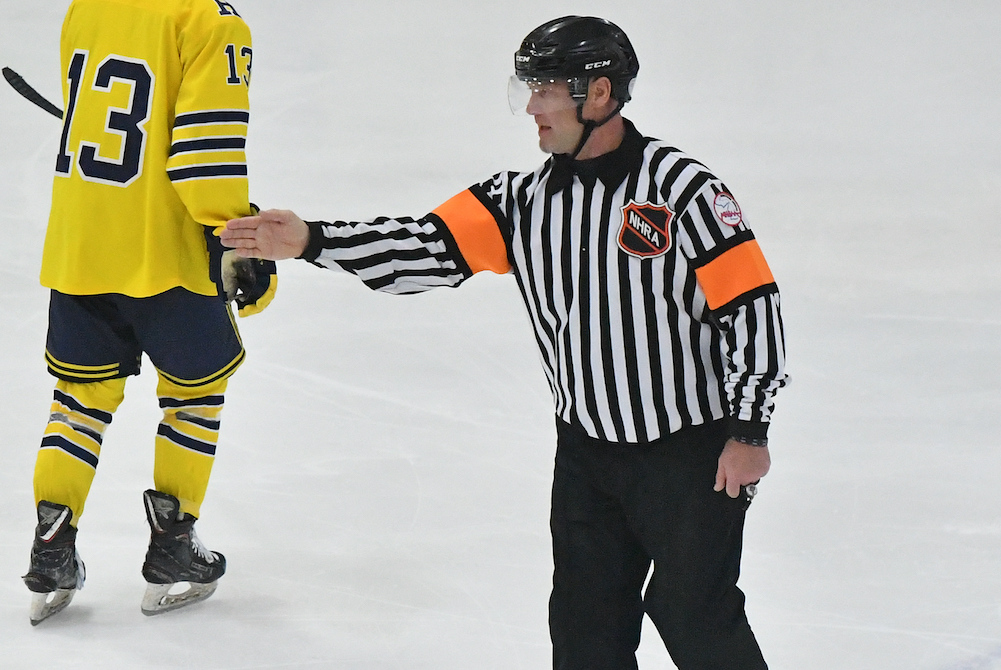
In front of a packed house at Plymouth’s USA Hockey Arena, referee Bryan Smolinski was in stripes, just like the rest of his officiating crew.
In his former life, he pulled on plenty of sweaters before lacing up the skates. That happens when one logs more than 1,000 games, tallies nearly 300 goals (274) and close to 400 assists (377) with eight teams spanning a 15-year playing career in the National Hockey League.
So, how did the 52-year-old former star player find himself on the ice last weekend as one of the referees for the pinnacle weekend of this high school season? Good question, even for the man known as “Smoke” during his playing days.
“I was working in youth development programs a few years back and reached out to some Michigan guys I had connections with about other ways to help the game,” Smolinski said. “I called Kevin May just to chat and asked, ‘Hey, how’s your reffing going?’ He said, ‘You know, we’re down a little bit,’ then said, ‘Why don’t you do it?’ I said, ‘Not a chance,’” Smolinski laughed.
Never Say Never
May persisted, imploring his friend to skate with him during a Fall league at Cranbrook in Bloomfield Hills. After eight weeks, once a week, Smolinski had a revelation.
“I’m like, ‘I’m kind of diggin’ this,’” Smolinski said “So, I did all the testing, and the educational part of it, and I really enjoyed it. I got with Danny (DiCristofaro) and his group, and he put me in as much as he could, and I really started to get my feet wet.”
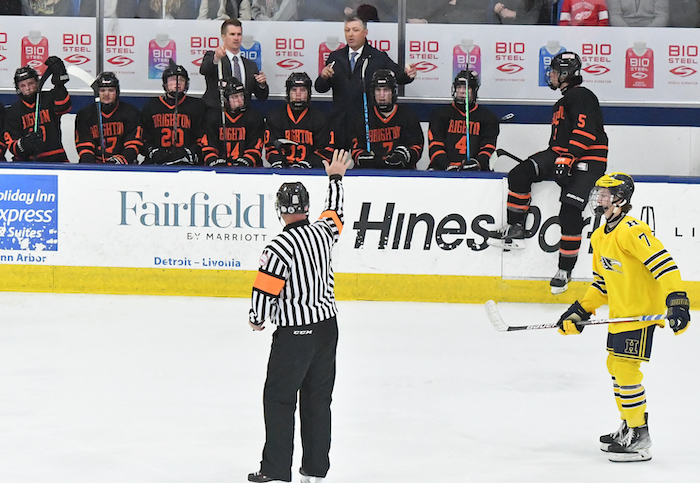 DiCristofaro is the assigner and referee-in-chief for the MHSAA’s Northeast Hockey Referees Association, and he has seen Smolinski’s growth first-hand.
“Obviously he’s got great instincts and a feel for the game, along with a wealth of experience, all of which has allowed him to climb the ladder quickly,” said DiCristofaro. “It’s been a joy to watch his growth as an official.”
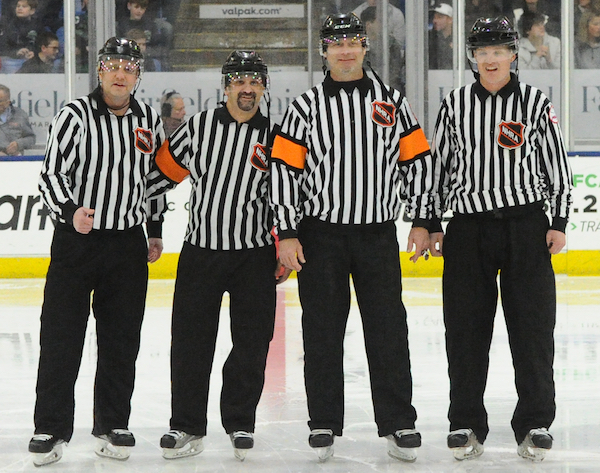
Fast forward to last Friday, and there were Smolinski and May sharing duties as referees during the MHSAA Semifinal with linesmen Michael Andrews and Thomas Robbins.
In between, there has been a learning curve that still continues, but the jump to officiating was not quite as daunting as his introduction to the NHL.
“I was scared to death. My first game was against Mario Lemieux. I’m in the old Boston Garden and now I’m playing against these guys and it’s their job, and they’re out there trying to make a living,” Smolinski recalled.
The emotions were not running nearly as frenzied for his first game as an MHSAA official, obviously, yet respect came in a different form.
“I couldn’t pick the puck up, I was breathing heavily; it was Kevin and me doing a two-man game in Brighton,” Smolinski recalled. “There were a few high-end kids playing, and I’m thinking, ‘I’m dying here.’ You know, there’s no training for that first time.”
What that experience did, however, was revitalize Smolinski in a new way. His playing career is well documented, not only in the NHL, but around Michigan. He enjoyed an honor-laden career at Michigan State University from 1989-93 before joining the Boston Bruins (who had drafted him three years earlier) at the end of the ’93 NHL campaign. Even after his final season, with Montreal in 2007-08, he stayed in the game via men’s leagues, or coaching his son, Max.
Smolinski and his wife, Julie, have three daughters: Ashtyn (22), Jojo (16) and Rylen (12), along with Max, whom dad coached for seven years including during a national championship run with a Little Caesars U15 team in 2019. Max, 19, is now playing collegiately at Rensselaer Polytechnic Institute.
So, for Smolinski, officiating offers a new chapter.
“Reffing brought back ... I wouldn’t say love of the game, because that’s always been there; it’s a different side of enjoying the game now. I have no horse in the race, my son’s off to college, my daughters are doing their thing; I wanted to find something new in the game,” Smolinski said. “I’ve coached, and I don’t want to do that. I found this, and I’ve stuck with it.”
Old College Ties
One of the great benefits of athletics at any level are the friendships made. For two kids who met in their first years on the MSU campus and forged a bond that lasts to this day, it’s amazing how their careers reached the pinnacle and have now come full circle.
Wes McCauley, an MSU teammate, is one of Smolinski’s best friends. After numerous years in the minor leagues, McCauley, like his friend, made it to the NHL. But McCauley made it as an official, working his first NHL game in 2003, when Smolinski was nearing the end of his playing career.
 Their games lined up on just a few occasions in the NHL, and the two lobbied hard to have McCauley work Smolinski’s 1,000th career game in his final season with the Canadiens in 2007-08. The request, sadly, was denied by the league.
On the rare occasions when the friends did share the same ice, less than a handful by Smolinski’s count, it was McCauley who was forced to rebuff any attempts at fraternization. It’s just part of an official’s edict.
“For both of us, it was amazing; it was just great,” Smolinski said. “I’d say, ‘Hey man what’s up?’ and he says, ‘Can’t talk.’ I’m like, ‘What do you mean, we talk all the time.’ Again, he’s like, ‘Can’t talk, get away from me.’ You know, it was just business.”
McCauley then reached the 1,000-game plateau himself in 2018 and is still going strong as a regular selection for playoff duties with nine Stanley Cup Finals assignments, including last year.
So, it should have been natural for Smolinski to go to his old friend immediately for officiating pointers once he joined the ranks, right? Well, maybe not immediately.
“I talk to Wes all the time, but I actually hid it from him right out of the gate because I didn’t want to take his razzing. Eventually it got out, and he was loving it. He started sending me whistles and visors and pants,” Smolinski said, grinning. “And none of it fit, you know, because I’m older and fatter, and he’s so damn skinny. So, I still had to go out and get all new gear.”
Both Sides Now
Having been to the top of his profession, now moving to the other side of that same mountain that his friend McCauley scaled, the respect has grown for those blowing the whistle.
“The preparation for officiating is much more mental,” Smolinski said. “Way more rules oriented. You’re always trying to get away with things that you can as a player; now you have to police that.”
Smolinski has a distinct advantage.
“I know everything they’re trying to do because I’ve done it. I know where you’re going with the puck, I know what kind of breakout you’re trying to do,” Smolinski said. “I have all the instincts, now I just try to stay out of the way and not ruin their game. The most fun is watching the game develop and the ups and downs. For me to be out there and enjoy it with them, that’s the fun part.”
 Those who have played hockey at any level have a built-in advantage should they consider the officiating avocation: the ability to skate. Unlike officiating in any other sport, skating is a prerequisite. This makes the pool limited, and almost solely composed of former players. Smolinski offers this advice.
“I prefer sticking with high school because I think there’s more decorum, more administrative structure. Kids are playing for their schools, there’s loyalty there,” said Smolinski. “And there is more accountability. People need report to athletic directors and supervisors. Other levels can be more loosely governed, or a bit more maverick in nature. Moms and dads get involved more, coaches maybe know a little less,” said Smolinski.
He has, in fact, worked a handful of non-school games, and there’s a stark difference.
“I wanted to see what was going on, and I see it first-hand,” Smolinski said. “There are some crazy people and parents out there, and these guys are getting absolutely tortured. I’ve been tortured. There has to be a level of respect for what officials do. I think schools can rein that in a little more. All the guys I’ve met give up a lot of time and work hard because they love to do it and love the game.”
All sports need an assist from school administration and from those who once played the games to keep the officials recruitment moving in the right direction. People like Smolinski can help.
“He clearly doesn’t need to do this, and that’s what makes it so fantastic,” DiCristofaro said. “We need more people who have played – at any level – to do what he’s done and stay in the game as officials.”
Smolinski continues to promote the game in other ways as well. Currently, he is involved in the NHL’s Learn To Play initiative, which aims to inspire youth and welcome more families into the hockey community.
“We work hand-in-hand with the NHL Players Association for player development and industry growth,” Smolinski said. “Ages 5 to 9 are introduced to hockey, get head-to-toe gear and instruction, and meet some former players.”
The idea is to have fun first, which can translate into years and maybe even a lifetime in the sport. It’s a lifetime that has given Smolinski so much and continues to do so as he watches it unfold for others from his new vantage point.
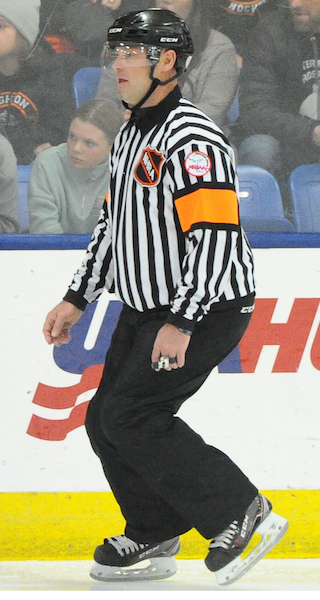
PHOTOS (Top) MHSAA official Bryan Smolinski signals during Friday's Division 1 Semifinal between Brighton and Hartland. (2) Smolinski, a retired NHL standout, communicates with the Bulldogs' bench. (3) Smolinski keeps watch during game play. (4) Smolinski, third from left, with his crew: Michael Andrews, Kevin May and Thomas Robbins.