


Keep on Coaching
February 1, 2013
By Geoff Kimmerly
Second Half editor
A few weeks ago, I finally got my first chance this season to watch a friend coach his basketball team. After guiding some others at the lower levels, this is his first time running the varsity – something he wasn't sure he wanted to do with a 1-year-old just learning to walk, but a challenge he ended up taking on to the benefit of all those involved.
Simply put, he’s good. I've seen a lot of teams and a lot of coaches over the past 15 years, and although I wouldn't know much of what to do if I were walking the sideline, I felt pretty qualified in telling him I was impressed – even if he didn't buy that I was offering an unbiased opinion. The best news is he’s gone from not sure about this a few months ago to talking about next season.
We know, at least anecdotally, that coaching continues to get more challenging. The time commitment has grown substantially to make running a program a year-round endeavor in a lot of sports at a lot of schools.
That commitment – especially for coaches with children of their own – was a main reason referred to in a New Haven Post-Chronicle story Saturday that noted 23 football coaching openings in Connecticut at one point this offseason. That state has 146 football teams – meaning roughly 15 percent will have new leaders this fall.
And that got me thinking about my friend, about how glad I am he’s given this a shot, and how I've seen so many others either not do so, or not stick around long despite having some pretty nice success.
A study published last winter in Interscholastic Athletic Administration magazine – a product of the National Interscholastic Athletic Administrators Association – noted some predictable results of a study that sought to determine the biggest challenges faced by first-year high school coaches.
The toughest according to the study was balancing the demands of coaching and teaching, experienced by nearly half the respondents – 98 percent of which coached high school teams and 81 percent of which are teachers.
The next six reasons all were noted by at least 30 percent of those in the study – personal fatigue, securing community support, securing and caring for facilities and equipment, parental contact, keeping non-starting players motivated, dealing with schedule interruptions and motivating athletes to achieve consistent, peak performance.
Nothing there is earth-shaking, and most if not all of these challenges are faced by high school coaches regardless of how long they've been in the field. But I got a little more perspective from some of the 32 items that ranked as least challenging to the first-year leaders – keeping in compliance with state and league regulations, dealing with substance abuse issues, teaching sport skills and creating a positive team atmosphere – things that seem most important, and yet appear to be easiest to do. I’m not sure what that tells us – but I think it tells us something.
Click to check out the entire three-page breakdown of the study, plus the researchers’ recommendations to remedy some of what first-year coaches face.
Giving back to Saginaw
I love reading about high-level athletes – like a star-studded group of alums from Saginaw – giving back to where they got their starts.
Pittsburgh Steelers star LaMarr Woodley made a big impact before the start of this school year by donating $60,000 to cover all participation fees for athletes in his former school district. The Saginaw News’ Hugh Bernreuter writes today about how Woodley (Saginaw High), the Philadelphia 76ers’ Jason Richardson (Saginaw Arthur Hill) and former Oakland Raiders standout Stu Schweigert (Saginaw Heritage) have combined to give more than $865,000 back to their home communities.
Bernreuter also mentions the non-monetary contributions of the Golden State Warriors’ Draymond Green (Saginaw High) and former Indianapolis Colts receiver Blair White (Saginaw Nouvel).
Click to read more about it.
Quote(s) of the Week
While rifling through more papers on my desk, I found an article from the Washington Post from Sept. 2011 titled “How high school sports save our schools.” I was drawn to it in part because I spent more than a decade in a newsroom, and it was a piece by a reporter covering education who instead of reporting on school boards and the like, delved into the importance of interscholastic athletics to education as a whole.
He spoke of how participation continues to grow even as resources dwindle, and of data supporting that extracurriculars like sports are more effective than academic classes in teaching leadership, teamwork, time management and “other skills crucial for success in the workplace.” Later, he mentioned a study noting that those who participate in extracurriculars earned more a decade later.
Click here to read the entre piece. These passages struck me most.
“Coaches might be the only faculty members still allowed by our culture and educational practice to get tough with students not making the proper effort. They have the advantage of teaching what are essentially elective non-credit courses. They can insist on standards of behavior that classroom teachers often cannot enforce because the stakes of dismissing or letting students drop their courses are too high. …
“Students do better in activities they choose. If we provide more of them, led by committed adults … that can make a difference. We know the bad news about education. Dropout rates are high. Achievement scores are stagnant. But sports participation is going up, despite pressure to cut it back. Let’s cheer about that and look for a way to draw in more students.”
Fast-Building Fowlerville Bowling Program Growing Into Striking Success
By
Geoff Kimmerly
MHSAA.com senior editor
January 26, 2023
HOWELL – The Fowlerville bowling program started with a question.
 Brent Wood was an eighth grader, bowling in the local rec department junior high league, when he saw the Howell High School team practicing a few lanes over one afternoon. He’d enjoyed bowling with his family growing up, but what grabbed his attention that day was the friendly atmosphere at the Highlanders’ practice – everyone seemed to be having fun.
So he asked his mom Denise, a speech therapist in the Fowlerville district, why their school didn’t have a team too.
She went to athletic director Brian Osborn for the answer, and it was a pretty simple one – the athletic department hadn’t been able to find a coach to start one up.
“I’m the kind of mom that if my kid wants it, I’ll see how I can make it happen,” Denise Wood said. “And when Brent is driven by something, I know he’ll do well at it.”
Denise Wood figured out how to bring high school bowling to Fowlerville – and then some.
Never before a coach, nor a bowler outside of family fun, she agreed to start a Gladiators high school bowling program – one that four years later has two varsities and a JV team and had to make cuts this winter for the first time.
Building any program from ground level is full of challenges. Throw in a pandemic, and it gets tougher for sure. But knocking down obstacles has been like knocking down pins – it’s a bit of a theme for the quickly-growing program, its coach and the now-senior who got things rolling.
Bowling began for Brent
Brent Wood had played baseball and flag football and wrestled growing up. He tried everything his mom would let him, and that’s impressive enough – he doesn’t have a complete right hip, just bone on bone where the femur and pelvis meet.
 Considering that challenge, opportunities in those other sports faded as he grew older. And he wasn’t a big fan of school either. But Denise Wood knew a bowling team would motivate Brent to stay active and do well academically.
Does it hurt where that hip padding should be? Brent said no – it just feels like what he knows to be normal. But Mom said she can tell when it does, and he’s had 13 surgeries over the years. Brent still managed to play those sports and learn how to ride a bike with just his left leg – “and I still manage to bowl somewhat decent some days,” he said.
He’s actually become an all-league bowler – most recently finishing ninth at the White Lake Lakeland Invitational last weekend – while employing an uncommon style.
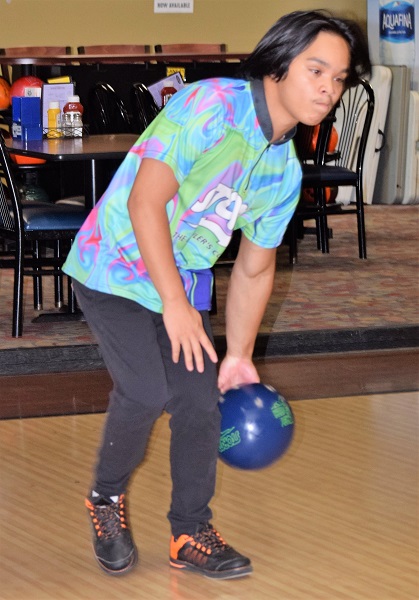
Generally, a left-handed bowler will land on the right foot when releasing the ball. Wood instead lands on his left, or opposite foot, to stay off the right one.
Denise Wood describes it as being a “very non-traditional single-handed lefty who has figured out how to make it work.” Brent said when he first started this bowling style, it was a little complicated – but last summer he took lessons and upped his knowledge by competing in a number of tournaments and against a variety of oil patterns. Additionally, “Over the summer I’ve seen one or two people land on the wrong foot like I do,” Wood said, “so I know I’m not the only one who does it.”
He'll be the second Fowlerville bowler to continue at the college level. He’ll join friend Trevor Cockerill, who graduated last year, at nearby Cleary University where he’ll compete for coach Hayley Dann – who impressed the family by telling them that instead of trying to change Brent’s style, she’ll “work with him with what he’s got,” Denise Wood recalled.
“That’s the coach I need, because that’s what Brent does – he works with what he’s got,” Denise said. “Brent is naturally athletically talented, and when it comes to stuff that’s athletic he’s quite the problem solver. He figures out how to do things.”
Starting from scratch
Mom figured things out, too.
Denise Wood calls herself a “google coach” – as in, she googles to learn drills and pick up tips on how to better guide the Gladiators. But considering the system she and her assistants have built over a short time, she’s not giving herself enough credit.
When Wood first asked Osborn why there wasn’t a program, she followed up by asking if a potential coach needed to be a good bowler. Osborn said not necessarily – if she was willing to learn the bowling side, he would help with how school-based sports work and take care of as much paperwork as possible.
 Challenge accepted.
First, the team needed somewhere to bowl. Fowlerville has made its home at Howell’s Bowl-E-Drome, about a 20-minute drive for practices twice a week.
The bowlers arrived. Fowlerville’s first season in 2019-20 saw 10 boys and two girls come out, making up a co-ed varsity and boys junior varsity team.
Next came “learning the bowling side” – and definitely, the internet helped. Mining various bowling websites and coaching resources, she’s put together a series of drills – all of her bowlers have copies of each in a folder they keep on hand – and with assistants Kelli Wilbur and Kevin Mahon designed practices to begin at the start of the season with skills assessments and then be organized by ability level to provide for more focused attention and instruction. The bowlers also make use of the school’s weight room one day a way – adjusting all of this around schedules for students who also dance, play in the band and train for other sports.
Wilbur and Mahon are experienced bowlers, and their additions have allowed Wood the last few years to focus more on team-building activities and administrative responsibilities like signing up for tournaments and data collection. For competitions, the three coaches take turns coaching each team so that all three become familiar with all of the Gladiators’ styles.
The majority of the bowlers are newcomers to the sport. Junior Emma Wilbur – Kelli’s daughter and the top roller on the girls team – counted herself and two more teammates who had grown up bowling.
“A lot of kids that come in, come in with no bowling experience whatsoever. They just heard it was fun, they wanted to be part of a team,” Wood said. “So this year we actually did an interview for the kids – they had to fill out a personal interview for why they came out for bowling. A lot of it was to have fun, become part of a team, and some kids said to become a better bowler.”
Turning to Paige
After a promising start, the program simply had to survive its second year.
With COVID-19 making everything more complicated, Fowlerville found itself with only five bowlers for the 2020-21 season – and couldn’t even bowl as a team at its Regional with Emma Wilbur in quarantine. Families weren’t allowed to watch competitions, and just getting the word out was a challenge.
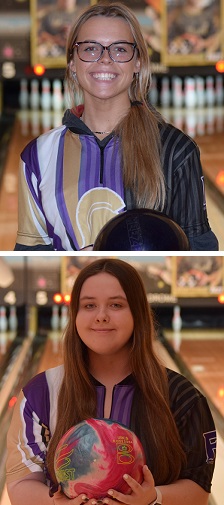 But Paige Frazier saved the day, figuratively speaking – and more realistically, potentially the program.
She solved some of the information block by starting Facebook and Instagram feeds for the bowling program that included video streams of competitions and updated information on cancelations and quarantines. “It definitely brought in a lot of attention,” Frazier remembered.
“If we hadn’t had Paige our COVID year, we wouldn’t have had a season at all,” Wood said. “Paige, I call her my female rock, because she kept the team alive.”
The work done during the COVID season paid off as the team got back in gear for last winter. The bowlers added to their social media marketing by hanging up fliers and getting word out on the program in the school’s morning announcements, and for 2021-22 enough bowlers came out to have separate girls and boys varsities for the first time.
“I had a lot of people ask me about it. A lot of people didn’t even know about it for a good two years,” Emma Wilbur said. “I had a couple friends who said they would try it out.”
Off and rolling again
The interview results from tryouts this season check out. While the team is serious about competing and succeeding, having fun and being part of a team are top priorities for most. The car rides to practices and bus rides to competitions are the best parts.
There’s still some convincing to do among classmates who might not consider bowling a sport. “They laugh about it until they find out we have a 1:30 dismissal for all the meets,” Wilbur said. But she and Frazier both play other sports too – Wilbur soccer and Frazier tennis – and realize the value in what they’ve helped create.
“I think being able to do something that you love to do, with all of your friends, a sport that you can go and do on the weekends and go and do after school … anytime that you want to you can go and do that,” Wilbur noted.
“Bowling's a really social sport,” Frazier added, “so you just learn to get along really well with your teammates, and just kinda relax and enjoy it.”
The Gladiators bowl in league matches once a week and have tournaments most January and February weekends through the regular season. Osborn said he’s excited to see so much interest at each grade level and is hopeful the program will continue to grow.
Brent Wood asked a winning question. The answer has been even better.
“It’s nice to see that we got everyone together that loves to do what we love to do,” Brent Wood said.
“Just seeing everyone enjoy the moment.”
 Geoff Kimmerly joined the MHSAA in Sept. 2011 after 12 years as Prep Sports Editor of the Lansing State Journal. He is a senior editor of MHSAA.com's editorial content and has served as MHSAA Communications Director since January 2021. Contact him at [email protected] with story ideas for the Barry, Eaton, Ingham, Livingston, Ionia, Clinton, Shiawassee, Gratiot, Isabella, Clare and Montcalm counties.
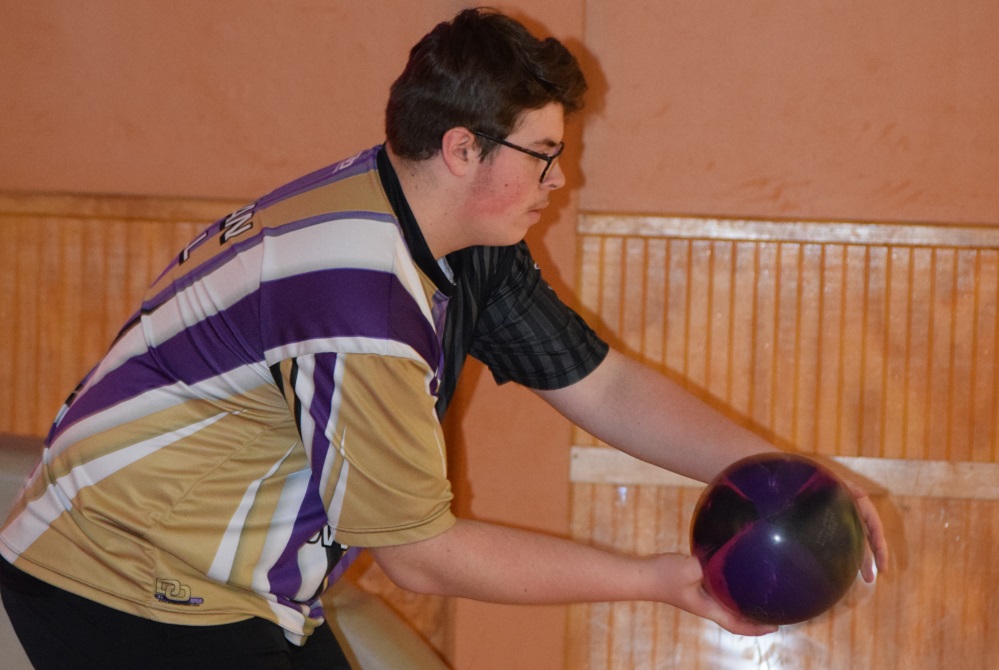
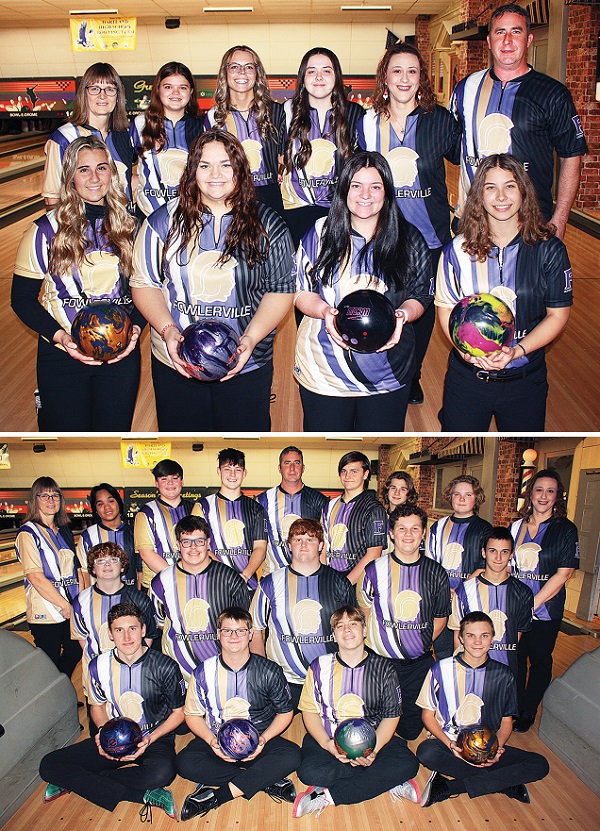
PHOTOS (Top) Fowlerville bowler Ethan Hall begins his approach. (2) Brent Wood shows his left-handed, left-footed bowling style. (3) Fowlerville’s Paige Frazier, top, and Emma Wilbur. (4) Fowlerville’s girls and boys teams this season, including head coach Denise Wood, top row far left, and assistants Kevin Mahon and Kelli Wilbur. (Photos courtesy of the Fowlerville bowling program.)