


Keep on Coaching
February 1, 2013
By Geoff Kimmerly
Second Half editor
A few weeks ago, I finally got my first chance this season to watch a friend coach his basketball team. After guiding some others at the lower levels, this is his first time running the varsity – something he wasn't sure he wanted to do with a 1-year-old just learning to walk, but a challenge he ended up taking on to the benefit of all those involved.
Simply put, he’s good. I've seen a lot of teams and a lot of coaches over the past 15 years, and although I wouldn't know much of what to do if I were walking the sideline, I felt pretty qualified in telling him I was impressed – even if he didn't buy that I was offering an unbiased opinion. The best news is he’s gone from not sure about this a few months ago to talking about next season.
We know, at least anecdotally, that coaching continues to get more challenging. The time commitment has grown substantially to make running a program a year-round endeavor in a lot of sports at a lot of schools.
That commitment – especially for coaches with children of their own – was a main reason referred to in a New Haven Post-Chronicle story Saturday that noted 23 football coaching openings in Connecticut at one point this offseason. That state has 146 football teams – meaning roughly 15 percent will have new leaders this fall.
And that got me thinking about my friend, about how glad I am he’s given this a shot, and how I've seen so many others either not do so, or not stick around long despite having some pretty nice success.
A study published last winter in Interscholastic Athletic Administration magazine – a product of the National Interscholastic Athletic Administrators Association – noted some predictable results of a study that sought to determine the biggest challenges faced by first-year high school coaches.
The toughest according to the study was balancing the demands of coaching and teaching, experienced by nearly half the respondents – 98 percent of which coached high school teams and 81 percent of which are teachers.
The next six reasons all were noted by at least 30 percent of those in the study – personal fatigue, securing community support, securing and caring for facilities and equipment, parental contact, keeping non-starting players motivated, dealing with schedule interruptions and motivating athletes to achieve consistent, peak performance.
Nothing there is earth-shaking, and most if not all of these challenges are faced by high school coaches regardless of how long they've been in the field. But I got a little more perspective from some of the 32 items that ranked as least challenging to the first-year leaders – keeping in compliance with state and league regulations, dealing with substance abuse issues, teaching sport skills and creating a positive team atmosphere – things that seem most important, and yet appear to be easiest to do. I’m not sure what that tells us – but I think it tells us something.
Click to check out the entire three-page breakdown of the study, plus the researchers’ recommendations to remedy some of what first-year coaches face.
Giving back to Saginaw
I love reading about high-level athletes – like a star-studded group of alums from Saginaw – giving back to where they got their starts.
Pittsburgh Steelers star LaMarr Woodley made a big impact before the start of this school year by donating $60,000 to cover all participation fees for athletes in his former school district. The Saginaw News’ Hugh Bernreuter writes today about how Woodley (Saginaw High), the Philadelphia 76ers’ Jason Richardson (Saginaw Arthur Hill) and former Oakland Raiders standout Stu Schweigert (Saginaw Heritage) have combined to give more than $865,000 back to their home communities.
Bernreuter also mentions the non-monetary contributions of the Golden State Warriors’ Draymond Green (Saginaw High) and former Indianapolis Colts receiver Blair White (Saginaw Nouvel).
Click to read more about it.
Quote(s) of the Week
While rifling through more papers on my desk, I found an article from the Washington Post from Sept. 2011 titled “How high school sports save our schools.” I was drawn to it in part because I spent more than a decade in a newsroom, and it was a piece by a reporter covering education who instead of reporting on school boards and the like, delved into the importance of interscholastic athletics to education as a whole.
He spoke of how participation continues to grow even as resources dwindle, and of data supporting that extracurriculars like sports are more effective than academic classes in teaching leadership, teamwork, time management and “other skills crucial for success in the workplace.” Later, he mentioned a study noting that those who participate in extracurriculars earned more a decade later.
Click here to read the entre piece. These passages struck me most.
“Coaches might be the only faculty members still allowed by our culture and educational practice to get tough with students not making the proper effort. They have the advantage of teaching what are essentially elective non-credit courses. They can insist on standards of behavior that classroom teachers often cannot enforce because the stakes of dismissing or letting students drop their courses are too high. …
“Students do better in activities they choose. If we provide more of them, led by committed adults … that can make a difference. We know the bad news about education. Dropout rates are high. Achievement scores are stagnant. But sports participation is going up, despite pressure to cut it back. Let’s cheer about that and look for a way to draw in more students.”
Koehler Gives State Power Rochester Another Championship-Caliber Leader
By
Keith Dunlap
Special for MHSAA.com
December 8, 2022
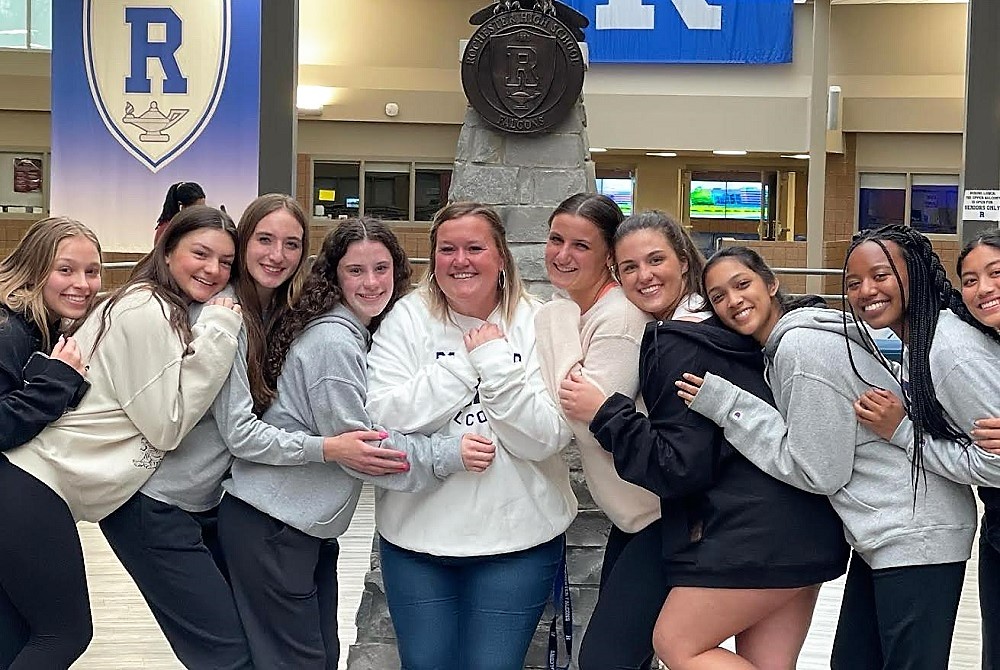
ROCHESTER HILLS – Understandably, Rochester competitive cheer head coach Samantha Koehler might not know exactly the emotions she will feel Friday.
 After all, the occasion will mark a first in more than four decades with a Rochester program that’s historically been considered the gold standard in the state.
When the Falcons compete at their first competition of the season at Troy, it will be the first time since 1981 that somebody other than the legendary Susan Wood will be at the helm of the program.
“Even with a change in leadership, we’re eager to show the world that Rochester cheer is back and better than ever,” Koehler said.
While there will probably be some nervousness, it also might be a relief to actually get into competition mode after an offseason of transition.
Following Rochester’s fifth-place finish in March at the Division 1 Final, Wood announced her retirement after 41 years as head coach.
All Wood (formerly Susan McVeigh) did during her tenure was lead Rochester to 14 MHSAA Finals championships and three runner-up finishes between 1994 and 2017.
She also led Rochester to five Michigan Cheerleading Coaches Association state titles and three runner-up finishes before competitive cheerleading became an MHSAA-sponsored sport in 1994.
In 36 out of 41 years with Wood in charge, Rochester competed in Finals of either MHSAA or MCCA state tournaments.
But rather than look at this as having to replace an irreplaceable legend, Koehler is looking at it as a chance to continue Rochester’s rich tradition – and such an opportunity was simply too good to pass up.
 “Yes, this position comes with a lot of high expectations and pressure,” Koehler admitted, while also praising the parents and team members who have helped make the transition easier. “But like George S. Patton, Jr. once said, pressure makes diamonds.”
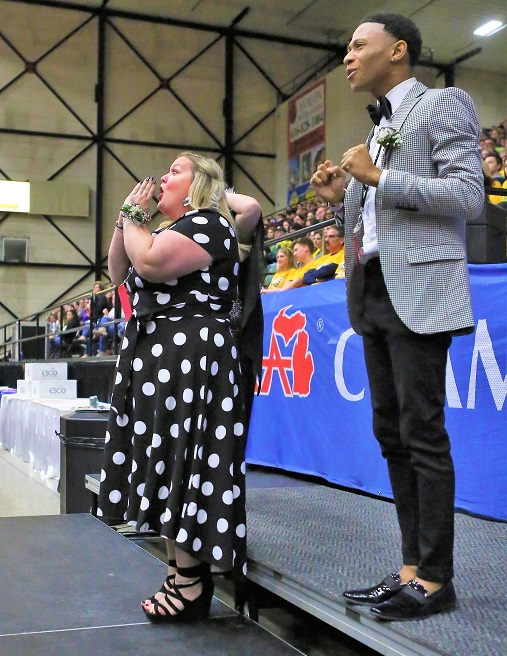
Koehler has had plenty of success as well, having spent the last seven years as head coach at Plymouth High School, where she was named Michigan cheer Coach of the Year in 2020 after leading Plymouth to a runner-up finish in Division 1.
She also has served as the head cheerleading coach at Wayne State University and on the board for the state coaches association.
“We wanted somebody with experience that coached at a high level and had success at a high level, because that’s where we are,” Rochester athletic director Dean Allen said. “The bar is high, and keep it there. Just keep Rochester cheer as the preeminent program in the state of Michigan. That was our goal.”
Allen said the biggest challenge has been for Koehler to balance out bringing in her own ideas, but also maintaining traditions that have made the program what it is.
So far, so good.
“She’s been able to do that,” Allen said.
While the last few months have been all about getting to know her new team and community, the coming winter will be about trying to get Rochester back on top at the Finals in March.
The Falcons haven’t won Division 1 since 2017, and have seen city rivals Stoney Creek (in 2019) and Rochester Adams (2020 and 2021) claim the last three championships between them.
“We are fortunate enough to compete against two of the best teams in the state frequently throughout the season,” Koehler said. “Competing against Adams and Stoney betters our program by motivating athletes and coaches to be the best we can be each and every day. With such a talented and dedicated group of athletes, we are excited and eager to challenge our city rivals for that state championship.”
 Keith Dunlap has served in Detroit-area sports media for more than two decades, including as a sportswriter at the Oakland Press from 2001-16 primarily covering high school sports but also college and professional teams. His bylines also have appeared in USA Today, the Washington Post, the Detroit Free Press, the Houston Chronicle and the Boston Globe. He served as the administrator for the Oakland Activities Association’s website from 2017-2020. Contact him at [email protected] with story ideas for Oakland, Macomb and Wayne counties.
PHOTOS (Top) Samantha Koehler, middle, is taking over the Rochester High competitive cheer program this season. (Middle) Koehler, with her Plymouth assistants, coach their team during the 2020 Division 1 Final. (Top photo courtesy of Dean Allen/Rochester Athletics. Middle photo by Hockey Weekly Action Photos.)