


Keep on Coaching
February 1, 2013
By Geoff Kimmerly
Second Half editor
A few weeks ago, I finally got my first chance this season to watch a friend coach his basketball team. After guiding some others at the lower levels, this is his first time running the varsity – something he wasn't sure he wanted to do with a 1-year-old just learning to walk, but a challenge he ended up taking on to the benefit of all those involved.
Simply put, he’s good. I've seen a lot of teams and a lot of coaches over the past 15 years, and although I wouldn't know much of what to do if I were walking the sideline, I felt pretty qualified in telling him I was impressed – even if he didn't buy that I was offering an unbiased opinion. The best news is he’s gone from not sure about this a few months ago to talking about next season.
We know, at least anecdotally, that coaching continues to get more challenging. The time commitment has grown substantially to make running a program a year-round endeavor in a lot of sports at a lot of schools.
That commitment – especially for coaches with children of their own – was a main reason referred to in a New Haven Post-Chronicle story Saturday that noted 23 football coaching openings in Connecticut at one point this offseason. That state has 146 football teams – meaning roughly 15 percent will have new leaders this fall.
And that got me thinking about my friend, about how glad I am he’s given this a shot, and how I've seen so many others either not do so, or not stick around long despite having some pretty nice success.
A study published last winter in Interscholastic Athletic Administration magazine – a product of the National Interscholastic Athletic Administrators Association – noted some predictable results of a study that sought to determine the biggest challenges faced by first-year high school coaches.
The toughest according to the study was balancing the demands of coaching and teaching, experienced by nearly half the respondents – 98 percent of which coached high school teams and 81 percent of which are teachers.
The next six reasons all were noted by at least 30 percent of those in the study – personal fatigue, securing community support, securing and caring for facilities and equipment, parental contact, keeping non-starting players motivated, dealing with schedule interruptions and motivating athletes to achieve consistent, peak performance.
Nothing there is earth-shaking, and most if not all of these challenges are faced by high school coaches regardless of how long they've been in the field. But I got a little more perspective from some of the 32 items that ranked as least challenging to the first-year leaders – keeping in compliance with state and league regulations, dealing with substance abuse issues, teaching sport skills and creating a positive team atmosphere – things that seem most important, and yet appear to be easiest to do. I’m not sure what that tells us – but I think it tells us something.
Click to check out the entire three-page breakdown of the study, plus the researchers’ recommendations to remedy some of what first-year coaches face.
Giving back to Saginaw
I love reading about high-level athletes – like a star-studded group of alums from Saginaw – giving back to where they got their starts.
Pittsburgh Steelers star LaMarr Woodley made a big impact before the start of this school year by donating $60,000 to cover all participation fees for athletes in his former school district. The Saginaw News’ Hugh Bernreuter writes today about how Woodley (Saginaw High), the Philadelphia 76ers’ Jason Richardson (Saginaw Arthur Hill) and former Oakland Raiders standout Stu Schweigert (Saginaw Heritage) have combined to give more than $865,000 back to their home communities.
Bernreuter also mentions the non-monetary contributions of the Golden State Warriors’ Draymond Green (Saginaw High) and former Indianapolis Colts receiver Blair White (Saginaw Nouvel).
Click to read more about it.
Quote(s) of the Week
While rifling through more papers on my desk, I found an article from the Washington Post from Sept. 2011 titled “How high school sports save our schools.” I was drawn to it in part because I spent more than a decade in a newsroom, and it was a piece by a reporter covering education who instead of reporting on school boards and the like, delved into the importance of interscholastic athletics to education as a whole.
He spoke of how participation continues to grow even as resources dwindle, and of data supporting that extracurriculars like sports are more effective than academic classes in teaching leadership, teamwork, time management and “other skills crucial for success in the workplace.” Later, he mentioned a study noting that those who participate in extracurriculars earned more a decade later.
Click here to read the entre piece. These passages struck me most.
“Coaches might be the only faculty members still allowed by our culture and educational practice to get tough with students not making the proper effort. They have the advantage of teaching what are essentially elective non-credit courses. They can insist on standards of behavior that classroom teachers often cannot enforce because the stakes of dismissing or letting students drop their courses are too high. …
“Students do better in activities they choose. If we provide more of them, led by committed adults … that can make a difference. We know the bad news about education. Dropout rates are high. Achievement scores are stagnant. But sports participation is going up, despite pressure to cut it back. Let’s cheer about that and look for a way to draw in more students.”
Breslin Bound: 2025-26 Girls Finals Weekend Preview
By
Geoff Kimmerly
MHSAA.com senior editor
March 18, 2026
There’s an extraordinary amount of anticipation for this weekend’s Girls Basketball Semifinals & Finals at Michigan State University’s Breslin Center.
 For starters, snowstorms pushed one of last week’s Regionals into the weekend, and two of this week’s Quarterfinals a day later into Wednesday.
And then there’s the field. Seven teams are seeking their first Finals championships, and six of those hope to play in title games for the first time. Tecumseh is back after winning Division 2 last season, but three more past champions are seeking their first title since the first decade of the 2000s, two more their first since the 1980s, and DeWitt its first since 1977.
Semifinals will be played Thursday and Friday, with all four championships games set for Saturday.
DIVISION 1 - Friday
Muskegon (24-2) vs Utica Eisenhower (24-2) - Noon
DeWitt (22-4) vs Detroit Renaissance (22-2) - 2 p.m.
DIVISION 2 - Friday
Flint Powers Catholic (24-3) vs Tecumseh (25-2) - 5:30 p.m.
Goodrich (27-0) vs Grand Rapids South Christian (27-0) - 7:30 p.m.
DIVISION 3 - Thursday
Pewamo-Westphalia (25-2) vs Roscommon (21-3) - Noon
Jackson Lumen Christi (23-3) vs Niles Brandywine (26-1) - 2 p.m.
DIVISION 4 - Thursday
Ishpeming (23-3) vs Morenci (26-1) - 5:30 p.m.
Portland St. Patrick (22-5) vs Onekama (19-7) - 7:30 p.m.
Finals – Saturday
Division 1 - 12:15 p.m.
Division 2 - 6:15 p.m.
Division 3 - 4 p.m.
Division 4 - 10 a.m.
Tickets for this weekend’s games are $14 for both Semifinals and Finals and available via the Breslin Center ticket office; please note the ticket office does not accept contactless/tap-to-pay payments such as Apple Pay or Google Pay, and it is strongly recommended that tickets be purchased in advance and added to mobile wallets prior to arrival at the Breslin Center. For ticket information and links visit the Girls Basketball page.
All Semifinals and Finals will be broadcast and viewable with subscription on the NFHS Network. Audio broadcasts of all Semifinals and Finals will be available free of charge from the MHSAA Network.
The Girls Basketball Semifinals & Finals are sponsored by Michigan Achievement Scholarship/MI Student Aid.
Here’s a look at the 16 semifinalists (with rankings by regular-season MPR and statistics through Regional Finals):
Division 1
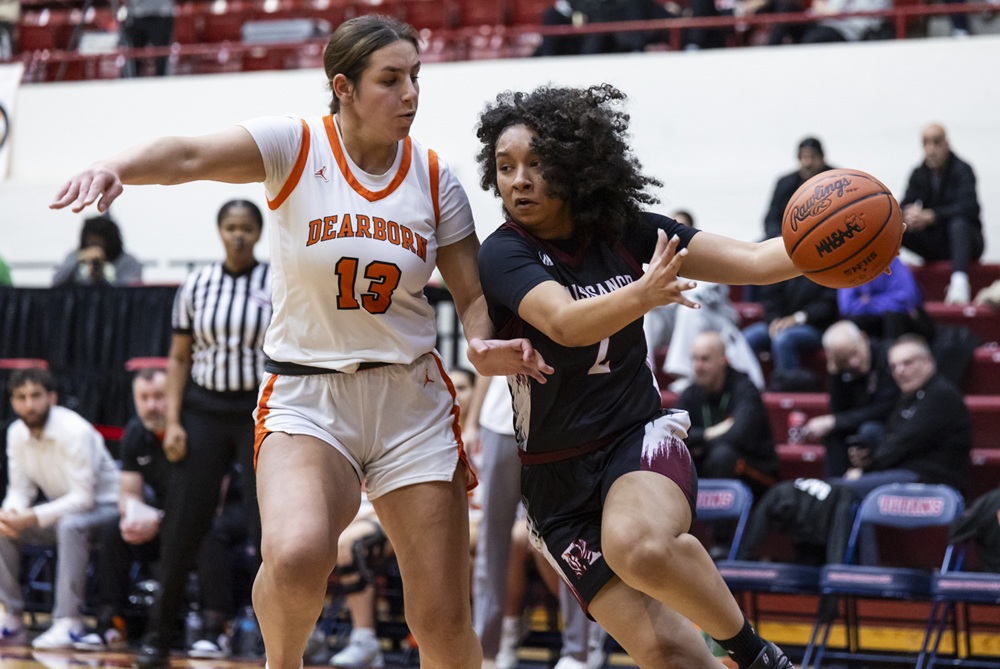
DETROIT RENAISSANCE
Record/MPR: 22-2, No. 2
League finish: First in Detroit Public School League Blue
Coach: DaShaun Wood, fourth season (87-11)
Championship history: Class B champion 2005, four runner-up finishes.
Best wins: 62-60 (OT) over No. 8 Wayne Memorial in Regional Final, 58-42 over No. 31 Livonia Stevenson in Regional Semifinal, 57-36 over No. 6 Utica Eisenhower, 49-48 (OT) over No. 3 Saginaw Heritage, 59-38 over Division 2 No. 17 Detroit Edison.
Players to watch: Maria Walker, 5-9 soph. G (9.9 ppg, 3.3 spg); Kassidy Cain, 5-5 soph. G, (10.9 ppg, 6.4 apg, 3.4 spg); Jaebri’an Autry, 6-0 sr. F (15 ppg, 7.5 rpg, 3.3 apg, 1.4 bpg).
Outlook: Renaissance is making the trip to the Semifinals for the first time since 2023 and most recently finished Division 1 runner-up in 2021. Autry played 15 minutes in that 2023 Semifinal loss to Rockford and senior Alehia Wade got on the court briefly, and they are two of only three seniors for a team that should continue to contend. Cain runs the point and Walker is the shooting guard, and they are among four sophomore starters who line up with Autry. Sophomore 6-foot-4 center Jayla Adams adds another 8.9 points, 7.6 rebounds and 1.4 blocks per game.
DEWITT
Record/MPR: 22-4, No. 14
League finish: Second in the Capital Area Activities Conference Blue
Coach: Bill McCullen, 30th season (575-118)
Championship history: Class C champion 1977, Class A runner-up 2015.
Best wins: 48-41 over No. 13 Belleville in Quarterfinal, 43-32 (Regional Final) and 51-40 over No. 15 Holt, 39-38 over No. 18 Sturgis in Regional Semifinal, 51-41 (District Final) and 51-44 over No. 28 East Lansing, 37-29 over No. 23 Mount Pleasant, 62-38 over No. 29 Coldwater, 50-42 over Division 2 No. 8 Haslett.
Players to watch: Carly Dennis, 5-8 sr. F (12.1 ppg, 5.3 rpg); Jaynie English, 5-7 jr. G (8.5 ppg, 45 3-pointers); Golden Nicholson, 5-8 jr. G (8.0 ppg, 4.8 rpg).
Outlook: The Panthers are making their first Semifinal run since 2015 after not only stunning reigning champion Belleville on Tuesday but graduating a pair of all-staters last spring. DeWitt avenged midseason losses to both Holt and East Lansing during the tournament and has done it all with a balanced lineup that has eight players averaging at least four points per game. During the playoffs alone, the Panthers are allowing just 38.6 points per game, and for the season they’ve held teams to 44 or fewer in all but two games. Guard Sophia Beland (7.1 ppg, 4.2 apg) joins Dennis as the team’s only seniors.
MUSKEGON
Record/MPR: 24-2, No. 9
League finish: First in Ottawa-Kent Conference Green
Coach: Bernard Loudermill, fourth season (66-26)
Championship history: Has never played in an MHSAA Final.
Best wins: 54-28 over No. 7 Grand Haven in Quarterfinal, 48-30 over No. 5 Midland in Regional Final, 52-34 over No. 3 Saginaw Heritage in Regional Semifinal, 35-27 (District Final) and 58-51 over No. 1 Rockford, 36-6 over No. 15 Holt, 52-37 over No. 19 Hudsonville, 58-34 over No. 25 East Kentwood, 47-25 over Division 2 No. 5 Grand Rapids West Catholic.
Players to watch: Mariah Sain, 5-9 sr. G (20.2 ppg, 42 3-pointers); Camiyah Bonner, 5-5 sr. G (13.2 ppg, 4.5 apg); Dy’nasti Bell, 6-4 jr. C (9.2 ppg, 7.9 rpg, 1.6 bpg).
Outlook: An exceptional run through the regular season has gotten even better during the playoffs as the Big Reds have not only defeated Rockford a second time but downed two of the Saginaw Valley League’s best by double digits and then avenged a one-point regular-season loss to Grand Haven in a big way. Muskegon has held its five playoff opponents to an average of 29 points per game, just under its magnificent season average of 29.5 allowed. Sain, who will continue at Charlotte (N.C.), was the Miss Basketball Award runner-up and is one of three senior starters and six who are part of the rotation.
UTICA EISENHOWER
Record/MPR: 24-2, No. 6
League finish: First in Macomb Area Conference Red
Coach: Madison Ristovski, second season (46-5)
Championship history: Has never played in an MHSAA Final.
Best wins: 57-43 over No. 34 Fraser in Quarterfinal, 74-69 over No. 17 Clarkston in Regional Final, 53-46 over No. 4 Orchard Lake St. Mary’s in Regional Semifinal, 44-34 over No. 12 Rochester Hills Stoney Creek in District Final, 50-31 and 55-39 over No. 33 Port Huron, 50-44 over Division 2 No. 7 Flint Powers Catholic, 64-15 over Division 2 No. 25 Armada.
Players to watch: Janielle Turner, 5-7 soph G (13 ppg); Leah Poggiolo, 5-10 soph. G (12 ppg, 6.0 rpg, 3.0 spg); Gabriella Gojcaj, 5-9 sr. G (11 ppg, 7.0 ppg, 4.0 spg, 1.0 bpg).
Outlook: In just her second season, Ristovski – who led Grosse Pointe Woods University Liggett to two Class C runner-up finishes as a player – has brought Eisenhower to the Quarterfinals and now Semifinals for the first time since 1982. The team’s only losses – both over the first six games of the season – came to opponents still playing, Renaissance and Goodrich. Sophomore point guard Madison Repicky (10 ppg, 6.0 apg, 4.0 spg) and senior guard Natalya Stojcevski (8.0 ppg, 8.0 rpg, 2.0 bpg) round out the starting lineup, and total eight players have scored 11 or more points in a game this season.
Division 2
FLINT POWERS CATHOLIC
Record/MPR: 24-3, No. 7
League finish: First in Saginaw Valley League South
Coach: Ryan Trevithick, sixth season (94-44)
Championship history: Two MHSAA titles (most recent 2001), two runner-up finishes.
Best wins: 53-38 over No. 15 Petoskey in Quarterfinal, 48-37 over No. 26 Portland in Regional Final, 51-42 (Regional Semifinal) and 69-45 over No. 12 Frankenmuth, 64-37 over No. 17 Detroit Edison, 49-40 over Division 1 No. 3 Saginaw Heritage, 46-33 over Division 1 No. 17 Clarkston, 54-43 over Division 3 No. 3 Pewamo-Westphalia
Players to watch: Kendyl Smith, 5-9 sr. G (17.8 ppg, 61 3-pointers, 4.7 apg, 3.0 spg); Evah Smith, 5-11 soph. F (12.7 ppg, 6.5 rpg); Paige Ringwelski, sr. 6-0 F (11.2 ppg, 6.6 rpg).
Outlook: Powers has advanced to its first Semifinal since 2014, and is seeking to reach its first championship game since 2013 in Class B. Kendyl Smith was a Miss Basketball Award finalist and will continue at Liberty (Va.), and she also made the all-state first team last season. All three of the Chargers’ losses came to Division 1 teams, including two – Renaissance and Eisenhower – still playing. Only four teams, all from Division 1, have reached 50 points against Powers this winter.
GOODRICH
Record/MPR: 27-0, No. 4
League finish: First in Flint Metro League Stars
Coach: Jason Gray, 27th season (549-99)
Championship history: Class B champion 2012 and 2013.
Best wins: 52-35 over No. 13 Warren Regina in Regional Final, 43-27 over No. 12 Frankenmuth, 68-46 over No. 16 Parma Western, 53-37 over Division 1 No. 3 Saginaw Heritage, 45-24 over Division 1 No. 4 Orchard Lake St. Mary’s, 45-28 over Division 1 No. 12 Rochester Hills Stoney Creek, 61-39 over Division 1 No. 6 Utica Eisenhower.
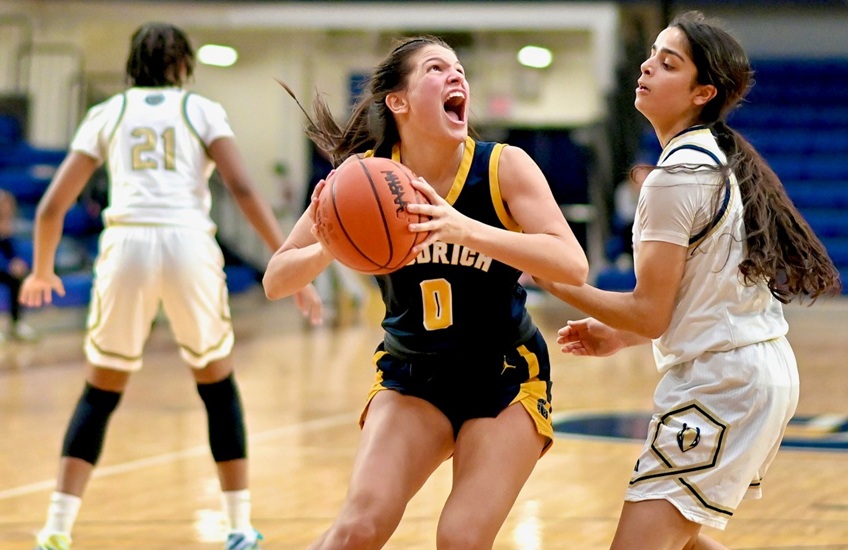
Players to watch: Tanner Schramm, 5-9 sr. G (12.7 ppg, 57 3-pointers); Baylor Lauinger, 5-7 jr. G (15.5 ppg, 4.2 apg, 4.6 spg); Kayla Hairston, 5-2 sr. G (14.1 ppg, 55 3-pointers).
Outlook: Goodrich is making its first trip to the Semifinals since 2023 but is always orbiting the possibility of a deep run, with a combined 100-9 record over the last four seasons and last week’s Regional title its fourth straight. Hairston made the all-state first team last season, and she and Schramm have Breslin experience as Schramm started and Hairston was the top sub as freshmen on that 2023 semifinalist team. The Martians also are unrelenting defensively, giving up an average of 24.8 points per game during the postseason and holding teams to fewer than 20 in 11 games this winter.
GRAND RAPIDS SOUTH CHRISTIAN
Record/MPR: 27-0 No. 1
League finish: First in O-K Gold
Coach: Erika Brown, third season (66-13)
Championship history: Class B champion 1988, three runner-up finishes.
Best wins: 61-48 (Quarterfinal), 50-44 and 73-62 over No. 5 Grand Rapids West Catholic, 67-38 over No. 6 Otsego in Regional Final, 73-45 over No. 28 Grand Rapids Catholic Central, 62-47 and 49-27 over No. 19 Wayland, 73-37 and 70-62 over Division 1 No. 27 Wyoming, 52-50 over Division 1 No. 1 Rockford, 49-47 over Division 1 No. 14 DeWitt.
Players to watch: Lizzie Wolthuis, 6-0 sr. G (12 ppg, 64 3-pointers); Sophia Prins, 5-6 sr. G (13.2 ppg, 39 3-pointers); Abby Prins, 6-0 soph. F (12.5 ppg, 4,1 apg).
Outlook: South Christian got past league rival West Catholic one more time Tuesday to reach the Semifinals for the first time since their Class B runner-up season of 2015-16. Sophia Prins made the all-state second team last season, and in addition to the starters above the Sailors get contributions from all over the lineup with Meredith Helmus adding another 10 ppg, Lexi Vermaas (5.6 ppg, 5.0 rpg) second in rebounding, freshman guard Kinley Regnery (39 3-pointers) one of the team’s top shooters and 6-foot-3 sophomore Avery Lutke (6.2 rpg, 1.6 bpg) joining Regnery giving a boost off the bench.
TECUMSEH
Record/MPR: 25-2, 20-2
League finish: First in Southeastern Conference White
Coach: Kristy Zajac, ninth season (162-46)
Championship history: Two MHSAA titles (most recent 2025), one runner-up finish.
Best wins: 75-44 over No. 10 Carleton Airport in Quarterfinal, 59-39 over No. 16 Parma Western in Regional Final, 60-44 over No. 8 Haslett in Regional Semifinal, 58-25 and 60-27 over No. 23 Chelsea, 41-28 over No. 17 Detroit Edison, 55-39 over Division 1 No. 3 Saginaw Heritage, 55-39 over Division 1 No. 5 Midland, 71-44 over Division 1 No. 29 Coldwater, 71-30 over Division 3 No. 6 Blissfield.
Players to watch: Addi Zajac, 6-0 jr. C (13.2 ppg, 11 rpg, 1.2 bpg); Chloe Bullinger, 5-9 sr. G (9.4 ppg, 5.5 rpg, 5.0 apg, 3.1 spg); Avery Zajac, 5-11 fr. G/F (13.3 ppg).
Outlook: The reigning champion lost just once to an in-state opponent this season – 54-52 to Grand Rapids West Catholic in a Jan. 3 rematch from last year’s title game – with the other defeat against an opponent from Cincinnati. No one else has come within single digits of catching Tecumseh, which has allowed more than 44 points in game only three times while topping 70 in 12 contests. Addi Zajac earned an all-state honorable mention last season, and she, Bullinger and senior guard Makayla Schlorf (11.7 ppg, 45 3-pointers) all started in last year’s Final. Freshman guard Delaney Brown adds another 9.2 ppg.
Division 3
JACKSON LUMEN CHRISTI
Record/MPR: 23-3, No. 2
League finish: First in Catholic High School League Central East
Coach: Scott Stine, first season (23-3)
Championship history: Has never played in an MHSAA Final.
Best wins: 60-39 over No. 13 Brooklyn Columbia Central in Regional Semifinal, 64-53 over No. 9 Grass Lake in District Final, 60-39 over No. 30 Monroe St. Mary Catholic Central in Regional Final, 58-56 over No. 12 Beaverton, 48-36 over Division 1 No. 4 Orchard Lake St. Mary’s, 55-49 over Division 1 No. 24 Farmington Hills Mercy, 50-49 over Division 2 No. 17 Detroit Edison, 50-28 over Division 2 No. 20 Michigan Center, 67-41 over Division 4 No. 5 Mio.
Players to watch: Kenna Hunt, 5-9 soph. G (19.9 ppg, 31 3-pointers, 6.2 rpg, 3.8 spg); Lucy Wrozek, 5-6 soph. G (12.6 ppg, 38 3-pointers); Ruby Boyce, 5-9 sr. F (4.6 ppg, 5.0 rpg).
Outlook: The Titans have broken through to make the Semifinals for the first time after reaching the Quarterfinals on Tuesday for the second-straight season. They’re coached by Stine, who won three of the last four Division 3 titles coaching Ypsilanti Arbor Prep including last year’s after defeating Lumen Christi in a Quarterfinal. The Titans played almost all larger schools during this regular season, losing only to Division 1 Rockford and two Ohio opponents. Hunt made the all-state first team last year.
NILES BRANDYWINE
Record/MPR: 26-1, No. 4
League finish: First in Lakeland Conference
Coach: Josh Hood, 17th season (376-39)
Championship history: Division 3 runner-up 2024.
Best wins: 62-50 over No. 5 Kalamazoo Christian in Regional Final, 52-28 over No. 27 Lawton, 60-42 over No. 32 Kent City, 56-38 over Division 1 No. 49 Kalamazoo Central.
Players to watch: Lily Gill, 5-6 jr. G (13.7 ppg, 5.9 rpg, 4.6 spg); Mackenna Price, 5-6 jr. G (10.8 ppg, 3.6 apg, 6.0 spg); Karleigh Byrd, 5-6 sr. G (9.3 ppg, 5.8 rpg, 3.9 spg).
Outlook: Brandywine has reached the Semifinals the last three seasons with a combined record of 79-4 over that time. The lone loss this winter came to Division 2 Otsego, which fell in a Regional Final last week, and no other opponent has gotten within single digits. Only four opponents have reached 40 points. Gill and Byrd started in last season’s Semifinal, and Price was the top sub, and they are joined among leading scorers this time by freshman forward Zaya Price (12.8 ppg, 7.3 rpg, 3.0 spg).
PEWAMO-WESTPHALIA
Record/MPR: 25-2, No. 3
League finish: First in Central Michigan Athletic Conference
Coach: Steve Eklund, 17th season (327-74)
Championship history: Division 3 champion 2019, three runner-up finishes.
Best wins: 55-33 over No. 20 Cass City in Quarterfinal, 39-24 (Regional Semifinal), 59-36 and 47-34 over No. 19 Laingsburg, 49-24 and 64-41 over No. 25 Bath, 58-50 over Division 1 No. 28 East Lansing, 55-53 over Division 2 No. 28 Grand Rapids Catholic Central, 45-29 and 45-21 over Division 4 No. 14 Portland St. Patrick.
Players to watch: Alonna Thelen, 5-9 sr. F (10.2 ppg, 36 3-pointers); Elly Bengel, 5-7 sr. G (12 ppg, 40 3-pointers); Adrianna Eklund, 5-11 soph. F (12.8 ppg, 33 3-pointers, 5.6 rpg, 3.1 apg).
Outlook: The Pirates are back at the Semifinals for the first time since their 2019 championship run and after losing last season only in their Regional Final. P-W has more defeats this time, but they came to Division 1 Saginaw Heritage and Division 2 Flint Powers Catholic, and they’ve won all but two of their games by at least 10 points. Bengel made the all-state first team last year and leads a potent perimeter attack that also includes junior guard Peyton Eklund (34 3-pointers) off the bench.
ROSCOMMON
Record/MPR: 21-3, No. 14
League finish: Third in Highland Conference
Coach: Greg Kauffman, fourth season (59-36)
Championship history: Has never played in an MHSAA Final.
Best wins: 67-63 (OT) over No. 16 Morley Stanwood in Quarterfinal, 47-30 over No. 17 Harbor Springs in Regional Semifinal, 40-37 over Division 1 No. 23 Mount Pleasant, 57-29 over Division 4 No. 11 Frankfort.
Players to watch: Zoey Kauffman, 5-9 sr. G/F (14.5 ppg, 30 3-pointers, 6.3 rpg, 3.5 apg, 3.5 spg); Alexis Carper, 5-9 jr. F (11.4 ppg, 9.0 rpg, 3.0 apg, 1.7 bpg); Mara Williams, 5-7 jr. G (7.2 ppg, 3.5 apg).
Outlook: Roscommon will play in its first Semifinal since 1996 after also winning its first Quarterfinal since that season, and the Bucks have done so emerging from a league that had three teams win at least 19 games this winter. They’ve held teams to 30 or fewer points 12 times including in three of five postseason games, and their lone on-court losses were to league champ McBain, which finished 21-1. Junior 6-0 center Nemiah Carper adds six points and just under seven rebounds per game, and senior guard Kylie Traver chips in 8.5 ppg.
Division 4
ISHPEMING
Record/MPR: 23-3, No. 13
League finish: Third in Western Peninsula Athletic Conference
Coach: Ryan Reichel, 14th season (173-132)
Championship history: Division 4 champion 2024.
Best wins: 60-22 over No. 12 Indian River Inland Lakes in Quarterfinal, 40-29 over No. 17 Ewen-Trout Creek in Regional Final, 67-34 over No. 23 Norway in Regional Semifinal, 65-36 over No. 16 Baraga, 51-39 over Division 2 No. 11 Negaunee, 54-44 over Division 2 No. 27 Gladstone.
Players to watch: Jenessa Eagle, 5-10 sr. G (24.4 ppg, 68 3-pointers, 3.7 spg); Mya Hemmer, 6-2 sr. C (16.6 ppg, 5.8 spg, 1.5 bpg); Frankie Stetson, 5-7 soph. G (6.3 ppg, 40 3-pointers).
Outlook: Eagle was the leading scorer and Hemmer the leading rebounder as both started as sophomores in the Hematites’ 2024 championship game win over Kingston. Ishpeming played in Division 3 last season and finished a strong 18-6, but back in Division 4 they’ve gone on another Breslin run. All three losses were to Division 2 opponents, and they avenged the first against Negaunee and split with Gladstone. Eagle made the all-state first team last season and has signed with Michigan Tech, and Hemmer will be playing volleyball next at Baylor.
MORENCI
Record/MPR: 26-1, No. 2
League finish: First in Tri-County Conference
Coach: Ashley Joughin, fifth season (102-20)
Championship history: Has never played in an MHSAA Final.
Best wins: 42-25 over No. 3 Kingston in Quarterfinal, 40-31 over No. 19 Allen Park Inter-City Baptist in Regional Semifinal, 58-25 over No. 4 Concord, 42-35 and 45-12 over No. 9 Adrian Lenawee Christian, 39-38 over Division 3 No. 6 Blissfield, 45-37 over Division 3 No. 30 Monroe St. Mary Catholic Central.
Players to watch: Colbie Ekins, 5-11 jr. C (12 ppg, 8.6 rpg); Evelyn Joughin, 5-5 sr. G (8.4 ppg, 30 3-pointers, 5.8 apg, 3.3 spg); Emersyn Bachelder, 5-7 sr. G (18.1 ppg, 31 3-pointers, 5.2 rpg, 3.4 spg).
Outlook: Morenci is a combined 71-7 over the last three seasons after also reaching the Quarterfinals the last two, and this time advanced to their first Semifinal since 2011. Bachelder made the all-state first team last season and has helped pace a run that has seen the lone loss to Division 3 Brooklyn Columbia Central and 20 wins by double digits. The victory Tuesday was Kingston’s lone loss this winter, and Morenci also earned three over Petersburg Summerfield (19-7), including in the Regional Final.
ONEKAMA
Record/MPR: 19-7, No. 21
League finish: Fourth in Northwest Conference
Coach: Dan Mesyar, first season (19-7)
Championship history: Has never played in an MHSAA Final.
Best wins: 38-33 No. 11 Frankfort in Quarterfinal, 54-42 over No. 18 St. Charles in Regional Semifinal, 47-38 over No. 15 Buckley, 43-36 over Division 3 No. 7 Kalamazoo Hackett Catholic Prep.
Players to watch: Callie Sinke, 5-3 soph. G (9.3 ppg, 4.4 rpg, 3.4 spg); Delaney McCarthy, 5-8 jr. C (9.2 ppg, 4.9 rpg,1.1 bpg); Ava Mauntler, 5-4 jr. G (10.5 ppg).
Outlook: Onekama has been another of the most intriguing stories this tournament, as the Portagers emerged from fourth in their league to reach their first Quarterfinal and now Semifinal since 1997. To do so they avenged two regular-season losses to Frankfort with Tuesday’s victory, and they’ve now won nine of their last 11 games and bounced back from those two defeats leading right into Districts. Forward Hailey Hart (5.2 ppg) is the only senior starter for Mesyar, who is in his first year coaching varsity basketball after previously coaching younger levels and varsity baseball at Ludington.
PORTLAND ST. PATRICK
Record/MPR: 22-5, No. 14
League finish: Fourth in CMAC
Coach: Michelle Smith, second season (39-12)
Championship history: Six MHSAA titles (most recent 2002), six runner-up finishes.
Best wins: 29-21 over No. 4 Concord in Quarterfinal, 41-20 over No. 8 Climax-Scotts in Regional Final, 57-39 over Division 3 No. 19 Laingsburg.
Players to watch: Macie Smith, 5-8 jr. F (6.8 ppg, 4.8 rpg); Gracelyn Rockey, 5-7 jr. G (15.5 ppg, 6.8 rpg, 3.4 spg); Lily Sandborn, 5-5 sr. G (7.9 ppg).
Outlook: With this first Semifinal appearance in 14 years, Portland St. Patrick is adding to a tradition that saw the Shamrocks win 16 Regional titles from 1982-2012, with Smith part of 1999 and 2000 Class D Finals championships as a player. St. Patrick has done it emerging from a CMAC that has Pewamo-Westphalia here in Division 3 and saw two other Division 3 teams win at least 19 games this winter; all five of St. Pat’s losses were to those opponents. The Shamrocks also have emerged despite losing senior center Maddie Honsowitz (12.2 ppg, 5.4 rpg) to a season-ending injury after only five games played. Freshman guard Macie Leonard adds another 6.4 ppg.
MHSAA.com's weekly “Breslin Bound” reports are powered by MI Student Aid, a division within the Department of Lifelong Education, Advancement, and Potential (MiLEAP). MI Student Aid encourages students to pursue postsecondary education by providing access to student financial resources and information. MI Student Aid administers the state’s scholarship and grant programs that help make college Accessible, Affordable and Attainable for you. Click to connect with MI Student Aid and find more information on Facebook and X @mistudentaid.
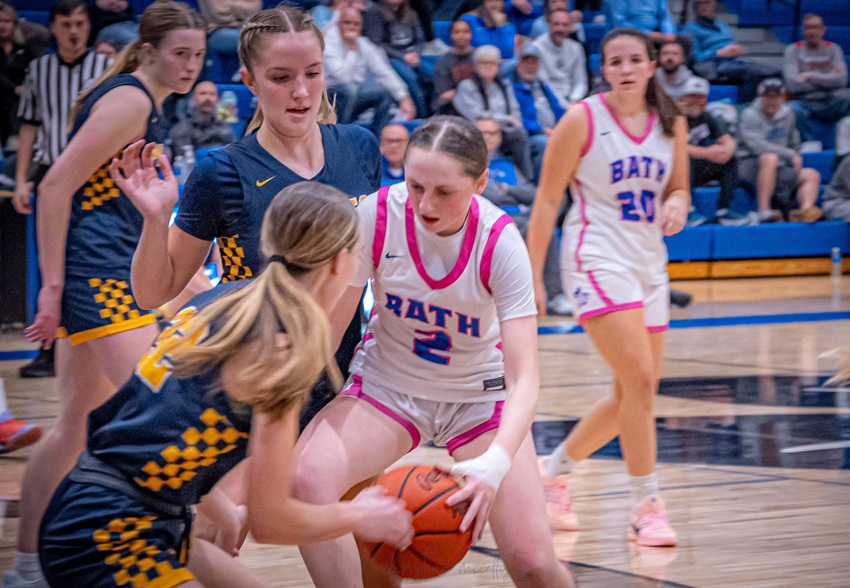
PHOTOS (Top) Detroit Renaissance’s Zahra Richardson (2) drives into the lane during Tuesday’s Quarterfinal win over Dearborn. (Middle) Goodrich’s Tanner Schramm (0) makes her move toward the basket during a Quarterfinal win over Detroit Country Day. (Below) A pair of Pewamo-Westphalia defenders, including Adrianna Eklund, close in on a Bath ball handler during a regular-season win. (Renaissance/Dearborn photo by KMS Photography. Goodrich/Country Day photo by Terry Lyons. P-W/Bath photo by Click by Christine McCallister.)