


Keep on Coaching
February 1, 2013
By Geoff Kimmerly
Second Half editor
A few weeks ago, I finally got my first chance this season to watch a friend coach his basketball team. After guiding some others at the lower levels, this is his first time running the varsity – something he wasn't sure he wanted to do with a 1-year-old just learning to walk, but a challenge he ended up taking on to the benefit of all those involved.
Simply put, he’s good. I've seen a lot of teams and a lot of coaches over the past 15 years, and although I wouldn't know much of what to do if I were walking the sideline, I felt pretty qualified in telling him I was impressed – even if he didn't buy that I was offering an unbiased opinion. The best news is he’s gone from not sure about this a few months ago to talking about next season.
We know, at least anecdotally, that coaching continues to get more challenging. The time commitment has grown substantially to make running a program a year-round endeavor in a lot of sports at a lot of schools.
That commitment – especially for coaches with children of their own – was a main reason referred to in a New Haven Post-Chronicle story Saturday that noted 23 football coaching openings in Connecticut at one point this offseason. That state has 146 football teams – meaning roughly 15 percent will have new leaders this fall.
And that got me thinking about my friend, about how glad I am he’s given this a shot, and how I've seen so many others either not do so, or not stick around long despite having some pretty nice success.
A study published last winter in Interscholastic Athletic Administration magazine – a product of the National Interscholastic Athletic Administrators Association – noted some predictable results of a study that sought to determine the biggest challenges faced by first-year high school coaches.
The toughest according to the study was balancing the demands of coaching and teaching, experienced by nearly half the respondents – 98 percent of which coached high school teams and 81 percent of which are teachers.
The next six reasons all were noted by at least 30 percent of those in the study – personal fatigue, securing community support, securing and caring for facilities and equipment, parental contact, keeping non-starting players motivated, dealing with schedule interruptions and motivating athletes to achieve consistent, peak performance.
Nothing there is earth-shaking, and most if not all of these challenges are faced by high school coaches regardless of how long they've been in the field. But I got a little more perspective from some of the 32 items that ranked as least challenging to the first-year leaders – keeping in compliance with state and league regulations, dealing with substance abuse issues, teaching sport skills and creating a positive team atmosphere – things that seem most important, and yet appear to be easiest to do. I’m not sure what that tells us – but I think it tells us something.
Click to check out the entire three-page breakdown of the study, plus the researchers’ recommendations to remedy some of what first-year coaches face.
Giving back to Saginaw
I love reading about high-level athletes – like a star-studded group of alums from Saginaw – giving back to where they got their starts.
Pittsburgh Steelers star LaMarr Woodley made a big impact before the start of this school year by donating $60,000 to cover all participation fees for athletes in his former school district. The Saginaw News’ Hugh Bernreuter writes today about how Woodley (Saginaw High), the Philadelphia 76ers’ Jason Richardson (Saginaw Arthur Hill) and former Oakland Raiders standout Stu Schweigert (Saginaw Heritage) have combined to give more than $865,000 back to their home communities.
Bernreuter also mentions the non-monetary contributions of the Golden State Warriors’ Draymond Green (Saginaw High) and former Indianapolis Colts receiver Blair White (Saginaw Nouvel).
Click to read more about it.
Quote(s) of the Week
While rifling through more papers on my desk, I found an article from the Washington Post from Sept. 2011 titled “How high school sports save our schools.” I was drawn to it in part because I spent more than a decade in a newsroom, and it was a piece by a reporter covering education who instead of reporting on school boards and the like, delved into the importance of interscholastic athletics to education as a whole.
He spoke of how participation continues to grow even as resources dwindle, and of data supporting that extracurriculars like sports are more effective than academic classes in teaching leadership, teamwork, time management and “other skills crucial for success in the workplace.” Later, he mentioned a study noting that those who participate in extracurriculars earned more a decade later.
Click here to read the entre piece. These passages struck me most.
“Coaches might be the only faculty members still allowed by our culture and educational practice to get tough with students not making the proper effort. They have the advantage of teaching what are essentially elective non-credit courses. They can insist on standards of behavior that classroom teachers often cannot enforce because the stakes of dismissing or letting students drop their courses are too high. …
“Students do better in activities they choose. If we provide more of them, led by committed adults … that can make a difference. We know the bad news about education. Dropout rates are high. Achievement scores are stagnant. But sports participation is going up, despite pressure to cut it back. Let’s cheer about that and look for a way to draw in more students.”
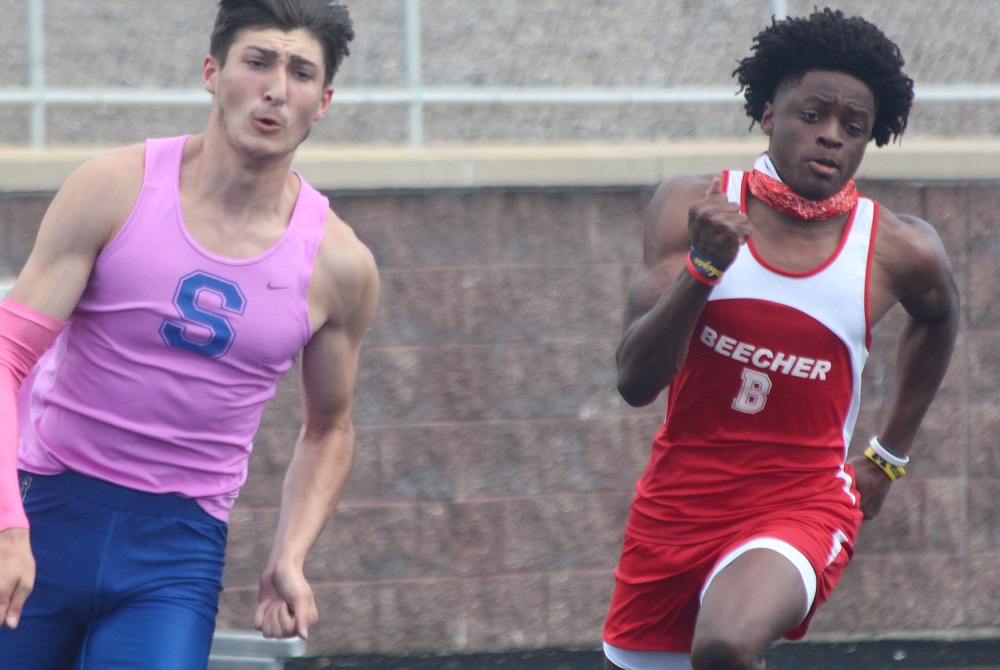
Beecher's Townsend Ready to Lead Chase Among State's Speediest Sprinters
By
Paul Costanzo
Special for MHSAA.com
April 13, 2022
Jaylin Townsend’s introduction to the state’s track & field scene came a year later than planned, but it was quite a first impression.
 As a sophomore, the Flint Beecher star walked out of the Lower Peninsula Division 4 Finals with two individual titles, one relay title and a runner-up finish in another relay.
“It kind of surprised me,” Townsend said. “Coming into the season off of COVID, we could barely get into the weight room, and it was hard to get on the track and run. We couldn’t get the blocks out. It was kind of an eye opener, really.”
Despite it being his first season – the 2020 season was canceled completely – Townsend was dominant throughout. He won all but one of the individual races he competed in, with the lone loss coming in the 200 meters in the first meet of the season.
That was quickly corrected, as he cut nearly four seconds off his time in his next meet and never lost the race again.
He won the 100 meters at the Division 4 Finals with a personal best of 10.98 seconds. He won the 200 in 22.75. His personal best in that event is 22.37, which was run in the prelims of the Regional.
Beecher’s relay teams that featured Townsend were equally dominant. The 800-meter relay team suffered just one defeat – disqualification at the Genesee Area Conference championship meet. Townsend, Micah Brown, Danny Bradley and Jacoby Sanders ran a season-best 1:30.59 to win at the Division 4 Finals.
The 400 relay team of Townsend, Bradley, Carmelo Harris and James Cummings II took second at the Division 4 Finals with a time of 44.11. It was their first non-DQ loss of the season.
It was close, but Jaylin Townsend (@Jay23Trip) took home two State Championship medals for Flint Beecher, winning the 100 Meter Dash and the 200 Meter Dash.#StateChamps x @MHSAA pic.twitter.com/BMnhp2GaPV
— STATE CHAMPS! Michigan (@statechampsmich) June 19, 2021
Townsend’s contributions were good for 38 team points, which alone would have placed fourth in Division 4. Beecher as a team finished third with 54 points.
While the immediate success came as a surprise to Townsend, it didn't to his coach.
“I saw it in him,” Beecher coach Joe Wilkerson said. “I knew he could be something special. I told his mother when I talked to her, ‘This guy is going to be a state champ this year.’ There was just something about him that I saw it in him. Lo and behold, he was a three-time state champ. It just made me feel good, because I could trust my own instincts a little bit right now.”
Townsend knows his success will motivate his future opponents even more, but he’s fine with that.
“Going into this year, I know they’re coming for me,” he said. “I know I have to put in some extra work.”
Putting in extra work is something Townsend is used to, as he had to a year ago to get up to speed. He said working on his stride and coming out of the blocks were the main points of emphasis.
“I had to learn a lot, actually,” he said. “Most of the stuff, I was just doing off raw talent. I would make sure to ask Coach, ‘Hey, do you have an extra 30 minutes? Can you stay after?’ My first-ever track meet, when I came out of the blocks, I used to pop right up.”
That has Wilkerson excited, as he believes the sky is the limit for his young star.
 “This guy, he’s exceptional,” said Wilkerson, who has coached track at Beecher on and off since 1979. “I’ve been coaching for a long time, and I’ve never had a student quite like him with that kind of natural ability.”
Townsend’s focus on track is essentially limited to the spring season, as he also plays football and basketball for the Buccaneers.
“I’ve always been a great athlete, and I wanted to continue to be great,” Townsend said. “Going into basketball, it keeps me in shape for track.”
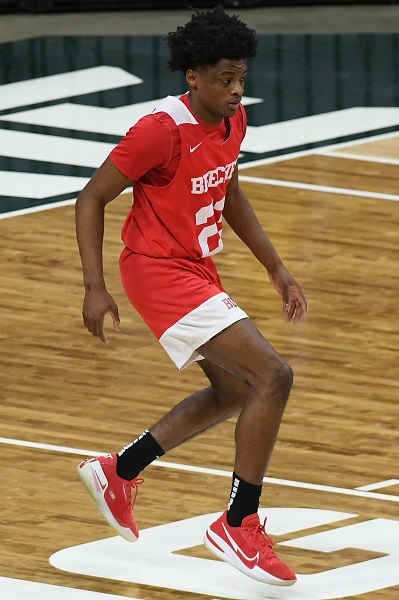
He was a key reserve forward for the Beecher basketball team, which advanced to the Division 3 Semifinals this season. He plays mostly in the post, despite being a shade under 6-foot-1 and 165 pounds.
Football is the sport he’s most focused on, particularly when it comes to competing in college. He plays receiver, free safety and cornerback for Beecher, and said he’s had talks with Central Michigan, Ferris State and Grand Valley State.
It was his performance on the track, though, that really helped to start those.
“When I started posting the speed, some of the colleges started to look like, ‘Hey, we can use this kid,’” Townsend said. “It helped out a lot.”
Heading into his junior track season, he hopes to turn a few more heads. He knows the best way to do that is to hold off the challengers who now have him in their sights, and continue to improve on his times. His goal is to work his 100 time down to 10.5 and his 200 time into the mid 21s.
“It kind of goes together,” he said. “Coming off last season, it put a target on my back, but it made some college coaches want to come to the track meets. They want to see me run. They want to see my speed. It’s nothing I can’t handle, though.”
 Paul Costanzo served as a sportswriter at The Port Huron Times Herald from 2006-15, including three years as lead sportswriter, and prior to that as sports editor at the Hillsdale Daily News from 2005-06. He can be reached at [email protected] with story ideas for Genesee, Lapeer, St. Clair, Sanilac, Huron, Tuscola, Saginaw, Bay, Arenac, Midland and Gladwin counties.
PHOTOS (Top) Flint Beecher’s Jaylin Townsend, right, turns a corner as he works to get a pace ahead of Saugatuck’s Benny Diaz on the way to winning last season’s LPD4 200 championship. (Middle) Townsend gets ready to defend during last month’s Division 3 Semifinal against Schoolcraft. (Top photo by Will Kennedy; middle photo by Hockey Weekly Action Photos.)