


Keep on Coaching
February 1, 2013
By Geoff Kimmerly
Second Half editor
A few weeks ago, I finally got my first chance this season to watch a friend coach his basketball team. After guiding some others at the lower levels, this is his first time running the varsity – something he wasn't sure he wanted to do with a 1-year-old just learning to walk, but a challenge he ended up taking on to the benefit of all those involved.
Simply put, he’s good. I've seen a lot of teams and a lot of coaches over the past 15 years, and although I wouldn't know much of what to do if I were walking the sideline, I felt pretty qualified in telling him I was impressed – even if he didn't buy that I was offering an unbiased opinion. The best news is he’s gone from not sure about this a few months ago to talking about next season.
We know, at least anecdotally, that coaching continues to get more challenging. The time commitment has grown substantially to make running a program a year-round endeavor in a lot of sports at a lot of schools.
That commitment – especially for coaches with children of their own – was a main reason referred to in a New Haven Post-Chronicle story Saturday that noted 23 football coaching openings in Connecticut at one point this offseason. That state has 146 football teams – meaning roughly 15 percent will have new leaders this fall.
And that got me thinking about my friend, about how glad I am he’s given this a shot, and how I've seen so many others either not do so, or not stick around long despite having some pretty nice success.
A study published last winter in Interscholastic Athletic Administration magazine – a product of the National Interscholastic Athletic Administrators Association – noted some predictable results of a study that sought to determine the biggest challenges faced by first-year high school coaches.
The toughest according to the study was balancing the demands of coaching and teaching, experienced by nearly half the respondents – 98 percent of which coached high school teams and 81 percent of which are teachers.
The next six reasons all were noted by at least 30 percent of those in the study – personal fatigue, securing community support, securing and caring for facilities and equipment, parental contact, keeping non-starting players motivated, dealing with schedule interruptions and motivating athletes to achieve consistent, peak performance.
Nothing there is earth-shaking, and most if not all of these challenges are faced by high school coaches regardless of how long they've been in the field. But I got a little more perspective from some of the 32 items that ranked as least challenging to the first-year leaders – keeping in compliance with state and league regulations, dealing with substance abuse issues, teaching sport skills and creating a positive team atmosphere – things that seem most important, and yet appear to be easiest to do. I’m not sure what that tells us – but I think it tells us something.
Click to check out the entire three-page breakdown of the study, plus the researchers’ recommendations to remedy some of what first-year coaches face.
Giving back to Saginaw
I love reading about high-level athletes – like a star-studded group of alums from Saginaw – giving back to where they got their starts.
Pittsburgh Steelers star LaMarr Woodley made a big impact before the start of this school year by donating $60,000 to cover all participation fees for athletes in his former school district. The Saginaw News’ Hugh Bernreuter writes today about how Woodley (Saginaw High), the Philadelphia 76ers’ Jason Richardson (Saginaw Arthur Hill) and former Oakland Raiders standout Stu Schweigert (Saginaw Heritage) have combined to give more than $865,000 back to their home communities.
Bernreuter also mentions the non-monetary contributions of the Golden State Warriors’ Draymond Green (Saginaw High) and former Indianapolis Colts receiver Blair White (Saginaw Nouvel).
Click to read more about it.
Quote(s) of the Week
While rifling through more papers on my desk, I found an article from the Washington Post from Sept. 2011 titled “How high school sports save our schools.” I was drawn to it in part because I spent more than a decade in a newsroom, and it was a piece by a reporter covering education who instead of reporting on school boards and the like, delved into the importance of interscholastic athletics to education as a whole.
He spoke of how participation continues to grow even as resources dwindle, and of data supporting that extracurriculars like sports are more effective than academic classes in teaching leadership, teamwork, time management and “other skills crucial for success in the workplace.” Later, he mentioned a study noting that those who participate in extracurriculars earned more a decade later.
Click here to read the entre piece. These passages struck me most.
“Coaches might be the only faculty members still allowed by our culture and educational practice to get tough with students not making the proper effort. They have the advantage of teaching what are essentially elective non-credit courses. They can insist on standards of behavior that classroom teachers often cannot enforce because the stakes of dismissing or letting students drop their courses are too high. …
“Students do better in activities they choose. If we provide more of them, led by committed adults … that can make a difference. We know the bad news about education. Dropout rates are high. Achievement scores are stagnant. But sports participation is going up, despite pressure to cut it back. Let’s cheer about that and look for a way to draw in more students.”

Retired MHSAA Executive Director Roberts Selected for NFHS Hall of Fame
By
Geoff Kimmerly
MHSAA.com senior editor
March 8, 2022
During an award introduction two years ago, MHSAA associate director Tom Rashid described his longtime close friend Jack Roberts as the leader who “took our darkest hours and problems and turned them into positives.”
The MHSAA has faced its share of challenging times, and those may have been among Roberts’ finest hours over 32 years as MHSAA executive director – and admittedly the times when his adrenaline flowed most. But there were many more good times and memorable advances for Michigan school sports under his leadership, and he will be recognized again this summer both for those and a lifetime of service to school sports in this state and across the nation.
John E. “Jack” Roberts was one of 12 honorees announced Tuesday as this year’s inductees into the National High School Sports Hall of Fame by the National Federation of State High School Associations (NFHS). He will be inducted as one of three former state association administrators selected for the 39th Hall of Fame class at a ceremony during the NFHS summer meeting July 1 in San Antonio, Texas.
He began his tenure as MHSAA executive director in 1986, and at the time of his retirement he was the nation’s longest-serving executive director of a state high school athletic association. He was the fourth person to serve the MHSAA in that leadership role full time, following Charles E. Forsythe (1931-42, 1945-68), Allen W. Bush (1968-78) and Vern L. Norris (1978-86).
Roberts will become the Hall of Fame’s ninth inductee from Michigan, joining Forsythe (inducted 1983), River Rouge boys basketball coach Lofton Greene (1986), Warren Regina athletic director, softball and basketball coach Diane Laffey (2000), Fennville basketball and baseball standout Richie Jordan (2001), Grosse Pointe Woods University Liggett boys and girls tennis coach Bob Wood (2005), Bloomfield Hills Cranbrook hockey standout Jim Johnson (2007), Owosso football, basketball and baseball all-stater Brad Van Pelt (2011); and Vermontville Maple Valley baseball national record holder Ken Beardslee (2016).
Roberts also follows in the footsteps of his late father, John Roberts, who served as executive director of the Wisconsin Interscholastic Athletic Association from 1957-85 and was inducted into the National High School Hall of Fame in 2000. They will be the first father-son team in the Hall of Fame.
Jack Roberts began his career serving as an assistant director for the National Federation from 1973-80. He was involved with the implementation of Title IX at the local and state levels and made immense contributions as the NFHS representative to the landmark Amateur Sports Act of 1978, and also played a significant role in the NFHS rules-writing process as the organization started writing and publishing rules for a number of new sports during the 1970s.
The MHSAA enjoyed continued growth under Roberts’ guidance, particularly in the number of Michigan students participating in athletics and in the number of MHSAA-sponsored tournament sports available to them. Several key rules changes came under Roberts’ watch and direction, and he made the MHSAA a national leader in health and safety efforts particularly in the areas of head injury care, heart safety initiatives and heat management strategies.
“I had a head start in this work. Growing up in the home of the executive director of the Wisconsin Interscholastic Athletic Association and then spending most of my 20s working for the National Federation office, and much of it with (longtime NFHS executive director) Cliff Fagan, was a jumpstart on this career,” Roberts said. “But I’m also satisfied at this point that, to paraphrase Hamilton in the musical ‘Hamilton,’ I didn’t give up on my shot. I was given a shot, I took it and I didn’t waste the chance.
“The job fit me, and I think I maxed the opportunity I had to serve educational athletics in this job, and that’s satisfying to think about at this time.”
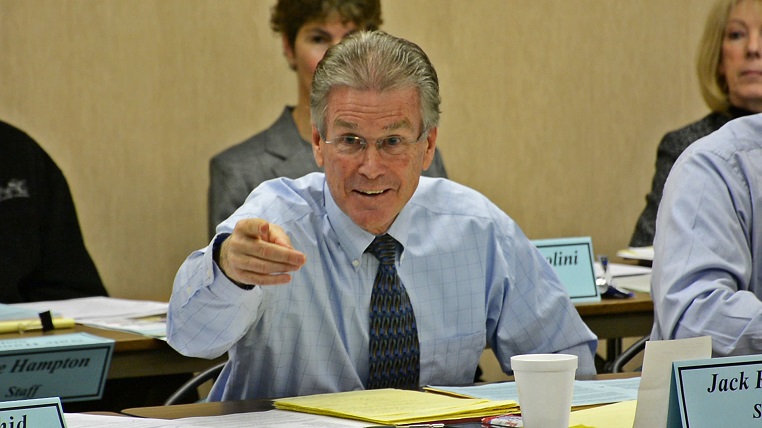 Under Roberts’ leadership, overall participation in high school athletics in Michigan increased 10 percent, and the MHSAA added more than 200 schools in increasing its membership by more than 15 percent at the high school and junior high/middle school levels combined. His tenure saw the addition of girls competitive cheer (1994), girls & boys bowling (2004) and girls & boys lacrosse (2005) to the MHSAA Tournament sport lineup, the creation of a separate wrestling tournament to determine champions by team format (1988), and 8-player football (2010, first playoffs 2011) as many small schools across the state began having trouble fielding 11-player teams because of enrollment and population decreases. Meanwhile, also under his leadership, the 11-player Football Playoffs expanded, doubling to 256 teams in 1999.
Among rules changes put in place during Roberts’ tenure was the addition of opportunities for multiple schools to create cooperative teams in sports where participation is lagging. He also helped Michigan become a national leader in improving sportsmanship; a comprehensive package enacted in 1996 set a statewide tone for appropriate behavior and perspective that continues to make an impact today.
Perhaps the most significant influences by Roberts came on the topics of health and safety. The MHSAA has led nationally in concussion care with its first programming in 2000 and return-to-play protocols enacted in 2010, and with mandated concussion reporting and insurance for those who suffer head injuries rolled out in 2015. A heat management policy and CPR requirements for coaches were introduced in 2013.
Also under this leadership, the first program for coaches education was launched in 1987 and evolved into the Coaches Advancement Program, with nearly 34,000 courses administered as part of CAP since 2004-05. The Women in Sports Leadership Conference was created in 1989 and remains the first, largest and longest-running program of its type in the country, regularly drawing upwards of 500 participants. The first of now-annual statewide Athletic Director In-Service Programs was conducted in 1992, and Michigan also remains a national leader in student services thanks to a variety of programs that were introduced under Roberts’ leadership.
Internally, he put the MHSAA on the leading edge nationally when it came to use the technology, especially in the realm of communications, where he put special emphasis on telling the story of school sports. “I think I was considered a conservative as to rules for eligibility and competition, and a progressive in how we delivered services to schools and school sports,” Roberts said.
In addition to his work specifically in Michigan, Roberts carried significant influence at the national level. He served as part of the NFHS Board of Directors and led the creation of the NFHS Network for video productions in 2012, serving as that board’s chairperson. He also has served on the board of directors of the National Association of Sports Officials (NASO).
“For 32 years, Jack Roberts was the epitome of what leadership looks like. He was the strongest advocate for high school sports that anyone could ever hope for,” said MHSAA Executive Director Mark Uyl, who succeeded Roberts in 2018. “He is without question one of the preeminent pioneers and difference-makers in the world of high school sports over the past 100 years.
“And other than my father, there has not been a man who has had a bigger impact and positive influence on my life personally than Jack Roberts.”
The National High School Hall of Fame was started in 1982 by the NFHS, and the rest of this year’s class is made up of athletes, coaches, administrators and an official. The 12 individuals were chosen after a two-level selection process involving a screening committee composed of active high school state association administrators, coaches and officials, and a final selection committee composed of coaches, former athletes, state association officials, media representatives and educational leaders. Nominations were made through NFHS member associations. Also chosen for this class were athletes Notah Begay (New Mexico), Walter Payton (Mississippi), Sanya Richards-Ross (Florida) and Thurman Thomas (Texas); sport coaches Ray Crowe (Indiana), Ron Kordes (Kentucky) and Lamar Rogers (Tennessee); administrators E. Wayne Cooley (Iowa) and Becky Oakes (Missouri), official Jeff Risk (North Dakota) and speech/debate coach Susan McLain (Oregon). (Click for more.)
Roberts came to the MHSAA in 1986 from the Fellowship of Christian Athletes, which he served as executive vice president. He is a 1970 graduate of Dartmouth College and taught English and coached football at high schools in Milwaukee and Denver before joining the NFHS staff.
He and his wife Peggy reside in East Lansing, and in retirement they together have increased their contributions to environmental matters and international refugee issues while both serving in leadership roles. Jack Roberts has served as board president for the Refugee Development Center in Lansing for 13 years, and Peggy Roberts served six years as chairperson of the board for Lansing’s Fenner Nature Center. As part of their environmental work, the Roberts are working within a small group of organizations to help them acquire and preserve land.