


Keep on Coaching
February 1, 2013
By Geoff Kimmerly
Second Half editor
A few weeks ago, I finally got my first chance this season to watch a friend coach his basketball team. After guiding some others at the lower levels, this is his first time running the varsity – something he wasn't sure he wanted to do with a 1-year-old just learning to walk, but a challenge he ended up taking on to the benefit of all those involved.
Simply put, he’s good. I've seen a lot of teams and a lot of coaches over the past 15 years, and although I wouldn't know much of what to do if I were walking the sideline, I felt pretty qualified in telling him I was impressed – even if he didn't buy that I was offering an unbiased opinion. The best news is he’s gone from not sure about this a few months ago to talking about next season.
We know, at least anecdotally, that coaching continues to get more challenging. The time commitment has grown substantially to make running a program a year-round endeavor in a lot of sports at a lot of schools.
That commitment – especially for coaches with children of their own – was a main reason referred to in a New Haven Post-Chronicle story Saturday that noted 23 football coaching openings in Connecticut at one point this offseason. That state has 146 football teams – meaning roughly 15 percent will have new leaders this fall.
And that got me thinking about my friend, about how glad I am he’s given this a shot, and how I've seen so many others either not do so, or not stick around long despite having some pretty nice success.
A study published last winter in Interscholastic Athletic Administration magazine – a product of the National Interscholastic Athletic Administrators Association – noted some predictable results of a study that sought to determine the biggest challenges faced by first-year high school coaches.
The toughest according to the study was balancing the demands of coaching and teaching, experienced by nearly half the respondents – 98 percent of which coached high school teams and 81 percent of which are teachers.
The next six reasons all were noted by at least 30 percent of those in the study – personal fatigue, securing community support, securing and caring for facilities and equipment, parental contact, keeping non-starting players motivated, dealing with schedule interruptions and motivating athletes to achieve consistent, peak performance.
Nothing there is earth-shaking, and most if not all of these challenges are faced by high school coaches regardless of how long they've been in the field. But I got a little more perspective from some of the 32 items that ranked as least challenging to the first-year leaders – keeping in compliance with state and league regulations, dealing with substance abuse issues, teaching sport skills and creating a positive team atmosphere – things that seem most important, and yet appear to be easiest to do. I’m not sure what that tells us – but I think it tells us something.
Click to check out the entire three-page breakdown of the study, plus the researchers’ recommendations to remedy some of what first-year coaches face.
Giving back to Saginaw
I love reading about high-level athletes – like a star-studded group of alums from Saginaw – giving back to where they got their starts.
Pittsburgh Steelers star LaMarr Woodley made a big impact before the start of this school year by donating $60,000 to cover all participation fees for athletes in his former school district. The Saginaw News’ Hugh Bernreuter writes today about how Woodley (Saginaw High), the Philadelphia 76ers’ Jason Richardson (Saginaw Arthur Hill) and former Oakland Raiders standout Stu Schweigert (Saginaw Heritage) have combined to give more than $865,000 back to their home communities.
Bernreuter also mentions the non-monetary contributions of the Golden State Warriors’ Draymond Green (Saginaw High) and former Indianapolis Colts receiver Blair White (Saginaw Nouvel).
Click to read more about it.
Quote(s) of the Week
While rifling through more papers on my desk, I found an article from the Washington Post from Sept. 2011 titled “How high school sports save our schools.” I was drawn to it in part because I spent more than a decade in a newsroom, and it was a piece by a reporter covering education who instead of reporting on school boards and the like, delved into the importance of interscholastic athletics to education as a whole.
He spoke of how participation continues to grow even as resources dwindle, and of data supporting that extracurriculars like sports are more effective than academic classes in teaching leadership, teamwork, time management and “other skills crucial for success in the workplace.” Later, he mentioned a study noting that those who participate in extracurriculars earned more a decade later.
Click here to read the entre piece. These passages struck me most.
“Coaches might be the only faculty members still allowed by our culture and educational practice to get tough with students not making the proper effort. They have the advantage of teaching what are essentially elective non-credit courses. They can insist on standards of behavior that classroom teachers often cannot enforce because the stakes of dismissing or letting students drop their courses are too high. …
“Students do better in activities they choose. If we provide more of them, led by committed adults … that can make a difference. We know the bad news about education. Dropout rates are high. Achievement scores are stagnant. But sports participation is going up, despite pressure to cut it back. Let’s cheer about that and look for a way to draw in more students.”
Franklin Finishes Title Sweep, Davison Adds Individual Win to Team Runner-up
By
Perry A. Farrell
Special for MHSAA.com
March 5, 2022
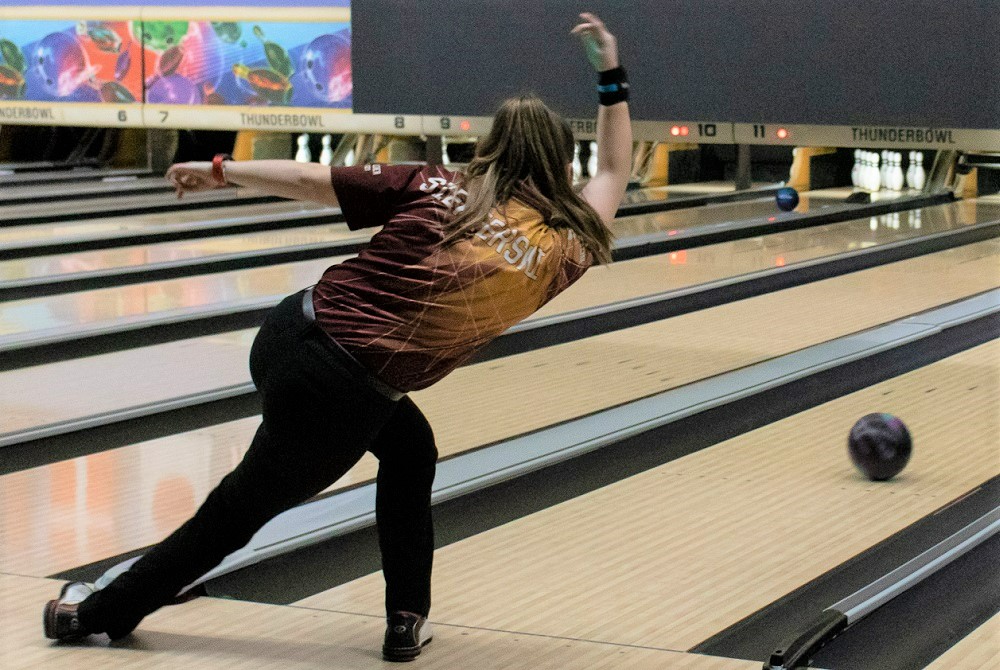
ALLEN PARK – Emma Siekierski kept doing just enough to advance at Saturday’s Division 1 Singles Finals, until she put up a 279 game to move to the championship by eliminating Bailey Tomlin of New Baltimore Anchor Bay.
The Davison senior then prevailed in the final, winning 430-374 over Alyssa Fortney of Zeeland.
“I wanted a state team title badly,’’ said Siekierski, whose team finished runner-up the day before. “We struggled Friday. In our gym we have so many team title banners, but now at least I get to go into the gym and see my name for the individual singles title. It’s something I’ll always cherish. I trusted my shot today.’’
In the boys, division Livonia Franklin made it a sweep in the team and individual titles as junior Ian Wright edged Jared Musser of Davison, 400-391, in the championship match.
“I really didn’t think I’d get here,’’ said Wright. “The goal was the team title. We waited a long time for that.’’
“I struggled in the main,’’ added Wright of the multiple competition areas at Allen Park’s Thunderbowl Lanes. “We got to the arena, and I was able to make some adjustments.’’
Holt senior David Schaberg was the top male qualifier at 1,439 followed by Warren Woods Tower’s Zach McMichael (1,416) and Caledonia’s Alec Bisterfeldt (1,365). The Ians from team champion Livonia Franklin – Cain and Wright – made the top six, while Davison also had two in the final 16: Jared Musser and Shane Gagnon. Caledonia’s Ayden Sulzener also made the top 16 at 1,288.
Cain came out firing in the quarterfinal with a 300 game to dispose of Dylan Jablonski of Canton 485-304. He eventually cooled off and lost to Musser, who had ACL surgery in his right leg two years ago, 451-357, in the quarterfinal. Musser is a one-step, two-handed bowler.
Musser had eliminated Nate VanderBeek of Wyoming, 441-395.
 Schaberg advanced by beating Matthew Starbenz of Brownstown Woodhaven, 420-390. His next opponent was Carson Hommes of Grand Rapids Forest Hills Northern, who had beaten Shane Gibson of Waterford Kettering, 378-311. Schaberg eliminated Hommes, 408-395, to advance to the semifinal against Musser, who prevailed 458-388.
Wright moved on by beating Sulzener 469-416. He took on Gagnon, who had eliminated Bisterfeldt, 442-416, and eliminated Gagnon (469-356) to move onto the semifinal.
Macomb Area Conference stars Carter Milasinovich of Utica Eisenhower and Connor Rogus of Dakota had to face each other in quarterfinal matchup after Milasinovich beat Tony DeLuccia of Rockford and Rogus downed McMichael, 467-387. Milasinovich won the friendly rivalry, 409-405, but eventually lost to Wright, 419-376 while Musser eliminated top seed Schaberg, 458-388.
Woods Tower’s Kayla Tafanelli was the top girls qualifier at 1,370, followed by Siekierski at 1,310. Three Zeeland bowlers made the top six: Fortney 1,231, senior Morgan Smith (1,227) and freshman Hayden Pompey-Oshinski (1,224).
New Baltimore Anchor Bay placed two in the top 16 – senior Melanie Straub and senior Bailey Tomlin – as did Hartland with Calie Mitchell and Morgan Maliszewski.
Tafanelli served notice she would be a force to be reckoned with, beating sophomore Samantha Mason, 545-348 with games of 268 and 277.
She faced Ava Crumley, who had defeated New Baltimore Anchor Bay’s Melanie Struab by one pin, 398-397 in the Round of 16.
Zeeland teammates Smith and Fortney faced each other in the quarterfinals after downing Calie Mitchell of Hartland and Hudsonville’s Morgan Blouw, respectively.
Fortney prevailed, 410-393 and upset Tafanelli, 439-422, in the semifinals to advance to the championship.
Nataleigh Eagle of Monroe beat Angelita Mireles of Holt, 332-320. She then squared off against Tomlin, who had finished off Pompey-Oshinski, 397-311.
The other quarterfinal had Maliszewski, who had defeated Aubree Clark of Utica (408-378), taking on Siekierski, who had eliminated Karley Chouinard of Westland John Glenn, 361-322.
PHOTOS (Top) Davison's Emma Siekierski rolls during Saturday's Division 1 Singles Final at Thunderbowl Lanes. (Middle) Franklin's Ian Wright lines up his shot during his championship match against Davison's Jared Musser. (Click for more from Champions Photography.)