


Keep on Coaching
February 1, 2013
By Geoff Kimmerly
Second Half editor
A few weeks ago, I finally got my first chance this season to watch a friend coach his basketball team. After guiding some others at the lower levels, this is his first time running the varsity – something he wasn't sure he wanted to do with a 1-year-old just learning to walk, but a challenge he ended up taking on to the benefit of all those involved.
Simply put, he’s good. I've seen a lot of teams and a lot of coaches over the past 15 years, and although I wouldn't know much of what to do if I were walking the sideline, I felt pretty qualified in telling him I was impressed – even if he didn't buy that I was offering an unbiased opinion. The best news is he’s gone from not sure about this a few months ago to talking about next season.
We know, at least anecdotally, that coaching continues to get more challenging. The time commitment has grown substantially to make running a program a year-round endeavor in a lot of sports at a lot of schools.
That commitment – especially for coaches with children of their own – was a main reason referred to in a New Haven Post-Chronicle story Saturday that noted 23 football coaching openings in Connecticut at one point this offseason. That state has 146 football teams – meaning roughly 15 percent will have new leaders this fall.
And that got me thinking about my friend, about how glad I am he’s given this a shot, and how I've seen so many others either not do so, or not stick around long despite having some pretty nice success.
A study published last winter in Interscholastic Athletic Administration magazine – a product of the National Interscholastic Athletic Administrators Association – noted some predictable results of a study that sought to determine the biggest challenges faced by first-year high school coaches.
The toughest according to the study was balancing the demands of coaching and teaching, experienced by nearly half the respondents – 98 percent of which coached high school teams and 81 percent of which are teachers.
The next six reasons all were noted by at least 30 percent of those in the study – personal fatigue, securing community support, securing and caring for facilities and equipment, parental contact, keeping non-starting players motivated, dealing with schedule interruptions and motivating athletes to achieve consistent, peak performance.
Nothing there is earth-shaking, and most if not all of these challenges are faced by high school coaches regardless of how long they've been in the field. But I got a little more perspective from some of the 32 items that ranked as least challenging to the first-year leaders – keeping in compliance with state and league regulations, dealing with substance abuse issues, teaching sport skills and creating a positive team atmosphere – things that seem most important, and yet appear to be easiest to do. I’m not sure what that tells us – but I think it tells us something.
Click to check out the entire three-page breakdown of the study, plus the researchers’ recommendations to remedy some of what first-year coaches face.
Giving back to Saginaw
I love reading about high-level athletes – like a star-studded group of alums from Saginaw – giving back to where they got their starts.
Pittsburgh Steelers star LaMarr Woodley made a big impact before the start of this school year by donating $60,000 to cover all participation fees for athletes in his former school district. The Saginaw News’ Hugh Bernreuter writes today about how Woodley (Saginaw High), the Philadelphia 76ers’ Jason Richardson (Saginaw Arthur Hill) and former Oakland Raiders standout Stu Schweigert (Saginaw Heritage) have combined to give more than $865,000 back to their home communities.
Bernreuter also mentions the non-monetary contributions of the Golden State Warriors’ Draymond Green (Saginaw High) and former Indianapolis Colts receiver Blair White (Saginaw Nouvel).
Click to read more about it.
Quote(s) of the Week
While rifling through more papers on my desk, I found an article from the Washington Post from Sept. 2011 titled “How high school sports save our schools.” I was drawn to it in part because I spent more than a decade in a newsroom, and it was a piece by a reporter covering education who instead of reporting on school boards and the like, delved into the importance of interscholastic athletics to education as a whole.
He spoke of how participation continues to grow even as resources dwindle, and of data supporting that extracurriculars like sports are more effective than academic classes in teaching leadership, teamwork, time management and “other skills crucial for success in the workplace.” Later, he mentioned a study noting that those who participate in extracurriculars earned more a decade later.
Click here to read the entre piece. These passages struck me most.
“Coaches might be the only faculty members still allowed by our culture and educational practice to get tough with students not making the proper effort. They have the advantage of teaching what are essentially elective non-credit courses. They can insist on standards of behavior that classroom teachers often cannot enforce because the stakes of dismissing or letting students drop their courses are too high. …
“Students do better in activities they choose. If we provide more of them, led by committed adults … that can make a difference. We know the bad news about education. Dropout rates are high. Achievement scores are stagnant. But sports participation is going up, despite pressure to cut it back. Let’s cheer about that and look for a way to draw in more students.”
St. John's Potent All-Around Game Includes Abilities To Direct, Dazzle
By
Tim Robinson
Special for MHSAA.com
February 25, 2022
HOWELL — Maeve St. John is, as an opposing coach described her, “the straw that stirs the drink” on the Howell girls basketball team.
 And, at first glance, the evidence backs that assertion.
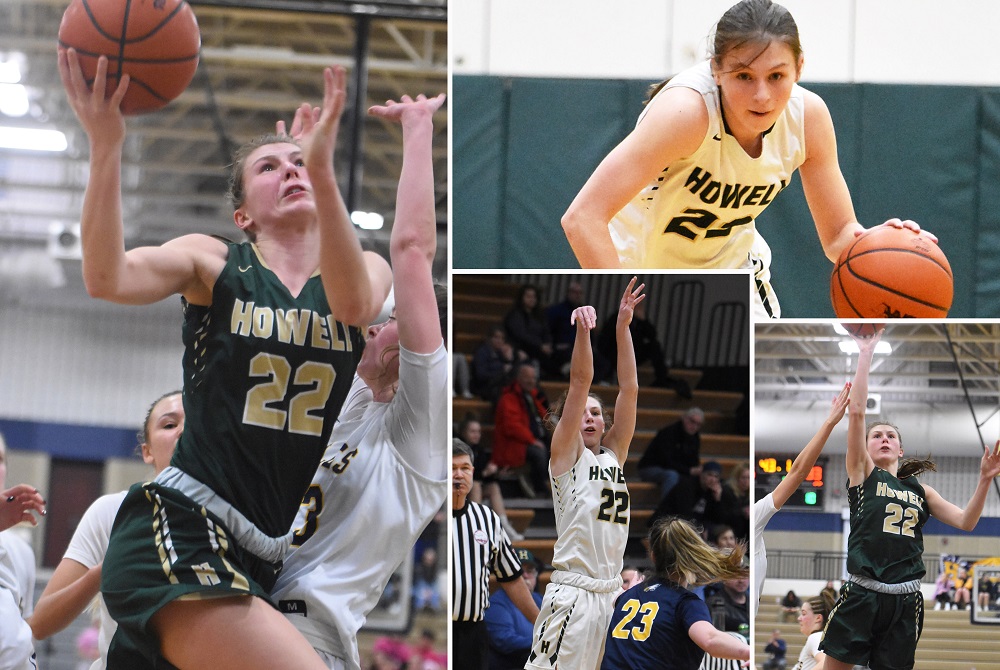
She is the team’s captain, leading scorer, one of its top rebounders, the school record-holder for assists and she also paces the Highlanders in charges taken, steals and blocked shots.
But, she said, her teammates keep her in line and focused, and that has made the difference in a Howell team that has beaten Division 1 powers Hartland and Wayne Memorial this season, with a possible rematch with Hartland in next week’s District tournament.
The difference?
“I accept criticism a lot better,” St. John says. “Last year, I was definitely more hard-headed. I feel I’m taking so much more advice from my teammates, and they hold me much more accountable. They can help me be better.”
What she’s been good at this season is helping her teammates be better, finding an open teammate, which in turn opens up more shots for herself.
Asked if she prefers scoring to feeding her teammates, St. John is quick with an answer.
“Assists are way better,” she said. “It's fun watching your teammates score, going in and getting a bucket and hitting shots. That’s exciting.”
St. John is averaging 15 points per game, with a robust 7.2 assists per contest and nearly three steals per as well.
“She’s better at harnessing her energy, and not feeling she has to be the one who does it all,” Howell coach Tim Olszewski said. “Maybe it’s an increased trust in her teammates, but she’s understanding that if she can draw an extra defender to her, then one of her teammates is open.”
St. John also occasionally makes a flashy move for no other reason than she can, sometimes looking over at the Howell bench with a smirk on her face.
“If you’re not trying to have fun out there, you’re not going to have fun,” she said. “I’m always looking to have fun out there. I’m always competing, trying new moves. Sometimes, they work. Sometimes they don’t, and I’m on the bench. Either way, it’s fun to try new things, to see what you’re capable of.”
That keeps opposing coaches, and her teammates, on alert, especially when St. John sees an opening and whips the ball to a teammate that may or may not be anticipating the pass.
“That happens a lot,” teammate Molly Duerloo said, chuckling. “But we capitalize on that. Her (on-court) vision has become better.”
Make no mistake about it: St. John has that rare combination of talent, curiosity, and joy one doesn’t often see in a top player.
“Boy, can she play this game,” Olszewski said. “She’s one of those special, special players. She just is. I don’t know how else to say it. She’s got the ability and the head about herself, and it’s going to be wonderful to watch her for four years at Northwood, because I think she’s going to excel there.”
Brighton coach Paul Ash, after watching her in a game in mid-February, also was impressed.
“I love watching that kid,” he said. “I’d pay money to watch that kid play. She’s a real, real competitor. She’s a fun kid to watch.”
St. John has little regret when it comes to sending up long-distance shots (she routinely launches 3-point tries from well beyond the arc), but also has no qualms about driving the lane or going after rebounds.
“She just plays at a high level,” Hartland coach Don Palmer said. “She’s exciting, she’s aggressive, and those kids just follow along,”
In addition to leading her team in most statistical categories, she also works closely with teammates in practice and even during games.
“She holds everyone accountable in practice,” Duerloo said. “She pushes everyone to be the best player they can be. She picks me up during a game if I’m not going good. She’ll say, ‘Hey you’ve got this. Next play. Believe in yourself.’”
The support, St. John said, goes both ways.
“They hold me accountable,” she said. “There are definitely some looks, some cussing out, ‘Hey, let’s go.’ That kind of thing. It’s a mutual respect. I think this group is something special. We’re all so close. We have all these inside jokes. Bus rides are fun. We feel so confident when we’re with each other.
“My teammates fuel me,” she added. “You look at someone going 110 percent, if you’re telling them to do something and you’re only going 80 percent, you’re not going to get any respect or anything done.”
St. John has signed with Northwood University, where she is considering majoring in personal finance or sports management.
“I love a lot of business-related things,” she said.
Right now, her increased understanding of her role as point guard and the possibilities it presents is a key reason why the Highlanders have won 14 of their last 15 games after a 1-3 start.
“She’s understanding the bigger picture,” Olszewski said. “There’s a reason why that particular shot or action, even though it might seem small or trite right now, how it could have a massive effect on the outcome of a game. And I think she’s excelled in that this year, understanding those situations.”
And, he said, St. John has been much more communicative with her teammates in helping them understand.
“Maeve’s always had an excellent basketball IQ and could always read situations,” Olszewski said. “When we talk about her being a leader, it’s about calming things down as opposed to throwing kerosene on the fire. I’ve also noticed an increase in her keeping herself accountable. Many times this year, she’s said, ‘That’s on me, team.’ She’s stepped to the forefront, which is what leaders do. She’s done a great job harnessing that energy and knowing when to unleash it and when to bring it back in a little bit.”
For St. John, it’s not so much being the straw that stirs the drink as being the leader of a pack of Highlanders willing to follow her for as long as possible.
But not without a little whimsy. Late in that mid-February game against Brighton, she drove the lane into a group of Bulldogs and somehow drew a foul on a shot that was off the mark. As she emerged, she looked at Olszewski and grinned.
“It was a forced shot, more like, ‘Oooh I got lucky on that play,’” she said. “I felt like I got bailed out on that play, and I looked at him and we chuckled.”
Howell had the game well in hand at that point. What if the game had been close?
“He wouldn't have been smiling,” St. John said, then added with a grin, “I probably would have still done it.”
PHOTOS Howell’s Maeve St. John has shown she can do it all – drive to the basket, shoot from the perimeter and find the open teammate. (Photos by Dan Zeppa.)