


Keep on Coaching
February 1, 2013
By Geoff Kimmerly
Second Half editor
A few weeks ago, I finally got my first chance this season to watch a friend coach his basketball team. After guiding some others at the lower levels, this is his first time running the varsity – something he wasn't sure he wanted to do with a 1-year-old just learning to walk, but a challenge he ended up taking on to the benefit of all those involved.
Simply put, he’s good. I've seen a lot of teams and a lot of coaches over the past 15 years, and although I wouldn't know much of what to do if I were walking the sideline, I felt pretty qualified in telling him I was impressed – even if he didn't buy that I was offering an unbiased opinion. The best news is he’s gone from not sure about this a few months ago to talking about next season.
We know, at least anecdotally, that coaching continues to get more challenging. The time commitment has grown substantially to make running a program a year-round endeavor in a lot of sports at a lot of schools.
That commitment – especially for coaches with children of their own – was a main reason referred to in a New Haven Post-Chronicle story Saturday that noted 23 football coaching openings in Connecticut at one point this offseason. That state has 146 football teams – meaning roughly 15 percent will have new leaders this fall.
And that got me thinking about my friend, about how glad I am he’s given this a shot, and how I've seen so many others either not do so, or not stick around long despite having some pretty nice success.
A study published last winter in Interscholastic Athletic Administration magazine – a product of the National Interscholastic Athletic Administrators Association – noted some predictable results of a study that sought to determine the biggest challenges faced by first-year high school coaches.
The toughest according to the study was balancing the demands of coaching and teaching, experienced by nearly half the respondents – 98 percent of which coached high school teams and 81 percent of which are teachers.
The next six reasons all were noted by at least 30 percent of those in the study – personal fatigue, securing community support, securing and caring for facilities and equipment, parental contact, keeping non-starting players motivated, dealing with schedule interruptions and motivating athletes to achieve consistent, peak performance.
Nothing there is earth-shaking, and most if not all of these challenges are faced by high school coaches regardless of how long they've been in the field. But I got a little more perspective from some of the 32 items that ranked as least challenging to the first-year leaders – keeping in compliance with state and league regulations, dealing with substance abuse issues, teaching sport skills and creating a positive team atmosphere – things that seem most important, and yet appear to be easiest to do. I’m not sure what that tells us – but I think it tells us something.
Click to check out the entire three-page breakdown of the study, plus the researchers’ recommendations to remedy some of what first-year coaches face.
Giving back to Saginaw
I love reading about high-level athletes – like a star-studded group of alums from Saginaw – giving back to where they got their starts.
Pittsburgh Steelers star LaMarr Woodley made a big impact before the start of this school year by donating $60,000 to cover all participation fees for athletes in his former school district. The Saginaw News’ Hugh Bernreuter writes today about how Woodley (Saginaw High), the Philadelphia 76ers’ Jason Richardson (Saginaw Arthur Hill) and former Oakland Raiders standout Stu Schweigert (Saginaw Heritage) have combined to give more than $865,000 back to their home communities.
Bernreuter also mentions the non-monetary contributions of the Golden State Warriors’ Draymond Green (Saginaw High) and former Indianapolis Colts receiver Blair White (Saginaw Nouvel).
Click to read more about it.
Quote(s) of the Week
While rifling through more papers on my desk, I found an article from the Washington Post from Sept. 2011 titled “How high school sports save our schools.” I was drawn to it in part because I spent more than a decade in a newsroom, and it was a piece by a reporter covering education who instead of reporting on school boards and the like, delved into the importance of interscholastic athletics to education as a whole.
He spoke of how participation continues to grow even as resources dwindle, and of data supporting that extracurriculars like sports are more effective than academic classes in teaching leadership, teamwork, time management and “other skills crucial for success in the workplace.” Later, he mentioned a study noting that those who participate in extracurriculars earned more a decade later.
Click here to read the entre piece. These passages struck me most.
“Coaches might be the only faculty members still allowed by our culture and educational practice to get tough with students not making the proper effort. They have the advantage of teaching what are essentially elective non-credit courses. They can insist on standards of behavior that classroom teachers often cannot enforce because the stakes of dismissing or letting students drop their courses are too high. …
“Students do better in activities they choose. If we provide more of them, led by committed adults … that can make a difference. We know the bad news about education. Dropout rates are high. Achievement scores are stagnant. But sports participation is going up, despite pressure to cut it back. Let’s cheer about that and look for a way to draw in more students.”
2022 WISL Honoree Hyman Lauded for Lifetime of Leadership
By
Geoff Kimmerly
MHSAA.com senior editor
February 25, 2022
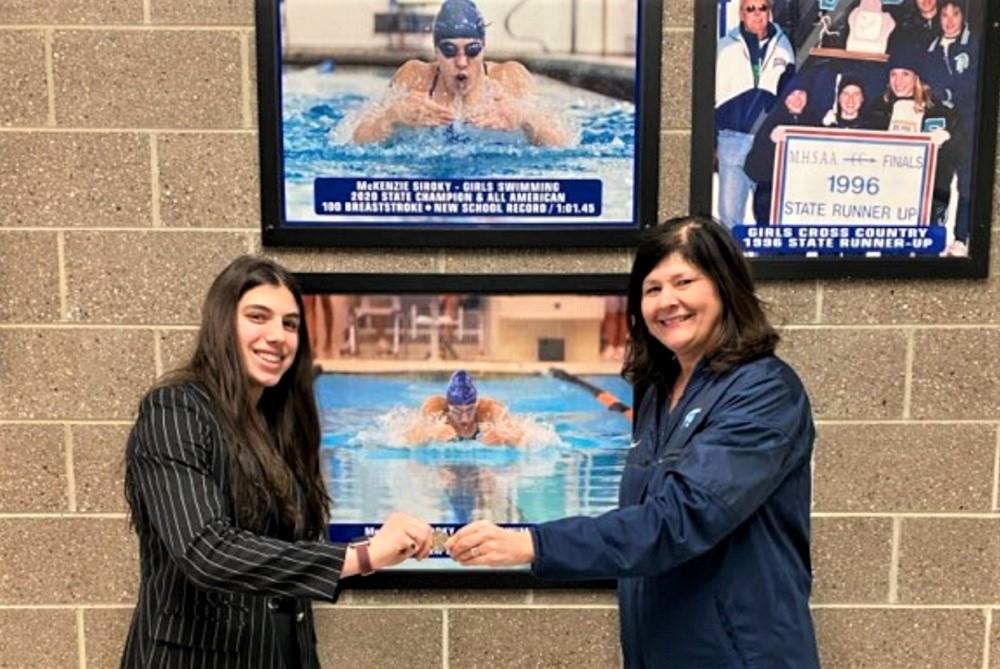
Lori Hyman was a sports standout in high school, then at Michigan State University. She then coached college basketball for 17 years, starting when she was only 23 years old, and surely could’ve continued down that path.
While always a leader, she decided to change gears in 1995 and provide guidance another way – coaching up coaches as a high school athletic director. Over the next 27 years, she became one of the most respected ADs in Michigan – and contributed in that role at her alma mater Livonia Stevenson over the last 22.
To celebrate her many contributions to school sports, at home but also statewide, Hyman has been named the 35th recipient of the MHSAA Women In Sports Leadership Award. She will receive the award during the Division 1 Girls Basketball Final on March 19 at Michigan State’s Breslin Center.
Hyman served her first five years as an athletic director at Dexter, making the move there after four college basketball coaching stops. After a memorable hoops career at MSU, she served as a women’s basketball graduate assistant at Ferris State University and then head coach at Northwood Institute (now University) from 1981-82 – when she was only 23 years old – through 1985-86.
She then served as an assistant at University of Illinois before returning as head coach at Ferris State from 1989-90 through 1994-95. In Fall 1995, she began at Dexter.
“Every part of my career I’ve been happy with, and honored, and just thoroughly enjoyed it,” Hyman said. “It’s been a passion of mine, every aspect.
“(Playing at Michigan State) was one of the best times, if not the best time, of my life as a youngster. And then being an athletic director has probably been the most rewarding as an adult. And being at Stevenson, coming back home, has been quite an honor and just a very rich experience for me.”
Each year, the Representative Council considers the achievements of women coaches, officials and athletic administrators affiliated with the MHSAA who show exemplary leadership capabilities and positive contributions to athletics.
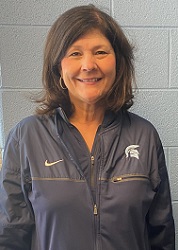 Hyman is a 1975 graduate of Stevenson, where she also played softball and competed in track & field. She was named MSU’s Outstanding Athlete of the Year for women’s basketball in 1979, after serving as co-captain of the team that season but missing the majority of it with an injury.
As an athlete at MSU, she joined her teammates in filing a 1978 discrimination complaint that requested the women’s basketball team receive travel allowances equal to those received by the Spartans men’s team. “It is very meaningful that Michigan State is where they are now, not just in women’s basketball but the women’s sport program,” Hyman said. “I feel like we were part of that growing and moving forward in a positive way, and I thank Michigan State for recognizing that and moving it forward.”
She graduated with a bachelor’s degree in physical education and health in 1980 and has a master’s in athletic administration from Wayne State University. She received her certified master athletic administrator designation from the National Interscholastic Athletic Administrators Association (NIAAA) in 2006.
Back at Stevenson, Hyman has directed the athletic program for a high school with nearly 1,700 students, which by enrollment ranks 50th out of 750 MHSAA member schools.
She has hosted a multitude of MHSAA Tournament events while at both Dexter and Stevenson and has served on the MHSAA’s girls tennis, girls basketball and boys basketball committees. She also has served as the girls and boys tennis commissioner of the Kensington Lakes Activities Association, of which Stevenson is a member.
“Lori has been a leader and pioneer in the world of athletics, and in particular as an advocate for females and girls sports,” MHSAA Executive Director Mark Uyl said. “When she left coaching basketball to work as an AD, it was an incredible victory for kids in our state. She’s been dependable, loyal and just a model of consistency in running a first-class program.”
Hyman was named her region’s Athletic Director of the Year by the Michigan Interscholastic Athletic Administrators Association (MIAAA) in 2014 and received its Jack Johnson Distinguished Service Award in 2015.
As an instructor for the MIAAA, Hyman has provided training particularly to beginning athletic directors. She has served as a Leadership Training Institute instructor as well for the MIAAA and as a presider and speaker at the MIAAA’s annual conference. She also has spoken at the MHSAA’s Women In Sports Leadership Conference.
“I’ve always been an advocate for women in sports and equal opportunity,” Hyman added. “I treat all of the sports here equally, male and female. But if I feel that there needs to be a little bit more advocacy for women in sports, whether it’s coaching and getting more girls involved, or officiating, administration, any kind of leadership, I’m really big on that.”
“I’m a big advocate for women in athletics, but (also) just athletics in general.”
In addition to her vast school sports responsibilities and contributions, Hyman has volunteered with Special Olympics, Livonia’s Newburg United Methodist Church and Rotary Club.
The first Women In Sports Leadership Award was presented in 1990.
Past recipients
1990 – Carol Seavoy, L’Anse
1991 – Diane Laffey, Harper Woods
1992 – Patricia Ashby, Scotts
1993 – Jo Lake, Grosse Pointe
1994 – Brenda Gatlin, Detroit
1995 – Jane Bennett, Ann Arbor
1996 – Cheryl Amos-Helmicki, Huntington Woods
1997 – Delores L. Elswick, Detroit
1998 – Karen S. Leinaar, Delton
1999 – Kathy McGee, Flint
2000 – Pat Richardson, Grass Lake
2001 – Suzanne Martin, East Lansing
2002 – Susan Barthold, Kentwood
2003 – Nancy Clark, Flint
2004 – Kathy Vruggink Westdorp, Grand Rapids
2005 – Barbara Redding, Capac
2006 – Melanie Miller, Lansing
2007 – Jan Sander, Warren Woods
2008 – Jane Bos, Grand Rapids
2009 – Gail Ganakas, Flint; Deb VanKuiken, Holly
2010 – Gina Mazzolini, Lansing
2011 – Ellen Pugh, West Branch; Patti Tibaldi, Traverse City
2012 – Janet Gillette, Comstock Park
2013 – Barbara Beckett, Traverse City
2014 – Teri Reyburn, DeWitt
2015 – Jean LaClair, Bronson
2016 – Betty Wroubel, Pontiac
2017 – Dottie Davis, Ann Arbor
2018 – Meg Seng, Ann Arbor
2019 – Kris Isom, Adrian
2020 – Nikki Norris, East Lansing
2021 – Dorene Ingalls, St. Ignace
PHOTO Livonia Stevenson athletic director Lori Hyman (right) and Finals swimming champion McKenzie Siroky hold up a championship medal alongside photos honoring Siroky's achievements. (Photo courtesy of the Stevenson athletic department.)