


Keep on Coaching
February 1, 2013
By Geoff Kimmerly
Second Half editor
A few weeks ago, I finally got my first chance this season to watch a friend coach his basketball team. After guiding some others at the lower levels, this is his first time running the varsity – something he wasn't sure he wanted to do with a 1-year-old just learning to walk, but a challenge he ended up taking on to the benefit of all those involved.
Simply put, he’s good. I've seen a lot of teams and a lot of coaches over the past 15 years, and although I wouldn't know much of what to do if I were walking the sideline, I felt pretty qualified in telling him I was impressed – even if he didn't buy that I was offering an unbiased opinion. The best news is he’s gone from not sure about this a few months ago to talking about next season.
We know, at least anecdotally, that coaching continues to get more challenging. The time commitment has grown substantially to make running a program a year-round endeavor in a lot of sports at a lot of schools.
That commitment – especially for coaches with children of their own – was a main reason referred to in a New Haven Post-Chronicle story Saturday that noted 23 football coaching openings in Connecticut at one point this offseason. That state has 146 football teams – meaning roughly 15 percent will have new leaders this fall.
And that got me thinking about my friend, about how glad I am he’s given this a shot, and how I've seen so many others either not do so, or not stick around long despite having some pretty nice success.
A study published last winter in Interscholastic Athletic Administration magazine – a product of the National Interscholastic Athletic Administrators Association – noted some predictable results of a study that sought to determine the biggest challenges faced by first-year high school coaches.
The toughest according to the study was balancing the demands of coaching and teaching, experienced by nearly half the respondents – 98 percent of which coached high school teams and 81 percent of which are teachers.
The next six reasons all were noted by at least 30 percent of those in the study – personal fatigue, securing community support, securing and caring for facilities and equipment, parental contact, keeping non-starting players motivated, dealing with schedule interruptions and motivating athletes to achieve consistent, peak performance.
Nothing there is earth-shaking, and most if not all of these challenges are faced by high school coaches regardless of how long they've been in the field. But I got a little more perspective from some of the 32 items that ranked as least challenging to the first-year leaders – keeping in compliance with state and league regulations, dealing with substance abuse issues, teaching sport skills and creating a positive team atmosphere – things that seem most important, and yet appear to be easiest to do. I’m not sure what that tells us – but I think it tells us something.
Click to check out the entire three-page breakdown of the study, plus the researchers’ recommendations to remedy some of what first-year coaches face.
Giving back to Saginaw
I love reading about high-level athletes – like a star-studded group of alums from Saginaw – giving back to where they got their starts.
Pittsburgh Steelers star LaMarr Woodley made a big impact before the start of this school year by donating $60,000 to cover all participation fees for athletes in his former school district. The Saginaw News’ Hugh Bernreuter writes today about how Woodley (Saginaw High), the Philadelphia 76ers’ Jason Richardson (Saginaw Arthur Hill) and former Oakland Raiders standout Stu Schweigert (Saginaw Heritage) have combined to give more than $865,000 back to their home communities.
Bernreuter also mentions the non-monetary contributions of the Golden State Warriors’ Draymond Green (Saginaw High) and former Indianapolis Colts receiver Blair White (Saginaw Nouvel).
Click to read more about it.
Quote(s) of the Week
While rifling through more papers on my desk, I found an article from the Washington Post from Sept. 2011 titled “How high school sports save our schools.” I was drawn to it in part because I spent more than a decade in a newsroom, and it was a piece by a reporter covering education who instead of reporting on school boards and the like, delved into the importance of interscholastic athletics to education as a whole.
He spoke of how participation continues to grow even as resources dwindle, and of data supporting that extracurriculars like sports are more effective than academic classes in teaching leadership, teamwork, time management and “other skills crucial for success in the workplace.” Later, he mentioned a study noting that those who participate in extracurriculars earned more a decade later.
Click here to read the entre piece. These passages struck me most.
“Coaches might be the only faculty members still allowed by our culture and educational practice to get tough with students not making the proper effort. They have the advantage of teaching what are essentially elective non-credit courses. They can insist on standards of behavior that classroom teachers often cannot enforce because the stakes of dismissing or letting students drop their courses are too high. …
“Students do better in activities they choose. If we provide more of them, led by committed adults … that can make a difference. We know the bad news about education. Dropout rates are high. Achievement scores are stagnant. But sports participation is going up, despite pressure to cut it back. Let’s cheer about that and look for a way to draw in more students.”

Stevenson's Siroky Surges Amid Challenges, Skates & Swims to Stardom
By
Tom Markowski
Special for Second Half
January 13, 2022
McKenzie Siroky isn't the first female athlete to compete on a boys hockey team in Michigan, but she might well be the best.
 Siroky's decision to try out, and be selected, for the Livonia Stevenson boys hockey team this season required a firm commitment and a hefty dose of courage. Siroky easily could have remained on the elite HoneyBaked AAA team she had been a member of for four years but she saw this, competing with and against the boys, as an opportunity.
And Siroky has never been one to back down from a new challenge. Besides, competing against the boys is nothing new for her – she has three older brothers who came through Stevenson coach David Mitchell's program – and she's confident it will eventually lead her to becoming a better player as she prepares to compete at the next level.
Siroky, 16, is a junior forward and arguably one of the top all-around female athletes in Michigan, perhaps the Midwest, over the last 10 years. She recently committed to play hockey at Minnesota-Duluth, one of the country's top programs, and two months ago she set the MHSAA Lower Peninsula Division 1 Girls Swimming & Diving Finals record in the 100-yard breaststroke.
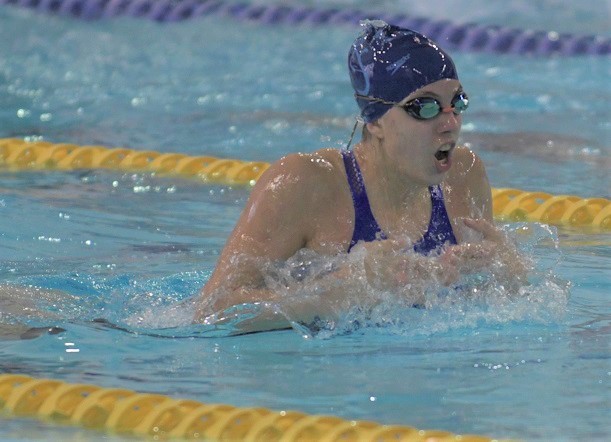
As a sophomore in 2020, Siroky won the Division 1 title in the breaststroke with a time of 1:01.45. At the Holland Aquatic Center this past November, Siroky won the event with a time of 1:00.85. Her 1:00.48 in the prelim set the MHSAA Finals all-class, all-division record, besting the 1:00.56 swam by Miranda Tucker of Waterford in 2014.
Siroky also was a member of relay teams that finished fourth in both the 200 medley and 200 freestyle.
Although hockey has always been her main sport, Siroky said she intends to compete in swimming next fall.
“I want to be the first to break the 1-minute (mark),” she said.
Given Siroky's track record, it shouldn't surprise anyone if she did. It's that challenge thing.
Sure she's talented, but there's so much more to Siroky than pure ability. She's had to overcome obstacles and heartaches most only hear about – and her work ethic and willingness to sacrifice have Siroky on the road to success.
Siroky said she started skating when she was about 5 years old. A year later, as a first grader, she played on her first organized hockey team, the Livonia Sharks, and she could hardly contain her joy.
“I remember going to school wearing my jersey,” she said. “I was so proud. I wore it all day.”
Siroky has been hooked ever since. But before hockey, there was swimming.
Her mother Michele Siroky also attended Stevenson and was a three-time Class A Finals champion, twice as part of relays and in 1987 in the 200 freestyle, before competing at Michigan State. Michele, who was a teammate of Olympic Gold medalist Sheila Taormina at Stevenson, introduced her eldest daughter to swimming and, although it was more of a summer activity at first, McKenzie’s love for the sport grew.
Michele's maiden name was McKenzie, hence her daughter's name. She coached at a handful of places including Stevenson and was an occupational therapist before working for Livonia Public Schools. In 2012, she was diagnosed with brain cancer. Three years later she developed breast cancer and beat that, but succumbed to the brain cancer and died on July 26, 2017.
 “She got me in the pool,” Siroky said. “She coached me for five or six years until she couldn't anymore. She also swam the breaststroke. I got most of my training (in that event) from her.
“She gave me motivation. She gave back to the community by coaching at Burton Hollow (Swim Club) and other ways.”
Michele was an exceptional person. She devoted herself to the care of children and her family. She made a seamless transition from being a swim mom to a hockey mom, driving her children to practice, preparing meals and keeping a sharp eye on their schedules.
For Siroky, a day doesn't pass without thoughts of her mother, who was her mentor, teacher and friend. She continues to draw strength from her and remains a driving force in her life.
As much as Siroky enjoyed being in the pool, and having her mother as a coach, hockey has always been her favorite sport. Perhaps it was watching her bothers (Alex, Kyle and Jack) play and compete so well that made such an impact on her. Or perhaps the realization that she was good at it, and enjoyed every minute on the ice, playing or practicing.
As she advanced from the Sharks to the Livonia Knights, Siroky ran into disappointment – and it proved beneficial.
The girls program placed two age groups per level. When Siroky was 9, she tried out for the 10-and-under team and was cut as the coaches leaned toward keeping the older players, leaving fewer spots for the younger ones. Undeterred, Siroky went to nearby Farmington where there was a team for her age group.
“It worked out well,” she said. “I started playing at the Triple-A level there. In Livonia they only had Double-A. I feel eventually I would have gone over (to Farmington). Yeah, being cut, I always use that as motivation.”
Other than skating with her brothers, the first time Siroky competed against the boys took place at a developmental summer camp while attending Holmes Middle School in Livonia.
“I felt like I matched up well,” she said. “I was fine.”
This experience made the decision to switch from HoneyBaked to competing with Stevenson this season all the easier.
“It came down to where I was going to develop the most,” she said. “I was playing in an age group, and I had a discussion (with HoneyBaked coaches) to move up.
“Now that I'm on the team, I couldn't be more grateful. I'm trying to get better every day. That's what Coach Mitch says – work to get better every day. And the guys have been great, pushing me every day in practice.”
The more Siroky faces adversity, the more she's inspired to excel.
“Her whole motivation is to be challenged,” Mitchell said. “She's not one to back down. It comes down to how can she become better.”
In July, Siroky was one of 32 players, including five total from Michigan, invited to compete in the USA Hockey Girls U18 Select Player Development Camp in St. Cloud, Minn. This group represented the best of the best for the age group, and from them 23 were selected to the USA U18 women's national team that would compete in the 2022 International Ice Hockey Federation (IIHF) Women's World Championships.
 Earlier this month, those 23 players were officially named as members of the 2022 Olympic team that will compete in China in February.
Siroky didn't make the final cut, thus adding motivation and another reason to compete with and against the boys.
“We look at this as an opportunity,” Mitchell said. “Everyone knows McKenzie and the positive energy she brings. She's infectious. It's been a win, win, win for everyone.”
When her mother passed, Siroky found it difficult, at times, to concentrate on her schoolwork. Yes, swimming and hockey provided an outlet, something she could sink her teeth into, but her attention toward school took time. And she received help.
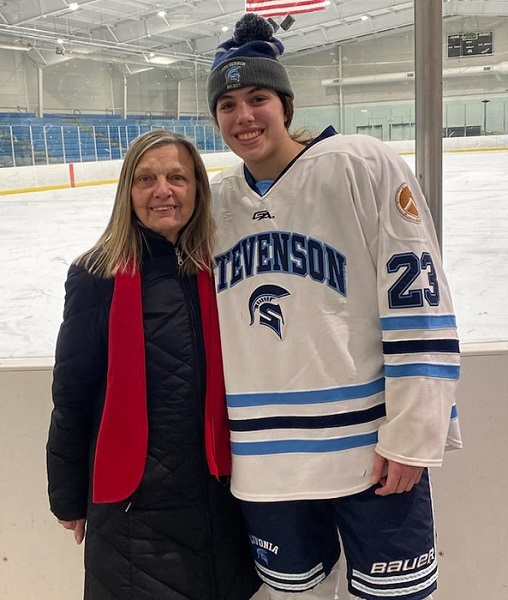
Two years ago, Siroky moved in with her grandmother, Barbara McKenzie, and it was just what Siroky needed. Her grandmother and the guidance she provided filled a gap.
“She does so much for me,” Siroky said. “It gets so busy for me. She'll take things off my shoulders, like some days I'll see that all my laundry is done. That really helps. She knows I like to eat fruits and vegetables, so she'll buy them. And she lives right across from Stevenson, so that saves me time, too.”
Perhaps not so coincidentally, Siroky's grades improved the last two years. She's earned all As.
Her schedule, especially in the fall when she competes in swimming and has hockey practice, is mind-boggling. Three times a week she'll go to swim practice in the morning before school. Then there's practice five days a week after school as well as Saturdays. After swim practice she'll take care of her homework assignments, have dinner, then go to hockey practice. No swim practice on Sundays, so those days are devoted to hockey.
She can't remember the last time she watched television. Energy drinks are a no-no, and she doesn't drink coffee or eat anything that has processed sugar.
“I'm living in the moment,” Siroky said. “I repeat to myself, over and over, ‘How bad do you want it?’”
The results are in full view with hockey and her education taking center stage. She achieved one major goal, that being to play in college. Another would be to make the U.S. U18 national team.
More immediate is this hockey season, which could prove to be quite successful for the Spartans. They started 1-1 (Siroky missed both games due to the swim Finals) and have won 10 of 11 since, including the last five. Stevenson's two losses are to Grosse Pointe South (3-2) and Birmingham Brother Rice (3-1).
“We lost 18 seniors from last year,” Mitchell said. “This group is phenomenal. It's been a high-character group.”
 Tom Markowski primarily covered high school sports for the The Detroit News from 1984-2014, focusing on the Detroit area and contributing to statewide coverage of football and basketball. He also is a former correspondent and web content director for State Champs! Sports Network. Contact him at [email protected] with story ideas for Oakland, Macomb and Wayne counties.
PHOTOS (Top) Livonia Stevenson’s McKenzie Siroky helps her team to an 8-0 win over Trenton on Jan. 5 (Middle) Siroky sets the all-class/division MHSAA Finals record in the 100 breaststroke during the LPD1 preliminaries in November. (Below) Siroky and her grandmother Barbara McKenzie. (Top photo by Douglas Bargerstock, middle photo by High School Sports Scene, below photo courtesy of McKenzie Siroky.)