


Keep on Coaching
February 1, 2013
By Geoff Kimmerly
Second Half editor
A few weeks ago, I finally got my first chance this season to watch a friend coach his basketball team. After guiding some others at the lower levels, this is his first time running the varsity – something he wasn't sure he wanted to do with a 1-year-old just learning to walk, but a challenge he ended up taking on to the benefit of all those involved.
Simply put, he’s good. I've seen a lot of teams and a lot of coaches over the past 15 years, and although I wouldn't know much of what to do if I were walking the sideline, I felt pretty qualified in telling him I was impressed – even if he didn't buy that I was offering an unbiased opinion. The best news is he’s gone from not sure about this a few months ago to talking about next season.
We know, at least anecdotally, that coaching continues to get more challenging. The time commitment has grown substantially to make running a program a year-round endeavor in a lot of sports at a lot of schools.
That commitment – especially for coaches with children of their own – was a main reason referred to in a New Haven Post-Chronicle story Saturday that noted 23 football coaching openings in Connecticut at one point this offseason. That state has 146 football teams – meaning roughly 15 percent will have new leaders this fall.
And that got me thinking about my friend, about how glad I am he’s given this a shot, and how I've seen so many others either not do so, or not stick around long despite having some pretty nice success.
A study published last winter in Interscholastic Athletic Administration magazine – a product of the National Interscholastic Athletic Administrators Association – noted some predictable results of a study that sought to determine the biggest challenges faced by first-year high school coaches.
The toughest according to the study was balancing the demands of coaching and teaching, experienced by nearly half the respondents – 98 percent of which coached high school teams and 81 percent of which are teachers.
The next six reasons all were noted by at least 30 percent of those in the study – personal fatigue, securing community support, securing and caring for facilities and equipment, parental contact, keeping non-starting players motivated, dealing with schedule interruptions and motivating athletes to achieve consistent, peak performance.
Nothing there is earth-shaking, and most if not all of these challenges are faced by high school coaches regardless of how long they've been in the field. But I got a little more perspective from some of the 32 items that ranked as least challenging to the first-year leaders – keeping in compliance with state and league regulations, dealing with substance abuse issues, teaching sport skills and creating a positive team atmosphere – things that seem most important, and yet appear to be easiest to do. I’m not sure what that tells us – but I think it tells us something.
Click to check out the entire three-page breakdown of the study, plus the researchers’ recommendations to remedy some of what first-year coaches face.
Giving back to Saginaw
I love reading about high-level athletes – like a star-studded group of alums from Saginaw – giving back to where they got their starts.
Pittsburgh Steelers star LaMarr Woodley made a big impact before the start of this school year by donating $60,000 to cover all participation fees for athletes in his former school district. The Saginaw News’ Hugh Bernreuter writes today about how Woodley (Saginaw High), the Philadelphia 76ers’ Jason Richardson (Saginaw Arthur Hill) and former Oakland Raiders standout Stu Schweigert (Saginaw Heritage) have combined to give more than $865,000 back to their home communities.
Bernreuter also mentions the non-monetary contributions of the Golden State Warriors’ Draymond Green (Saginaw High) and former Indianapolis Colts receiver Blair White (Saginaw Nouvel).
Click to read more about it.
Quote(s) of the Week
While rifling through more papers on my desk, I found an article from the Washington Post from Sept. 2011 titled “How high school sports save our schools.” I was drawn to it in part because I spent more than a decade in a newsroom, and it was a piece by a reporter covering education who instead of reporting on school boards and the like, delved into the importance of interscholastic athletics to education as a whole.
He spoke of how participation continues to grow even as resources dwindle, and of data supporting that extracurriculars like sports are more effective than academic classes in teaching leadership, teamwork, time management and “other skills crucial for success in the workplace.” Later, he mentioned a study noting that those who participate in extracurriculars earned more a decade later.
Click here to read the entre piece. These passages struck me most.
“Coaches might be the only faculty members still allowed by our culture and educational practice to get tough with students not making the proper effort. They have the advantage of teaching what are essentially elective non-credit courses. They can insist on standards of behavior that classroom teachers often cannot enforce because the stakes of dismissing or letting students drop their courses are too high. …
“Students do better in activities they choose. If we provide more of them, led by committed adults … that can make a difference. We know the bad news about education. Dropout rates are high. Achievement scores are stagnant. But sports participation is going up, despite pressure to cut it back. Let’s cheer about that and look for a way to draw in more students.”

Longtime Coach's Legendary Expertise Keeps Manistee Surging
By
Tom Spencer
Special for MHSAA.com
November 19, 2021
Name any high school or community pool in Michigan, and odds are Corey Van Fleet has been there.
 Perhaps it is true of any pool in the United States.
He might have even helped build it.
And, a little more odds. If the pool hosted an MHSAA Finals meet, one of Van Fleet’s teams likely participated. Although he won’t have any qualifiers making the trip to the Division 3 girls meet Friday, he’s been to championship weekend lots of times with Birmingham Seaholm and Manistee. His 1962-65 Seaholm boys teams won four straight Class A Finals, and his Manistee boys team is coming off a Finals trip last winter and its best season ever.
Van Fleet, now 85 years young, is in his 68th of coaching swimmers. He’s spent the last 13 with the boys and girls teams of Manistee High School. He started the program after helping build the pool.
The school utilizes the Paine Aquatics Center named after Bill Paine, who presented a proposal to the City of Manistee, the Manistee Area Public Schools and Van Fleet. Paine’s proposal called for the pool, which opened in July 2009, to be attached to the high school facilities.
“So I’m sitting in my office one day and this tall, lanky guy (Paine) walks in and closes the door and says my wife and I want to donate an aquatics complex in Manistee, and Sandy Saylor says you know something about swimming,” Van Fleet recalls. “‘Will you help me build it?’
“We talked about it for a while and I said yeah, I’d help him,” Van Fleet continued. “So we ended up with a nice eight-lane swimming pool in Manistee.”
Van Fleet, who also had coached at Florida State, coached and served as athletic director at Oakland University and then served as AD at Long Beach State (Calif.) during an illustrious career at the college level, took the next step naturally.
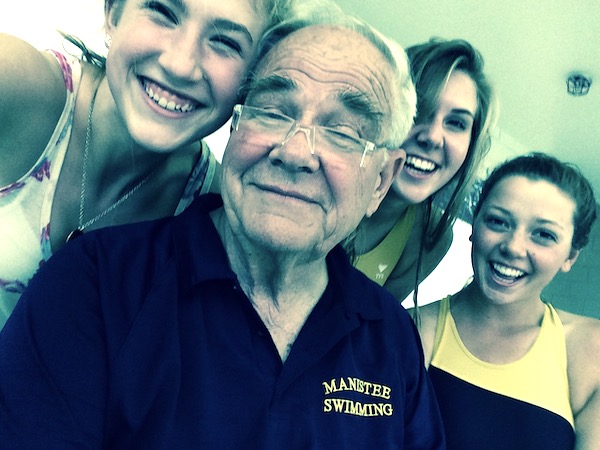 “The superintendent of schools at the time (Robert Olsen) said you build the darn thing, you might as well get some programs started,” Van Fleet recalled. “That was 13 years ago, and I’m still at it.”
At it, Van Fleet continues. He plans to stay with it until he just can’t do it anymore.
“I am still fairly healthy,” he said. “If I can find six people that can carry me out of church, I can think about quitting.”
During his tenure at Manistee, Van Fleet’s teams have dominated the Coastal Conference and produced multiple academic all-state swimmers. The boys team captured the 2020 academic all-state title with a 3.82 team grade point average.
“I am most proud, I think, about our academic progress,” Van Fleet said. “We take great pride in passing some classes.”
Van Fleet is also filled with pride when he reflects on all the swimmers he’s seen go on to become lawyers, doctors, teachers, engineers and coaches.
“I am pleased with the number of kids who have gone on to do some pretty big things in the world off our swimming programs,” he said. “I’d like to think they might have learned lessons about goal planning and sticking to it and hard work and all that stuff.
“That’s what lights me up.”
Van Fleet’s initial high school coaching job was at Madison Heights in 1959. He’s coached at camps all over Michigan, including his first at Burt Lake in 1954. Today he owns and operates a summer swimming camp in Irons, 30 miles southeast of Manistee. He also built it.
Jeff Brunner, a veteran MHSAA official in multiple sports including swimming, and father of former members of the Traverse City high school swimming co-op, is among many singing praises of Van Fleet’s impact on the sport.
“Corey has a wealth of information that he has accumulated in his coaching career,” Brunner said. “If I was a high school swimmer, I’d want to learn all I could from him – swimming for him would be such a unique opportunity.”
Andrew Huber, principal of Manistee’s middle and high schools, agrees with Brunner.
“We're humbled to have had Corey as part of our school and community,” he said. “His wealth of experience, knowledge, and relationship building has helped create a foundation of well-being for students and adults alike.
“His enthusiasm for swimming is infectious, and his energy is amazing for anyone regardless of age,” he continued. “It's been truly impressive to observe him connect and inspire students for the many years he's been in Manistee, and realize his impact is generational.”
The Manistee boys swim team starts practice next week. The Chippewas, along with their girls squad, have battled through COVID. The pandemic is one of many changes through which Van Fleet has guided his athletes.
“We’ve seen changes in training methods,” he said. “We’ve seen changes in diet.
“We’ve seen changes in philosophies in terms of what’s important and what’s not important,” he went on. “Kids have changed, and parents have changed.”
Training methods have been modified the most, along with new multi-lane pools popping up in Michigan, Van Fleet noted.
“Swimming is more technical now,” he said. “The science of swimming has become paramount.
“It is not just going in and kick a few legs and swim a few hundreds and go home — we’ve gone the gamut,” he continued. “It is very specific now every time you want a kid to do something, and now our swimming pools are showplaces – they are magnificent.”
 Tom Spencer is a longtime MHSAA-registered basketball and soccer official, and former softball and baseball official, and he also has coached in the northern Lower Peninsula area. He previously has written for the Saginaw News, Bay County Sports Page and Midland Daily News. He can be reached at [email protected] with story ideas for Manistee, Wexford, Missaukee, Roscommon, Ogemaw, Iosco, Alcona, Oscoda, Crawford, Kalkaska, Grand Traverse, Benzie, Leelanau, Antrim, Otsego, Montmorency, Alpena, Presque Isle, Cheboygan, Charlevoix and Emmet counties.
PHOTOS (Top) Corey Van Fleet (far right) visits with his Manistee girls team the wall honoring him at Oakland University. (Middle) Van Fleet is in his 68th year coaching swimming. (Photos courtesy of the Manistee girls swimming & diving program.)