

Keep on Coaching
February 1, 2013
By Geoff Kimmerly
Second Half editor
A few weeks ago, I finally got my first chance this season to watch a friend coach his basketball team. After guiding some others at the lower levels, this is his first time running the varsity – something he wasn't sure he wanted to do with a 1-year-old just learning to walk, but a challenge he ended up taking on to the benefit of all those involved.
Simply put, he’s good. I've seen a lot of teams and a lot of coaches over the past 15 years, and although I wouldn't know much of what to do if I were walking the sideline, I felt pretty qualified in telling him I was impressed – even if he didn't buy that I was offering an unbiased opinion. The best news is he’s gone from not sure about this a few months ago to talking about next season.
We know, at least anecdotally, that coaching continues to get more challenging. The time commitment has grown substantially to make running a program a year-round endeavor in a lot of sports at a lot of schools.
That commitment – especially for coaches with children of their own – was a main reason referred to in a New Haven Post-Chronicle story Saturday that noted 23 football coaching openings in Connecticut at one point this offseason. That state has 146 football teams – meaning roughly 15 percent will have new leaders this fall.
And that got me thinking about my friend, about how glad I am he’s given this a shot, and how I've seen so many others either not do so, or not stick around long despite having some pretty nice success.
A study published last winter in Interscholastic Athletic Administration magazine – a product of the National Interscholastic Athletic Administrators Association – noted some predictable results of a study that sought to determine the biggest challenges faced by first-year high school coaches.
The toughest according to the study was balancing the demands of coaching and teaching, experienced by nearly half the respondents – 98 percent of which coached high school teams and 81 percent of which are teachers.
The next six reasons all were noted by at least 30 percent of those in the study – personal fatigue, securing community support, securing and caring for facilities and equipment, parental contact, keeping non-starting players motivated, dealing with schedule interruptions and motivating athletes to achieve consistent, peak performance.
Nothing there is earth-shaking, and most if not all of these challenges are faced by high school coaches regardless of how long they've been in the field. But I got a little more perspective from some of the 32 items that ranked as least challenging to the first-year leaders – keeping in compliance with state and league regulations, dealing with substance abuse issues, teaching sport skills and creating a positive team atmosphere – things that seem most important, and yet appear to be easiest to do. I’m not sure what that tells us – but I think it tells us something.
Click to check out the entire three-page breakdown of the study, plus the researchers’ recommendations to remedy some of what first-year coaches face.
Giving back to Saginaw
I love reading about high-level athletes – like a star-studded group of alums from Saginaw – giving back to where they got their starts.
Pittsburgh Steelers star LaMarr Woodley made a big impact before the start of this school year by donating $60,000 to cover all participation fees for athletes in his former school district. The Saginaw News’ Hugh Bernreuter writes today about how Woodley (Saginaw High), the Philadelphia 76ers’ Jason Richardson (Saginaw Arthur Hill) and former Oakland Raiders standout Stu Schweigert (Saginaw Heritage) have combined to give more than $865,000 back to their home communities.
Bernreuter also mentions the non-monetary contributions of the Golden State Warriors’ Draymond Green (Saginaw High) and former Indianapolis Colts receiver Blair White (Saginaw Nouvel).
Click to read more about it.
Quote(s) of the Week
While rifling through more papers on my desk, I found an article from the Washington Post from Sept. 2011 titled “How high school sports save our schools.” I was drawn to it in part because I spent more than a decade in a newsroom, and it was a piece by a reporter covering education who instead of reporting on school boards and the like, delved into the importance of interscholastic athletics to education as a whole.
He spoke of how participation continues to grow even as resources dwindle, and of data supporting that extracurriculars like sports are more effective than academic classes in teaching leadership, teamwork, time management and “other skills crucial for success in the workplace.” Later, he mentioned a study noting that those who participate in extracurriculars earned more a decade later.
Click here to read the entre piece. These passages struck me most.
“Coaches might be the only faculty members still allowed by our culture and educational practice to get tough with students not making the proper effort. They have the advantage of teaching what are essentially elective non-credit courses. They can insist on standards of behavior that classroom teachers often cannot enforce because the stakes of dismissing or letting students drop their courses are too high. …
“Students do better in activities they choose. If we provide more of them, led by committed adults … that can make a difference. We know the bad news about education. Dropout rates are high. Achievement scores are stagnant. But sports participation is going up, despite pressure to cut it back. Let’s cheer about that and look for a way to draw in more students.”
Preview: Wings Awaits Challengers Chasing Champions, Record-Setting Opportunity
By
Geoff Kimmerly
MHSAA.com senior editor
February 26, 2026
Detroit Catholic Central. Lowell. Dundee. Hudson.
Together, they have won 20 of the 24 MHSAA Team Finals championships awarded this decade. And all are seeded first in their respective divisions again this weekend at Wings Event Center in Kalamazoo.
While their winning streaks remain storylines of note, one more definitely deserves attention. Hudson coach Scott Marry will bring a 980-216 career record into this weekend. One more win will tie him with retired Stevensville Lakeshore coach Bruce Bittenbender for the most in MHSAA wrestling history. A second victory in Saturday’s Semifinal would send Marry to the top of the list.
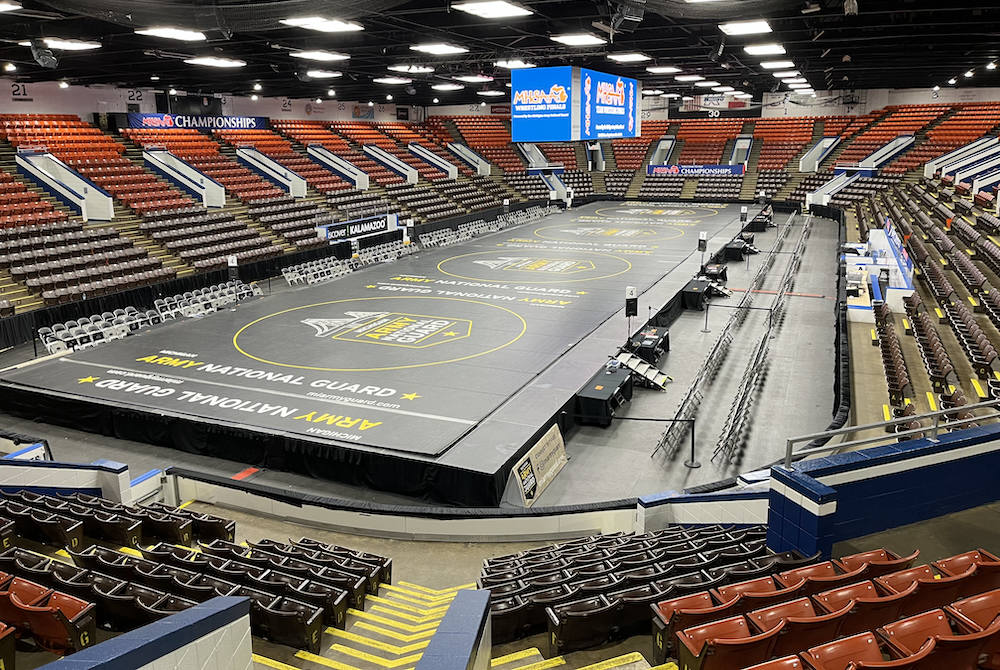
Competition begins Friday at noon with the first of four sets of Quarterfinals. Semifinals are 9:30 a.m. and noon Saturday, with championship matches on four adjacent mats at 3:45 p.m. Brackets for all four divisions, links to buy tickets and watch online can be found on the Wrestling page. See below for glances at all 32 hopefuls, listed by division and seed.
Division 1
#1 DETROIT CATHOLIC CENTRAL
Record/rank: 17-5, No. 1
League finish: First in Catholic High School League
Coach: Mitch Hancock, 19th season (422-68)
Championship history: Eighteen MHSAA championships (most recent 2025), four runner-up finishes.
Individual Finals qualifiers: 106 Gavin Boller (30-10) fr., 113 Gabriel Ryzyi (35-8) fr., 120 Brent Coak (23-17) fr., 126 Jamison Gregory (27-7) jr., 126 Ryan Totten (35-9) jr., 132 Wyatt Lees (37-3) sr., 132 Meyer Murray (23-14) soph., 138 Mack Moscovic (33-10) jr., 150 Grayson Fuchs (22-1) jr., 157 Alexander Buskirk (30-7) sr., 175 Braxten Roche (21-7) soph., 190 Caden Krueger (36-4) jr., 215 Collin Payne (30-15) sr.
Outlook: Detroit Catholic Central will attempt to win a fourth-straight Division 1 championship for the second time and run its total to eight Finals titles over the last decade. There are still only three seniors among 13 Individual Finals qualifiers, and two reigning individual champions in Lees and Fuchs. Totten finished runner-up to Lees at 120 pounds last year, while Moscovic, Gregory, Murray, Buskirk, Roche and Krueger all are returning Individual Finals placers as well. Lees will be wrestling for a fourth individual title and Fuchs for his third next weekend.
#2 HARTLAND
Record/rank: 24-1, No. 2
League finish: First in Kensington Lakes Activities Association West
Coach: Kyle Summerfield, fifth season (138-8)
Championship history: Division 1 champion 2016, seven runner-up finishes.
Individual Finals qualifiers: 106 Brodie Dunbar (37-11) soph., 113 Jase Sensor (40-8) soph., 120 Jonah McPherson (38-11) soph., 138 Bohdan Abbey (43-1) sr., 144 Ashton Jewell (46-9) jr., 144 Braydon Tougas (36-5) jr., 150 James Kozsa (40-11) sr., 157 Dallas Korponic (45-2) sr., 165 Joseph Cappellano (40-10) sr., 175 Jacen Pocock (34-9) jr., 215 Lucas Bates (36-9) sr.
Outlook: Hartland is back at the Finals for the fourth time in five seasons under Summerfield and after winning a league that included two other top-10 teams. Abbey are Korponic are reigning Individual Finals champions and both seeking to finish their high school careers next weekend with third individual titles. Hartland defeated No. 4 Clarkston 52-18 in their Regional Final.
#3 BRIGHTON
Record/rank: 24-2, No. 3
League finish: Second in KLAA West
Coach: Matt Wisniewski, first season (24-2)
Championship history: Division 1 champion 2015, runner-up 2018 and 2019.
Individual Finals qualifiers: 120 Bronson Shinkonis (33-7) soph., 126 Drake Pollins (31-8) (sr.), 132 Ethan Smith (33-9) sr., 144 Xander Courneya (33-9) sr. 150 Kaden Tindall (34-7) sr., 175 Mason Gardner (30-13) sr., 190 Dominic Nauss (33-4) soph., 215 Sullivan Haas (31-7) jr., 285 Alexander Salmon (32-9) sr., G-140 Alexis Lazar (23-0) sr.
Outlook: Brighton is seeking to take the next step again after falling by just a point in last year’s Semifinals. Wisniewski took over the program this season after seven as an assistant and has returning Individual Finals placers in Shinkonis, Courneya, Tindall, Nauss, junior Jameson Woods (19-10, 113) and sophomore Beck Yurkunas (35-10, 138). Woods was the runner-up at 106 last season. The Bulldogs defeated No. 6 Grand Ledge, No. 10 Howell and No. 15 Hastings on the way to this weekend.
#4 TEMPERANCE BEDFORD
Record/rank: 29-5, No. 8
League finish: First in Southeastern Conference
Co-coaches: Kevin Vogel, 15th season (375-69) & Logan Rimmer, first season (29-5)
Championship history: Eleven MHSAA championships (most recent 2001), seven runner-up finishes.
Individual Finals qualifiers: 120 Cody Duvendack (41-5) jr., 126 Maxim Benore (37-13) sr., 132 Tristan King (43-6) sr., 138 Nolan King (41-8) sr., 157 George Yockey (28-13) jr., 175 Zach Miracle (43-2) sr.
Outlook: Bedford has moved up a seed from last season after just missing making the 2025 Semifinals with a one-point Quarterfinal defeat. Miracle was the individual runner-up last season at 165 pounds and is one of five senior starters. Duvendack also was a Finals placer a year ago. Bedford advanced to this weekend with a 42-21 Regional Final win over No. 7 Westland John Glenn.
#5 ROCKFORD
Record/rank: 26-4, No. 9
League finish: First in Ottawa-Kent Conference Red
Coach: Brian Richardson, 17th season (392-139)
Championship history: Two MHSAA championships (most recent 2009), three runner-up finishes.
Individual Finals qualifiers: 106 Brody Compau (43-0) fr., 120 Layne Martin (43-0) jr., 126 Keagen Elliott (39-6) jr., 132 Logan Welmerink (25-7) soph., 144 Liam Fitzpatrick (44-0) sr., 175 Logan Hammingh (42-1) sr., G-155 Ashton Wright (18-7) soph., G-170 Easton Wright (15-5) sr.
Outlook: The Rams are back at Finals weekend after defeating No. 13 Grandville 44-30 in their Regional Final, and also moved up a seed from a year ago. This team could be on the verge of something more over the next few seasons with only three seniors and six underclassmen in the starting lineup. Martin is the reigning champion at 113, and Elliott, Welmerink, Fitzpatrick and Hammingh all are returning individual placers.
#6 DAVISON
Record/rank: 10-6, No. 11
League finish: First in Saginaw Valley League
Coach: Jason Mester, second season (27-10)
Championship history: Ten MHSAA championships (most recent 2022), seven runner-up finishes.
Individual Finals qualifiers: 106 Jacob Holley (29-7) fr., 113 Brice Hamlin (22-16) soph., 120 Bryce Holt (26-8) sr., 126 Steve Vaughn (24-11) jr., 144 Calvin Martz (24-12) sr., 150 Wyatt Cross (22-12) soph., 157 Julius Pacheco (30-3) jr., 215 Brandon Glisson (27-11) sr., G-110 Aubrey Bowman (25-3) soph.
Outlook: Just like two years ago, when Davison nearly made the championship match as a No. 6 seed, the Cardinals could be dangerous from this spot also coming off finishing runner-up a year ago. Vaughn was an Individual Finals champion as a freshman and placer last year, along with Martz, Pacheco, Glisson and Tobias Pacheco (4-4, 157).
#7 ROCHESTER ADAMS
Record/rank: 15-4, No. 12
League finish: Third in Oakland Activities Association Red
Coach: Mike Holtz, 19th season (289-129)
Championship history: Division 1 champion 1998, runner-up 1999.
Individual Finals qualifiers: 126 John David Quinlan (38-5) jr., 132 Will Eastin (28-17) soph., 144 Deacon Morgan (24-1) jr., 150 Demetrious Thomas (31-12) jr., 165 Dominic Beccari (35-6) sr., 190 Jackson Harris (19-6) jr., 215 Maxim Vostryakov (39-9) sr.
Outlook: Adams has won four straight District titles and taken the next steps this time with its first Regional championship since 1999, thanks in part to a 37-35 win over No. 14 Romeo in their Regional Semifinal. Holtz was an all-stater for the Highlanders and part of the teams that finished champion and runner-up during the late 1990s. Morgan was the individual runner-up last season at 126, and Beccari and Quinlan were placers.
#8 MACOMB DAKOTA
Record/rank: 23-4, unranked
League finish: First in Macomb Area Conference Red
Coach: Ed Skowneski III, 14th season (358-76)
Championship history: Has never advanced to an MHSAA Final.
Individual Finals qualifiers: 106 Kevin Shamblin (35-17) soph., 113 Kayson Spens (37-16) fr., 138 Carl Nihranz (49-2) sr., 144 Lucas Harper (38-7) sr.
Outlook: Dakota has made it 12 Regional titles under Skowneski, and a third straight with a lineup featuring only four seniors but a large group of juniors through the mid to heavier weights. Nihranz has placed at the Individual Finals his first three seasons and should be a championship contender next weekend.
Division 2
#1 LOWELL
Record/rank: 32-3, No. 1
League finish: First in River Cities Alliance
Coach: Kyle Slocum, first season (32-3)
Championship history: Fifteen MHSAA championships (most recent 2025), six runner-up finishes.
Individual Finals qualifiers: 113 John Carter McKay (40-9) soph., 120 Jarrett Smith (42-2) sr., 126 Carson Blum (40-8) soph., 138 Cole Cichocki (36-10) jr., 144 Logan Dawson (42-7) sr., 150 Cody Foss (36-12) sr., 157 Trevor Boone (33-8) sr., 175 Seth Harvey (32-7) sr., 215 Weston McFarland (21-8) jr., 285 Braylen Meeuwsen (35-16) soph., G-100 Veronica Tapia (26-3) sr., G-110 Tatianna Castillo (30-1) soph.
Outlook: Lowell will be seeking a 13th-straight Division 2 title and first under Slocum, who was promoted after 18 years as an assistant for the Red Arrows and was an individual champion at Belding in 2004. Smith will be wrestling for his third individual championship next weekend and defeated Blum to win last year’s, and Cichocki and Dawson also were Division 2 placers. Castillo is the reigning champion in the girls 105 class and Tapia was the runner-up at 100 last season.
#2 THREE RIVERS
Record/rank: 35-4, No. 2
League finish: First in Wolverine Conference
Coach: Jeff Smith, 10th season (182-86)
Championship history: Has never advanced to an MHSAA Final.
Individual Finals qualifiers: 106 Owen Moreland (41-13) fr., 120 Kyler Snellenbarger (36-15) soph., 126 Brody Morrill (42-10) jr., 138 Jak Monroe (42-11) sr., 144 Ethan Moreland (45-11) jr., 150 Carter Hensley (42-6) sr., 165 Braylon Faile (49-5) jr., 175 Louis Smith (53-0) sr., 190 Jaxon Smith (46-8) sr., G-140 Stella Eachen (37-7) fr., G-145 MacKenna Webster (38-1) sr.
Outlook: Three Rivers reached the Semifinals last season and will look to continue climbing led by four seniors who all have topped 40 wins this season. The Wildcats are making a third-straight trip to Finals weekend and have a combined record of 91-6 during that time. Both Louis and Jaxon Smith were Finals placers last season, and Moreland was as a freshman.
#3 ALGONAC
Record/rank: 29-3, No. 3
League finish: Second in Bluewater Area Conference
Coach: Brian Ranger, 14th season (354-109)
Championship history: Has never advanced to an MHSAA Final.
Individual Finals qualifiers: 113 Jack Reyes (38-12) sr., 126 Christian Brown (37-11) soph., 132 Vincent Finn (43-6) jr. 150 Nate Clemons (33-18) jr., 165 Julian Walker (48-2) sr., 175 Andrew Brown (42-6) sr., 215 Trevor Jarvi (45-7) soph.
Outlook: Algonac – which moved into Division 2 this season – earned its first Regional title since making a run to the Division 3 Semifinals in 2023 and after emerging from what remains one of the strongest wrestling leagues in the state. Walker was the runner-up at 165 in Division 3 a year ago, and Reyes and sophomore TJ Landrum (27-10, 126) also are returning Finals placers.
#4 LINDEN
Record/rank: 25-4, No. 4
League finish: First in Flint Metro League
Coach: Aaron Lawrence, third season (102-15)
Championship history: Has never advanced to an MHSAA Final.
Individual Finals qualifiers: 106 Ethan Hunt (34-9) soph., 113 Tyler Sage (46-2) soph., 120 Luciano Luna (41-12) soph., 144 Wyatt Devasher (39-14) sr., 150 Parker Makela (38-14) jr., 157 Adoniah Delgado (46-5) sr., 190 Lucas Lewandowski (15-3) soph.
Outlook: Linden jumped up two seeds for its second-straight trip to Finals weekend, and after defeating No. 8 Fenton along the way. The future continues to look bright; although five seniors start, so too do eight sophomores. Among them, Sage was an individual placer last season and is a combined 102-5 over his first two seasons.
#5 NEW BOSTON HURON
Record/rank: 25-3, No. 5
League finish: First in Huron League
Coach: Logan Ritchie, fifth season (95-32)
Championship history: Class B champion 1978 and 1981.
Individual Finals qualifiers: 106 Caleb Frazier (31-4) sr., 113 Max Banas (33-15) soph., 126 Daniel Gemmel (47-3) jr., 150 Nathan Matsos (42-9) sr., 165 Joshua Hubbard (40-9) sr., G-130 Hailey Wisler (22-4) sr., G-190 Madelyn Grube (26-5) fr.
Outlook: Huron advanced to the Semifinals last season with only one senior individual qualifier, and has just four senior starters this time. Gemmel is a returning Finals placer and one of 10 starters who have topped 30 wins this winter – with three sophomores included in that group.
#6 EATON RAPIDS
Record/rank: 37-5, No. 7
League finish: First in Capital Area Activities Conference White
Coach: Devin Milheim, fourth season (102-33)
Championship history: Eight MHSAA championships (most recent 1999), seven runner-up finishes.
Individual Finals qualifiers: 113 Jameson Onstott (53-5) fr., 120 Nicholas Wade (38-6) soph., 144 Logan Adleman (50-9) soph., 175 Gavin Sebastian (43-11) fr., 190 Donny Hoyt (43-8) jr., 285 Jamison Brown (53-7) jr.
Outlook: The Greyhounds are making their first trip to Finals weekend under Milheim, who formerly coached at Jackson Northwest and was an individual placer for Eaton Rapids during his time on the mat. The Greyhounds defeated No. 14 Fowlerville and No. 6 Portland to win their Regional.
#7 FREELAND
Record/rank: 25-7, No. 11
League finish: First in the Tri-Valley Conference
Coach: Jon Rosebush, second season (47-10)
Championship history: Division 2 runner-up 2024.
Individual Finals qualifiers: 113 Easton Rosebush (44-9) sr., 126 Maddox Wilson (39-10) jr., 132 Michael Wilson (43-8) jr., 144 Nolan Cunningham (41-10) jr., 190 Colton Winchell (37-10) fr., 285 Brigham Smith (46-5) sr.
Outlook: The Falcons made the Semifinals two seasons ago and enter this weekend with twice as many individual qualifiers as last year even with only four senior starters. Smith also was an Individual Finals qualifier last season. Freeland defeated No. 12 Bay City John Glenn in the Regional Final to advance.
#8 FRUITPORT
Record/rank: 24-6, No. 13
League finish: First in O-K Silver
Coach: Chad Johnson, fourth season (record N/A)
Championship history: Class B runner-up 1975.
Individual Finals qualifiers: 126 Zachary Aardema (42-5) jr., 132 Murphy Lengkeek (46-7) fr., 138 Alex Aardema (39-17) soph., 215 Chase Rosema (36-11) sr.
Outlook: Fruitport has won four District and two league titles under Johnson, and now will make its first trip to the Quarterfinals in program history. The Trojans defeated No. 10 Greenville and annual contender Gaylord in the Regional. Rosema is one of six senior starters.
Division 3
#1 DUNDEE
Record/rank: 23-3, No. 1
League finish: First in Lenawee County Athletic Association
Coach: Garrett Stevens, fourth season (77-10)
Championship history: Seventeen MHSAA championships (most recent 2025), eight runner-up finishes.
Individual Finals qualifiers: 106 Dom Sindone (29-8) fr., 113 Ryan Williams (32-10) soph., 120 Mason Haines (33-7) sr., 126 Bryan Sterling (33-6) sr., 132 Mason Katschor (35-7) jr., 144 Braden Broderick (38-7) sr., 150 Stone Redmon (16-4) soph., 157 Blake Cosby (37-2) sr., 165 Donny Beaufait (33-1) sr., 175 Avery Lane (32-10) jr., 190 Owen Motylinski (25-12) sr., 215 Rocco Redmon (28-11) sr., 285 Austin Miller (32-10) soph.
Outlook: Dundee’s pursuit of a ninth-straight team title rides on the shoulders of eight senior starters including four who are among the team’s five returning Individual Finals champs from a year ago – Haines, Broderick, Cosby and Beaufait. Katschor also won his individual bracket last season, both Redmons were runners-up, and Sterling and Lane were placers. The Vikings also have a dual win this season over Detroit Catholic Central, giving them again a claim as the state’s overall top team.
#2 WHITEHALL
Record/rank: 30-0, No. 2
League finish: First in West Michigan Conference Lakes
Coach: Justin Zeerip, eighth season (218-21)
Championship history: Division 3 runner-up 2021, 2023 and 2024, Class C runner-up 1984.
Individual Finals qualifiers: 106 Robert Belinger (41-8) soph., 113 Blake Wallace (40-11) soph., 120 Dominic Zygmuntowski (47-5) fr., 126 Cody Manzo (42-7) sr., 126 Issac O’Boyle (31-16) soph., 132 Max Krukowski (41-8) sr., 150 Kolten Weiler (35-15) sr., 157 Liam Leeke (47-2) jr., 190 Tanner Woodworth (34-8) soph., 215 Billy Darke Jr. (39-13) soph., G-115 Miley Manzo (32-10) soph., G-130 Kassie Sapp (35-1) soph.
Outlook: Whitehall has reached Finals weekend the last six seasons and finished runner-up three of those six, most recently in 2024. The Vikings defeated No. 5 Kent City 38-30 in the Regional Final to advance this time and will make this run with six senior starters including three who advanced to the Individual Finals as well. Whitehall graduated two individual champions from a year ago, but Leeke was a Finals placer and Sapp was the runner-up in the girls 115-pound division last winter.
#3 YALE
Record/rank: 26-6, No. 3
League finish: First in BWAC
Co-coaches: Rob Majcher, 13th season (216-173) & Adam Sopha, second season (58-9)
Championship history: Division 3 runner-up 2025.
Individual Finals qualifiers: 106 Pierce Moran (40-11) soph., 113 William Lawson (41-12) jr., 120 Kason Soucy (34-13) fr., 126 Mackey McClelland (50-5) soph., 132 Logan Rhodes (46-6) jr., 138 Chase Sopha (45-12) jr., 144 Kersten McClelland (8-3) sr., 144 Austin Rhodes (51-3) fr., 150 Levi Frazer (34-20) jr., G-110 Gianna Hoskins (27-8) jr., G-125 Adriana Murray (35-3) soph., G-130 Lydia Stevens (41-1) fr.
Outlook: The Bulldogs reached the championship match last season for the first time and should challenge again. As noted with Algonac above, the BWAC is one of the state’s best leagues, and Yale finished ahead of Algonac and had to get through Imlay City, No. 12 Armada and Richmond again during the postseason. Mackey McClelland was an individual runner-up last season, and Rhodes, Kersten McClelland and Hoskins were Finals placers.
#4 LAKE ODESSA LAKEWOOD
Record/rank: 22-7, No. 4
League finish: Third in CAAC White
Coach: Anthony Harmer, eighth season (149-44)
Championship history: Has never advanced to an MHSAA Final.
Individual Finals qualifiers: 106 Dakota Harmer (37-4) soph., 113 Austin Rohrbacher (27-14) soph., 132 Vincent Stamm (28-11) jr., 157 Bryson Boucher (39-2) jr.
Outlook: Lakewood has moved up two seeds for the second-straight Finals weekend with close wins over Delton Kellogg and Bronson among the most notable of this postseason run. Boucher was an individual runner-up last season, and Stamm also was a Finals placer.
#5 MONTROSE
Record/rank: 28-3, No. 9
League finish: Second in Mid-Michigan Activities Conference
Coach: Jason Perrin, ninth season (195-67)
Championship history: Nine MHSAA titles (most recent 2005), five runner-up finishes.
Individual Finals qualifiers: 106 Brysen Briggs (41-11) soph., 113 Jonathan Kreider (29-16) soph., 113 Colt Robbins (33-10) fr., 132 Ivin Perior (40-18) soph., 150 Noah Szwed (38-3) sr., 157 Gauge Vincke (49-4) sr., 165 Richard Cummings (37-12) sr., 215 Lucas Viar (45-11) jr., 285 Owen Perior (23-5) sr.
Outlook: The Rams are back after claiming their first Regional title since 2022 thanks in part to postseason wins over No. 10 Birch Run and No. 13 Saginaw Swan Valley. A strong group of six seniors and one junior – including five Finals qualifiers – anchors the heavier side of the lineup, with Szwed a returning individual placer.
#6 OGEMAW HEIGHTS
Record/rank: 38-6, No. 6
League finish: First in Jack Pine Conference large-school division
Coach: Dominic Goulette, 13th season (267-121)
Championship history: Division 2 champion 1998.
Individual Finals qualifiers: 113 Roman Goulette (43-9) jr., 132 Apollo Goulette (36-11) fr., 138 Gage David (48-7) fr., 144 Landon Lauria (35-10) soph., 150 Jackson Ziegler (45-8) jr., 190 Conner Lambert (46-9) sr., 215 Calvin Marshall (52-1) sr., G-105 Addison Wenkel (13 1) fr.
Outlook: Ogemaw Heights returned to the Quarterfinals last season for the first time since 1998, and this year has moved up two seeds for its repeat trip. The Falcons also remain young with three senior starters and also five freshmen and four sophomores in the probable Friday lineup. Roman Goulette and Lambert were Individual Finals placers last season.
#7 HART
Record/rank: 26-6, No. 7
League finish: First in WMC Rivers
Coach: Rocky Smith, third season (81-16)
Championship history: Has never advanced to an MHSAA Final.
Individual Finals qualifiers: 106 Jude Salazar (28-7) soph., 126 Kole Thomas (39-3) jr., 138 Logan Jorissen (39-10) sr., 138 Caden VanGelderen (31-18) jr., 144 Halen Boos (41-10) sr., 175 Haegan Hansen (42-7) jr., 285 Adrian Lara (33-5) sr.
Outlook: Hart has won seven straight Regional titles, this time doubling up or more all four postseason opponents to return to Wings. Thomas and Lara both were individual placers a year ago.
#8 ALLEGAN
Record/rank: 31-4, No. 11
League finish: First in Southwestern Athletic Conference
Coach: Chase Beard, fifth season (89-47)
Championship history: Two MHSAA titles (most recent 2007), two runner-up finishes.
Individual Finals qualifiers: 150 Treydan Vanderkooi (53-0) sr., 157 Ryan Sparks (47-6) sr., 175 Rysten Williams (50-3) sr., G-130 Annabell Roden (19-14) soph.
Outlook: Allegan is coming off a second-straight Regional title and up to a combined 62-7 over the last two seasons. Sparks and Williams were Finals placers a year ago.
Division 4
#1 HUDSON
Record/rank: 34-3, No. 1
League finish: Second in LCAA
Coach: Scott Marry, 38th season (980-216)
Championship history: Twelve MHSAA championships (most recent 2025), four runner-up finishes.
Individual Finals qualifiers: 106 Jaxton Kimling (35-10) jr., 113 Royce Beal (43-5) fr., 120 Liam McClain (38-7) fr., 132 Ethan Rising (23-7) jr., 132 Nicholas Sorrow (47-2) sr., 138 Colt Perry (40-7) sr., 144 Chase Clark (22-10) jr., 150 Beckett Campbell (49-0) soph., 157 Wyatt Kimble (45-4) fr., 165 Owen Loop (29-14) jr., 190 Devon Brigman (37-10) sr., 285 Malachi Marshall (34-14) sr., G-105 Grace Miller (13-6) jr.
Outlook: It’s easy to understand why the LCAA is another of the strongest leagues in the state when Hudson has won four straight Division 4 titles but finished runner-up to Dundee and just ahead of Clinton, another contender. The Tigers defeated No. 7 Springport to advance to this weekend and continue to have a star-studded lineup led by two-time reigning individual champion Sorrow and Campbell coming off his first title. Kimling and Perry were runners-up last season and Brigman also was a placer.
#2 ST. LOUIS
Record/rank: 23-3, No. 2
League finish: First in Jack Pine Conference small-school division
Coach: Kevin Kuhn, 19th season (399-111)
Championship history: Division 4 runner-up 2024, Class C-D runner-up 1995.
Individual Finals qualifiers: 113 Rudy Clapp (36-10) soph., 120 Alex Rodriguez (39-0) sr., 126 Owen Fogel (48-3) sr., 126 Cole Grollimund (38-16) soph., 138 Laythan Haworth (41-8) sr., 165 Karson Tweh (37-17) jr., 190 Drew Challender (44-6) sr., 190 Carson Zacharko (34-20) soph., 285 Tiger Russell (30-24) sr.
Outlook: St. Louis finished runner-up in 2024 and just missed making the championship match again as the second seed last season. The Sharks will make another run at reaching Saturday afternoon with four returning Individual Finals placers, led by Fogel who won 113 a year ago. Rodriguez was the runner-up at 120 after winning 113 in 2024, Challender was runner-up at 165, and Haworth also was an individual placer last winter.
#3 CLINTON
Record/rank: 28-8, No. 3
League finish: Third in LCAA
Coach: Casey Randolph, 12th season (346-79)
Championship history: Two MHSAA championships (most recent 2021), one runner-up finish.
Individual Finals qualifiers: 106 Hudson Miller (37-13) jr., 113 Zach Taylor (42-8) jr., 150 Tanner Bolton (36-16) sr., 157 Braxton Randolph (32-9) soph., 165 Cliff Jones (36-8) sr., 175 Landon Lakatos (25-13) sr., 190 Bryce Randolph (46-2) sr., 190 Owen Wright (19-17) jr., 215 Gradyn Whelan (39-3) soph.
Outlook: After reaching the Semifinals as a fifth seed a year ago, Clinton is up to a third seed this weekend coming off its 10th-straight Regional title. The Redwolves have defeated No. 12 Riverview Gabriel Richard and No. 10 Manchester on the way to Kalamazoo. Bryce Randolph is the reigning champion at 190, and Jones also was an individual placer last season.
#4 DECATUR
Record/rank: 37-6, No. 5
League finish: First in Southwest 10 Conference
Coach: Mitchell Kennedy, ninth season (167-81)
Championship history: Has never appeared in an MHSAA Final.
Individual Finals qualifiers: 106 Colton Cady (37-13) fr., 120 Kolton Burns (46-2) jr., 157 Tyler Morales (51-2) soph., 165 Brody Mead (22-4) sr., 165 Aidan Wiggins (43-11) jr., 175 Parker Wiggins (39-14) jr., 190 Rowan Bradford (36-1) sr., G-130 Elyse Morales (24-0) sr.
Outlook: Decatur is returning to Finals weekend for the first time since 2022 and with its winningest season during Kennedy’s successful run that’s also included three straight league and seven consecutive District titles. Decatur defeated No. 4 Martin to advance to this weekend. Burns was the runner-up at 113 last season, Bradford was the runner-up at 190, and Wiggins and Mead also were individual placers.
#5 UNION CITY
Record/rank: 27-8, No. 9
League finish: Third in Big 8 Conference
Coach: Jason Counterman, eighth season (168-46)
Championship history: Division 4 runner-up 1997, Class C-D runner-up 1972.
Individual Finals qualifiers: 126 Kaden Russell (42-8) soph., 132 Blayne Crance (36-8) jr., 138 Mitchell Graham (33-6) jr., 157 Isaiah Waidelich (41-15) soph., G-105 Onalee Taylor (16-5) fr.
Outlook: Union City has moved up one seed for this return trip to Kalamazoo and could make a run at reaching Saturday with five seniors and four juniors anchoring the lineup. The Chargers graduated three Individual Finals placers and five qualifiers total after last season, but Crance, Russell and Graham all will be making repeat trips to Ford Field.
#6 ROSCOMMON
Record/rank: 32-7, No. 8
League finish: Second in Highland Conference
Coach: Drake Lewandowski, second season (49-16)
Championship history: Division 3 runner-up 2006.
Individual Finals qualifiers: 106 Kasen Spencer (43-4) soph., 132 Kayden Miller (40-11) soph., 138 Heath Varner (36-10) soph., 165 Cael Tyler (52-0) fr., 190 Toby Bigford (49-4) sr., 285 Walker Borchers (40-16) sr.
Outlook: Roscommon has moved up two seeds from last season, and with a lineup featuring just four seniors after graduating just one starter a year ago. Cael Tyler has been an immediate standout, and senior Crew Tyler (8-0, 175) was a Finals placer last season.
#7 NEW LOTHROP
Record/rank: 19-9, No. 11
League finish: Fourth in MMAC
Coach: Jeff Campbell, 25th season (590-135)
Championship history: Sixteen MHSAA championships (most recent 2016), eight runner-up finishes.
Individual Finals qualifiers: 106 Christian Hansen (31-12) fr., 113 Cameron Naessens (27-11) soph., 138 Conner Eickholt (33-19) jr., 157 Kyler Campbell (41-1) jr., 165 Evan Ostrander (33-14) soph., 215 Tony Ingersoll (27-12) sr.
Outlook: After two years away, New Lothrop is headed back to the Quarterfinals and with a lineup with only three seniors that could continue to make noise in 2027. Kyler Campbell leads a group of five starters who have won at least 30 matches.
#8 POWERS NORTH CENTRAL
Record/rank: 17-5, unranked
League finish: Does not compete in a league.
Coach: John Raab, third season (27-20)
Championship history: Has never appeared in an MHSAA Final.
Individual Finals qualifiers: 106 Praxton Labonte (43-6) fr., 138 Cooper Raab (39-7) jr., 215 Myles Nehring (29-18) soph., G-105 Maizy Olson (26-7) soph.
Outlook: North Central will wrestle in a Quarterfinal for the first time and with plenty to look forward to while bringing a lineup with no seniors but four freshmen and four sophomores. Cooper Raab and Olson were both Individual Finals placers last season.
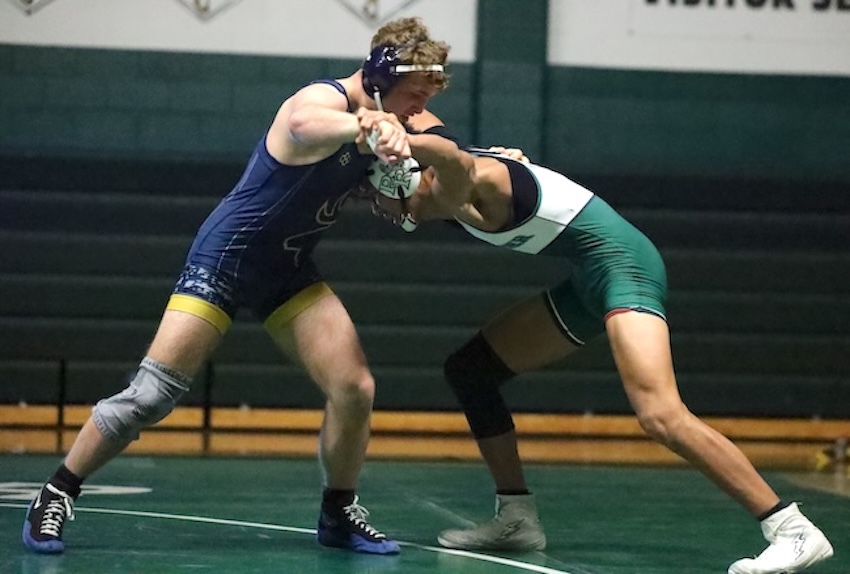
(Photo of Roscommon/LeRoy Pine River match by Tonya Holmes.)