


Keep on Coaching
February 1, 2013
By Geoff Kimmerly
Second Half editor
A few weeks ago, I finally got my first chance this season to watch a friend coach his basketball team. After guiding some others at the lower levels, this is his first time running the varsity – something he wasn't sure he wanted to do with a 1-year-old just learning to walk, but a challenge he ended up taking on to the benefit of all those involved.
Simply put, he’s good. I've seen a lot of teams and a lot of coaches over the past 15 years, and although I wouldn't know much of what to do if I were walking the sideline, I felt pretty qualified in telling him I was impressed – even if he didn't buy that I was offering an unbiased opinion. The best news is he’s gone from not sure about this a few months ago to talking about next season.
We know, at least anecdotally, that coaching continues to get more challenging. The time commitment has grown substantially to make running a program a year-round endeavor in a lot of sports at a lot of schools.
That commitment – especially for coaches with children of their own – was a main reason referred to in a New Haven Post-Chronicle story Saturday that noted 23 football coaching openings in Connecticut at one point this offseason. That state has 146 football teams – meaning roughly 15 percent will have new leaders this fall.
And that got me thinking about my friend, about how glad I am he’s given this a shot, and how I've seen so many others either not do so, or not stick around long despite having some pretty nice success.
A study published last winter in Interscholastic Athletic Administration magazine – a product of the National Interscholastic Athletic Administrators Association – noted some predictable results of a study that sought to determine the biggest challenges faced by first-year high school coaches.
The toughest according to the study was balancing the demands of coaching and teaching, experienced by nearly half the respondents – 98 percent of which coached high school teams and 81 percent of which are teachers.
The next six reasons all were noted by at least 30 percent of those in the study – personal fatigue, securing community support, securing and caring for facilities and equipment, parental contact, keeping non-starting players motivated, dealing with schedule interruptions and motivating athletes to achieve consistent, peak performance.
Nothing there is earth-shaking, and most if not all of these challenges are faced by high school coaches regardless of how long they've been in the field. But I got a little more perspective from some of the 32 items that ranked as least challenging to the first-year leaders – keeping in compliance with state and league regulations, dealing with substance abuse issues, teaching sport skills and creating a positive team atmosphere – things that seem most important, and yet appear to be easiest to do. I’m not sure what that tells us – but I think it tells us something.
Click to check out the entire three-page breakdown of the study, plus the researchers’ recommendations to remedy some of what first-year coaches face.
Giving back to Saginaw
I love reading about high-level athletes – like a star-studded group of alums from Saginaw – giving back to where they got their starts.
Pittsburgh Steelers star LaMarr Woodley made a big impact before the start of this school year by donating $60,000 to cover all participation fees for athletes in his former school district. The Saginaw News’ Hugh Bernreuter writes today about how Woodley (Saginaw High), the Philadelphia 76ers’ Jason Richardson (Saginaw Arthur Hill) and former Oakland Raiders standout Stu Schweigert (Saginaw Heritage) have combined to give more than $865,000 back to their home communities.
Bernreuter also mentions the non-monetary contributions of the Golden State Warriors’ Draymond Green (Saginaw High) and former Indianapolis Colts receiver Blair White (Saginaw Nouvel).
Click to read more about it.
Quote(s) of the Week
While rifling through more papers on my desk, I found an article from the Washington Post from Sept. 2011 titled “How high school sports save our schools.” I was drawn to it in part because I spent more than a decade in a newsroom, and it was a piece by a reporter covering education who instead of reporting on school boards and the like, delved into the importance of interscholastic athletics to education as a whole.
He spoke of how participation continues to grow even as resources dwindle, and of data supporting that extracurriculars like sports are more effective than academic classes in teaching leadership, teamwork, time management and “other skills crucial for success in the workplace.” Later, he mentioned a study noting that those who participate in extracurriculars earned more a decade later.
Click here to read the entre piece. These passages struck me most.
“Coaches might be the only faculty members still allowed by our culture and educational practice to get tough with students not making the proper effort. They have the advantage of teaching what are essentially elective non-credit courses. They can insist on standards of behavior that classroom teachers often cannot enforce because the stakes of dismissing or letting students drop their courses are too high. …
“Students do better in activities they choose. If we provide more of them, led by committed adults … that can make a difference. We know the bad news about education. Dropout rates are high. Achievement scores are stagnant. But sports participation is going up, despite pressure to cut it back. Let’s cheer about that and look for a way to draw in more students.”
1st & Goal: 2025 11-Player Semifinals Review
By
Geoff Kimmerly
MHSAA.com senior editor
November 24, 2025
The pairings are set for the MHSAA 11-Player Football Finals at Ford Field, with seven teams earning opportunities Saturday to finish this fall without a loss – although three of next weekend’s championship games will feature matchups of undefeated contenders.
 The weekend’s Semifinals also saw four reigning champions earn chances at repeat titles, and Dexter earn its first trip to the final weekend of the season for the first time.
It’s a short week because of Thanksgiving, but we’ll be back Wednesday with game-by-game previews of all eight upcoming contests. For now, see below for a glance at all 16 games that got us here.
(Note: Highlights from Saturday's 8-Player Finals will be included in a final football championship "Review" next week.)
Division 1
Detroit Catholic Central 46, East Kentwood 6
The Shamrocks (13-0) will play in their first Final since 2016 after shutting down an East Kentwood offense that had scored fewer than 35 points only one other time this season. The Falcons (10-3) had reached the Semifinals for the first time since 2014. Click for more from the Detroit Free Press.
GIDEON JOINS THE GASH RETURN PARTY
Gideon Gash takes the opening kickoff of the second half to the 🏠
CC up 32-0 over EK
Delivered by @hungryhowies pic.twitter.com/EDf40zmFFP— STATE CHAMPS! Michigan (@statechampsmich) November 22, 2025
Detroit Cass Tech 48, Rochester Adams 22
The reigning Division 1 champion Technicians (13-0) will have the opportunity to play for a first Finals repeat since winning in 2011 and 2012 after continuing a playoff streak of scoring at least 42 points in all four wins. Adams (10-3) finished its season in the Semifinals for the second straight. Click for more from the Detroit News.
Detroit Cass Tech punched its ticket to Ford Field with a 48-22 win over Rochester Adams in the Division 1 Semifinal. The Technicians delivered a dominant performance on both sides of the ball to secure their spot in the state championship game. Check out all the highlights, big… pic.twitter.com/VglljhxROj
— STATE CHAMPS! Michigan (@statechampsmich) November 23, 2025
Division 2
Orchard Lake St. Mary’s 42, Portage Central 7
St. Mary’s (10-2) will play for a chance to repeat as Division 2 champion after finding its way against a Portage Central defense that otherwise gave up only 64 points this season. The Mustangs finished 12-1, tying their 2013 team for most wins in program history. Click for more from the Oakland Press.
LORENZO BARBER HAVE A DAY!💪
Barber helped lead the Eaglets early in their 42-7 victory over Portage Central!
Delivered by @hungryhowies pic.twitter.com/tpZCj50Xpc— STATE CHAMPS! Michigan (@statechampsmich) November 23, 2025
Dexter 41, Birmingham Groves 6
The Dreadnaughts’ Cooper Arendt and Cole Novara continued two of the most incredible statistical seasons in MHSAA history in lifting Dexter (12-1) into its first championship game. The pair connected on four touchdowns in ending Groves’ second-straight Semifinal run at 9-4. Click for more from the Ann Arbor News.
THIS KID IS UNREAL😮
Cole Novara has his 4th TD of the day to put his Dexter boys up 41-6
Delivered by @hungryhowies pic.twitter.com/fCsF3UVCUj— STATE CHAMPS! Michigan (@statechampsmich) November 22, 2025
Division 3
Mount Pleasant 41, Lowell 21
Mount Pleasant (13-0) turned in one of its highest-scoring offensive days this season to earn its first trip to the Finals since 2011. Lowell concluded its longest run since 2016 at 10-3. Click for more from the Mount Pleasant Morning Sun.
If you missed it last night on @WNEMTV5news, no problem!
The @MtpOilers defeated Lowell 41-21 to advance to the state finals for the first time in 14 years!
Mt. Pleasant dominated from the opening kickoff.
See the highlights and hear from the Oilers👇 pic.twitter.com/9oKdNZrRFp— Mark Pearson (@MarkPearsonTV) November 23, 2025
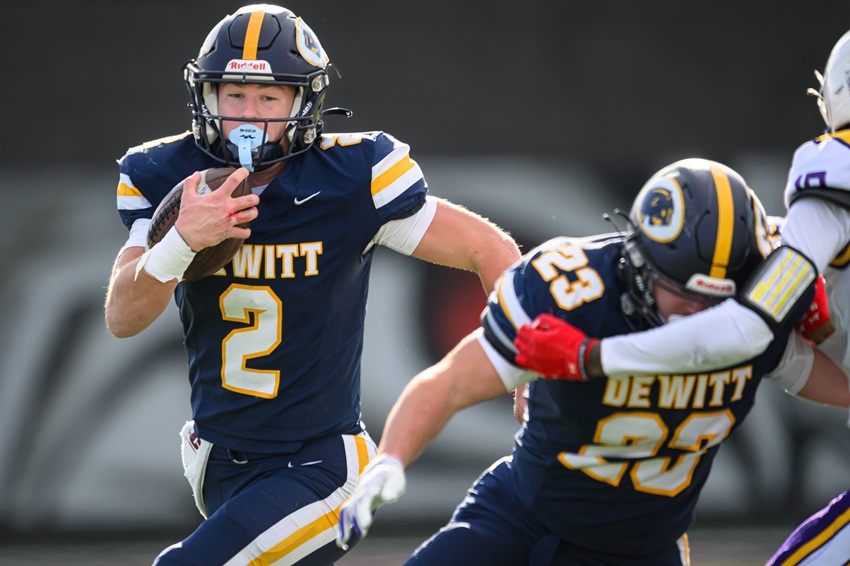
DeWitt 41, Warren De La Salle Collegiate 20
Traverse Moore scored four touchdowns to help bring DeWitt (13-0) back from a 13-7 halftime deficit and return to the Finals for the first time since 2021. De La Salle (6-7) turned a 1-4 start this season into its fifth Semifinal trip over the last six and after missing a year ago. Click for more from the Lansing State Journal.
TRAVERSE MOORE WAS IN A DIFFERENT MODE🔥
Moore's 3 touchdowns on the day continued helped one of the State's most electric offense's make a trip back to Ford Field!
Delivered by @hungryhowies pic.twitter.com/dp1TmIRACE— STATE CHAMPS! Michigan (@statechampsmich) November 23, 2025
Division 4
Hudsonville Unity Christian 45, Vicksburg 17
Unity Christian (12-1) again cleared its playoff opponent by double digits and will return to the Finals after last making the trip in 2021. Vicksburg finished its longest playoff run at 8-5 for the season. Click for more from the Grand Rapids Press.
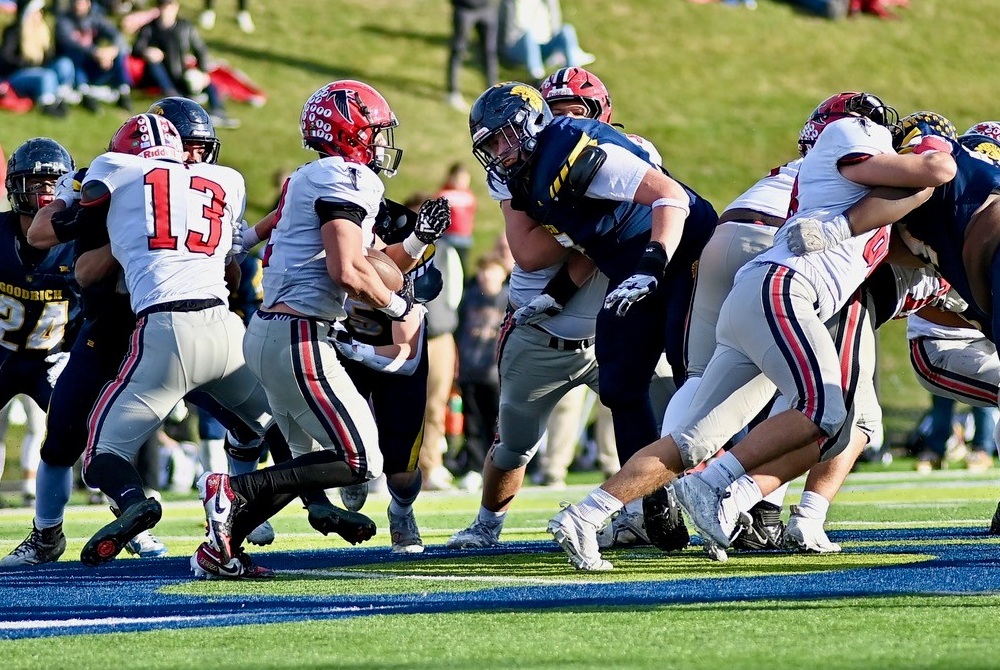
Dearborn Divine Child 10, Goodrich 7
Divine Child (12-1) put an end both to reigning champ Goodrich’s repeat hopes and 25-game winning streak, handing the lone defeat to an opponent for the second-straight week after downing Harper Woods 10-6 in a Regional Final. The Martians ended 12-1, while the Falcons advanced to their first Final since 1985. Click for more from MLIVE-Detroit.
Division 5
Grand Rapids West Catholic 34, Ogemaw Heights 24
West Catholic (12-1) had slightly fewer yards than Ogemaw Heights, but made them count a little bit more taking a 13-12 halftime lead all the way to earning its first Finals trip since 2022. Collin Abram (two touchdowns) on offense and Jael Djouguem (12 tackles) on defense led the Falcons. Ogemaw finished 11-1 while making its first Semifinal appearance since 2009. Click for more from the Bay City Times.
Pontiac Notre Dame Prep 51, Monroe Jefferson 21
Reigning champion Notre Dame Prep (11-2) will get the chance to win it all again after doing so for the first time a year ago. Several Fighting Irish found the end zone to earn that opportunity, with quarterback Sam Stowe throwing three scoring passes and running for a TD as well. Jefferson finished its first Semifinal season since 1999 at 11-2. Click for more from the Oakland Press.
Division 6
Kingsley 14, Kent City 0
Kingsley (11-2) is headed to Ford Field for the second time in three years after handing Kent City (12-1) its only loss of its winningest season. The teams were tied at halftime, but the Stags’ defense was just slightly more successful during the final two quarters in posting its first shutout this fall. Click for more from the Traverse City Record-Eagle.
Jackson Lumen Christi 25, Almont 19 (3OT)
This came down to the most dramatic ending of the weekend, as both contenders went scoreless during the first overtime and couldn’t convert after touchdowns during the second before Lumen (10-3) scored in the third and kept Almont (12-1) out of the end zone. Click for more from the Jackson Citizen Patriot.
BENNY GASTON IS THE DEFINITION OF CLUTCH‼️
As a Freshman Gaston sent the Lumen Christi baseball team to the State Championship with a walkoff single, now as a Junior he sends the Titans football team to Ford Field and puts his head coach Herb Brogan second overall in wins… pic.twitter.com/q7MtEHZPMH— STATE CHAMPS! Michigan (@statechampsmich) November 22, 2025
Division 7
Menominee 32, Pewamo-Westphalia 28
The Maroons (13-0) came back from a 21-6 halftime deficit and scored the game-winner with 24 seconds to play to earn a second trip in three seasons to Ford Field. The Pirates (11-1) were held to their fewest points this season and had given up only 86 over their first 11 games before Menominee broke through. Click for more from Upper Michigan’s Source.
Schoolcraft 43, Clinton 14
Schoolcraft will play in its first championship game since 2001 after scoring this game’s first 37 points. The Eagles (11-2) put up their third-most points in a game this season and held Clinton (10-3) to its fewest since opening weekend. Click for more from the Kalamazoo Gazette.
Division 8
Harbor Beach 40, Bark River-Harris 0
Harbor Beach (13-0) earned its second shutout of a season during which the Pirates are giving up only eight points per game, this one to earn a first trip to Ford Field since 2012. Bark River-Harris completed its first Semifinal season since 2003 at 10-2. Click for more from the Huron Daily Tribune.
Hudson 67, Allen Park Cabrini 14
Hudson will return to the Finals for the second time in five years with a chance for a second undefeated championship run this decade. The Tigers (13-0) topped 60 points for the fifth time this season but second week in a row in ending Allen Park Cabrini’s longest tournament run and winningest season at 11-2. Click for more from the Adrian Daily Telegram.
MHSAA.com's weekly “1st & Goal” previews and reviews are powered by MI Student Aid, a division within the Department of Lifelong Education, Advancement, and Potential (MiLEAP). MI Student Aid encourages students to pursue postsecondary education by providing access to student financial resources and information. MI Student Aid administers the state’s scholarship and grant programs that help make college Accessible, Affordable and Attainable for you. Click to connect with MI Student Aid and find more information on Facebook and Twitter @mistudentaid.
PHOTOS (Top) Dearborn Divine Child running back Marcello Vitti (2) takes a handoff into the line during his team's Division 4 Semifinal win over Goodrich. (Middle) DeWitt's Traverse Moore (2) follows a blocker during the Panthers' Division 3 win over Warren De La Salle Collegiate. (Divine Child/Goodrich photo by Terry Lyons. DeWitt/De La Salle photo by Kolleth Photo.)