


Let's Play 2 (or 3, or 4)
February 16, 2012
A few conversations I had at last week's Women In Sports Leadership conference further affirmed a point I've been making for years -- high school athletes, if they'd like, shouldn't hesitate to play multiple sports.
Doing so does not hurt, but might just help their chances at landing that prized college scholarship -- on top of adding another layer to the high school sports experience.
Reaffirming this for me last week was Michigan State softball coach Jacquie Joseph, who spoke on that subject at the WISL conference. She's heading into her 24th season as a head coach at the Division I college level -- so she's been around for some of the evolution of both high school sports specialization and college recruiting. Plus, she coaches a sport that sees its share of athletes playing just that one.
Later, I spoke with a high school coach who leads teams in three sports and also played one at the Division I college level. She's a believer in this as well.
Some of the things I've been told over the years about playing more than one sport:
- It allows an athlete to learn more skills and hone more parts of his or her athleticism.
- Using another range of movement further helps condition an athlete's body and make it more resistant to injury.
- It's hardly rare to see a college football coach watching a prospect's basketball game -- coaches like to see how athleticism transfers across sports, and sometimes will see something from an athlete playing basketball that he didn't show on the football field. (Football and basketball are used in this example, but the same applies to a number of similar situations.)
- Athletes get an opportunity to play whatever they'd like only this once (unless they turn out to be that rare college athlete who takes on more than one sport at that level).
These are hardly new arguments. But they are always worth repeating -- especially when the people frequently making them (college coaches) are the ones single-sport athletes often are trying to impress.
Yale Athletics Completes Banner Winter with 3 Record-Setting Seasons
By
Paul Costanzo
Special for MHSAA.com
March 20, 2025
Whatever dollar number Chace Palmateer had next to “banner updates” on the 2024-25 Yale athletic department budget, it’s not going to be enough.
 But after a record-breaking winter for the Bulldogs, he’s not really concerned with costs.
“We have six (titles to add) for winter alone, and that’s not including that we had a pretty good fall with cross country,” Palmateer said. “It’s a fantastic problem to have, and truthfully, I hope we have more in the spring.”
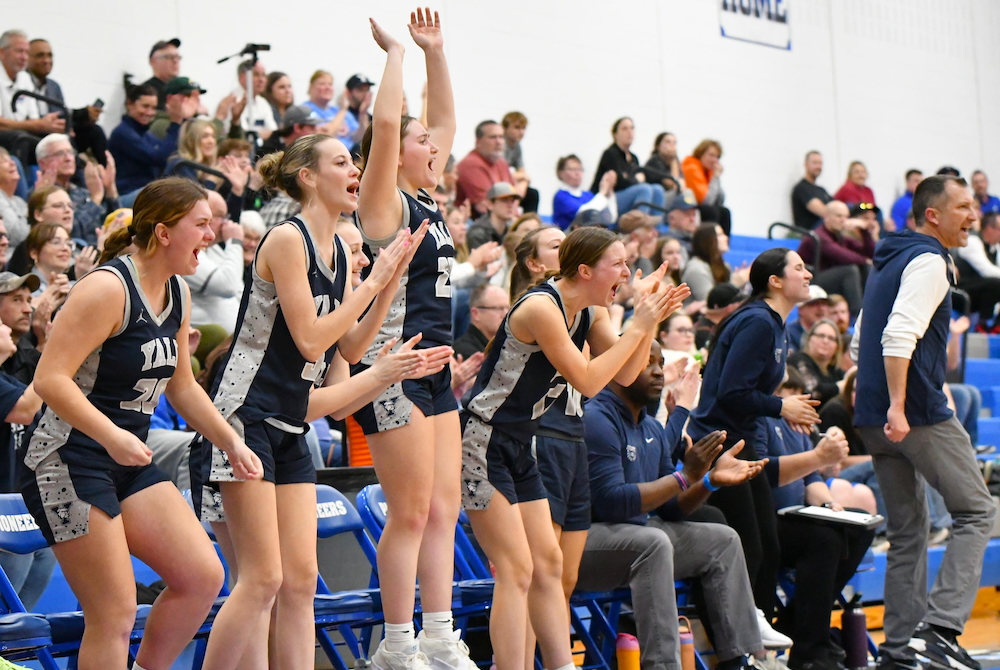
Yale’s wrestling, boys basketball and girls basketball teams each completed perhaps the best seasons in their respective program histories this winter, smashing team and individual records along the way.
“That energy among our student-athletes was phenomenal this winter,” Yale boys basketball coach Garnett Kohler said. “That’s one thing about our Yale community, we all support each other. We’re all Bulldogs, through and through, and we love to see each other have success. I thought we kind of fed off each other’s success, too. The wrestlers got going really good early, and that kind of set the stage, then us and the girls got going.”
Yale’s wrestlers were runners-up at the Division 3 Team Final, their best finish ever. The boys basketball team set a record for wins in a season at 22, won the Blue Water Area Conference and District titles, and advanced to the Division 2 Regional Final for just the second time in program history. The girls also set a record for wins in a season at 22, shared the BWAC title, won a District and advanced to a Regional Final for the first time.
“The atmosphere in the school was great,” Yale wrestling coach Rob Majcher said. “So many programs were having so much success because of the work they put in. It’s nice to see that hard work that the kids and coaches put in really paid off for them.”
Majcher’s team was the first to make its postseason run, winning its second-straight Regional title with a dramatic 32-31 victory against BWAC rival Algonac.
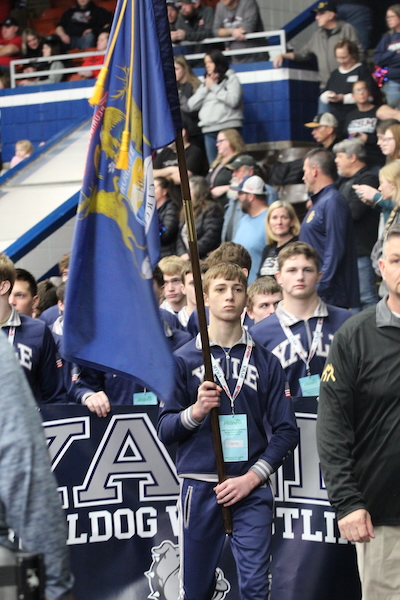 The Bulldogs defeated Adrian Madison in the Quarterfinals and Lake Odessa Lakewood in the Semifinals at Kalamazoo’s Wings Event Center before running into an all-time great Dundee team in the Final.
“It meant everything (to get to the Finals),” Yale senior 120-pounder Landon Sopha said. “Everything I’ve done throughout my life was all coming down to that moment for the team. It was just pure joy and excitement, not only getting that mitten (trophy), but thinking of these next years and how great Yale wrestling can be.”
Sopha was part of a record-tying six boys Individual Finals qualifiers for the Bulldogs, and one of five to place, as he took third at 120. Mackey McClelland (113) placed second, Cole McLaughlin (165) placed third, Logan Rhodes (120) placed fourth and Kersten McClelland (132) placed fifth. The five boys placers were second-best in program history, and if you add Gianna Hoskins (105) and Ember Marriott (190), who both placed sixth in the girls tournament in their respective weight classes, the seven total would be an all-time best.
Throughout the year, the Bulldogs set program records for most individual varsity matches won (798), takedowns (1,485) and varsity pins (475) in a season.
McLaughlin set the record for most first-minute pins in a season at 24, and Kersten McClelland had 536 match points, a school record.
“We told the kids, ‘You stick with this, and you will do good things,’” Majcher said. “As a coach, it’s definitely fulfilling to see a group of kids that did stay and did achieve what they were able to.”
Then there was Sopha, who finished off a record-breaking career for the Bulldogs. He became the first in Yale wrestling history to advance to the individual semifinals all four years, the second four-time all-state finisher, fourth four-time Finals qualifier, third four-time BWAC champ, and the all-time leader in career match points at 1,354. He also became the second Yale wrestler to reach the 200-win mark.
“It means a lot,” Sopha said. “For me, it’s something that I’ll be able to look back on forever. It’s something that I’ll hopefully be able to watch people in the future break. It’s pretty cool.”
As wrestling season wound down, the boys basketball team found itself re-writing its own program record book.
Yale finished 22-4 on the year, winning a record 19 regular-season games and setting a program record for consecutive wins with 14. It was a season that surprised Kohler.
 “We lost eight seniors from last year, and they had a lot of success on their own,” he said. “We had a lot of new guys coming in, and I did know they had some talent and had some success coming up through the younger ages. I knew we could eventually be good, but I didn’t expect the season-long success we had, strictly because we were so young and untested. That’s really a testament to what (seniors) Ryan Fisher, Clayton Harmon and Blake Bowman were able to do. They were able to get those other guys to buy into that real early, and everybody kind of fed off their leadership.”
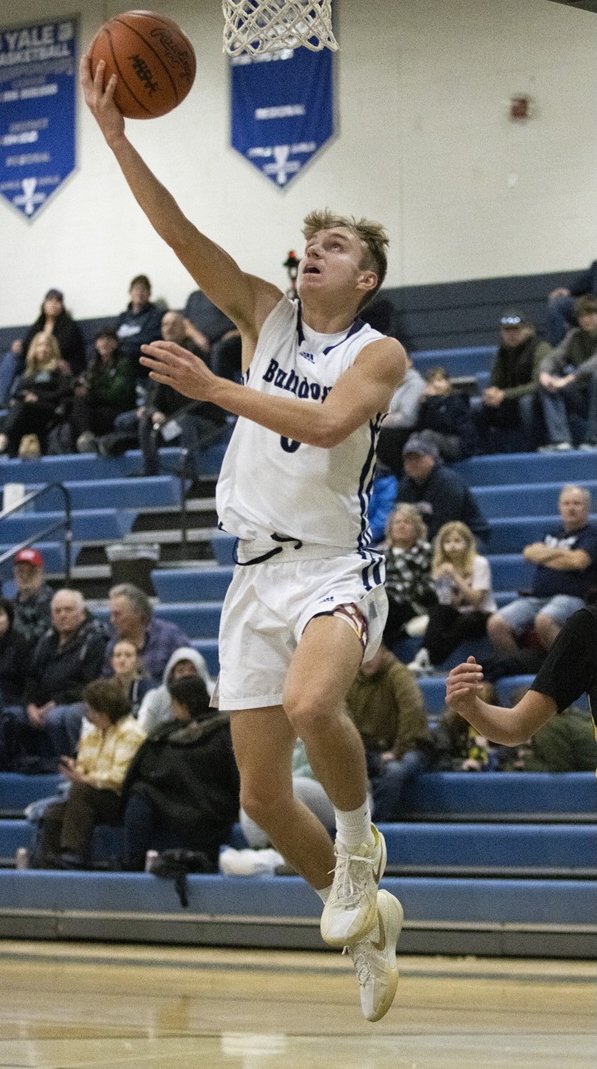
While the team was setting records, junior guard Jackson Kohler was lighting the individual record book on fire.
He set marks for points (560), steals (82) and 3-pointers (76) made in a season, as well as points (1,164) and assists (417) for a career.
“Obviously, I’m a team guy, so I wanted the league championship and the District championship, but it’s always good to have accomplishments along the way when you’re winning,” said Jackson Kohler, who is Garnett’s son. “Being a little kid growing up when he was coaching here earlier, I was always watching the older guys practice and how they would go about practicing and how they would be in their games. I always looked up to them and just worked and worked to get to where I am now.”
As Jackson was setting records on the boys side, his classmate Sadie Dykstra was doing the same while leading a record-setting Yale girls team.
Dykstra, who won the long jump and 300-meter hurdles at the Lower Peninsula Division 2 Track & Field Finals in 2024, also became her program’s all-time leading scorer this season, sitting at 1,248 after her junior year.
She’s the Yale girls basketball record holder for points in a game (38), field goals in a game (14), free throws made in a game (12), points in a season (596), scoring average in a season (22.9) and field goals made in a season (217 prior to the Regional Final).
“I think it was super cool – this doesn’t happen very often where you can (go) from the girls side to the boys side and see records being broken by two individual players,” said Dykstra, who admitted that her record-setting season hadn’t really sunk in yet. “I’m going to be honest, it’s probably not even hit me yet that our team went that far to the Regional. Of course, I’m super excited, but I just know I have so much more to give. I’m really looking forward to next season.”
For Yale girls basketball coach Jason Leonard, who spent time with the boys program before taking over the girls head coaching job a year ago, seeing Kohler and Dykstra excel at the same time has been a joy.
“You don’t get to see that – you’re lucky to see one on one side, boys or girls,” he said. “To me, they’re the two best players in the area, and it’s a pretty cool thing to see. I’ve seen Jackson come up on the boys side and as a freshman, he had a huge impact. It’s pretty cool to see and pretty cool for the programs and the community to have them leading their teams to a new level.”
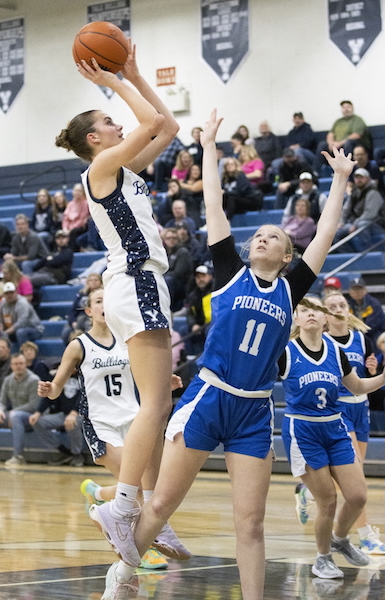 Of course, Dykstra’s records were just the tip of the iceberg for a team that was also experiencing a record run.
The Bulldog girls tied their program record for BWAC wins (13) and regular-season wins (19), while setting the mark for total wins. They also set records for free throw percentage (63.96 percent) and field goals made in a season (551 prior to the Regional Final).
Dykstra also wasn’t the only record-breaker on the team, as senior Alyssa Barr became the program’s all-time leader in career rebounds and blocks with 690 and 74, respectively, heading into the Regional Final loss against Country Day.
“I think we exceeded expectations,” Dykstra said. “I don’t think anybody thought, ‘Oh, they’re going to get to the finals of Regionals,’ just for the fact that we matched up with Armada in the first round of Regionals. I think we definitely exceeded expectations coming from more of other people’s standpoints. For me, I think we met my expectations, because we weren’t going to lose to a team (Armada) two out of three times.”
Regardless of the expectations any of the teams had coming into the season, one thing is certain: It was a winter nobody in Yale will soon forget.
“I will say, we’ve had very good teams come out of the Thumb, and different schools have had different teams succeed at different times, but I don’t remember a school having across-the-board success like we had this winter with the three teams,” Garnett Kohler said. “In schools like ours, talent gets spread out across the groups, and talent comes in waves. To do it all in the same season, it’s pretty fun to watch.”
 Paul Costanzo served as a sportswriter at The Port Huron Times Herald from 2006-15, including three years as lead sportswriter, and prior to that as sports editor at the Hillsdale Daily News from 2005-06. He can be reached at [email protected] with story ideas for Genesee, Lapeer, St. Clair, Sanilac, Huron, Tuscola, Saginaw, Bay, Arenac, Midland and Gladwin counties.
PHOTOS (Top) Players on Yale’s bench cheer on their teammates during a game this season. (2) Landon Sopha carries the state flag during the opening ceremony at the MHSAA Team Wrestling Finals. (3) Jackson Kohler gets to the basket against Algonac. (4) Sadie Dykstra shoots a jumper against Croswell-Lexington. (Photos by Katie Allen/Yale Expositor.)