


Let's Play 2 (or 3, or 4)
February 16, 2012
A few conversations I had at last week's Women In Sports Leadership conference further affirmed a point I've been making for years -- high school athletes, if they'd like, shouldn't hesitate to play multiple sports.
Doing so does not hurt, but might just help their chances at landing that prized college scholarship -- on top of adding another layer to the high school sports experience.
Reaffirming this for me last week was Michigan State softball coach Jacquie Joseph, who spoke on that subject at the WISL conference. She's heading into her 24th season as a head coach at the Division I college level -- so she's been around for some of the evolution of both high school sports specialization and college recruiting. Plus, she coaches a sport that sees its share of athletes playing just that one.
Later, I spoke with a high school coach who leads teams in three sports and also played one at the Division I college level. She's a believer in this as well.
Some of the things I've been told over the years about playing more than one sport:
- It allows an athlete to learn more skills and hone more parts of his or her athleticism.
- Using another range of movement further helps condition an athlete's body and make it more resistant to injury.
- It's hardly rare to see a college football coach watching a prospect's basketball game -- coaches like to see how athleticism transfers across sports, and sometimes will see something from an athlete playing basketball that he didn't show on the football field. (Football and basketball are used in this example, but the same applies to a number of similar situations.)
- Athletes get an opportunity to play whatever they'd like only this once (unless they turn out to be that rare college athlete who takes on more than one sport at that level).
These are hardly new arguments. But they are always worth repeating -- especially when the people frequently making them (college coaches) are the ones single-sport athletes often are trying to impress.
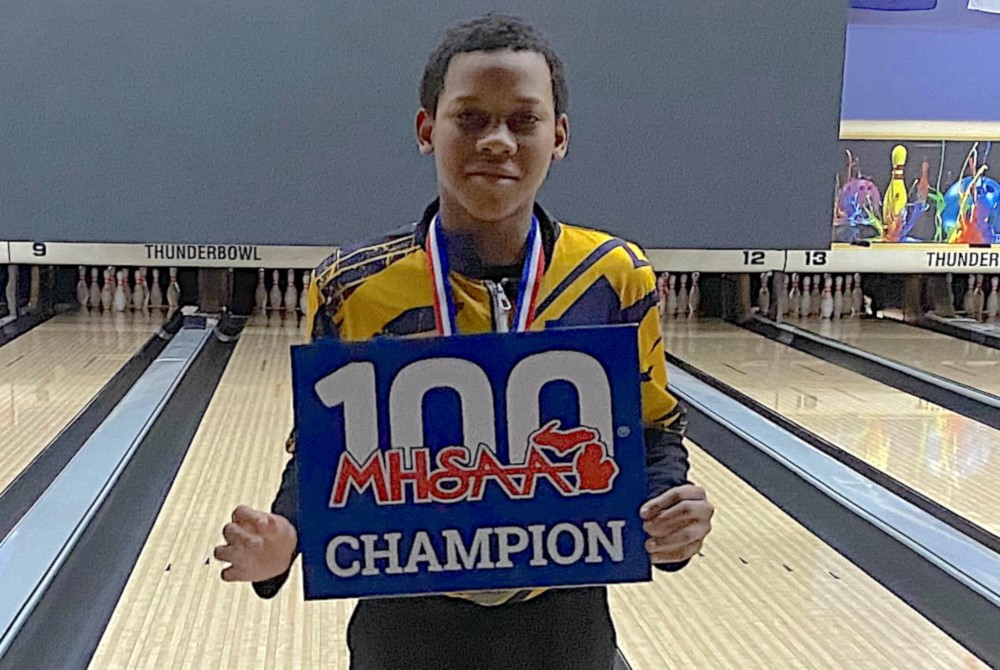
Wayne's Derrick Powers Past Reigning Champ to Clinch Division 1 Title
By
Perry A. Farrell
Special for MHSAA.com
March 1, 2025
ALLEN PARK – All Dylan Harnden could do was shake his head.
In attempt to repeat as Division 1 singles champion Saturday at Thunderbowl Lanes, he ran into a buzzsaw named Lyman Derrick III.
The Wayne Memorial sophomore, standing just 5-foot-3, couldn’t miss. His two-handed style produced games of 257-233 and he emerged as champion over Harnden, who shot 444.
“He had the front seven and the front six; there was nothing I could do,’’ admitted Harnden.
Said Derrick: “I would describe my style as unusual.’’
Derrick broke 200 pins in 11 of his 14 games Saturday. His dad, Lynam Derrick Jr., saw this coming.
“He has been bowling since he was 4,’’ said Derrick Jr. “At 6 he almost threw a 300. My friends won’t even bowl with him anymore.
“He has put in a ton of work. So proud of him.’’
Said former PBA pro John Mazza: “He is amazing.’’
Derek Kern of Muskegon Mona Shores shot a 300 in the second game of qualifying. He eventually finished as the ninth qualifier at 1,320.
The top spot went to Haden Hebel of Hartland at 1,372, followed by Davison’s Joe Merz at 1,366, Jenison’s Benjamin Slagter at 1,355 and Matt Sprau of Portage Central with a score of 1,351. Harnden was seventh at 1,331.
Hebel advanced against Cole Rogus of Macomb Dakota, 459-453 to face Andrew Fsadni of Salem, who had knocked out Kern, 401-385.
Merz eliminated Johnathan Hatcher of Belleville, 466-453, then took on Harnden, who had defeated Jacob Kondratyev of Troy, 450-383.
Slagter also moved on by defeating Noah VanderVelde of Zeeland West, 435-424, but Sprau was defeated by Andy Folks of Belleville 439-344 to move on against Derrick. Derrick had downed Devin Harris of Kalamazoo Loy Norrix, 385-339
Feeling right at home, Harnden moved past Merz to reach the semifinals with a 477-402 victory. Derrick advanced to the semifinals, besting Folks 428-361 with top seed Hebel then in the way. Hebel advanced with a 459-452 thriller over Fsadni.
Slagter joined him in the semis with a 482-420 victory over Roberts, which included a 277 game, and squared off against Harnden, who won 435-383. Derrick ended the top seed’s run, eliminating Hebel, 390-369.