


Let's Play 2 (or 3, or 4)
February 16, 2012
A few conversations I had at last week's Women In Sports Leadership conference further affirmed a point I've been making for years -- high school athletes, if they'd like, shouldn't hesitate to play multiple sports.
Doing so does not hurt, but might just help their chances at landing that prized college scholarship -- on top of adding another layer to the high school sports experience.
Reaffirming this for me last week was Michigan State softball coach Jacquie Joseph, who spoke on that subject at the WISL conference. She's heading into her 24th season as a head coach at the Division I college level -- so she's been around for some of the evolution of both high school sports specialization and college recruiting. Plus, she coaches a sport that sees its share of athletes playing just that one.
Later, I spoke with a high school coach who leads teams in three sports and also played one at the Division I college level. She's a believer in this as well.
Some of the things I've been told over the years about playing more than one sport:
- It allows an athlete to learn more skills and hone more parts of his or her athleticism.
- Using another range of movement further helps condition an athlete's body and make it more resistant to injury.
- It's hardly rare to see a college football coach watching a prospect's basketball game -- coaches like to see how athleticism transfers across sports, and sometimes will see something from an athlete playing basketball that he didn't show on the football field. (Football and basketball are used in this example, but the same applies to a number of similar situations.)
- Athletes get an opportunity to play whatever they'd like only this once (unless they turn out to be that rare college athlete who takes on more than one sport at that level).
These are hardly new arguments. But they are always worth repeating -- especially when the people frequently making them (college coaches) are the ones single-sport athletes often are trying to impress.
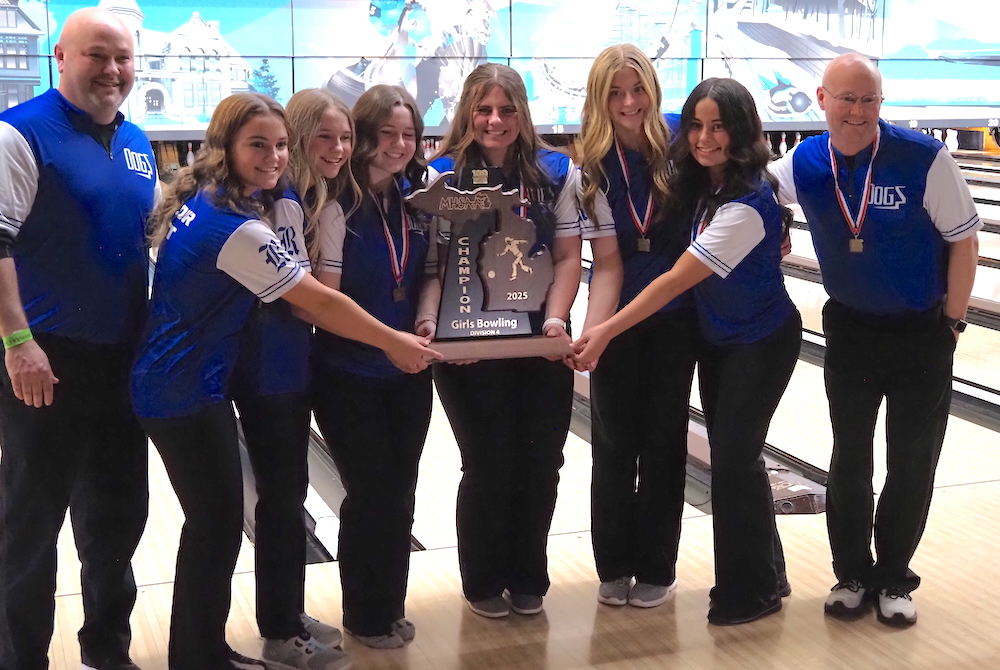
Ravenna Girls Finish Comeback in Deciding Match to Claim 1st Finals Win
By
Nick Cooper
Special for MHSAA.com
February 28, 2025
MUSKEGON – Friday was a storybook ending for Ravenna’s Emma Herremans.
The Bulldogs’ lone senior bowler helped secure the program’s first Finals team championship.
Ravenna went the distance with Bad Axe in the deciding match, even trailing 2-1 before winning the final two games 172-150 and 186-179 to clinch.
“It feels amazing. I have to take a pause to just take everything in,” said Herremans.
Ravenna’s championship capped off an undefeated season and was the first Finals title for the school in any sport other than football.
“We just sat there, and our hearts were racing the entire time,” said Ravenna coach Jason Nutt.
En route to the championship, the top-seeded Bulldogs defeated No. 8 seed Jackson Lumen Christi and No. 5 seed Jonesville.
Bracket play featured multiple seeding upsets with No. 7 Homer sweeping second seed Burton Atherton in three games in a quarterfinal. Fifth seed Jonesville defeated No. 4 seed Allen Park Cabrini during the same round.
Ravenna posted the top score during qualifying, 2,899 pins, to outpace the field by 164.
After reaching the quarterfinals in 2024 and then winning the championship in 2025, Ravenna figures to assert itself as a statewide presence for years to come. Looking to the future, Nutt’s expectation for his program is one of optimism.
“It’s good to get one. We should continue to get strong,” he said.