


Let's Play 2 (or 3, or 4)
February 16, 2012
A few conversations I had at last week's Women In Sports Leadership conference further affirmed a point I've been making for years -- high school athletes, if they'd like, shouldn't hesitate to play multiple sports.
Doing so does not hurt, but might just help their chances at landing that prized college scholarship -- on top of adding another layer to the high school sports experience.
Reaffirming this for me last week was Michigan State softball coach Jacquie Joseph, who spoke on that subject at the WISL conference. She's heading into her 24th season as a head coach at the Division I college level -- so she's been around for some of the evolution of both high school sports specialization and college recruiting. Plus, she coaches a sport that sees its share of athletes playing just that one.
Later, I spoke with a high school coach who leads teams in three sports and also played one at the Division I college level. She's a believer in this as well.
Some of the things I've been told over the years about playing more than one sport:
- It allows an athlete to learn more skills and hone more parts of his or her athleticism.
- Using another range of movement further helps condition an athlete's body and make it more resistant to injury.
- It's hardly rare to see a college football coach watching a prospect's basketball game -- coaches like to see how athleticism transfers across sports, and sometimes will see something from an athlete playing basketball that he didn't show on the football field. (Football and basketball are used in this example, but the same applies to a number of similar situations.)
- Athletes get an opportunity to play whatever they'd like only this once (unless they turn out to be that rare college athlete who takes on more than one sport at that level).
These are hardly new arguments. But they are always worth repeating -- especially when the people frequently making them (college coaches) are the ones single-sport athletes often are trying to impress.
Rebuilt Culture Driving Success as Roelens Steps Away at Port Huron Northern
By
Paul Costanzo
Special for MHSAA.com
November 13, 2024
The spark that helped ignite the past decade of success for the Port Huron Northern football program came early in Larry Roelens’ tenure, and, ironically, during the one full season that the Huskies finished with a losing record under him.
 Northern, which had just three winning seasons over the previous 15, started 0-2 in 2015, but rattled off four straight wins under its first-year coach, who was noticing that things were changing for the better.
“I’ll be honest, Northern wasn’t in a very good state when I got the job,” Roelens said. “But for me and the guys that stayed around (on the coaching staff), I could never have done what I did without the guys on my staff. They’re like family to me and to my kids; they call them uncles. We went in with the mindset that we have to change the culture.
“We started 0-2 that first season, but then won four in a row. We lost three tough games to end the season, but that kind of changed the culture. We built on that, and the next year went 6-3.”
That next season was the beginning of the most successful stretch of football during the playoff era for the Huskies, as they made the postseason nine straight years, tripling the number of playoff appearances they had made during the 40 years prior.
The ninth postseason appearance was the last for Roelens, however, as he stepped down as Northern coach following a Division 2 District Semifinal loss to Warren De La Salle Collegiate on Oct. 24. He has accepted a position as assistant principal at the school, and administrators in the district are not allowed to hold head coaching positions.
“Honestly, that was a very hard decision to make for me,” Roelens said. “I went into education to be a coach and a teacher. But it was very much based on a family decision. I’ll be able to spend more time with my kids (Audrey, 5, and Brady, 3), and coach their teams.”
 Roelens leaves the Northern program in as good a place as it’s been, perhaps ever.
He was 69-30 over his 10 seasons, with the nine playoff appearances and four Macomb Area Conference Blue titles. Northern also won four postseason games under Roelens.
Before he took over the program, Northern had three playoff appearances in program history – 1986, 1999 and 2010 – and a single postseason victory.
The program had not won eight games in a season since 1987, but did so four times under Roelens, including with a 10-2 mark in 2018, which matched the school record for wins.
“It’s pretty crazy,” said Northern senior quarterback Ty Fletcher. “He kind of morphed the program to what it is today. … I feel like, when he started getting into the playoffs and they had all those playoff appearances in (consecutive) seasons, that started that trend of winning football. Then we ended up staying there and being a competitive team.”
As it so often does, the success built an excitement around the program that found its way through the youth levels.
“We were all coming up through the youth teams, and we all stayed together on the freshman level, and we always talked about how everyone wants to play for Northern,” Fletcher said. “About how cool it was to play under the lights there.”
A lot of that excitement at the youth level has also been buoyed by a string of Division I college talent that has come through the program during Roelens’ time, led by Braiden McGregor. The defensive end was among the top recruits in the country in 2020 and played a key role on Michigan’s national title team. He is now playing for the New York Jets.
He wasn’t a one-off for the Huskies in terms of DI talent, as Luke Fletcher is now in his second year at Eastern Michigan, and current juniors Amir Morelan and Lincoln Watkins have both received Power 4 offers.
“Braiden’s class, we had a few kids that went on to play college football,” Roelens said. “That right there was proof that, even in a small town, they’re going to find you if you’re good enough. I think that pushed a lot of kids, because they started to understand that if you’re good enough and you work hard enough, they’ll find you.”
Roelens even being at Northern in the first place was a bit of a surprise for those in the area, as he was a star athlete at cross-town rival Port Huron High. Roelens played quarterback at Port Huron and went on to play baseball at Saginaw Valley State after graduating in 2004.
 He student taught at Northern during the 2009-10 school year, but even then he helped out with the Port Huron football program.
His journey with Northern athletics began with assistant roles in the basketball and baseball programs later that year, and in the fall of 2010 he became the JV head football coach.
For four of the next five seasons he was on the Huskies staff, before taking over the program prior to the 2015 season.
With his new position, he’ll remain in the school and around the coaches and players in the program. And, while the thrill of coaching was something Roelens cherished, those relationships are what he’s valued most.
“I’ve been very blessed with the people I’ve had around me throughout those 10 years,” he said. “The support I had from Northern, the support of the parents, the Northern community, it’s been a blessing. My family, my wife and kids, they’ve all been tremendous.”
 Paul Costanzo served as a sportswriter at The Port Huron Times Herald from 2006-15, including three years as lead sportswriter, and prior to that as sports editor at the Hillsdale Daily News from 2005-06. He can be reached at [email protected] with story ideas for Genesee, Lapeer, St. Clair, Sanilac, Huron, Tuscola, Saginaw, Bay, Arenac, Midland and Gladwin counties.
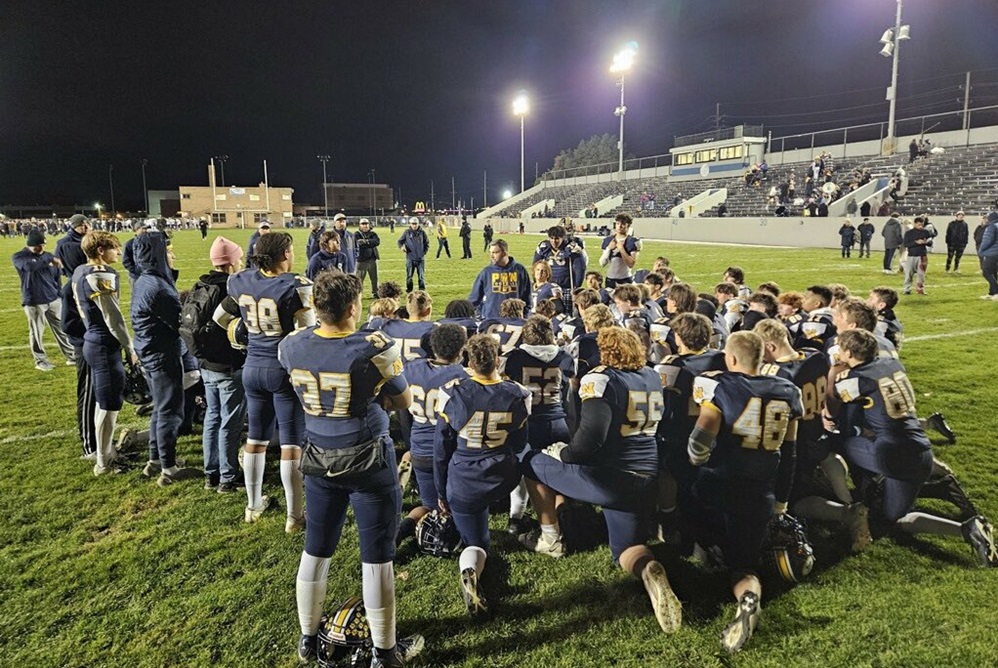
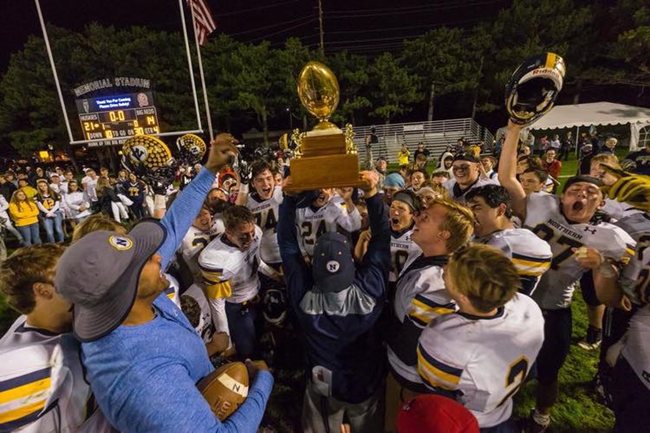
PHOTOS (Top) Port Huron Northern football coach Larry Roelens, middle, is surrounded by his kneeling players during a postgame huddle. (Middle) Roelens holds daughter Audrey, and wife Kelsey holds son Brady on the field. (Below) Roelens hoists the Brick Fowler Trophy after a Northern win over rival Port Huron. (Photos courtesy of the Roelens family.)