

Let's Play 2 (or 3, or 4)
February 16, 2012
A few conversations I had at last week's Women In Sports Leadership conference further affirmed a point I've been making for years -- high school athletes, if they'd like, shouldn't hesitate to play multiple sports.
Doing so does not hurt, but might just help their chances at landing that prized college scholarship -- on top of adding another layer to the high school sports experience.
Reaffirming this for me last week was Michigan State softball coach Jacquie Joseph, who spoke on that subject at the WISL conference. She's heading into her 24th season as a head coach at the Division I college level -- so she's been around for some of the evolution of both high school sports specialization and college recruiting. Plus, she coaches a sport that sees its share of athletes playing just that one.
Later, I spoke with a high school coach who leads teams in three sports and also played one at the Division I college level. She's a believer in this as well.
Some of the things I've been told over the years about playing more than one sport:
- It allows an athlete to learn more skills and hone more parts of his or her athleticism.
- Using another range of movement further helps condition an athlete's body and make it more resistant to injury.
- It's hardly rare to see a college football coach watching a prospect's basketball game -- coaches like to see how athleticism transfers across sports, and sometimes will see something from an athlete playing basketball that he didn't show on the football field. (Football and basketball are used in this example, but the same applies to a number of similar situations.)
- Athletes get an opportunity to play whatever they'd like only this once (unless they turn out to be that rare college athlete who takes on more than one sport at that level).
These are hardly new arguments. But they are always worth repeating -- especially when the people frequently making them (college coaches) are the ones single-sport athletes often are trying to impress.
Preview: MIS Could Play Host to Champions 1st-Time, Repeat and 3-Peat
By
Geoff Kimmerly
MHSAA.com senior editor
November 1, 2024
Two reigning team champions are anticipated to celebrate again at this weekend’s Lower Peninsula Boys Cross Country Finals at Michigan International Speedway – but joined as well by a potential first-timer and first-time-in-a-long-time winner.
Northville is running for a third-straight championship in Division 1, and Traverse City St. Francis a repeat in Division 3, and both are ranked No. 1 in their respective divisions this week. In Division 4, Mason County Eastern is No. 1 and seeking its first Finals team title. In Division 2, top-ranked Allendale will run for its first this century.
See below for more on several team and individual contenders Saturday. The "season bests" list referred to frequently is a ranking list of every runner's best time this season, maintained by Athletic.net. The first boys race, in Division 4, begins at 9:30 a.m.; click here for the full schedule and ticket information.
Additionally, all eight races Saturday at MIS will be streamed live and viewable with subscription on the NFHS Network: Divisions 1 & 2 | Divisions 3 & 4.
Division 1
Reigning champion: Northville
2023 runner-up: Brighton
2024 top-ranked: 1. Northville, 2. Jenison, 3. Brighton.
Northville is anticipated to run its championship streak to three with five runners from last season’s Finals lineup back and all among the top eight during their Regional championship run last weekend. But once again, the Kensington Lakes Activities Association party doesn’t stop there, as Brighton is looking to add to its recent titles in 2019 and 2021 and brings back four runners from last year’s third-place team; the Bulldogs placed five among the top 14 at their Regional win. Jenison won its Regional on a tie-breaker ahead of No. 4 Grand Haven and will push to move up from seventh last year, when the lineup will filled with all juniors and one sophomore. Six of those seven runners will be back this weekend.
Individuals: Only four of the top 15 individual placers last season didn’t graduate, and fourth-place Kamari Ronfeldt of Ann Arbor Pioneer is the top returning finisher and has the fastest top time in Division 1 this fall at 15:02.3, just more than a second ahead of Jenison’s Seth Conner who placed fifth at the 2023 Final. Milford junior Kyle O’Rourke was 10th last fall and Northville senior Ethan Powell 13th; O’Rourke is third on this season’s top times list and won his Regional last weekend. Also winning Regionals were Conner, Okemos junior Ian Morgan, Kalamazoo Loy Norrix junior Jackson Lam, Howell sophomore Jack MacGregor, Canton junior Aiden Pengelly, Oxford senior James Cusick, Utica junior Harper Wesley and Pioneer junior Beckett Crooks just more than two seconds ahead of Ronfeldt.
Division 2
Reigning champion: Ada Forest Hills Eastern
2023 runner-up: Pinckney
2024 top-ranked: 1. Allendale, 2. Grand Rapids Christian, 3. Holland Christian.
West Michigan dominates the top of the rankings in Division 2 with East Grand Rapids also No. 4 and Forest Hills Eastern No. 5 this week. Allendale is seeking its first championship since 1999 in Class C, Grand Rapids Christian its first since 2014 and Holland Christian its first ever to go with a runner-up finish in 1999 in Class B. Allendale did finish fourth at last year’s Final with only one senior and placed the top six from 2023 among the top 11 during last weekend’s Regional win, when Holland Christian ran second. Grand Rapids Christian also won its Regional by three points ahead of EGR and six in front of FHE. The Eagles placed sixth last season at the Final and have three runners back. Holland Christian is looking to move up from 18th a year ago, when it ran without a senior. The Maroons have five this time.
Individuals: T.J. Hansen’s winning 14:52.8 last season is tied for the seventh-fastest 5K time in Finals history, and the Freeland senior has the fastest time in the state this season at 14:41.5. The second-fastest top time also belongs to a Division 2 runner, as Marshall senior Jack Bidwell posted a 14:56 at a different course but on the same day as Hansen’s 14:41. Bidwell placed fourth at last season’s Final. Forest Hills Eastern senior Henry Dixon (sixth), Dearborn Divine Child senior Colin Murray (ninth) and Allendale junior Ronnie Silveira (14th) were the only other non-seniors in last year’s top 15. Dixon, Bidwell, Hansen and Murray won Regionals last weekend, joined by Gladwin senior Elijah Christensen, Allendale sophomore Mason Hill, Parma Western junior Edison Lopeman, Macomb Lutheran North sophomore Joshua Macri and New Boston Huron junior Moises Salazar.
Division 3
Reigning champion: Traverse City St. Francis
2023 runner-up: St. Louis
2024 top-ranked: 1. Traverse City St. Francis, 2. Jackson Lumen Christi, 3. Ithaca.
St. Francis’ championship last season came with just one senior in the lineup, and five of six juniors on that team were among the top eight as the Gladiators won their Regional last weekend ahead of No. 5 Charlevoix. Lumen Christi is seeking to move up from 12th last season and win its first Finals title since 2012, paced in part by senior Leo Swager, who finished 12th last season while running for St. Francis. An Ithaca championship would be its first since 1948 in Class D, and the Yellowjackets finished 11th last season without a senior and only two juniors. Six of those seven runners will be back at MIS this weekend.
Individuals: Although last year’s winner graduated, Reed City senior August Rohde finished second and has the third-fastest top time in all divisions this fall at 14:58.7. Onsted senior Mitchell Hiatt was sixth last season, Central Montcalm junior Gage Hoffman eighth, and St. Louis senior Landon Pestrue 10th. Rohde, Hiatt and Hoffman are coming off Regional championships, as are St. Francis senior Josh Slocum, Muskegon Western Michigan Christian senior Matthias Morse, Watervliet senior Daniel Mandujano, Ithaca junior Landen Styka, Rochester Hills Lutheran Northwest freshman Nole Lorenzen and Flat Rock junior Jacob Stanislawski.
Division 4
Reigning champion: Hillsdale Academy
2023 runner-up: Holland Calvary
2024 top-ranked: 1. Mason County Eastern, 2. Hillsdale Academy, 3. Holland Calvary.
Hillsdale Academy’s championship last season was its second in three seasons, and Calvary’s runner-up finish was its highest in program history – and both are expected to be in the mix again. But Mason County Eastern – eighth a year ago – may be the team to chase this time. MCE is seeking its first top-two Finals finish and won last weekend’s Regional on a tie-breaker ahead of No. 5 Maple City Glen Lake, but with four of the top 14 finishers including three who were among the Cardinals’ top five a year ago. Hillsdale Academy placed the top five and seven of the top eight in its Regional win, and five of those runners were in the lineup a year ago, and Holland Calvary won its Regional with all seven runners among the top 17 including six who competed at last year’s Final as freshmen.
Individuals: Royal Oak Shrine Catholic junior Abenezer Cerone is the highest-returning placer from a year ago after finishing third, and he’s tied for the third-fastest top time in this division this fall. Kalamazoo Hackett Catholic Prep junior Marek Butkiewicz has the fastest by nearly 26 seconds at 15:11.8 after finishing sixth in 2023. Hillsdale Academy senior Reece Poole also is back after his fifth-place Finals finish last season, while Mesick sophomore Kyle Redman was seventh and Glen Lake senior Colebrook Sutherland ninth – and Dansville senior Theodore Davis ninth in Division 3. Butkiewicz, Davis and Cerone won Regionals last week, joined by Harbor Beach junior Brody Karg, Hillsdale Academy junior Grayson Rorick, White Cloud senior Coleson Cruzan, Mount Pleasant Sacred Heart sophomore Wesley Chaffee, Mason County Eastern senior Alex Tyndall and Petoskey St. Michael freshman Cody Bradley. Tyndall has the second-fastest top time in Division 4 this season at 15:37.2.
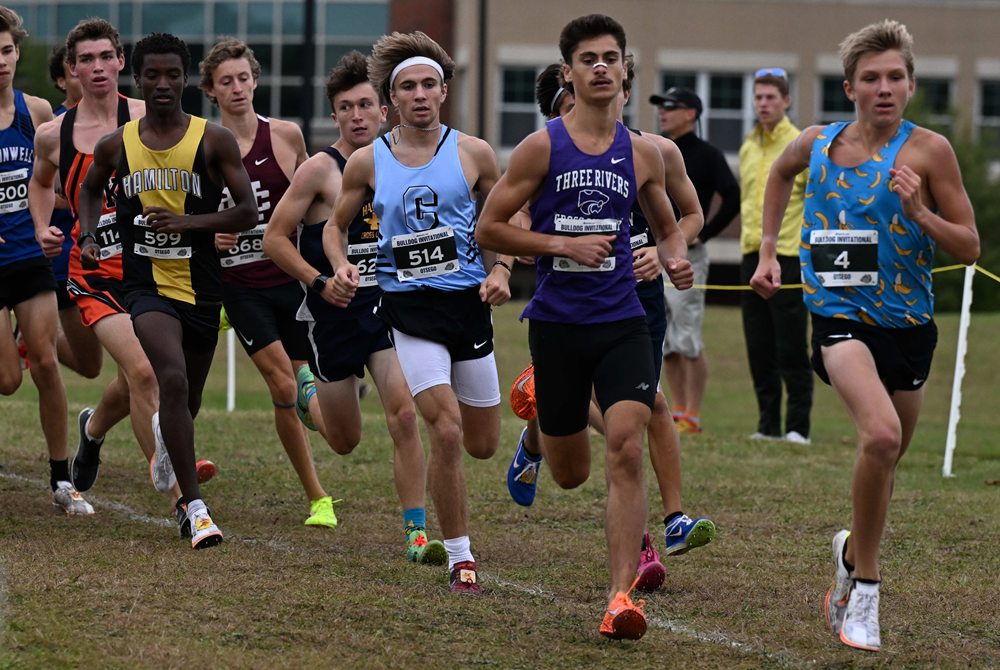
PHOTO Several runners, including Grand Rapids Christian’s Simon Triezenberg (514), run the Division 2 race Sept. 28 at the Otsego Invitational. (Photo by Gary Shook.)