


Let's Play 2 (or 3, or 4)
February 16, 2012
A few conversations I had at last week's Women In Sports Leadership conference further affirmed a point I've been making for years -- high school athletes, if they'd like, shouldn't hesitate to play multiple sports.
Doing so does not hurt, but might just help their chances at landing that prized college scholarship -- on top of adding another layer to the high school sports experience.
Reaffirming this for me last week was Michigan State softball coach Jacquie Joseph, who spoke on that subject at the WISL conference. She's heading into her 24th season as a head coach at the Division I college level -- so she's been around for some of the evolution of both high school sports specialization and college recruiting. Plus, she coaches a sport that sees its share of athletes playing just that one.
Later, I spoke with a high school coach who leads teams in three sports and also played one at the Division I college level. She's a believer in this as well.
Some of the things I've been told over the years about playing more than one sport:
- It allows an athlete to learn more skills and hone more parts of his or her athleticism.
- Using another range of movement further helps condition an athlete's body and make it more resistant to injury.
- It's hardly rare to see a college football coach watching a prospect's basketball game -- coaches like to see how athleticism transfers across sports, and sometimes will see something from an athlete playing basketball that he didn't show on the football field. (Football and basketball are used in this example, but the same applies to a number of similar situations.)
- Athletes get an opportunity to play whatever they'd like only this once (unless they turn out to be that rare college athlete who takes on more than one sport at that level).
These are hardly new arguments. But they are always worth repeating -- especially when the people frequently making them (college coaches) are the ones single-sport athletes often are trying to impress.
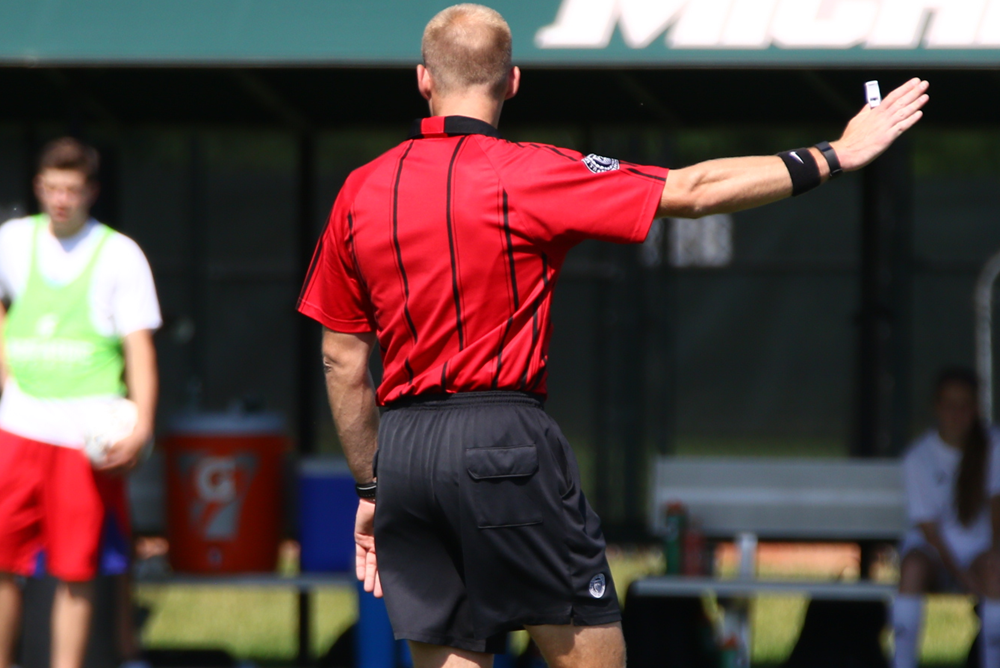
Be the Referee: Soccer Red Card
By
Paige Winne
MHSAA Marketing & Social Media Coordinator
April 16, 2024
Be The Referee is a series of short messages designed to help educate people on the rules of different sports, to help them better understand the art of officiating, and to recruit officials.
Below is this week's segment – Soccer Red Card - Listen
On the soccer field, number 9 is waiting to sub in for number 4 when number 4 commits a foul worthy of a yellow card. The referee stops play to issue the yellow.
On the way to report the card to the home team’s coach, number 4 uses insulting language toward the referee. What should happen next?
Should the referee ignore the player’s insult? Does number 4 get a red card, and then gets subbed out? Or should number 4 get a red card and number 9 stays on the bench, so their team plays down a player?
If you said a red card and the substitute is not allowed to enter – you are correct. Because the substitute was not yet waved into the game, she cannot enter for an ejected player. They must play down a player the remainder of the contest.
Previous Editions
April 9: Batted Baseball Hits Runner - Listen
March 12: Basketball Replay - Listen
March 5: Hockey Officials - Listen
Feb. 27: Less Than 5 - Listen
Feb. 20: Air Ball - Listen
Feb. 13: Hockey Penalties - Listen
Jan. 30: Wrestling Tiebreakers - Listen
Jan. 23: Wrestling Technology - Listen
Jan. 9: 3 Seconds - Listen
Dec. 19: Unsuspecting Hockey Hits - Listen
Dec. 12: No More One-And-Ones - Listen
Nov. 21: Football Finals Replay - Listen
Nov. 14: Volleyball Unplayable Areas - Listen
Nov. 7: Pass/Kick Off Crossbar - Listen
Oct. 31: Cross Country Interference - Listen
Oct. 24: Soccer Overtime - Listen
Oct. 17: Tennis Spin - Listen
Oct. 10: Blocked Kick - Listen
Oct. 3: Volleyball Double & Lift - Listen
Sept. 26: Registration Process - Listen
Sept. 20: Animal Interference - Listen
Sept. 13: Feet Rule on Soccer Throw-In - Listen
Sept. 6: Volleyball Jewelry - Listen
Aug. 30: Football Rules Similarities - Listen
Aug. 23: Football Rules Differences - Listen