

Let's Play 2 (or 3, or 4)
February 16, 2012
A few conversations I had at last week's Women In Sports Leadership conference further affirmed a point I've been making for years -- high school athletes, if they'd like, shouldn't hesitate to play multiple sports.
Doing so does not hurt, but might just help their chances at landing that prized college scholarship -- on top of adding another layer to the high school sports experience.
Reaffirming this for me last week was Michigan State softball coach Jacquie Joseph, who spoke on that subject at the WISL conference. She's heading into her 24th season as a head coach at the Division I college level -- so she's been around for some of the evolution of both high school sports specialization and college recruiting. Plus, she coaches a sport that sees its share of athletes playing just that one.
Later, I spoke with a high school coach who leads teams in three sports and also played one at the Division I college level. She's a believer in this as well.
Some of the things I've been told over the years about playing more than one sport:
- It allows an athlete to learn more skills and hone more parts of his or her athleticism.
- Using another range of movement further helps condition an athlete's body and make it more resistant to injury.
- It's hardly rare to see a college football coach watching a prospect's basketball game -- coaches like to see how athleticism transfers across sports, and sometimes will see something from an athlete playing basketball that he didn't show on the football field. (Football and basketball are used in this example, but the same applies to a number of similar situations.)
- Athletes get an opportunity to play whatever they'd like only this once (unless they turn out to be that rare college athlete who takes on more than one sport at that level).
These are hardly new arguments. But they are always worth repeating -- especially when the people frequently making them (college coaches) are the ones single-sport athletes often are trying to impress.
Evart Softball Follows Record Book Achievers to Statewide Championship Success
By
Geoff Kimmerly
MHSAA.com senior editor
March 30, 2026
Evart’s march to the 2024 Division 3 championship included several record book accomplishments, by the team and three of its standouts.
As a team Evart made the single-season wins list in finishing 37-4 and additionally for hitting 32 home runs with 261 RBI with its pitchers totaling 361 strikeouts. Katelyn Gostlin finished her four-year career that spring with nine record book listings including for 47 career doubles, Allyson Theunick finished a four-year career with eight listings including for 39 career doubles and 34 career home runs, and Kyrah Gray was added for 12 triples that spring as a sophomore.
Gray was added to more lists as a junior in 2025, with 70 runs scored, 20 doubles and a 14-strikeout/5-inning game, and she’s on career lists with 189 runs, 40 doubles and 27 triples with this season to play. Teammate Mattisen Tiedt was added for 36 career doubles over her first three seasons, and as a team Evart had 89 doubles and 287 RBI over 35 games last year.
Theunick is playing at Grand Valley State, and Gray has signed with Ferris State.
See below for several recently-added listings to the softball record book and click the heading to see the record book in full. Several more applications have been received and are in the process of being confirmed.
Softball
Olivia Turner capped one of the most notable careers in MHSAA softball history in 2024 with 24 record book entries – and as the career record holder in three categories to go with a the single-season hits record she set as a junior. The current Bradley University (Ill.) sophomore finished with the career hits record of 329, career doubles record of 104 and career RBI record of 345 over four seasons. She also finished with a .612 career average and seventh on the career runs scored list with 255. Four-year teammate Rylee Fitzpatrick graduated in 2024 with 16 record book listings, finishing second on the career runs list with 300, fifth with 293 career hits and eighth with 71 career doubles. Emily Brown, then a junior, was added for 79 runs, 73 hits and 16 doubles, and Bree Salts, also then a junior, was added nine times and made career lists with 27 home runs and 209 RBI through three seasons. As a team, Grass Lake was added for 484 runs (ranking fifth) and a record 571 hits, both from 2023. Salts is playing at Central Michigan, Fitzpatrick at Madonna and Brown for Hope College.
Brownstown Woodhaven’s Ariel Krueger capped her four-year career last spring with 10 record book listings, including for 244 runs, 241 hits, 59 doubles, 27 triples, 24 home runs and 165 RBI over 153 games and four seasons. She’s continuing at Duke.
Lillian Martinez made career lists with 203 runs, 218 hits and 183 stolen bases for Hemlock through four seasons concluding last spring. She’s continuing at Valparaiso. A pair of at bats for then-sophomore Lyndsey Lyscas against Freeland that season also put her in the record book three times. She hit back-to-back grand slams, making the consecutive home run list, single-game grand slam list and single-game RBI list with eight. She also made the single-season home runs list with 12 that spring.
Delaney Reagan was added twice as a senior for Saranac in 2024 – she hit a pair of home runs in consecutive at bats and both during the second inning of a win over Potterville.
Pinckney’s Cecelia Thorington graduated in 2024 on career lists in three categories – and as the state record holder for a stolen bases streak that lasted the majority of her final three seasons. Thorington stole a record 130 consecutive bases without being caught, beginning on May 14 of her sophomore season and continuing through her final high school game. She finished her career with 187 stolen bases total – which rank 10th all-time – and also is listed for 224 runs scored and 21 triples over 140 games. She’s playing at University of Michigan. Additionally, Mackenzie Burns was added for six RBI in a 2024 game against Stockbridge. She’s continuing her career at Wheeling University in West Virginia.
Elizabeth Vanderburg had an unforgettable doubleheader as a freshman for Paw Paw in 2024. She made the record book with three home runs and seven RBI in a game against Niles and hit two more home runs during the other half of the doubleheader.
Helena Fettue earned her first record book entry in her first season at Armada in 2024. She hit 18 doubles over 36 games as a freshman.
Zeeland East’s Emme Meyering enjoyed a power-packed 2024 game against Muskegon Mona Shores. The then-junior hit a pair of home runs during the third inning of their doubleheader, then a third-straight home run during the first inning of the second game (and another homer four innings later in that second game). She’s playing at Grace College (Ind.).
Orchard Lake St. Mary’s Maddy Anson showed rare power in 2024 as a junior, hitting 24 home runs – tying for fifth-most for one season. She also earned a listing for three homers in one game against Holly. She is continuing at Kentucky.
A pair of Okemos players earned listings for accomplishments across both games of a 2024 doubleheader with Charlotte. In the first game, Carsyn Knapp tied the MHSAA record getting hit by pitches four times. In the second game, Keirlyn Bane made the single-game RBI list with six. Both were seniors, and Bane is playing at Kutztown (Pa.).
Newaygo was added in five team categories after its 2024 District title run, including for a .420 batting average over 38 games. Amaya Lathrop, now a senior, made the single-season doubles list with 20, and two seniors in 2024 were added to career lists – Olivia DeJohn and Addison Goodin both for doubles and RBI, and DeJohn also for triples, home runs and walks drawn. Several more Newaygo players earned listings in 2025 – senior Karissa Carlson for 17 doubles, senior Gracie Stamp for hitting two consecutive home runs, and then-juniors Chloe Clark and Lathrop both for driving in six runs in one game. Senior Marissa Carrier made two lists – the first for getting hit by pitches twice in one inning, and also for being hit three times total that game. As a team, Newaygo made lists with 72 doubles and 294 over 37 games. DeJohn is continuing at Cleary, Carlson is continuing at Alpena Community College, and Lathrop will continue at Cornerstone.
Johannesburg-Lewiston star Jayden Marlatt finished her four-year varsity career in 2024 with seven record book entries, including for 242 career runs, 32 career home runs and a .670 batting average as a junior. She’s playing at Ferris State.
Katelyn Ruth earned seven record book listings during her four-year varsity career for Westland Hope Christian Academy and then a cooperative between that school and Lutheran Westland. Most notably, she made the single-season batting average list twice with a high of .691 as a junior, and career lists with 30 home runs and a .598 average. Additionally, teammates Izzy Burgoa-Getyina and Becky Reddeman made single-game lists. Ruth and Reddeman are playing at Wisconsin Lutheran College, and Burgoa-Getyina is a senior this spring.
Ishpeming’s Payton Manninen capped her four-season varsity career in 2024 with 13 record book entries, appearing on career lists for hits (206), doubles (45), triples (23), home runs (21), RBI (182) and batting average (.595) all over 114 games. She also made single-season lists as a senior with 11 home runs and a .694 average.
Caro graduated a pair of four-year standouts in 2024 who made career lists in multiple categories. Leah Daniels and Makayla Hennessey both made career standings for doubles, while Hennessey also was added for runs scored and walks and Daniels for hits, triples, RBI and a .534 batting average. Daniels is playing at Detroit Mercy, and Hennessey is playing at St. Clair County Community College.
Vicksburg’s second-straight run to the Division 2 Final in 2024 included five more record book achievements by graduating seniors. Maddison Diekman was added to the single-season hits list for the second time, this time with 86. Brooklynn Ringler was one of three Bulldogs to make the single-season doubles list, hitting 20 and followed on her team by Audrey Dugan (17) and Delaney Monroe (16). Monroe also made the single-season RBI list for the second time, this time with 71. Diekman is playing at Central Michigan, Monroe is playing at Lawrence Tech, Dugan is playing at Glen Oaks Community College, and Ringler is playing golf at Davenport.
Dexter now-senior Clara Lamb reached the record book for doubles during the last two seasons, with a high of 22 as a junior, and she’s on the career list with 47 with one season to play. She will continue her career at Case Western Reserve in Cleveland.
Several Mendon standouts from the last several seasons have been added, a few for both single-season and career accomplishments. Payton Smith was added seven times including for a .569 career average, 61 career doubles and 180 career RBI from 2019-22, with 2020 canceled due to COVID-19. Kara Swan was added five times including for 27 doubles – tying for eighth all-time – in 2021. Jadyn Samson’s 92 runs in 2024 were the second-most for a single season and one of her three listings. Seniors Rowen Allen and Cienna Nightingale, 2025 graduate Brielle Bailey, 2023 grad Lauren Schabes and 2022 grad Izzy Smith also were added to one or more lists. Smith is playing at Briar Cliff in Iowa, Bailey plays for Kalamazoo Valley Community College, Allen will continue at Campbellsville in Kentucky, and Nightingale will play volleyball at Kalamazoo College.
Addison Neelis and Vestaburg as a team both made the record book three times in 2024, Neelis most notably for scoring 69 runs over 38 games and Vestaburg with 403 runs, 64 doubles and 278 RBI as a team. She’s now playing at Mid Michigan College.
Big Rapids’ Marissa Warren graduated in 2024 with 23 record book entries, making seven career lists including with 267 career runs (ranking fifth), 277 hits (ranking eighth), 65 doubles (tied for 13th) and 243 RBI (tied for fifth). Cailin Knoop finished her career on the career doubles list, and Pharis Carroll also finished a four-year varsity career on the hits and runs career lists. Big Rapids also made the single-season list with 282 RBI. Warren is playing with Toledo and Knoop is playing at Calvin.
Leslie graduated arguably its strongest class in program history in 2024, with several seniors that season making MHSAA record lists for single-season and career accomplishments. Gabby Waldofsky graduated with nine listings, including 237 career runs, 288 career hits (ranking sixth), 20 career triples and a .536 career average. Jalen Fossitt earned eight listings, including for 216 career runs, 226 career hits, 28 doubles for the 2024 season (tying for sixth-most), 86 career doubles (ranking second) and 216 career RBI. Ada Bradford earned 14 listings; her 66 career doubles rank 14th, her 241 career RBI rank seventh, her 106 career pitching wins are tied for 20th and her 1,281 career strikeouts rank 14th. Myah Fletcher was added for 40 doubles over her four seasons. Fossitt is playing at Hope College, Bradford is playing at Aquinas college, and Fletcher is playing at Centre College in Kentucky.
Several Fowler listings were added from the last three seasons. Saige Miller, who has committed to play at Maryland after graduating this spring, was added for 71 and 70 hits and 16 and 18 doubles over the last two seasons, respectively. Paisley Hansen, a graduate last spring, was added for 16 doubles as a junior, 43 for her four-year career and 156 RBI as well. Anna Andros (25) and Carly Andros (23) both were added to the career hit-by-pitch list, Anna graduating last spring and Carly in 2023, and then-senior Bri Halfmann made the single-game RBI list with seven against Lansing Waverly on May 28, 2024. Fowler also made team lists both of the last two seasons for hits, doubles and runs batted in.
Payton Schafsnitz started the rally quickly for Frankenmuth against Essexville Garber on April 30, 2024, when she hit two home runs back-to-back in the first inning. She was a senior that season and plays at Northwood.
Brown City’s Madeline Hohne has been added for her back-to-back no-hitters against Capac and Marine City Cardinal Mooney on May 31, 2024. She’s a senior and will continue at Spoon River College in Illinois.
Traverse City St. Francis seniors Sophie Hardy and Hunter St. Peter earned listings in the records as seniors in 2024. Hardy made lists for 74 hits, a 21-game hitting streak, 75 runs scored, 19 doubles and a .649 average. St. Peter also made the doubles list, with 17.
Farmington Hills Mercy tied for third all-time with 62 home runs and ranked sixth with 496 strikeouts in finishing 38-2 in 2024, along with making team lists with 24 shutouts, 382 hits, 71 doubles and 292 RBI. Then-senior Kat Burras (12) and then-junior Kaitlyn Pallozzi contributed to that home run total making the individual single-season list, and Pallozzi made the strikeouts list as well with 430 over only 186 innings. Pallozzi capped her career last spring with three more record book listings – for a 0.18 ERA and 363 strikeouts as a senior and 1,262 strikeouts for her career. Teammate Evelyn Miller made the career hit-by-pitch list, with 24 over four seasons. Pallozzi is continuing her career at Alabama, Miller is continuing at Loyola-Chicago, and Burras is playing at Sacred Heart in Connecticut.
Kylee Scheurer finished her Portland St. Patrick career in 2024 ninth on the batting average list at .614 over her four seasons and 108 games. She also was most recently added for 72 hits and a .667 average as a senior and 226 hits and 34 doubles for her career. She’s running track at Oakland.
A pair of Muskegon Mona Shores players earned listings in the record book during their March 21, 2025, game against Holton. Maddy Faught drove in six runs, and Amelia Pena was hit by two pitches in the seventh inning of the 13-4 win. Pena was a senior and Faught a sophomore.
Alexa Hyler became the fifth player listed for hitting four triples in one game after doing so for Greenville against Central Montcalm on April 4, 2025. She’s a junior.
Gaylord won Division 2 championships in 2023 and 2024 as part of an incredible run to begin this decade. The Blue Devils as a team were added to the team record book six times, most notably for hitting an all-time best 73 home runs in 2023 and second-place 72 home runs in 2024. Several individuals also earned listings, with Aubrey Jones making lists 12 times including for 71 career home runs (ranking second) and 26 as a senior (also ranking second), and 241 RBI (tied for seventh). Jayden Jones is listed 15 times, including for 48 career home runs (tied for 11th) and 243 career runs scored (16th). Others making record book lists during the start of this decade were Alexis Kozlowski, Alexis Shepherd, Kennedy Wangler and Taylor Moeggenberg. Jayden Jones started her career at Virginia Tech and is playing now with sister Aubrey at Oklahoma State. Kozlowski and Wangler play at Ferris State, Shepherd at Toledo, and Moeggenberg played at Cornerstone last season.
Niles Brandywine’s Addison Anglin drove in six runs in a 2025 win over South Haven, and six more in a win over Bridgman. She’s a senior and has committed to continue her career at Glen Oaks Community College.
Marlette set an MHSAA single-game record with 36 hits against Caro last season, and together the teams earned the first listing for highest-scoring game as Marlette won 36-21. Caro led 19-14 after four innings before Marlette scored 11 runs in the top of the fifth.
New Baltimore Anchor Bay’s Averi Rowlett made the single-inning and single-game lists for RBI during a 13-8 over Macomb Dakota last May 8. She drove in six runs during her team’s 10-run fifth inning and finished with six for the game. She’s a senior this year and has committee to Detroit Mercy.
Anna Carlson completed her four-year varsity career at Bloomfield Hills last spring all over the MHSAA record book, with 13 entries including for 171 runs, 41 doubles, 27 home runs and 181 RBI over 127 games. She’s continuing her career at Maine.
A pair of Dowagiac standouts were added to the records for accomplishments this decade. Marlie Carpenter was added for 67 runs scored and 17 doubles last spring, plus for two home runs and seven RBI in one inning and game. Aubrey Busby was added twice for 20 doubles, for both the 2021 and 2023 seasons. Busby graduated in 2024, and Carpenter is a senior and recently signed to continue at Trevecca Nazarene in Nashville, Tenn.
Lillian Wassman made the record book four times for her stunning performance for Midland Bullock Creek against Beaverton last May 13. The then-senior hit three home runs in consecutive at bats, including two in one inning, and also drove in seven runs. Bullock Creek as a team made noise offensively last season as well, making the record book with 70 doubles, 35 home runs and 289 RBI over 39 games.
A pair of Ithaca hitters made doubles lists last spring as seniors. Ivy Davenport was added for 18 in one season and 37 over her four-year career, while Emmalee Shankel was added for 35 over her four seasons. Shankel is playing at Adrian College.
Stella Phillips became the first player to make the sacrifices list since 2016 when she totaled 23 in 34 games last spring as a senior at Rochester Adams.
Chelsea’s Ashley Sherwood hit her way onto the single-season home run list last spring with 11 over 38 games. She’s a senior this school year and has committed to Hope College.
Several Midland standouts were added for successes this decade, as was the team in several categories. Addie Edwards was added for 51 career doubles and 20 career home runs, plus 10 home runs in 2023 as a sophomore, and 175 career RBI. Grace Schloop was added for 48 career doubles, 11 home runs as a sophomore in 2022, 29 career home runs and 158 career RBI. Hayden Purvis was added for 39 career doubles from 2021-24, and Morgan Williams was added for 11 home runs as a junior in 2023 and 20 home runs for her career (from 2021-23, as she missed her senior season with an injury). As a team, Midland was added several times including for 414 runs, 91 doubles and 329 RBI in 2022, 40 home runs in 2023 and 391 strikeouts in 2024. Williams played last season at Wayne State and will continue at Missouri S&T. Schloop plays at Saginaw Valley State, and Edwards plays at Calvin.
Watervliet’s Grace Chisek graduated in 2024 with 26 record book listings – and some of the most impressive career numbers all-time. Her 272 runs across 150 games and four seasons rank fourth on that career list, while her 290 hits rank sixth, her 43 career triples second, her 239 RBI ninth and her .612 career batting average tied for 10th. She also had a 37-game hitting streak that’s tied for eighth longest. She plays at Grand Rapids Community College.
Lilly Parr earned Onaway’s first softball record book listing in a decade last spring when she had six RBI in a game against Atlanta. Parr was a senior.
Parma Western’s Hailey Whisman struck out 378 hitters as a senior in 2023 to make the single-season list in that category. She’s playing at Davenport.
Tori Briggs finished her four-year, 121-game Fowlerville career in 2024 with 15 record book listings, including career marks of 198 runs scored, 217 hits, 50 doubles, 21 triples, 26 home runs, 163 RBI and a .534 batting average. She is continuing her career at Central Michigan. Additionally, former Gladiators teammates Angelle Haan and Tommi Kleinschmidt were added for single-game accomplishments. Haan is playing at Tiffin, and Kleinschmidt graduated last spring and is playing volleyball at Lansing Community College.
Saginaw Michigan Lutheran Seminary’s Kerin Gardner enjoyed an impressive debut as a freshman last spring, making the single-season runs list with 76 over 43 games.
Several Hudsonville Unity Christian achievements from the last four seasons were added, led by 2025 graduate Molly Versluis’ five listings including for 232 hits, 55 doubles and 177 RBI over her four-year, 165-game career. Natalie Bush (15), Makenna Bareman (14) and Ella Davison (10) all made single-season home run lists among others, and Davison is on career lists for doubles (43) and RBI (156) with one season to play. Unity as a team was added 19 times, including for 483 hits, 107 doubles, 38 home runs and 356 RBI in 2022. Versluis is continuing at Ferris State.
Buchanan made the MHSAA team wins list three times with at least 35 during the first half of this decade, and several individual record book performances contributed to those successes. Caitlyn Horvath made the single-season hit list as a senior last spring with 78 and the career list with 243 over 160 games. Hannah Herman had 254 career hits over 157 games from 2021-24 and also made the career doubles list with 58. Hailee Kara had 229 hits and 65 doubles over 164 games from 2021-24. Camille Lozmack, Cora Weinberg, Sophia Lozmack and Alea Fisher also were added to the single-season doubles list, Cameron Carlson was added for two home runs in an inning last spring, and Aspen Berry made hit-by-pitch and single-season home runs lists. Herman and Kara are playing at Western Michigan, Horvath is continuing at Grand Rapids Community College, Camille Lozmack played at Alma College, Sophia Lozmack played at Lake Michigan College, Fisher plays at Aquinas, Carlson is a junior this school year and Berry is a senior.
Saline’s run to the Division 1 championship last spring was sparked by several record-book performances. As a team, Saline made the records with 39 wins (finishing 39-5) plus 421 hits, 92 doubles, 37 home runs, 309 RBI and 446 strikeouts – the strikeouts ranking 10th all-time. Senior Sydney Hastings was added for 66 runs scored, 72 hits, 21 doubles and 12 home runs, and Reese Rupert was added for 17 doubles. Hastings is continuing at University of Michigan, and Rupert is a senior this school year and signed with Grand Valley State.
Grayling’s Anna Wood graduated last spring atop the single-season (27) and career (66) lists for number of times hit by pitches, and she also scored 203 runs over 139 games and four seasons. Jessica Campbell made the career RBI list with 179 over 137 games and four years, and Cali D’Amour made the career runs scored list with 172 over 129 games and four seasons. Campbell also made the single-season home runs list with 12 as a senior, and she, D’Amour and Wood earned single-game listings as well. D’Amour is playing at Davenport and Campbell is continuing at Brunswick Community College (North Carolina).
Escanaba’s Katey Lamb hit two grand slams in the fourth inning of a game against Macomb Dakota last May 18, resulting in record book listings for most grand slams and RBI (8) in an inning and game – setting or tying the inning records. She was a senior.
Marlie Rehm has hit 38 doubles over three seasons at Holt to already reach the career list with one season to play, plus earned listings for single-season doubles and single-game RBI. She’s committed to continue at Wisconsin-Platteville.
Marysville’s Kendal Quain was added four times for accomplishments during the 2025 season, including for 14 home runs, and Marysville as a team was added for 42 home runs. She’s a senior this season and will next play volleyball at Hope College.
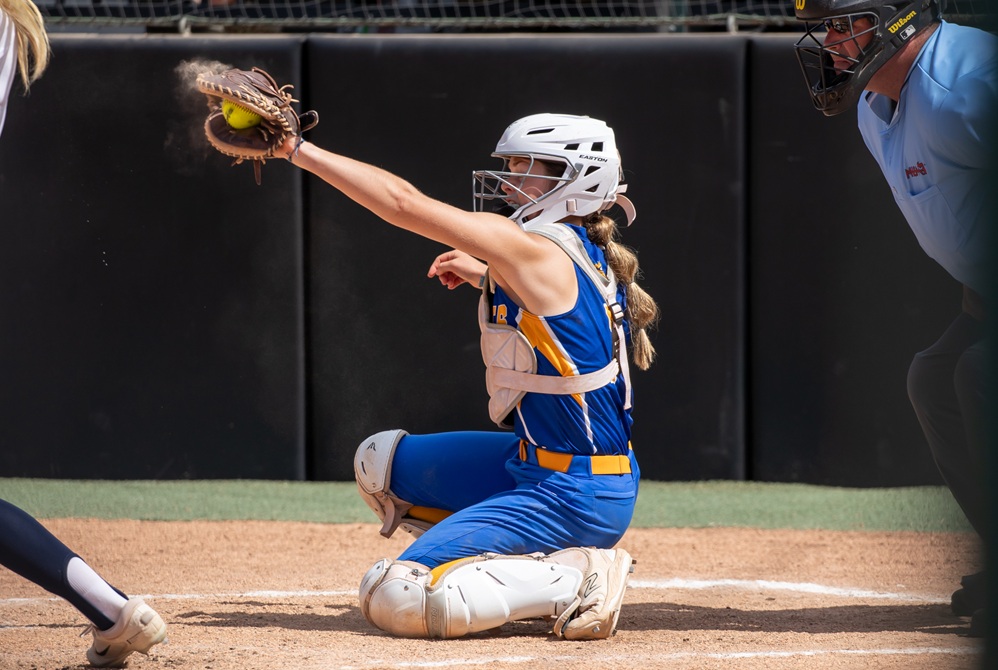
PHOTO Evart's Allyson Theunick catches a pitch during Evart's championship win in 2024 at Secchia Stadium.