


Let's Play 2 (or 3, or 4)
February 16, 2012
A few conversations I had at last week's Women In Sports Leadership conference further affirmed a point I've been making for years -- high school athletes, if they'd like, shouldn't hesitate to play multiple sports.
Doing so does not hurt, but might just help their chances at landing that prized college scholarship -- on top of adding another layer to the high school sports experience.
Reaffirming this for me last week was Michigan State softball coach Jacquie Joseph, who spoke on that subject at the WISL conference. She's heading into her 24th season as a head coach at the Division I college level -- so she's been around for some of the evolution of both high school sports specialization and college recruiting. Plus, she coaches a sport that sees its share of athletes playing just that one.
Later, I spoke with a high school coach who leads teams in three sports and also played one at the Division I college level. She's a believer in this as well.
Some of the things I've been told over the years about playing more than one sport:
- It allows an athlete to learn more skills and hone more parts of his or her athleticism.
- Using another range of movement further helps condition an athlete's body and make it more resistant to injury.
- It's hardly rare to see a college football coach watching a prospect's basketball game -- coaches like to see how athleticism transfers across sports, and sometimes will see something from an athlete playing basketball that he didn't show on the football field. (Football and basketball are used in this example, but the same applies to a number of similar situations.)
- Athletes get an opportunity to play whatever they'd like only this once (unless they turn out to be that rare college athlete who takes on more than one sport at that level).
These are hardly new arguments. But they are always worth repeating -- especially when the people frequently making them (college coaches) are the ones single-sport athletes often are trying to impress.
Brighton Names Baseball Field for Program Builder, Longtime Leader
By
Tim Robinson
Special for MHSAA.com
May 4, 2023
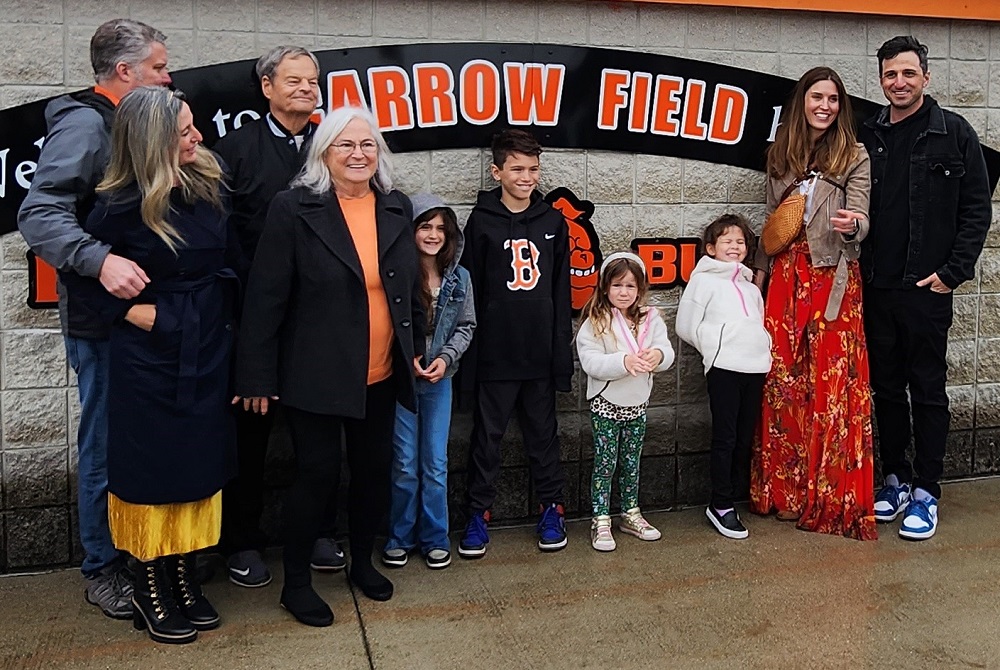
BRIGHTON — Mark Carrow didn’t know what to expect April 22 when he arrived at Brighton High School’s baseball field, where he was the guest of honor for a ceremony officially naming it Carrow Field.
 “I remember back in October, when they announced this would happen, I told my wife, Mary, that there will be probably 60-70 people here, because there are 18 players on each team and their parents,” he recalled. “We pulled up here and there were all these people, and these young men who look older now.”
Dozens of Brighton alumni, some of whom Carrow hadn’t seen since their high school days nearly a half-century ago, were in attendance for the ceremony held before a doubleheader with Ypsilanti Lincoln.
Carrow retired in 2006 after 34 seasons as Brighton’s baseball coach, recording 823 wins, now eighth on the state’s all-time list. He also was an assistant football coach and coached both boys and girls middle school basketball.
He came to Brighton a year after graduating from the University of Michigan, where he played baseball for the Wolverines, starring at third base.
“My dream was to coach baseball at Ann Arbor High,” Carrow said of his high school alma mater, now Ann Arbor Pioneer. “That was my dream.”
But he had applied to Brighton Area Schools as well, and after a year teaching in Grand Rapids, he and Mary both were offered teaching positions.
“Wouldn’t you know it? We were in school for two days and Ann Arbor calls me up,” Carrow said. “They had a phys ed job open. I’d have been the JV football coach, and I knew the baseball coach was on his way out. It was everything I wanted, and I went to (administrator) Bob Scranton and said, ‘Here’s what’s happening.’ He told me to think about it over the weekend and come back Monday.
“My wife and I talked it over, and we were so grateful to Brighton for giving us a chance to be near our hometown that we felt we owed them a year,” Carrow said. “In November, we bought a house that we lived in for 22 years.”
Brighton’s sports teams weren’t the dominant squads of today. The football team had had two winning seasons in 20 years, and the year Carrow arrived went 0-9.
“We played in six homecoming games, including our own,” he said. “Everyone wanted to play us.”
The baseball team wasn’t much better, having gone decades without a winning season.
But the Bulldogs were 12-12 that first spring under Carrow’s leadership, and never finished below .500 during the rest of his tenure.
 The Bulldogs joined the Southeastern Conference the next year and got off to a 7-0 start before losing at Lincoln.
“The kids were crying on the bus ride home,” Carrow said, “and I knew right then that Brighton had turned a corner, that it meant something to win and losing wasn’t acceptable anymore.”
Brighton took off, winning 20 games or more in all of his last 23 years as a coach, and a total of 13 league titles, 12 District titles, three Regional crowns and while making two trips to the Semifinals.
The talent was there, too, including 16 all-state players and two Mr. Baseball Award winners in Ron Hollis and Drew Henson.
Carrow earned national and Michigan Coach of the Year honors three times apiece and was inducted into the Michigan High School Baseball Coaches Hall of Fame in 1992.
The field was renamed in his honor after the Brighton school board changed its policy to allow the renaming of facilities to honor living persons less than two years ago.
But Carrow is quick to cite the reasons for his success.
“The players are the ones who made this possible,” he said. “I mean that from the bottom of my heart. I never threw a pitch or hit the baseball. I got 800 wins, but it was because of them.
Carrow has a photographic memory, which came in handy while chatting with former players.
“It was funny, because with each kid I remembered an incident about them,” he said. “Jeff Bogos, who I hadn’t seen since he graduated in 1979, came out and I said, ‘Do you remember when we were at Milan and your knee went out (of place) in the middle of the field?’ It happened twice. He said, ‘How do you remember that?’ And I said, ‘How could I not?’”
Carrow moved to Florida after his retirement, where he and his longtime assistant, George Reck, meet up a couple of times a week. He makes frequent trips north to watch U-M football and to visit his son, Chris, who lives in Chicago.
Baseball is firmly in his past.
“I think I’ve been to one high school game since I went down there,” Carrow said. “I hated the way the coach was coaching, and Mary did, too. She said, ‘We don’t have to watch any more high school baseball,’ and I said, ‘You’re right.’”
When he retired, Carrow said he would likely be forgotten in a few years.
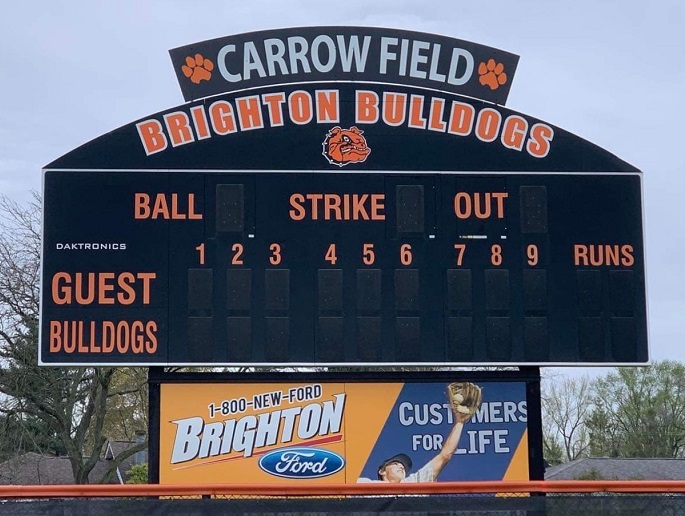
Seventeen years later, his legacy is assured and his memory will be invoked any time one looks at the scoreboard in left-center field that has a “Carrow Field” sign on top of it.
Not bad for a coach who was in the right place at the right time.
“My dream was fulfilled, and rightly so,” Carrow said. “And, believe me, I made the right decision. I couldn't have had better kids to teach or lived in a better community. It couldn't have worked out any better.”
PHOTOS (Top) The Carrow family stands together in front of the welcome sign to Carrow Field – including daughter Tiffany (front left), Mark and Mary (second from left, front and back) and son Chris (far right). (Middle) The Carrow name stands tall atop the scoreboard at the field named for the longtime coach. (Family photo by Daniel Collins.)