


Let's Play 2 (or 3, or 4)
February 16, 2012
A few conversations I had at last week's Women In Sports Leadership conference further affirmed a point I've been making for years -- high school athletes, if they'd like, shouldn't hesitate to play multiple sports.
Doing so does not hurt, but might just help their chances at landing that prized college scholarship -- on top of adding another layer to the high school sports experience.
Reaffirming this for me last week was Michigan State softball coach Jacquie Joseph, who spoke on that subject at the WISL conference. She's heading into her 24th season as a head coach at the Division I college level -- so she's been around for some of the evolution of both high school sports specialization and college recruiting. Plus, she coaches a sport that sees its share of athletes playing just that one.
Later, I spoke with a high school coach who leads teams in three sports and also played one at the Division I college level. She's a believer in this as well.
Some of the things I've been told over the years about playing more than one sport:
- It allows an athlete to learn more skills and hone more parts of his or her athleticism.
- Using another range of movement further helps condition an athlete's body and make it more resistant to injury.
- It's hardly rare to see a college football coach watching a prospect's basketball game -- coaches like to see how athleticism transfers across sports, and sometimes will see something from an athlete playing basketball that he didn't show on the football field. (Football and basketball are used in this example, but the same applies to a number of similar situations.)
- Athletes get an opportunity to play whatever they'd like only this once (unless they turn out to be that rare college athlete who takes on more than one sport at that level).
These are hardly new arguments. But they are always worth repeating -- especially when the people frequently making them (college coaches) are the ones single-sport athletes often are trying to impress.
Set, Ready, Challenge: 11-Player Football Finals Challenges New in 2022
By
Jon Ross
MHSAA Director of Broadcast Properties
November 25, 2022
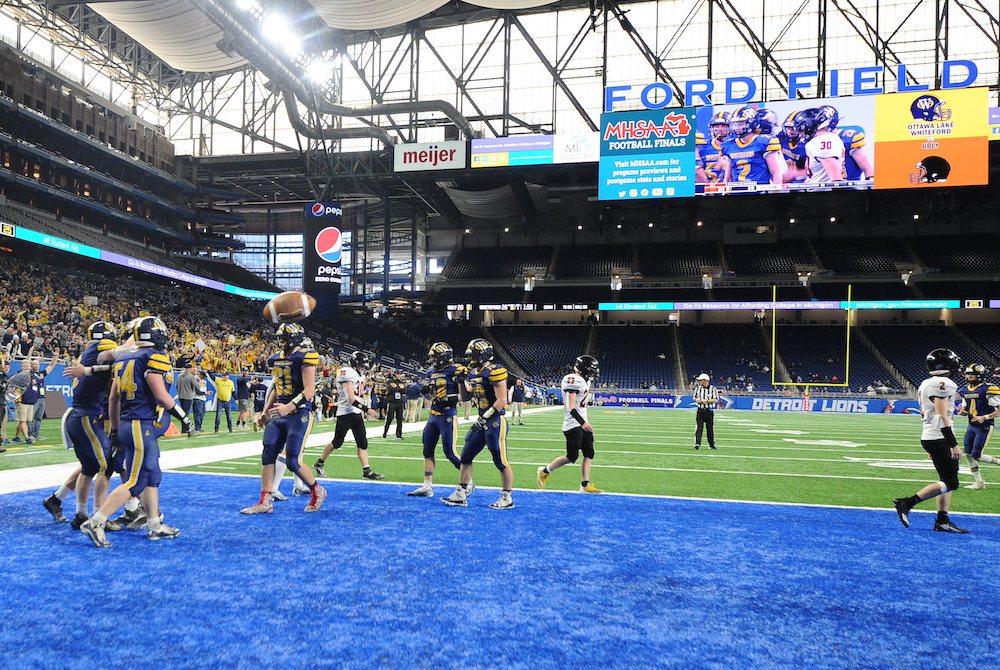
New this year at the MHSAA 11-Player Football Finals is the opportunity for head coaches to challenge a call.
In previous years, all potential scoring plays and potential turnovers were automatically reviewed. That process will continue and now, under a limited set of circumstances, the head coach can challenge calls.
To do so, the head coach must first call a timeout. If a team has no timeouts remaining, they are not able to challenge a call. Challenges must be presented to the officials immediately after the timeout is granted. If the challenge is successful, the team will get its timeout back and have the ability to challenge one more call during regulation. A second successful challenge will not result in the ability to challenge a third call.
The following plays are reviewable by challenge:
- Complete/incomplete passes
- Runner/receiver in/out of bounds
- Runner ruled not down
- Forward progress spot as it relates to the yard to gain
- First touching of a kick
- Recovery of a ball in/out of bounds
- Forward/backward pass
- Penalties called on the field only for:
- Illegal forward pass
- Targeting or illegal helmet contact
- Pass interference only as it relates to the pass being previously tipped
NOTE: All other penalties called on the field are not reviewable. These include, but are not limited to: illegal formation, ineligible receivers downfield, illegal participation, illegal substitution or delay of game. If a penalty is not called by the officials on the field, the play can never be reviewed to retroactively call a penalty.
In overtime, challenges – like timeouts – reset. Each team has the ability to challenge one call for the entirety of overtime, but must have a timeout to use to do so. A successful challenge in overtime will not result in the ability to challenge a second call.
If a play is overturned in regulation or overtime, the replay officials will correct all aspects of the play including time, position of the ball and whether the clock will be started on the RFP or snap. The game clock or play clock may be reviewed only as it directly relates to the overturning of a call on the field.
There is no change to the review of potential scoring and potential turnover plays. Those plays are automatically looked at by the replay official and replay assistant. If the replay official can confirm the ruling on the field without stopping play, the official will do so. If more time is needed to review the play, the on-field referee will announce that and then will announce the replay official’s decision. For a play to be reversed, there must be indisputable video evidence that shows the original call was incorrect. Every attempt will be made to complete the review process in 90 seconds or less.
The addition of the coach’s challenge was approved by the MHSAA’s Representative Council at its May 2022 meeting.