


Let's Play 2 (or 3, or 4)
February 16, 2012
A few conversations I had at last week's Women In Sports Leadership conference further affirmed a point I've been making for years -- high school athletes, if they'd like, shouldn't hesitate to play multiple sports.
Doing so does not hurt, but might just help their chances at landing that prized college scholarship -- on top of adding another layer to the high school sports experience.
Reaffirming this for me last week was Michigan State softball coach Jacquie Joseph, who spoke on that subject at the WISL conference. She's heading into her 24th season as a head coach at the Division I college level -- so she's been around for some of the evolution of both high school sports specialization and college recruiting. Plus, she coaches a sport that sees its share of athletes playing just that one.
Later, I spoke with a high school coach who leads teams in three sports and also played one at the Division I college level. She's a believer in this as well.
Some of the things I've been told over the years about playing more than one sport:
- It allows an athlete to learn more skills and hone more parts of his or her athleticism.
- Using another range of movement further helps condition an athlete's body and make it more resistant to injury.
- It's hardly rare to see a college football coach watching a prospect's basketball game -- coaches like to see how athleticism transfers across sports, and sometimes will see something from an athlete playing basketball that he didn't show on the football field. (Football and basketball are used in this example, but the same applies to a number of similar situations.)
- Athletes get an opportunity to play whatever they'd like only this once (unless they turn out to be that rare college athlete who takes on more than one sport at that level).
These are hardly new arguments. But they are always worth repeating -- especially when the people frequently making them (college coaches) are the ones single-sport athletes often are trying to impress.
The Official View: It's In Our Blood
By
Brent Rice
MHSAA Assistant Director
September 10, 2019
Some have said that officiating has to be in your blood.
The avocation runs through the veins of nearly 10,000 officials in this state, and “The Official View” returns this week not only to inform those valuable contributors to school sports, but also to provide an inside look at some of the people wearing the stripes – including a daughter who has followed her dad onto the court.

It’s Official!
The MHSAA Officials Guidebook is the main source for rules and regulations and policies and procedures to which MHSAA Registered Officials are to adhere. For the first time in several years, the document has been updated and revised for clarification and the removal of redundancies. It also has a new look and format that will hopefully make it easier for officials to read and review. The updated Guidebook can be found by CLICKING HERE.
Officials Bulletins for the fall season have started. Check out your specific officials sports page for this and more. You can find documents, helpful links and sport-specific information. CLICK HERE.
Rule of the Week
VOLLEYBALL After the first set comes to a close, the coach approaches the officials’ table and removes the lineup sheet to prepare the lineup for the next set.
Ruling: This move is legal … between sets. However, the lineup sheet, along with the roster sheet, must remain at the officials’ table throughout each set.
It’s Your Call
FOOTBALL This week’s clip questions the legality of a block. In the video, No. 64 in white immediately at the snap cut blocks No. 54 in blue.
Is this a legal block? What’s the call?
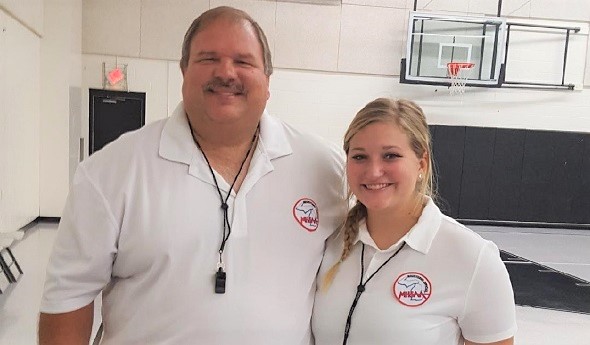
Official View: A Family Tradition
Interested in getting a job before she headed off to college, Frankenmuth native Megan Jarlock noticed it was difficult to find one that fit around her busy schedule and that could give her the level of saving (or spending) money she sought.
She started officiating at the suggestion of her dad, Mark, who has served as an MHSAA official for nearly 20 years himself. Mark informed Megan she could make twice as much per hour officiating as she could working in traditional college-student jobs, and she could determine for herself what games she did and didn’t want to accept.
Besides the side cash and schedule convenience, officiating provides Megan additional benefits as well. Megan is able to remain around sports she loves, stay active and keep healthy and happy. She officiates volleyball in the fall and basketball in the winter, and has even done some softball in the spring. The most important thing, though, is that she gets to officiate with her dad.
“I am also very lucky to have my dad by my side to help me learn and grow as an official and a person,” says Megan.
One of the best parts of working with her dad is the car rides, where they have a chance to catch up on each other’s busy lives. And like a lot of mentor officials, Mark often takes his daughter out to dinner after the game to discuss things she did well and areas she can improve. She is grateful for the ability to share time with her dad, both doing what they love.
Of her dad and experience, Megan said, “He is a great sports official, but an even better father and role model. I’m really enjoying being an official, and these are the moments with my family that I will remember for the rest of my life.”
PHOTO: Megan Jarlock and her dad, Mark, prepare to work an MHSAA contest. (Photo provided by the Jarlock family.)