


Let's Play 2 (or 3, or 4)
February 16, 2012
A few conversations I had at last week's Women In Sports Leadership conference further affirmed a point I've been making for years -- high school athletes, if they'd like, shouldn't hesitate to play multiple sports.
Doing so does not hurt, but might just help their chances at landing that prized college scholarship -- on top of adding another layer to the high school sports experience.
Reaffirming this for me last week was Michigan State softball coach Jacquie Joseph, who spoke on that subject at the WISL conference. She's heading into her 24th season as a head coach at the Division I college level -- so she's been around for some of the evolution of both high school sports specialization and college recruiting. Plus, she coaches a sport that sees its share of athletes playing just that one.
Later, I spoke with a high school coach who leads teams in three sports and also played one at the Division I college level. She's a believer in this as well.
Some of the things I've been told over the years about playing more than one sport:
- It allows an athlete to learn more skills and hone more parts of his or her athleticism.
- Using another range of movement further helps condition an athlete's body and make it more resistant to injury.
- It's hardly rare to see a college football coach watching a prospect's basketball game -- coaches like to see how athleticism transfers across sports, and sometimes will see something from an athlete playing basketball that he didn't show on the football field. (Football and basketball are used in this example, but the same applies to a number of similar situations.)
- Athletes get an opportunity to play whatever they'd like only this once (unless they turn out to be that rare college athlete who takes on more than one sport at that level).
These are hardly new arguments. But they are always worth repeating -- especially when the people frequently making them (college coaches) are the ones single-sport athletes often are trying to impress.
Brush Up on the New Transfer Rule
July 18, 2019
By Rob Kaminski
MHSAA benchmarks editor
Eligibility under the new “sport-specific” transfer rule begins this coming fall after circulating extensively for nearly one school year.
Unless one of the stated 15 exceptions is met, participation during the 2018-19 school year determines eligibility for 2019-20.
The new rule adopted by the Representative Council at its May 2018 meeting has found support among most audiences. A transfer student’s eligibility in 2019-20 is based upon that student’s participation from this past school year (2018-19). It will be paramount for administrators and coaches to have awareness of the sports a transfer student participated in during the previous school year.
The long-standing 15 Exceptions to immediate eligibility, such as a full and complete residential change or a student moving between divorced parents by completing of an Educational Transfer Form, did not change.
One might call the rule on the way out “The Fourth-Friday Transfer Rule.” Under this old rule, when a student enrolled at the new school determined his or her eligibility. Under the new Sport Specific Transfer rule, what a student played in the previous season determines eligibility.
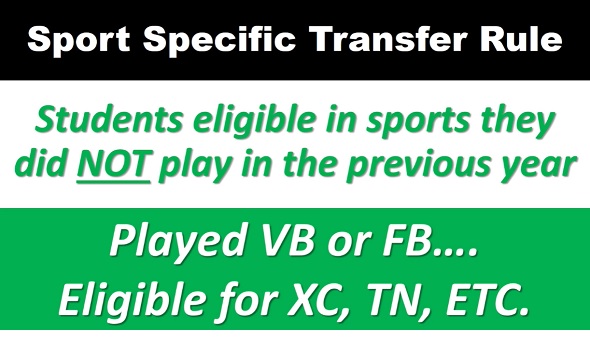
The Council passed a more lenient rule on the one hand and more restrictive on the other. The more lenient aspect is a change that finds a transfer student ELIGIBLE in any sport in which he or she did not participate in a game or a scrimmage in the previous school year.
The more restrictive portion tends to discourage students who change schools for sports reasons. A transfer student who did play a sport in the previous season – and who does not meet one of the 15 Exceptions – is NOT ELIGIBLE in that sport for the next season. If a student changes schools in mid-season, the student would be ineligible for the rest of that season in that sport and the next season for that sport.
Participation under this and other rules means playing in an interscholastic game or scrimmage after starting the 9th grade at any high school. It does not mean practice, but entering an interscholastic game, meet or scrimmage in any way. It also may involve more than one sport, so a three-sport athlete who does not have a residential change and transfers would be ineligible in those sports during the next school year – but eligible for any other sport. It also means a student cut from a team – one who never entered a scrimmage or game – may transfer and play without delay for that new school’s team. It may also mean that a student who meets one of the stated exceptions such as a residential change but enrolls in a school other than her or his school of residence, would have eligibility in sports not played in the previous year.
The new rule will tend to discourage students from changing schools for sports because they would be ineligible in any sport they have played in school the previous season for that sport. It will increase participation for some students who were otherwise not eligible under the current rule.
It is always best to contact school athletic directors who can connect with the MHSAA to verify eligibility prior to enrollment.
If the student’s new school requests in writing, the MHSAA Executive Committee may approve a waiver that reduces the period of ineligibility to 90 scheduled school days at the new school if the change of schools was for compelling reasons demonstrated with outside documentation having nothing to do with sports, curriculum, finances, and school demographics. The Executives Committee also has authority to approve immediate eligibility.