


Let's Play 2 (or 3, or 4)
February 16, 2012
A few conversations I had at last week's Women In Sports Leadership conference further affirmed a point I've been making for years -- high school athletes, if they'd like, shouldn't hesitate to play multiple sports.
Doing so does not hurt, but might just help their chances at landing that prized college scholarship -- on top of adding another layer to the high school sports experience.
Reaffirming this for me last week was Michigan State softball coach Jacquie Joseph, who spoke on that subject at the WISL conference. She's heading into her 24th season as a head coach at the Division I college level -- so she's been around for some of the evolution of both high school sports specialization and college recruiting. Plus, she coaches a sport that sees its share of athletes playing just that one.
Later, I spoke with a high school coach who leads teams in three sports and also played one at the Division I college level. She's a believer in this as well.
Some of the things I've been told over the years about playing more than one sport:
- It allows an athlete to learn more skills and hone more parts of his or her athleticism.
- Using another range of movement further helps condition an athlete's body and make it more resistant to injury.
- It's hardly rare to see a college football coach watching a prospect's basketball game -- coaches like to see how athleticism transfers across sports, and sometimes will see something from an athlete playing basketball that he didn't show on the football field. (Football and basketball are used in this example, but the same applies to a number of similar situations.)
- Athletes get an opportunity to play whatever they'd like only this once (unless they turn out to be that rare college athlete who takes on more than one sport at that level).
These are hardly new arguments. But they are always worth repeating -- especially when the people frequently making them (college coaches) are the ones single-sport athletes often are trying to impress.
Title Time Differs Among Hockey States
July 12, 2019
By Rob Kaminski
MHSAA benchmarks editor
Next season’s three-week playoff format for the MHSAA Ice Hockey Tournament will fall more closely in line with similar postseasons for state associations around the country which sponsor the sport.
According to 2017-18 National Federation of State High School Associations participation statistics, 18 states sponsor boys ice hockey.
Michigan ranked third in number of schools involved with 240, behind Minnesota (282) and Massachusetts (278). In terms of overall participants, the MHSAA was fourth with 3,353, trailing Massachusetts (7,377), Minnesota (5,751) and New Jersey (3,492) and just ahead of New York (3,088). Wisconsin and Ohio boast more than 2,000 participants annually.
So, how do the tournaments compare among those states similar to Michigan? Most use longer tournament calendars than the two-week span previously employed by the MHSAA.
The timeframe for the season just past in the Minnesota tournament had most play beginning Feb. 21 and ending the same day as the MHSAA Finals, March 9. Some teams started on Feb. 19. The MHSAA dropped the puck for its first games on Monday, Feb. 25. It should be noted that Minnesota crowns just two champions annually, compared to the MHSAA’s three divisions.
Meanwhile, in Wisconsin and Ohio, just one school takes the statewide title each year, so it stands to reason that the postseason is spread out even further. Both states began the 2019 playoffs on Monday, Feb. 11.
Wisconsin’s tourney culminated on March 2 at Veteran’s Memorial Coliseum in Madison as teams played the Quarterfinals, Semifinals and Final over three consecutive days.
Ohio, meanwhile, took a week-long break following District Finals on March 1 or 2, then played the Semifinals and Final at Nationwide Arena in Columbus during March 8-9. This is similar to the rest period the MHSAA will enjoy moving forward from its Quarterfinals to the Semifinals and Finals in 2020.
Just as the season was reaching its pinnacle in Wisconsin, the postseason title chase was merely beginning in Massachusetts, where this year it opened Feb. 25.
Massachusetts is tied for the most divisions of the states studied here with four, but the top division is created with a different twist.
“The top division is often called the ‘Super 8’ or 1A. This tournament is set up differently than the other divisions,” said Massachusetts Ice Hockey Coaches Association President Dan Connolly. “The Super 8 is a double-elimination tournament. The seedlings for this tournament are done by power seeding via a committee using strength of schedule, record, team vs. teams under consideration and win-loss record down the stretch.”
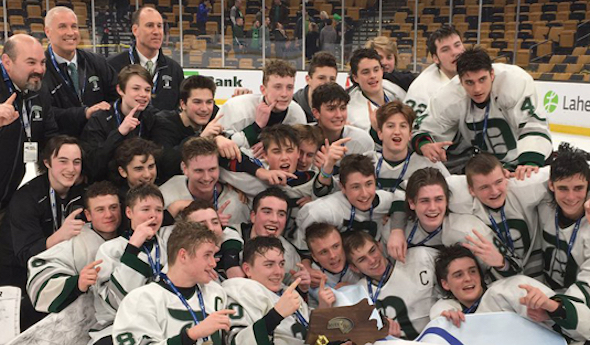
Connolly said just 10 teams are chosen for the Super 8, and seed Nos. 7 through 10 must face off in a play-in game to join the top six. The two teams losing the play-in game return to their respective pre-assigned state divisions and can still win those tournaments. Such was the case in 2019, when Duxbury High lost in its bid to join the Super 8 field, but then won the Division 1 Final.
Like Michigan, those three divisions are based on enrollment, but unlike Michigan, the divisions are seeded based on winning percentage.
The Finals take place on a Sunday at the TD Garden in Boston, a celebration of hockey that features six games (four boys and two girls finals). This year’s event took place March 17, and nearly went into March 18. The Division 1 Final began at 9:59 p.m. as the previous contest, the Super 8 Final, went to four overtimes.
As mentioned, Minnesota’s tournament ended the same day as the MHSAA’s in 2019, and featured one overtime game among its two Finals at the Xcel Energy Center in St. Paul as Edina took the top class over Eden Prairie, 3-2.
The Sunday finales in Boston might seem foreign to followers of MHSAA tournaments, but New York also features a Sunday as the stage for its two state Finals, following Semifinals on Saturday. This year’s playoffs went from Feb. 20-March 10, culminating at the Harborcenter in Buffalo.
Neighboring New Jersey comes closest in length to the old MHSAA format with four divisions – three public and one non-public – taking just 14 days to determine winners at the Prudential Center in Newark. The 2019 titles were determined on Monday, March 4, with Semifinals the Wednesday prior.
PHOTO: Duxbury celebrated Massachusetts’ Division 1 championship this past season after missing out on making the “Super 8” bracket.