

MHSAA Historian Picks 10 to Remember
August 9, 2016
By Rob Kaminski
MHSAA benchmarks editor
It sounded simple and fun, the theme for the MHSAA's spring issue of benchmarks: a history of MHSAA tournaments.
It certainly was the latter, but simple? Not so much.
There’s no way to do justice to nearly a century’s worth of history in some sports. Complicating matters was the abundance of information and photographs for some, and the scant amount of detailed data and images for others.
MHSAA historian Ron Pesch was given an equally challenging task: recount a “Top 10” list from his days covering various MHSAA Finals. He shares them here and, he adds, they are in no order of favorites.
The Shot: 1986 Class B Boys Basketball Final at Crisler Arena – Saginaw Buena Vista’s Chris Coles’ desperation shot, launched at the buzzer from well beyond half court, dropped through the hoop to give the Knights a 33-32 win over defending champion Flint Beecher in a rematch of the 1985 Class B title game. The shot was Coles’ first of the second half and his only points in the contest.
The Smurfs: 1986 Class A Football Final at the Pontiac Silverdome – The "Smurfs" – Muskegon Coach Dave Taylor's nickname for his small, quick swarming defensive linemen – limited heavily favored Sterling Heights Stevenson to four yards rushing and 73 yards of total offense in a 10-0 win. As a 1979 graduate of Muskegon High School, I was elated.
The Drive: 1989 Class B Football Final at the Pontiac Silverdome – I slid down from the press box into the stands at the Silverdome for the end of this one. With 2:20 remaining, the atmosphere was simply electric, as Farmington Hills Harrison’s lauded quarterback Mill Coleman took the reins with his team down 27-21 to DeWitt. The senior executed a flawless two-minute drill, guiding his team to the DeWitt 9 before scampering into the end zone for the tying points. Steve Hill added his fourth PAT for the lead, then secured the victory with an interception on the next series.
King Kool: 2005 Class B Boys Basketball Final, Breslin Center, East Lansing – David Kool was a flawless 20 for 20 from the free-throw line and scored 43 points as Grand Rapids South Christian downed Muskegon Heights 67-60.
The Parade: 2004 Individual Wrestling Finals, The Palace of Auburn Hills – In 2004, I traveled to Auburn Hills to watch the MHSAA Individual Wrestling Finals for the first time. The pageantry of the Grand March, the skills on display, the roar of the massive crowd, and the ensuing beauty and chaos of a wrestling extravaganza of this scale is truly a sight to see.
 A Marathon: 2007 Division 3 Football Final, Ford Field, Detroit – East Grand Rapids and Orchard Lake St. Mary’s ended regulation tied 14-14, and this would turn into a five overtime battle that required an extra hour of play. No previous football playoff game, from Districts up, had ever gone beyond four overtimes. After exchanging field goals, touchdowns, extra points and two-point conversions, East Grand Rapids emerged with a 46-39 victory.
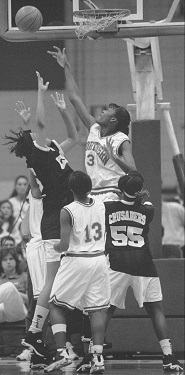
Tawana Towers: 1994 Class A Girls Basketball Final at Kellogg Arena, Battle Creek – Flint Northern, coached by Leteia Hughley and led by 6-4 freshman Tawana McDonald, defeated 1993 runner-up Detroit Martin Luther King, 46-32, for the Class A championship. McDonald batted down an MHSAA-record 10 shots, pulled down 13 rebounds and added five points and seven assists in a stellar performance.
Never Quit: 2008 Division 2 Football Semifinal, Spartan Stadium, East Lansing – Unbeaten, No. 1-ranked and heavily favored Muskegon trailed Davison by 22 late in the third quarter and 16 with less than five minutes to play. In perhaps the greatest comeback in playoff history, Muskegon recovered two onside kicks and scored 19 points in the final 4:31 to escape with a 38-35 victory and its third trip in five years to an MHSAA Final.
MHSAA Legends: 1998-2008 – For 10 years, the MHSAA showcased great teams from the past with their Legends of the Game series. From a historian’s perspective it was a chance to meet and learn more about folks I had often known only from the pages of microfilm. It was quite the treat to see years fall away as coaches, team managers and players reunited, in many cases for the first time after decades apart.
The MHSAA Record Books: Online, 1994 – One of my first efforts as state historian was to expand the record books beyond their primary focus on football, basketball, track & field and swimming & diving. With the arrival of the internet, an enhanced version of the record books was brought online. Coaches and fans were quick to respond with letters and e-mails, happily listing entries that had been “missed.” Soon, five category headings in a sport grew to 20, then to 50 and beyond.
Kids: 2004 Football Finals, Pontiac Silverdome – (OK, this is No. 11 ... consider it an extra point). For the first time, my sons joined me for my annual excursion to Metro Detroit for a Thanksgiving Day football weekend. They got to see the Silverdome before the move of the MHSAA Football Finals to beautiful Ford Field. Future Big Reds, they also got to see their future alma mater win another title.
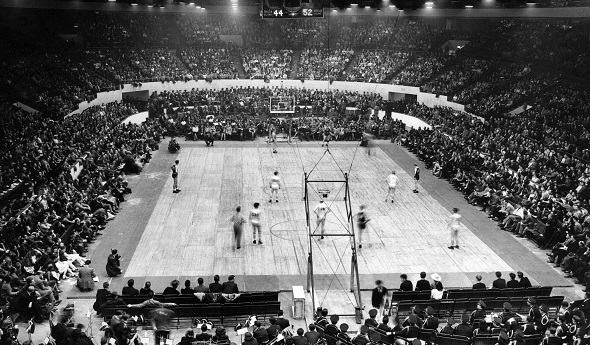
PHOTOS: (Top) An MHSAA boys basketball tournament game is played at Olympia Stadium in Detroit. (Middle) Flint Northern's Tawana McDonald blocks a shot during the 1994 Class A Final.

5 Strategies To Improve Range Of Motion
March 6, 2024
When it comes to health and fitness, regular exercise and strength training get the most attention. But it turns out that improving your range of motion may pay greater dividends, particularly over the long haul.

“All kinds of things can impact our range of motion,” says Jennifer Burnham, an athletic trainer at Henry Ford Health. “As we age, our joints become less pliable, but any kind of surgery or injury can also impact our range of motion. And if you're somebody who sits at a desk all day long, that can affect your range of motion as well.”
Why Is Improving Flexibility Important?
Staying active with regular cardiovascular exercise and strength training is a great way to maintain your overall physical health. But it’s important to remember that flexibility exercises come with plenty of perks, too, including:
- Preventing injury
- Staving off arthritis by lubricating joints and tissues
- Improving posture and balance
"Unfortunately, if you have limited range of motion, you may perform tasks incorrectly, causing other muscles and joints to overcompensate for the lack of mobility,” Burnham says. “Over time, that compensation mechanism can increase the risk of injury.”
To complicate matters, our lifestyles often don’t support our range of motion goals. Many of us spend most of our days sitting at a desk or hunched over a screen. And when we’re not sitting still, most of us are slouching.
What Are Some Ways To Improve Range Of Motion?
You don’t have to be able to twist your limbs into a pretzel to achieve full range of motion. Instead, try to improve on your current level of flexibility with these five simple strategies:
- Pay attention to timing. If you’re not ready to add a stretching day to your workout regimen, consider adding a set of flexibility exercises at the end of every session. Pre-workout stretching is helpful, too, but stretching when your muscles are warm is a more effective way to stave off injuries.
- Focus on mobility and stability. Even if you can do the splits or touch your toes to the back of your head, you won’t be able to hold the position if you don’t also have strong core muscles. “Most people do stabilizing exercises such as strength training and lifting weights without paying much attention to mobilizing activities like stretching and yoga,” Burnham says. “But you really need to do both stabilizing and flexibility exercises to get an effective workout.”
- Do a mix of dynamic and static stretches. Two types of stretches can help you gain an edge when it comes to improving range of motion: Dynamic (an active type of stretching where you’re moving within your range of motion) and static stretching (where you hold a stretch). Dynamic stretching with arm and head circles, side stretches, and hip circles before exercise is a good way to warm up cool muscles and help lubricate the joints. With static stretching such as touching your toes to stretch your hamstrings, the goal is to hold a position for 30 seconds or more. Static stretches are often best performed after a workout when your muscles are warm.
- Try foam rolling. Foam rollers act almost like a rolling pin to smooth out tight muscles. Used correctly, they can help improve range of motion — and release stress and tension. You can use foam rollers to prime your body for exercise, or to recover after a workout.
- Aim for balance. If one part of your body is super flexible, focus on increasing range of motion in the opposing muscle group. “So, for example, if your hamstrings are very flexible, make sure to target your quadriceps with flexibility exercises,” Burnham says. “The goal is to make sure you’re aiming for balancing in your body.”
While stretching is an important way to achieve and maintain balance, flexibility and range of motion, it isn’t always intuitive. Not sure where to begin? Consider meeting with a personal trainer or athletic trainer to help you devise a program.
“Watching YouTube videos can be helpful, but if you’ve never done flexibility exercises before, you could overstretch your muscles or find yourself in an incorrect position to stretch,” Burnham says. “And yes, you can create bodily injury by overstretching.”
To find a sports medicine provider at Henry Ford Health, visit henryford.com/sportsmedicine or call 313-651-1969.
Reviewed by Jennifer Burnham, MS, AT, ATC, CSCS, a certified athletic trainer at the Henry Ford Center for Athletic Medicine.