

MHSAA Historian Picks 10 to Remember
August 9, 2016
By Rob Kaminski
MHSAA benchmarks editor
It sounded simple and fun, the theme for the MHSAA's spring issue of benchmarks: a history of MHSAA tournaments.
It certainly was the latter, but simple? Not so much.
There’s no way to do justice to nearly a century’s worth of history in some sports. Complicating matters was the abundance of information and photographs for some, and the scant amount of detailed data and images for others.
MHSAA historian Ron Pesch was given an equally challenging task: recount a “Top 10” list from his days covering various MHSAA Finals. He shares them here and, he adds, they are in no order of favorites.
The Shot: 1986 Class B Boys Basketball Final at Crisler Arena – Saginaw Buena Vista’s Chris Coles’ desperation shot, launched at the buzzer from well beyond half court, dropped through the hoop to give the Knights a 33-32 win over defending champion Flint Beecher in a rematch of the 1985 Class B title game. The shot was Coles’ first of the second half and his only points in the contest.
The Smurfs: 1986 Class A Football Final at the Pontiac Silverdome – The "Smurfs" – Muskegon Coach Dave Taylor's nickname for his small, quick swarming defensive linemen – limited heavily favored Sterling Heights Stevenson to four yards rushing and 73 yards of total offense in a 10-0 win. As a 1979 graduate of Muskegon High School, I was elated.
The Drive: 1989 Class B Football Final at the Pontiac Silverdome – I slid down from the press box into the stands at the Silverdome for the end of this one. With 2:20 remaining, the atmosphere was simply electric, as Farmington Hills Harrison’s lauded quarterback Mill Coleman took the reins with his team down 27-21 to DeWitt. The senior executed a flawless two-minute drill, guiding his team to the DeWitt 9 before scampering into the end zone for the tying points. Steve Hill added his fourth PAT for the lead, then secured the victory with an interception on the next series.
King Kool: 2005 Class B Boys Basketball Final, Breslin Center, East Lansing – David Kool was a flawless 20 for 20 from the free-throw line and scored 43 points as Grand Rapids South Christian downed Muskegon Heights 67-60.
The Parade: 2004 Individual Wrestling Finals, The Palace of Auburn Hills – In 2004, I traveled to Auburn Hills to watch the MHSAA Individual Wrestling Finals for the first time. The pageantry of the Grand March, the skills on display, the roar of the massive crowd, and the ensuing beauty and chaos of a wrestling extravaganza of this scale is truly a sight to see.
 A Marathon: 2007 Division 3 Football Final, Ford Field, Detroit – East Grand Rapids and Orchard Lake St. Mary’s ended regulation tied 14-14, and this would turn into a five overtime battle that required an extra hour of play. No previous football playoff game, from Districts up, had ever gone beyond four overtimes. After exchanging field goals, touchdowns, extra points and two-point conversions, East Grand Rapids emerged with a 46-39 victory.
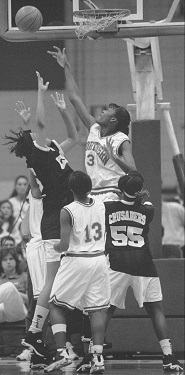
Tawana Towers: 1994 Class A Girls Basketball Final at Kellogg Arena, Battle Creek – Flint Northern, coached by Leteia Hughley and led by 6-4 freshman Tawana McDonald, defeated 1993 runner-up Detroit Martin Luther King, 46-32, for the Class A championship. McDonald batted down an MHSAA-record 10 shots, pulled down 13 rebounds and added five points and seven assists in a stellar performance.
Never Quit: 2008 Division 2 Football Semifinal, Spartan Stadium, East Lansing – Unbeaten, No. 1-ranked and heavily favored Muskegon trailed Davison by 22 late in the third quarter and 16 with less than five minutes to play. In perhaps the greatest comeback in playoff history, Muskegon recovered two onside kicks and scored 19 points in the final 4:31 to escape with a 38-35 victory and its third trip in five years to an MHSAA Final.
MHSAA Legends: 1998-2008 – For 10 years, the MHSAA showcased great teams from the past with their Legends of the Game series. From a historian’s perspective it was a chance to meet and learn more about folks I had often known only from the pages of microfilm. It was quite the treat to see years fall away as coaches, team managers and players reunited, in many cases for the first time after decades apart.
The MHSAA Record Books: Online, 1994 – One of my first efforts as state historian was to expand the record books beyond their primary focus on football, basketball, track & field and swimming & diving. With the arrival of the internet, an enhanced version of the record books was brought online. Coaches and fans were quick to respond with letters and e-mails, happily listing entries that had been “missed.” Soon, five category headings in a sport grew to 20, then to 50 and beyond.
Kids: 2004 Football Finals, Pontiac Silverdome – (OK, this is No. 11 ... consider it an extra point). For the first time, my sons joined me for my annual excursion to Metro Detroit for a Thanksgiving Day football weekend. They got to see the Silverdome before the move of the MHSAA Football Finals to beautiful Ford Field. Future Big Reds, they also got to see their future alma mater win another title.
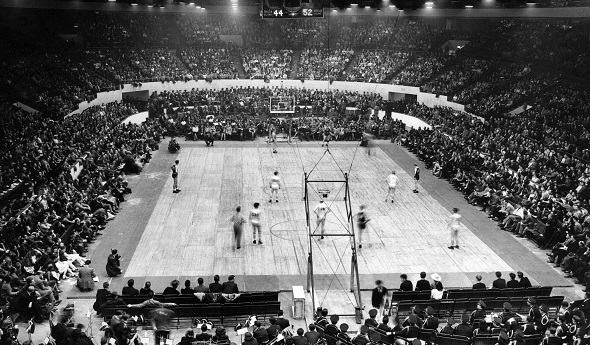
PHOTOS: (Top) An MHSAA boys basketball tournament game is played at Olympia Stadium in Detroit. (Middle) Flint Northern's Tawana McDonald blocks a shot during the 1994 Class A Final.
St. Mary's Record Run Recalls Homer's 'Small-Town Baseball Odyssey'
By
Geoff Kimmerly
MHSAA.com senior editor
April 21, 2023
As Orchard Lake St. Mary’s celebrated setting the MHSAA record for longest baseball winning streak at 77 and counting over the weekend – and with a national record certainly within reach this season – we can recall just two decades ago when Homer’s similar streak and the two seasons of buzz it stirred was on the verge of its start.
Homer, representing a community of about 1,700 residents, finished 38-0 on the way to winning the Division 3 championship in 2004, and then returned to win its first 37 games of 2005 before falling to Saginaw Nouvel 7-6 in that season’s Division 3 Final at Battle Creek’s C.O. Brown Stadium.
Along the way over those two seasons, the Trojans smashed the previous MHSAA baseball consecutive wins record of 56, and went on to set a national record of 75 straight wins that stood until 2011, when it was surpassed by both Martensdale St. Mary’s of Iowa and Portsmouth, N.H. The latter has topped the national list since 2012 after extending its winning streak into 2012 to the current record of 89 games.
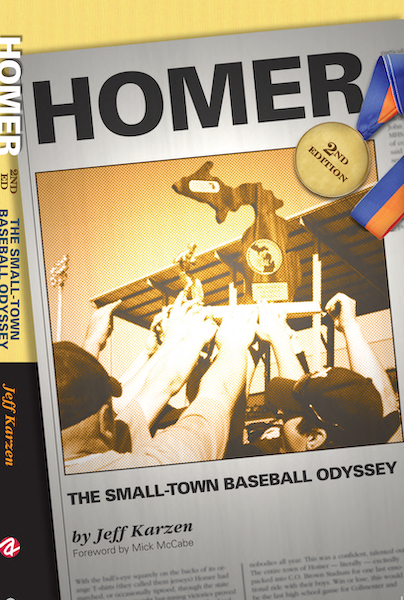
Battle Creek Enquirer reporter Jeff Karzen followed Homer’s record run through many of its most notable moments, and that coverage and the relationships built during that time – and as the Trojans came back to win the Division 4 title in 2006 – led to his first book “Homer: The Small-Town Baseball Odyssey” published in 2011.
Below is an excerpt highlighting the small school’s run to national stardom – followed by updates on a few of the major players who helped the Trojans become unforgettable.
Buy the book here: JeffKarzen.com
***
 Homer: The Small-Town Baseball Odyssey
August Publications
Copyright © 2011 Jeff Karzen
All rights reserved
First edition published 2008
Second edition published 2012
Homer began the 2005 season ranked No. 1 in Division 3, a spot it had grabbed and held onto for the second half of ’04. Seven starters returned from a team that had made history with a 38-0 season. Still, Homer had some things to prove to itself.
So far in high school, and even as Little Leaguers, this group of Homer players had been largely defined by Josh Collmenter and Matt Powers. In big postseason games, Collmenter and Powers would take the pressure off their younger teammates and welcome it squarely on their shoulders. Collmenter was always the big-game pitcher. Powers could always be counted on in the middle of the batting order. How would Homer deal without having its two leaders?
“They definitely set the mindset for our team,” Dan Holcomb said of Collmenter and Powers. “When you’re a freshman coming up you don’t really know what varsity is all about or what Homer baseball is all about. You get up there and having those young guys playing against teams like Blissfield is kind of overwhelming. But having guys like Josh and Matt kept you loose and didn’t let you think about Blissfield, or think about seven state titles [won by the Royals]. They just said, ‘Hey guys, let’s have some fun. We’re going out to play some baseball today.’ They just made sure everyone had their mind right.”
Whether it was nerves about following up the unbeaten season with a good showing or an uneasy feeling taking the field without their two leaders, the Trojans began the new season with a close call in a doubleheader against Marshall and its star, Evan Sharpley. Marshall was a good team and a much bigger school, but Homer simply didn’t have it. Somehow, the Trojans escaped with a 14-13 win in eight innings (the most runs it had given up in years) and then a 4-2 triumph in Game Two. With the first two wins under their belt, the Trojans began to roll. Over the next 12 games, they gave up a total of 13 runs, proof that the season opener was nothing more than a fluke. Collmenter and Powers were missing, but junior-dominated Homer began to form its own identity.
The state record for consecutive wins was 56, set by Grand Haven High School from 1960-62. Homer’s Trojans were quickly nearing the record. The streak had reached 49 games when Homer took the short drive west on M-60 for a Big Eight tilt with the Union City Chargers. By now, the other teams in Homer’s conference had basically ruled out beating the powerhouse. Goals such as scoring runs, playing all seven innings without the mercy rule, and even putting the ball in play against Homer’s overpowering pitchers had become the scaled-down aspirations for the opponent.
One rival coach, Quincy’s Brett Allman, didn’t let his team watch Homer’s impressive pregame routine where the Trojan players showed off their big-time throwing arms and precision fielding. “When they warmed up, I talked to my team outside the dugout, or had them hit Wiffle balls or something,” Allman said. “Something besides watch them take infield. They put on a show. And they were proud of the way they took infield, and rightfully so. I don’t need to watch Dusty Compton throw the ball across the infield because I know what they can do. I didn’t think it would be real beneficial for my guys to watch them take infield.”
Under gray, rainy skies in Union City, both teams finished their warm-ups and looked around. Something was missing. It was going to be hard to play this game without any umpires in sight. They waited and waited. Finally, around 5 p.m., 30 minutes after the scheduled start time, one ump arrived. Knowing how much less is seen on the field with only one umpire (regular- season high-school games have two), Salow was hesitant to let the game begin. The lone umpire told both coaches that his partner was on the way, so the coaches acquiesced and allowed the game to start with one set of eyes in charge of the entire field. Union City must’ve forgotten that its opponent that day had won 49 consecutive games. The Chargers came out like they were the team to beat and jumped all over Homer. A few innings into the game, Homer was stunningly down 7-0. “I said to Tom, ‘Not only are we going to lose our streak but we’re going to get 10-runned (a mercy rule loss),’” Salow said.
Of course, Homer started chipping away at the lead. But seven runs was a lot to come back from, even for these Trojans. In the fifth inning, with Homer still trailing by a few runs, C.J. Finch decided it was time to take control of the perilous situation. “Not today! Not today!” Finch screamed. “This is not going to happen today.”
With rain continuing to fall, Homer got within one run in the sixth inning. That’s when the umpire, who worked alone all game, walked over to Homer’s dugout to speak with Salow.
“It’s not looking good, starting to rain harder. Not sure if we’re gonna be able to finish this thing,” the ump told Salow.
“Absolutely not,” the coach fired back. “We started this game 40 minutes late and if we’d started on time, it would be over by now. Not only that, but we have a streak going. These kids have worked too hard to put this streak together and they’re not going to lose it this way.”
The umpire caved in and so did Union City. Homer rallied to win 9-7, extending the winning streak to 50 games. Seven more remained to break the state record that had stood for 44 years.
“I was on pins and needles,” Union City coach Joe Tinervia said of his team’s near-miss. “I was playing that game like it was 1-0. That shows you what I think of Homer.”
A few weeks later, Homer easily topped Concord 10-0 to tie Grand Haven’s state record of 56 straight wins. The stage was set for the talented boys from the one-stoplight town to make history. A Friday doubleheader against Reading, one of the conference’s better teams, would be the record-breaker. It seemed fitting, too, because Reading had handed Homer its last loss in a regional playoff game in 2003. Homer made history in a rather ho-hum affair, winning Game 1 of the doubleheader, 12-2. “It wasn’t breathtaking or staggering or awe-inspiring,” a Battle Creek Enquirer columnist wrote the next day. “But it was efficient. Forgive Homer if it didn’t stage a large celebration for the new record. It’s just that the boys are used to winning.”
“It was just good enough, not flashy,” Salow said after his team won its 57th straight baseball game. “I’d like to think we’re a blue-collar club. It’s the way guys are taught in practice and in the classroom. We try and never get too high or too low.”
***
Where are they now?
- Josh Collmenter pitched in Major League Baseball for seven seasons, the first five-plus for Arizona before finishing his career with Atlanta. He won a career-high 11 games in 2014 and finished his pro career with a 38-35 MLB record. He currently is living in Phoenix and doing radio and TV for Diamondbacks broadcasts.
- Scott Salow left Homer and became superintendent at Petersburg Summerfield in 2021. He coached the Trojans through 2019, building a career record of 577-157.
- Dan Holcomb lives in Nashville, Tenn., and has been a Seattle Mariners scout for six seasons, covering Tennessee, Alabama and Mississippi. He spent six years as a college coach prior to scouting. He pitched collegiately at University of Evansville, Grand Valley State University and Huntingon University (Ind.).
- Dale Cornstubble is married with two kids and living in Homer. He is an electrician and teaches catching lessons on the side. He played at Central Michigan University and was drafted and played briefly in the minor leagues for the Kansas City Royals.
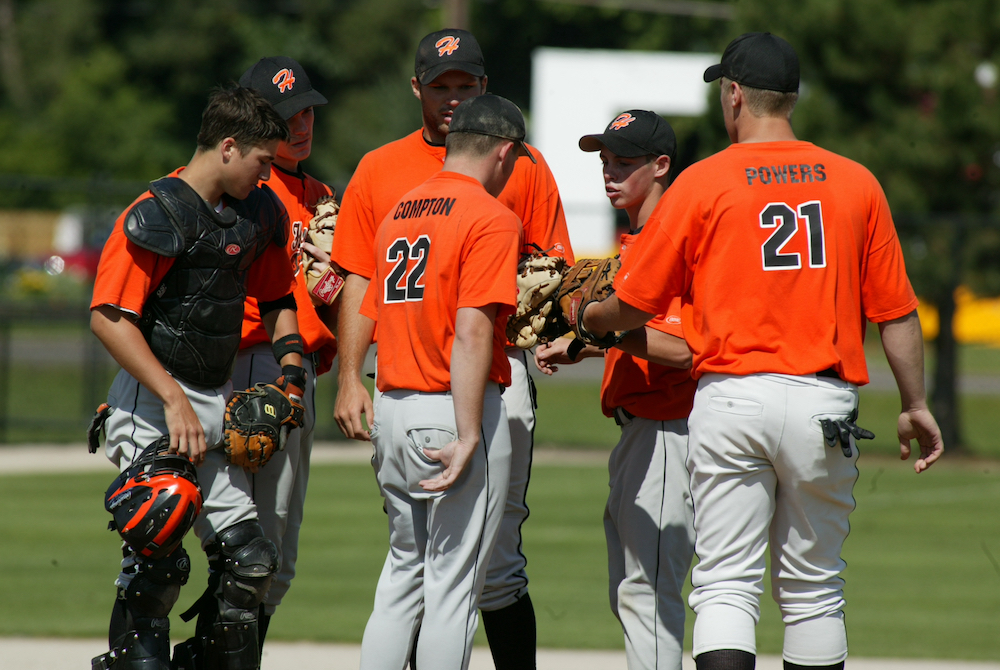
PHOTO Homer players meet on the mound during their 2004 Division 3 Semifinal win over Muskegon Oakridge.