

MHSAA Historian Picks 10 to Remember
August 9, 2016
By Rob Kaminski
MHSAA benchmarks editor
It sounded simple and fun, the theme for the MHSAA's spring issue of benchmarks: a history of MHSAA tournaments.
It certainly was the latter, but simple? Not so much.
There’s no way to do justice to nearly a century’s worth of history in some sports. Complicating matters was the abundance of information and photographs for some, and the scant amount of detailed data and images for others.
MHSAA historian Ron Pesch was given an equally challenging task: recount a “Top 10” list from his days covering various MHSAA Finals. He shares them here and, he adds, they are in no order of favorites.
The Shot: 1986 Class B Boys Basketball Final at Crisler Arena – Saginaw Buena Vista’s Chris Coles’ desperation shot, launched at the buzzer from well beyond half court, dropped through the hoop to give the Knights a 33-32 win over defending champion Flint Beecher in a rematch of the 1985 Class B title game. The shot was Coles’ first of the second half and his only points in the contest.
The Smurfs: 1986 Class A Football Final at the Pontiac Silverdome – The "Smurfs" – Muskegon Coach Dave Taylor's nickname for his small, quick swarming defensive linemen – limited heavily favored Sterling Heights Stevenson to four yards rushing and 73 yards of total offense in a 10-0 win. As a 1979 graduate of Muskegon High School, I was elated.
The Drive: 1989 Class B Football Final at the Pontiac Silverdome – I slid down from the press box into the stands at the Silverdome for the end of this one. With 2:20 remaining, the atmosphere was simply electric, as Farmington Hills Harrison’s lauded quarterback Mill Coleman took the reins with his team down 27-21 to DeWitt. The senior executed a flawless two-minute drill, guiding his team to the DeWitt 9 before scampering into the end zone for the tying points. Steve Hill added his fourth PAT for the lead, then secured the victory with an interception on the next series.
King Kool: 2005 Class B Boys Basketball Final, Breslin Center, East Lansing – David Kool was a flawless 20 for 20 from the free-throw line and scored 43 points as Grand Rapids South Christian downed Muskegon Heights 67-60.
The Parade: 2004 Individual Wrestling Finals, The Palace of Auburn Hills – In 2004, I traveled to Auburn Hills to watch the MHSAA Individual Wrestling Finals for the first time. The pageantry of the Grand March, the skills on display, the roar of the massive crowd, and the ensuing beauty and chaos of a wrestling extravaganza of this scale is truly a sight to see.
 A Marathon: 2007 Division 3 Football Final, Ford Field, Detroit – East Grand Rapids and Orchard Lake St. Mary’s ended regulation tied 14-14, and this would turn into a five overtime battle that required an extra hour of play. No previous football playoff game, from Districts up, had ever gone beyond four overtimes. After exchanging field goals, touchdowns, extra points and two-point conversions, East Grand Rapids emerged with a 46-39 victory.
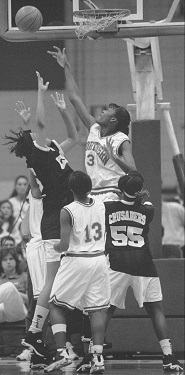
Tawana Towers: 1994 Class A Girls Basketball Final at Kellogg Arena, Battle Creek – Flint Northern, coached by Leteia Hughley and led by 6-4 freshman Tawana McDonald, defeated 1993 runner-up Detroit Martin Luther King, 46-32, for the Class A championship. McDonald batted down an MHSAA-record 10 shots, pulled down 13 rebounds and added five points and seven assists in a stellar performance.
Never Quit: 2008 Division 2 Football Semifinal, Spartan Stadium, East Lansing – Unbeaten, No. 1-ranked and heavily favored Muskegon trailed Davison by 22 late in the third quarter and 16 with less than five minutes to play. In perhaps the greatest comeback in playoff history, Muskegon recovered two onside kicks and scored 19 points in the final 4:31 to escape with a 38-35 victory and its third trip in five years to an MHSAA Final.
MHSAA Legends: 1998-2008 – For 10 years, the MHSAA showcased great teams from the past with their Legends of the Game series. From a historian’s perspective it was a chance to meet and learn more about folks I had often known only from the pages of microfilm. It was quite the treat to see years fall away as coaches, team managers and players reunited, in many cases for the first time after decades apart.
The MHSAA Record Books: Online, 1994 – One of my first efforts as state historian was to expand the record books beyond their primary focus on football, basketball, track & field and swimming & diving. With the arrival of the internet, an enhanced version of the record books was brought online. Coaches and fans were quick to respond with letters and e-mails, happily listing entries that had been “missed.” Soon, five category headings in a sport grew to 20, then to 50 and beyond.
Kids: 2004 Football Finals, Pontiac Silverdome – (OK, this is No. 11 ... consider it an extra point). For the first time, my sons joined me for my annual excursion to Metro Detroit for a Thanksgiving Day football weekend. They got to see the Silverdome before the move of the MHSAA Football Finals to beautiful Ford Field. Future Big Reds, they also got to see their future alma mater win another title.
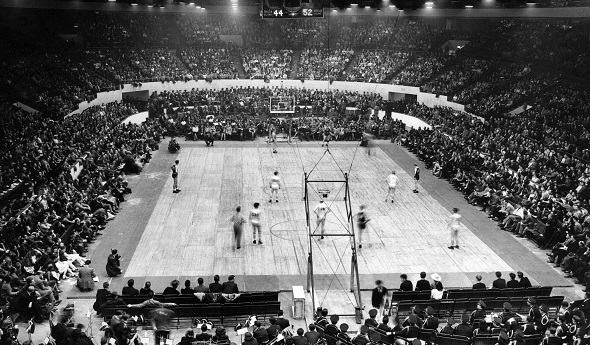
PHOTOS: (Top) An MHSAA boys basketball tournament game is played at Olympia Stadium in Detroit. (Middle) Flint Northern's Tawana McDonald blocks a shot during the 1994 Class A Final.

Why Spring Sports Injuries Are Common & How To Prevent Them
April 11, 2023
When spring is in the air, athletes of all ages head outdoors to play their favorite sports, including softball, baseball, tennis, lacrosse and track & field.
 Unfortunately, the change of season also ushers in injuries, says Joseph Medellin, M.D., a primary care sports medicine doctor at Henry Ford Medical Center-Jackson. A variety of factors can cause spring sports injuries, including:
► Too much or too little winter activity: With shorter days and colder temperatures, some athletes aren’t as active in winter. Even if you are going to the gym regularly, sport-specific muscles – like muscles in the chest and shoulder that help you throw a baseball – may weaken.
At the start of a new sports season, a sudden increase in the demand on these muscles can lead to injury. Taking steps to get ready for spring sports before the season starts can lower this risk. It’s also not uncommon for multi-sport athletes to have games and practices year-round with multiple practices in one day. Not allowing yourself enough downtime can lead to overuse injuries, including strains and sprains.
► Transitioning outdoors: Winter sports often take place on hard surfaces, like wood basketball courts, gyms and treadmills. These surfaces are flat, making it easier to maintain your footing. Spring sports involve soft running surfaces like grass and turf that are uneven. They can also be wet, muddy or icy due to spring weather. All these circumstances increase the risk of injury due to falls.
Cold weather can also be a factor. Early spring temperatures can still be quite cold. It takes longer for muscles to warm up, and they might not work as efficiently. This can be especially troublesome with sports like softball where there are lulls in activity between innings. Playing with cold muscles can increase the risk of sprains and strains.
► Sport-specific movements: Throwing, sprinting and kicking are moves that most people don’t do on a daily basis. They require powerful motions that can stress unconditioned muscles and joints. This is especially true if you haven’t been cross-training to strengthen supporting muscles or haven’t gradually increased your intensity.
A sprinter may experience hip pain from running at full speed around the curve of a track. Rotator cuff injuries can occur in sports that involve throwing, like the javelin, shot put, and baseball and softball. Soccer players can pull their groin from repeatedly taking long kicks.
If You Suspect A Sports Injury, Don’t Put Off Care
A doctor’s office is often the last place eager athletes want to be at the start of the season. But pain should not be a regular part of your training program. If you think you’ve sustained an injury, trying to push through often makes it worse.
Making time to see the doctor can be challenging, especially if you have to miss a practice or game for your appointment. But it’s worth it. “The sooner you get evaluated, the sooner we can get you on the path to recovery,” Dr. Medellin says.
The opposite can be said when treatments are delayed. “The longer you’ve had an injury, the longer it may take to heal,” explains Dr. Medellin. “And first-line treatments aren’t as likely to be successful, which can mean more time away from your sport.”
Sports Injury Treatments That Keep You In The Game
Seeing a doctor doesn’t always mean you’ll have to sit out the season. Treatment may include intermittent rest, as long as you don’t have a severe injury like a stress fracture or tendon tear. “We may recommend a return to sport at a lower intensity or with additional rest days to see if the pain goes away,” says Dr. Medellin.
Patients with minor injuries might also benefit from physical therapy between practices. Physical therapists can correct poor form. They can also help you safely stretch and strengthen injured muscles to promote healing. Conditioning through Henry Ford Health's sports performance program can also speed recovery and prevent injury.
“A sports medicine doctor’s goal is to keep athletes active and involved in the sport they love,” says Dr. Medellin. “That’s what I want for my patients.”
To find a sports medicine provider at Henry Ford Health, visit henryford.com/sportsmedicine or call 313-651-1969.
Joseph Medellin, M.D., is a primary care sports medicine doctor at Henry Ford Medical Center-Jackson.