

MHSAA Historian Picks 10 to Remember
August 9, 2016
By Rob Kaminski
MHSAA benchmarks editor
It sounded simple and fun, the theme for the MHSAA's spring issue of benchmarks: a history of MHSAA tournaments.
It certainly was the latter, but simple? Not so much.
There’s no way to do justice to nearly a century’s worth of history in some sports. Complicating matters was the abundance of information and photographs for some, and the scant amount of detailed data and images for others.
MHSAA historian Ron Pesch was given an equally challenging task: recount a “Top 10” list from his days covering various MHSAA Finals. He shares them here and, he adds, they are in no order of favorites.
The Shot: 1986 Class B Boys Basketball Final at Crisler Arena – Saginaw Buena Vista’s Chris Coles’ desperation shot, launched at the buzzer from well beyond half court, dropped through the hoop to give the Knights a 33-32 win over defending champion Flint Beecher in a rematch of the 1985 Class B title game. The shot was Coles’ first of the second half and his only points in the contest.
The Smurfs: 1986 Class A Football Final at the Pontiac Silverdome – The "Smurfs" – Muskegon Coach Dave Taylor's nickname for his small, quick swarming defensive linemen – limited heavily favored Sterling Heights Stevenson to four yards rushing and 73 yards of total offense in a 10-0 win. As a 1979 graduate of Muskegon High School, I was elated.
The Drive: 1989 Class B Football Final at the Pontiac Silverdome – I slid down from the press box into the stands at the Silverdome for the end of this one. With 2:20 remaining, the atmosphere was simply electric, as Farmington Hills Harrison’s lauded quarterback Mill Coleman took the reins with his team down 27-21 to DeWitt. The senior executed a flawless two-minute drill, guiding his team to the DeWitt 9 before scampering into the end zone for the tying points. Steve Hill added his fourth PAT for the lead, then secured the victory with an interception on the next series.
King Kool: 2005 Class B Boys Basketball Final, Breslin Center, East Lansing – David Kool was a flawless 20 for 20 from the free-throw line and scored 43 points as Grand Rapids South Christian downed Muskegon Heights 67-60.
The Parade: 2004 Individual Wrestling Finals, The Palace of Auburn Hills – In 2004, I traveled to Auburn Hills to watch the MHSAA Individual Wrestling Finals for the first time. The pageantry of the Grand March, the skills on display, the roar of the massive crowd, and the ensuing beauty and chaos of a wrestling extravaganza of this scale is truly a sight to see.
 A Marathon: 2007 Division 3 Football Final, Ford Field, Detroit – East Grand Rapids and Orchard Lake St. Mary’s ended regulation tied 14-14, and this would turn into a five overtime battle that required an extra hour of play. No previous football playoff game, from Districts up, had ever gone beyond four overtimes. After exchanging field goals, touchdowns, extra points and two-point conversions, East Grand Rapids emerged with a 46-39 victory.
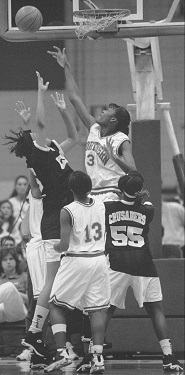
Tawana Towers: 1994 Class A Girls Basketball Final at Kellogg Arena, Battle Creek – Flint Northern, coached by Leteia Hughley and led by 6-4 freshman Tawana McDonald, defeated 1993 runner-up Detroit Martin Luther King, 46-32, for the Class A championship. McDonald batted down an MHSAA-record 10 shots, pulled down 13 rebounds and added five points and seven assists in a stellar performance.
Never Quit: 2008 Division 2 Football Semifinal, Spartan Stadium, East Lansing – Unbeaten, No. 1-ranked and heavily favored Muskegon trailed Davison by 22 late in the third quarter and 16 with less than five minutes to play. In perhaps the greatest comeback in playoff history, Muskegon recovered two onside kicks and scored 19 points in the final 4:31 to escape with a 38-35 victory and its third trip in five years to an MHSAA Final.
MHSAA Legends: 1998-2008 – For 10 years, the MHSAA showcased great teams from the past with their Legends of the Game series. From a historian’s perspective it was a chance to meet and learn more about folks I had often known only from the pages of microfilm. It was quite the treat to see years fall away as coaches, team managers and players reunited, in many cases for the first time after decades apart.
The MHSAA Record Books: Online, 1994 – One of my first efforts as state historian was to expand the record books beyond their primary focus on football, basketball, track & field and swimming & diving. With the arrival of the internet, an enhanced version of the record books was brought online. Coaches and fans were quick to respond with letters and e-mails, happily listing entries that had been “missed.” Soon, five category headings in a sport grew to 20, then to 50 and beyond.
Kids: 2004 Football Finals, Pontiac Silverdome – (OK, this is No. 11 ... consider it an extra point). For the first time, my sons joined me for my annual excursion to Metro Detroit for a Thanksgiving Day football weekend. They got to see the Silverdome before the move of the MHSAA Football Finals to beautiful Ford Field. Future Big Reds, they also got to see their future alma mater win another title.
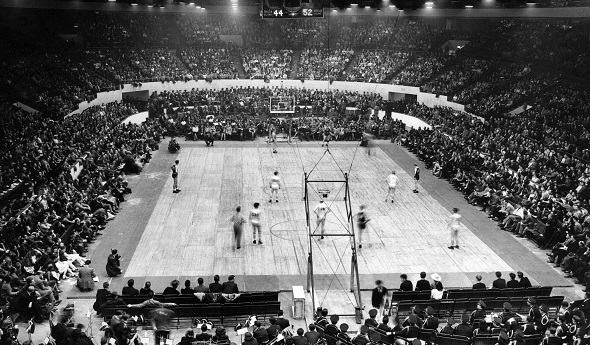
PHOTOS: (Top) An MHSAA boys basketball tournament game is played at Olympia Stadium in Detroit. (Middle) Flint Northern's Tawana McDonald blocks a shot during the 1994 Class A Final.
Retired NHL-er Back on Ice to Answer Call - By Making Them
By
Rob Kaminski
MHSAA benchmarks editor
March 16, 2023
The most accomplished skater on the ice during Friday’s triple-overtime MHSAA Division 1 Semifinal hockey thriller between Hartland and Brighton was not wearing the school colors of either team.
In front of a packed house at Plymouth’s USA Hockey Arena, referee Bryan Smolinski was in stripes, just like the rest of his officiating crew.
In his former life, he pulled on plenty of sweaters before lacing up the skates. That happens when one logs more than 1,000 games, tallies nearly 300 goals (274) and close to 400 assists (377) with eight teams spanning a 15-year playing career in the National Hockey League.
So, how did the 52-year-old former star player find himself on the ice last weekend as one of the referees for the pinnacle weekend of this high school season? Good question, even for the man known as “Smoke” during his playing days.
“I was working in youth development programs a few years back and reached out to some Michigan guys I had connections with about other ways to help the game,” Smolinski said. “I called Kevin May just to chat and asked, ‘Hey, how’s your reffing going?’ He said, ‘You know, we’re down a little bit,’ then said, ‘Why don’t you do it?’ I said, ‘Not a chance,’” Smolinski laughed.
Never Say Never
May persisted, imploring his friend to skate with him during a Fall league at Cranbrook in Bloomfield Hills. After eight weeks, once a week, Smolinski had a revelation.
“I’m like, ‘I’m kind of diggin’ this,’” Smolinski said “So, I did all the testing, and the educational part of it, and I really enjoyed it. I got with Danny (DiCristofaro) and his group, and he put me in as much as he could, and I really started to get my feet wet.”
 DiCristofaro is the assigner and referee-in-chief for the MHSAA’s Northeast Hockey Referees Association, and he has seen Smolinski’s growth first-hand.
“Obviously he’s got great instincts and a feel for the game, along with a wealth of experience, all of which has allowed him to climb the ladder quickly,” said DiCristofaro. “It’s been a joy to watch his growth as an official.”
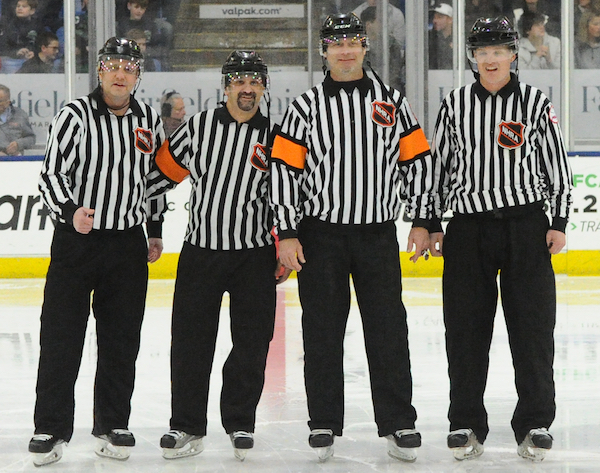
Fast forward to last Friday, and there were Smolinski and May sharing duties as referees during the MHSAA Semifinal with linesmen Michael Andrews and Thomas Robbins.
In between, there has been a learning curve that still continues, but the jump to officiating was not quite as daunting as his introduction to the NHL.
“I was scared to death. My first game was against Mario Lemieux. I’m in the old Boston Garden and now I’m playing against these guys and it’s their job, and they’re out there trying to make a living,” Smolinski recalled.
The emotions were not running nearly as frenzied for his first game as an MHSAA official, obviously, yet respect came in a different form.
“I couldn’t pick the puck up, I was breathing heavily; it was Kevin and me doing a two-man game in Brighton,” Smolinski recalled. “There were a few high-end kids playing, and I’m thinking, ‘I’m dying here.’ You know, there’s no training for that first time.”
What that experience did, however, was revitalize Smolinski in a new way. His playing career is well documented, not only in the NHL, but around Michigan. He enjoyed an honor-laden career at Michigan State University from 1989-93 before joining the Boston Bruins (who had drafted him three years earlier) at the end of the ’93 NHL campaign. Even after his final season, with Montreal in 2007-08, he stayed in the game via men’s leagues, or coaching his son, Max.
Smolinski and his wife, Julie, have three daughters: Ashtyn (22), Jojo (16) and Rylen (12), along with Max, whom dad coached for seven years including during a national championship run with a Little Caesars U15 team in 2019. Max, 19, is now playing collegiately at Rensselaer Polytechnic Institute.
So, for Smolinski, officiating offers a new chapter.
“Reffing brought back ... I wouldn’t say love of the game, because that’s always been there; it’s a different side of enjoying the game now. I have no horse in the race, my son’s off to college, my daughters are doing their thing; I wanted to find something new in the game,” Smolinski said. “I’ve coached, and I don’t want to do that. I found this, and I’ve stuck with it.”
Old College Ties
One of the great benefits of athletics at any level are the friendships made. For two kids who met in their first years on the MSU campus and forged a bond that lasts to this day, it’s amazing how their careers reached the pinnacle and have now come full circle.
Wes McCauley, an MSU teammate, is one of Smolinski’s best friends. After numerous years in the minor leagues, McCauley, like his friend, made it to the NHL. But McCauley made it as an official, working his first NHL game in 2003, when Smolinski was nearing the end of his playing career.
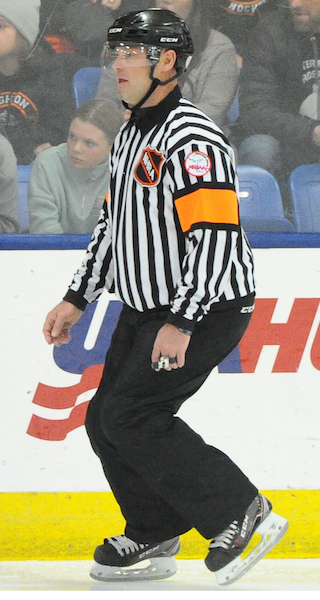 Their games lined up on just a few occasions in the NHL, and the two lobbied hard to have McCauley work Smolinski’s 1,000th career game in his final season with the Canadiens in 2007-08. The request, sadly, was denied by the league.
On the rare occasions when the friends did share the same ice, less than a handful by Smolinski’s count, it was McCauley who was forced to rebuff any attempts at fraternization. It’s just part of an official’s edict.
“For both of us, it was amazing; it was just great,” Smolinski said. “I’d say, ‘Hey man what’s up?’ and he says, ‘Can’t talk.’ I’m like, ‘What do you mean, we talk all the time.’ Again, he’s like, ‘Can’t talk, get away from me.’ You know, it was just business.”
McCauley then reached the 1,000-game plateau himself in 2018 and is still going strong as a regular selection for playoff duties with nine Stanley Cup Finals assignments, including last year.
So, it should have been natural for Smolinski to go to his old friend immediately for officiating pointers once he joined the ranks, right? Well, maybe not immediately.
“I talk to Wes all the time, but I actually hid it from him right out of the gate because I didn’t want to take his razzing. Eventually it got out, and he was loving it. He started sending me whistles and visors and pants,” Smolinski said, grinning. “And none of it fit, you know, because I’m older and fatter, and he’s so damn skinny. So, I still had to go out and get all new gear.”
Both Sides Now
Having been to the top of his profession, now moving to the other side of that same mountain that his friend McCauley scaled, the respect has grown for those blowing the whistle.
“The preparation for officiating is much more mental,” Smolinski said. “Way more rules oriented. You’re always trying to get away with things that you can as a player; now you have to police that.”
Smolinski has a distinct advantage.
“I know everything they’re trying to do because I’ve done it. I know where you’re going with the puck, I know what kind of breakout you’re trying to do,” Smolinski said. “I have all the instincts, now I just try to stay out of the way and not ruin their game. The most fun is watching the game develop and the ups and downs. For me to be out there and enjoy it with them, that’s the fun part.”
 Those who have played hockey at any level have a built-in advantage should they consider the officiating avocation: the ability to skate. Unlike officiating in any other sport, skating is a prerequisite. This makes the pool limited, and almost solely composed of former players. Smolinski offers this advice.
“I prefer sticking with high school because I think there’s more decorum, more administrative structure. Kids are playing for their schools, there’s loyalty there,” said Smolinski. “And there is more accountability. People need report to athletic directors and supervisors. Other levels can be more loosely governed, or a bit more maverick in nature. Moms and dads get involved more, coaches maybe know a little less,” said Smolinski.
He has, in fact, worked a handful of non-school games, and there’s a stark difference.
“I wanted to see what was going on, and I see it first-hand,” Smolinski said. “There are some crazy people and parents out there, and these guys are getting absolutely tortured. I’ve been tortured. There has to be a level of respect for what officials do. I think schools can rein that in a little more. All the guys I’ve met give up a lot of time and work hard because they love to do it and love the game.”
All sports need an assist from school administration and from those who once played the games to keep the officials recruitment moving in the right direction. People like Smolinski can help.
“He clearly doesn’t need to do this, and that’s what makes it so fantastic,” DiCristofaro said. “We need more people who have played – at any level – to do what he’s done and stay in the game as officials.”
Smolinski continues to promote the game in other ways as well. Currently, he is involved in the NHL’s Learn To Play initiative, which aims to inspire youth and welcome more families into the hockey community.
“We work hand-in-hand with the NHL Players Association for player development and industry growth,” Smolinski said. “Ages 5 to 9 are introduced to hockey, get head-to-toe gear and instruction, and meet some former players.”
The idea is to have fun first, which can translate into years and maybe even a lifetime in the sport. It’s a lifetime that has given Smolinski so much and continues to do so as he watches it unfold for others from his new vantage point.
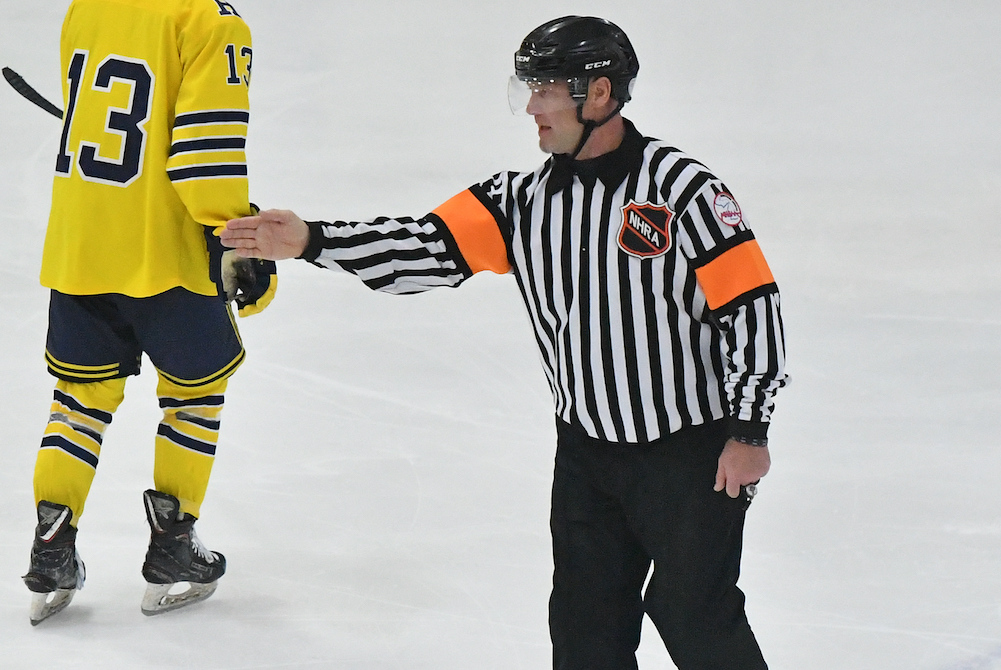
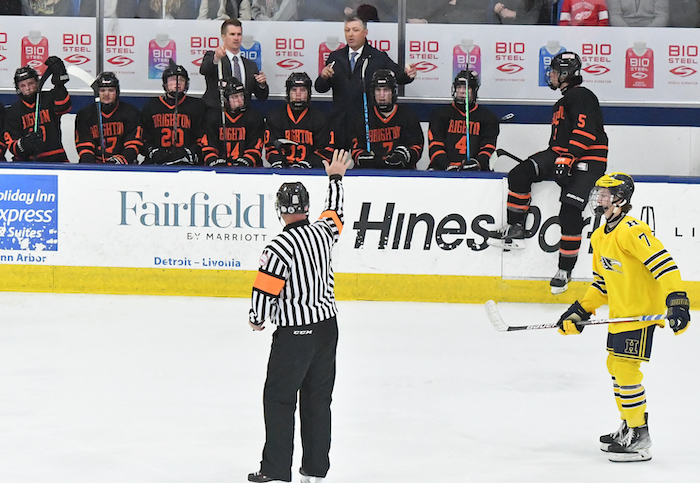
PHOTOS (Top) MHSAA official Bryan Smolinski signals during Friday's Division 1 Semifinal between Brighton and Hartland. (2) Smolinski, a retired NHL standout, communicates with the Bulldogs' bench. (3) Smolinski keeps watch during game play. (4) Smolinski, third from left, with his crew: Michael Andrews, Kevin May and Thomas Robbins.