

MHSAA Historian Picks 10 to Remember
August 9, 2016
By Rob Kaminski
MHSAA benchmarks editor
It sounded simple and fun, the theme for the MHSAA's spring issue of benchmarks: a history of MHSAA tournaments.
It certainly was the latter, but simple? Not so much.
There’s no way to do justice to nearly a century’s worth of history in some sports. Complicating matters was the abundance of information and photographs for some, and the scant amount of detailed data and images for others.
MHSAA historian Ron Pesch was given an equally challenging task: recount a “Top 10” list from his days covering various MHSAA Finals. He shares them here and, he adds, they are in no order of favorites.
The Shot: 1986 Class B Boys Basketball Final at Crisler Arena – Saginaw Buena Vista’s Chris Coles’ desperation shot, launched at the buzzer from well beyond half court, dropped through the hoop to give the Knights a 33-32 win over defending champion Flint Beecher in a rematch of the 1985 Class B title game. The shot was Coles’ first of the second half and his only points in the contest.
The Smurfs: 1986 Class A Football Final at the Pontiac Silverdome – The "Smurfs" – Muskegon Coach Dave Taylor's nickname for his small, quick swarming defensive linemen – limited heavily favored Sterling Heights Stevenson to four yards rushing and 73 yards of total offense in a 10-0 win. As a 1979 graduate of Muskegon High School, I was elated.
The Drive: 1989 Class B Football Final at the Pontiac Silverdome – I slid down from the press box into the stands at the Silverdome for the end of this one. With 2:20 remaining, the atmosphere was simply electric, as Farmington Hills Harrison’s lauded quarterback Mill Coleman took the reins with his team down 27-21 to DeWitt. The senior executed a flawless two-minute drill, guiding his team to the DeWitt 9 before scampering into the end zone for the tying points. Steve Hill added his fourth PAT for the lead, then secured the victory with an interception on the next series.
King Kool: 2005 Class B Boys Basketball Final, Breslin Center, East Lansing – David Kool was a flawless 20 for 20 from the free-throw line and scored 43 points as Grand Rapids South Christian downed Muskegon Heights 67-60.
The Parade: 2004 Individual Wrestling Finals, The Palace of Auburn Hills – In 2004, I traveled to Auburn Hills to watch the MHSAA Individual Wrestling Finals for the first time. The pageantry of the Grand March, the skills on display, the roar of the massive crowd, and the ensuing beauty and chaos of a wrestling extravaganza of this scale is truly a sight to see.
 A Marathon: 2007 Division 3 Football Final, Ford Field, Detroit – East Grand Rapids and Orchard Lake St. Mary’s ended regulation tied 14-14, and this would turn into a five overtime battle that required an extra hour of play. No previous football playoff game, from Districts up, had ever gone beyond four overtimes. After exchanging field goals, touchdowns, extra points and two-point conversions, East Grand Rapids emerged with a 46-39 victory.
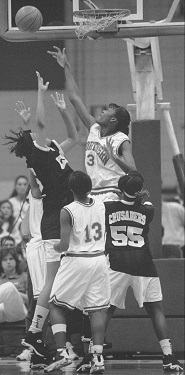
Tawana Towers: 1994 Class A Girls Basketball Final at Kellogg Arena, Battle Creek – Flint Northern, coached by Leteia Hughley and led by 6-4 freshman Tawana McDonald, defeated 1993 runner-up Detroit Martin Luther King, 46-32, for the Class A championship. McDonald batted down an MHSAA-record 10 shots, pulled down 13 rebounds and added five points and seven assists in a stellar performance.
Never Quit: 2008 Division 2 Football Semifinal, Spartan Stadium, East Lansing – Unbeaten, No. 1-ranked and heavily favored Muskegon trailed Davison by 22 late in the third quarter and 16 with less than five minutes to play. In perhaps the greatest comeback in playoff history, Muskegon recovered two onside kicks and scored 19 points in the final 4:31 to escape with a 38-35 victory and its third trip in five years to an MHSAA Final.
MHSAA Legends: 1998-2008 – For 10 years, the MHSAA showcased great teams from the past with their Legends of the Game series. From a historian’s perspective it was a chance to meet and learn more about folks I had often known only from the pages of microfilm. It was quite the treat to see years fall away as coaches, team managers and players reunited, in many cases for the first time after decades apart.
The MHSAA Record Books: Online, 1994 – One of my first efforts as state historian was to expand the record books beyond their primary focus on football, basketball, track & field and swimming & diving. With the arrival of the internet, an enhanced version of the record books was brought online. Coaches and fans were quick to respond with letters and e-mails, happily listing entries that had been “missed.” Soon, five category headings in a sport grew to 20, then to 50 and beyond.
Kids: 2004 Football Finals, Pontiac Silverdome – (OK, this is No. 11 ... consider it an extra point). For the first time, my sons joined me for my annual excursion to Metro Detroit for a Thanksgiving Day football weekend. They got to see the Silverdome before the move of the MHSAA Football Finals to beautiful Ford Field. Future Big Reds, they also got to see their future alma mater win another title.
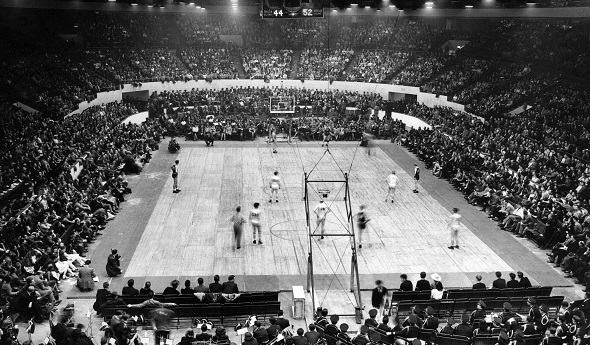
PHOTOS: (Top) An MHSAA boys basketball tournament game is played at Olympia Stadium in Detroit. (Middle) Flint Northern's Tawana McDonald blocks a shot during the 1994 Class A Final.
Bloomingdale Trainer Performing Invaluable Role in Keeping Athletes Playing
By
Pam Shebest
Special for MHSAA.com
November 22, 2022
BLOOMINGDALE — If Scott Allison looks bored during one of Bloomingdale’s sporting events, that is a good thing.
 “Trainers like to be behind the scenes and in the shadows,” the certified athletic trainer said. “We’re only needed in emergencies.
“It’s one of those jobs that if we’re sitting around looking bored, then things are going well.”
But if an athlete goes down with an injury, Allison is quick to run onto the court or field.
In his first year at Bloomingdale, he has found that working with middle and high school students is a lot different than his previous work with the minor-league hockey Kalamazoo Wings.
Treating the hockey team, with whom he spent much of his 22 years, “There was a lot of traumatic stuff like lacerations or deep contusions, overuse injuries like hip flexors or core injuries or broken bones.
“Everything’s acute and fast. It’s a different animal. In hockey, they’re all pro athletes so they know their bodies really well.”
However, high school and middle school athletes are still in a growing phase.
“These kids don’t really know what’s going on a lot of times, so it’s a lot more education on what’s happening,” Allison said.
“Is it an injury, or is it just soreness? You get a lot of kids that don’t understand the difference between aches and pains or an injury. We see a lot of ankle sprains or shin splints because they’re just developing. They’re in that awkward range where their bodies try to grow too fast.”
 Allison is the Cardinals’ first certified athletic trainer, a new position for which athletic director Jason Hayes campaigned.
“What we notice is that if a kid’s injured, they’re out a lot less if you have a trainer because it speeds up recovery time,” said Hayes, who also coaches varsity football and is an assistant wrestling coach. “It’s like having a built-in physical therapist on your staff, too.”
Studies support Hayes’ statements.
According to information from The Sports Institute at University of Washington, “‘The athletic trainers know the athletes,” says Stan Herring, M.D., cofounder of The Sports Institute at (University of Washington) Medicine and a team physician for the Seattle Seahawks and Seattle Mariners. “They see the athletes frequently, if not every day. They know when something is wrong. They are medical professionals who evaluate, treat and rehabilitate athletes.’”
The article continued: “Three recent studies suggest that athletic trainers are linked to significant improvements in the diagnosis of concussion in young athletes and significant reductions in ‘time-loss’ injuries that require athletes to take time away from sports.”
Allison sees himself as a teacher as well as a trainer.
“We see a lot more strains or growth issues,” he said. “A lot of it is maintenance and teaching kids what’s going on with their bodies or what they need to do to change things.”
He also meets with parents and coaches to talk about the best way to prevent injuries.
Allison’s day begins about 1:30 or 2 p.m., giving athletes a chance to talk with him before practices or games.
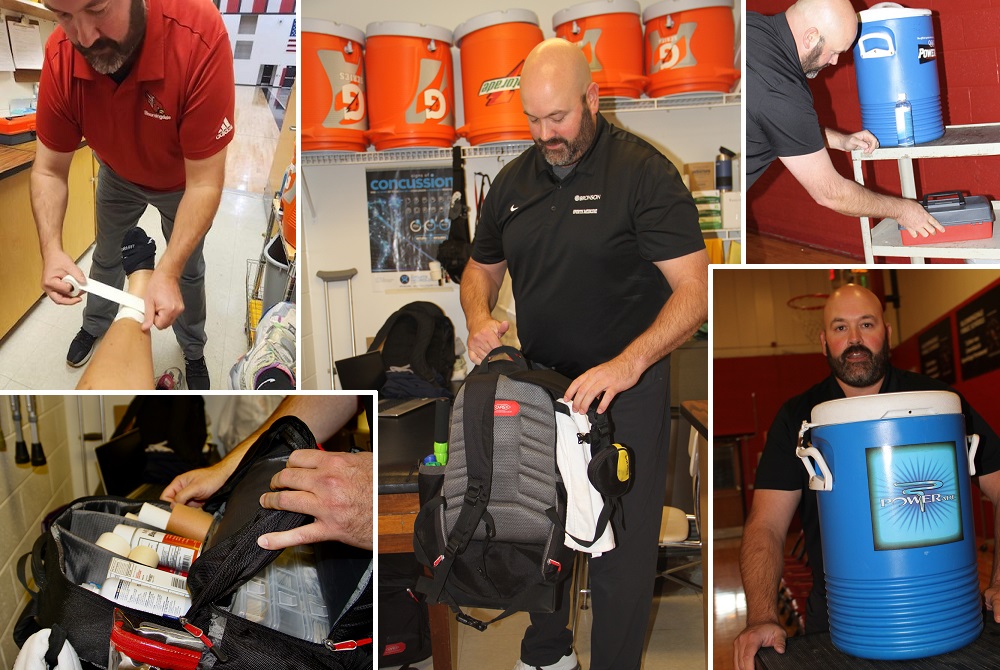
During the action, he always has his first aid backpack filled with the basics: air splints for fractures or dislocations, AED, EpiPens, and bench kits (with taping and bandaging supplies, splints, gauze, ACE wraps, ice bags, latex gloves and other basic first aid supplies.)
He travels with the teams when they are involved in high-impact sports, such as football, and many times he is also called to treat an opposing player if that team has no trainer.
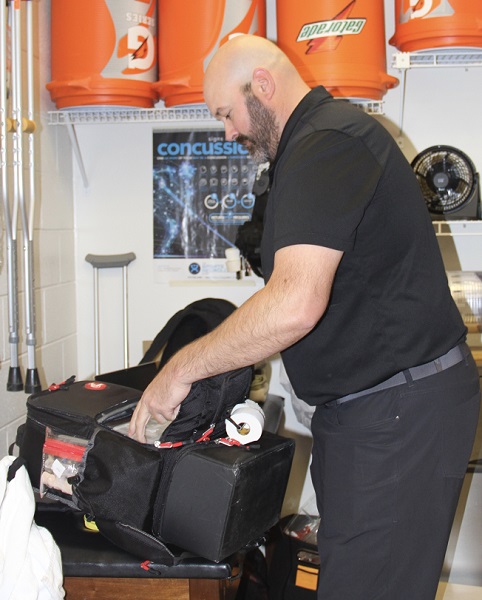 Allison is a perfect fit with Bloomingdale, Hayes said.
His wife, Kirsten, coached the Cardinals girls basketball team for seven years. His daughter Emma, now at Glen Oaks Community College, graduated from there, and his daughter Bailey is an eighth grader.
“We are a very lucky town,” Hayes said. “We had Doc (Robert) Stevens, who had been volunteering as our athletic trainer for 15 years. He’s just aging out.
“About a year ago, he came to me and said that it was his last year. Scott has 22 years experience, and he has relationships here. To me, it was a no-brainer.”
Assistant varsity football coach Lance Flynn, who also coaches the middle school football team, saw Allison in action during competition in the fall.
“First quarter in a middle school football game, a kid broke his arm,” Flynn said. “My own son, Ryder, was on the varsity team and he sprained his AC socket and Scott took care of him.
“If something happens during a game, they can go see him and I don’t have to worry much because I know they’re in good hands.”
Allison’s affiliation with Bronson Sports Medicine is also a plus, the trainer said.
“With Bronson, we can offer a lot more and expedite getting in to see doctors or specialists if we need to,” he said. “We’re on the same system as the doctors, so we can diagnose and send notes to the doctors and they can send notes back to us.
“If there’s anybody we need to keep track of with the doctors, I can talk with the doctors and figure out how that’s going. If anybody needs to see me, they know I’m here early if they just want to come down to talk.”
Bronson also provides certified athletic trainers at 21 other southwest Michigan high schools: Brooke Vandepolder (Battle Creek Central), Lindsay Aarseth-Lindhorst (Climax-Scotts), Amanda Monsivaes (Comstock), Makenzie Hodgson (Delton Kellogg), Salvador Robles-Soriano (Gobles), Holly Ives (Richland Gull Lake), Katelyn Baker-Contreras (Kalamazoo Hackett Catholic Prep), Lizzy Smith (Kalamazoo Central), Emma Beener (Kalamazoo Christian), Holly Sisson (Kalamazoo Loy Norrix), Nico Talentino (Mattawan), Aaron Eickhoff (Otsego), Quincey Powell (Parchment), Malorie Most (Paw Paw), Jessica Bakhuyzen (Plainwell), Lance LeTourneau (Portage Central), Janelle Currie (Portage Northern), Carrie Calhoun (Schoolcraft), Chelsea Harrison (South Haven), Alexis Walters (Three Rivers) and Natalie McClish (Vicksburg).
 Pam Shebest served as a sportswriter at the Kalamazoo Gazette from 1985-2009 after 11 years part-time with the Gazette while teaching French and English at White Pigeon High School. She can be reached at [email protected] with story ideas for Calhoun, Kalamazoo and Van Buren counties.
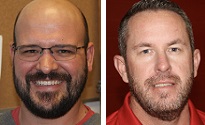
PHOTOS (Top) Bloomingdale trainer Scott Allison has several tasks as he works to keep the school’s student-athletes healthy and pain-free. (Middle) Bloomingdale athletic director Jason Hayes, left, and assistant varsity football coach Lance Flynn. (Below) Allison packs his bag for another full afternoon. (Ankle-taping photo by Andreya Robinson; all other photos by Pam Shebest.)