

MHSAA Historian Picks 10 to Remember
August 9, 2016
By Rob Kaminski
MHSAA benchmarks editor
It sounded simple and fun, the theme for the MHSAA's spring issue of benchmarks: a history of MHSAA tournaments.
It certainly was the latter, but simple? Not so much.
There’s no way to do justice to nearly a century’s worth of history in some sports. Complicating matters was the abundance of information and photographs for some, and the scant amount of detailed data and images for others.
MHSAA historian Ron Pesch was given an equally challenging task: recount a “Top 10” list from his days covering various MHSAA Finals. He shares them here and, he adds, they are in no order of favorites.
The Shot: 1986 Class B Boys Basketball Final at Crisler Arena – Saginaw Buena Vista’s Chris Coles’ desperation shot, launched at the buzzer from well beyond half court, dropped through the hoop to give the Knights a 33-32 win over defending champion Flint Beecher in a rematch of the 1985 Class B title game. The shot was Coles’ first of the second half and his only points in the contest.
The Smurfs: 1986 Class A Football Final at the Pontiac Silverdome – The "Smurfs" – Muskegon Coach Dave Taylor's nickname for his small, quick swarming defensive linemen – limited heavily favored Sterling Heights Stevenson to four yards rushing and 73 yards of total offense in a 10-0 win. As a 1979 graduate of Muskegon High School, I was elated.
The Drive: 1989 Class B Football Final at the Pontiac Silverdome – I slid down from the press box into the stands at the Silverdome for the end of this one. With 2:20 remaining, the atmosphere was simply electric, as Farmington Hills Harrison’s lauded quarterback Mill Coleman took the reins with his team down 27-21 to DeWitt. The senior executed a flawless two-minute drill, guiding his team to the DeWitt 9 before scampering into the end zone for the tying points. Steve Hill added his fourth PAT for the lead, then secured the victory with an interception on the next series.
King Kool: 2005 Class B Boys Basketball Final, Breslin Center, East Lansing – David Kool was a flawless 20 for 20 from the free-throw line and scored 43 points as Grand Rapids South Christian downed Muskegon Heights 67-60.
The Parade: 2004 Individual Wrestling Finals, The Palace of Auburn Hills – In 2004, I traveled to Auburn Hills to watch the MHSAA Individual Wrestling Finals for the first time. The pageantry of the Grand March, the skills on display, the roar of the massive crowd, and the ensuing beauty and chaos of a wrestling extravaganza of this scale is truly a sight to see.
 A Marathon: 2007 Division 3 Football Final, Ford Field, Detroit – East Grand Rapids and Orchard Lake St. Mary’s ended regulation tied 14-14, and this would turn into a five overtime battle that required an extra hour of play. No previous football playoff game, from Districts up, had ever gone beyond four overtimes. After exchanging field goals, touchdowns, extra points and two-point conversions, East Grand Rapids emerged with a 46-39 victory.
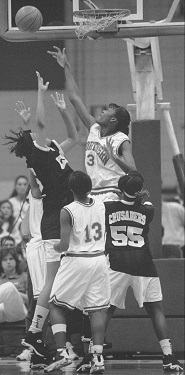
Tawana Towers: 1994 Class A Girls Basketball Final at Kellogg Arena, Battle Creek – Flint Northern, coached by Leteia Hughley and led by 6-4 freshman Tawana McDonald, defeated 1993 runner-up Detroit Martin Luther King, 46-32, for the Class A championship. McDonald batted down an MHSAA-record 10 shots, pulled down 13 rebounds and added five points and seven assists in a stellar performance.
Never Quit: 2008 Division 2 Football Semifinal, Spartan Stadium, East Lansing – Unbeaten, No. 1-ranked and heavily favored Muskegon trailed Davison by 22 late in the third quarter and 16 with less than five minutes to play. In perhaps the greatest comeback in playoff history, Muskegon recovered two onside kicks and scored 19 points in the final 4:31 to escape with a 38-35 victory and its third trip in five years to an MHSAA Final.
MHSAA Legends: 1998-2008 – For 10 years, the MHSAA showcased great teams from the past with their Legends of the Game series. From a historian’s perspective it was a chance to meet and learn more about folks I had often known only from the pages of microfilm. It was quite the treat to see years fall away as coaches, team managers and players reunited, in many cases for the first time after decades apart.
The MHSAA Record Books: Online, 1994 – One of my first efforts as state historian was to expand the record books beyond their primary focus on football, basketball, track & field and swimming & diving. With the arrival of the internet, an enhanced version of the record books was brought online. Coaches and fans were quick to respond with letters and e-mails, happily listing entries that had been “missed.” Soon, five category headings in a sport grew to 20, then to 50 and beyond.
Kids: 2004 Football Finals, Pontiac Silverdome – (OK, this is No. 11 ... consider it an extra point). For the first time, my sons joined me for my annual excursion to Metro Detroit for a Thanksgiving Day football weekend. They got to see the Silverdome before the move of the MHSAA Football Finals to beautiful Ford Field. Future Big Reds, they also got to see their future alma mater win another title.
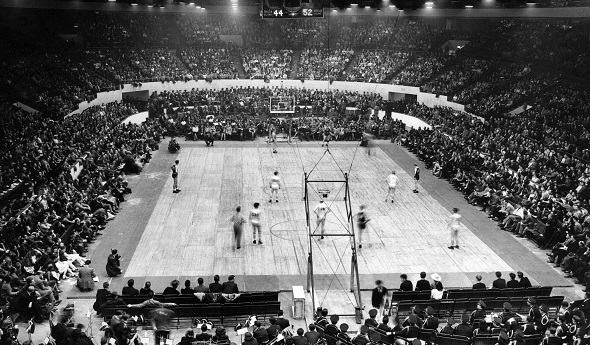
PHOTOS: (Top) An MHSAA boys basketball tournament game is played at Olympia Stadium in Detroit. (Middle) Flint Northern's Tawana McDonald blocks a shot during the 1994 Class A Final.
Rep Council Approves Expanded Basketball Schedules, Classification Changes at Winter Meeting
By
Geoff Kimmerly
MHSAA.com senior editor
March 29, 2022
An increase in the number of regular-season games high school basketball teams are allowed to play may be the most visible action taken by the Representative Council of the Michigan High School Athletic Association during its annual Winter Meeting on March 25 in East Lansing. However, a change in classification procedure expected to bring more equity to tournament groupings should have the most far-reaching effects across all sports.
The Winter Meeting frequently serves as an opportunity for the Council to discuss items expected to come up for action at its final meeting of the school year, scheduled for May 1-2. However, the Council took a number of actions at this meeting as they relate to scheduling currently underway for the 2022-23 school year, or Spring tournaments this May.
The Council approved a Basketball Committee proposal that will allow, beginning with the 2022-23 season, high school basketball teams to play up to 22 regular-season games at every level (varsity, junior varsity and freshman). Teams previously played a maximum of 20 games during the regular season; this adjustment brings MHSAA school schedules in line with what is allowed in most other Midwest states. Additionally as part of that proposal, mandatory preseason practice was reduced by one week, allowing teams to begin playing games after 14 days instead of 21.
The Council also approved a proposal by the Classification Committee that will result in postseason divisions more reflective of the number of schools actively sponsoring teams for that season. Divisions are assigned by taking the number of teams playing a sport and dividing equally by the number of team championships awarded in that sport (for example, four in baseball and softball). Previously, by the time seasons started the smallest-school divisions in many sports ended up with fewer teams than larger-school divisions because several small schools would declare they would be sponsoring a team during the classification process in March but then be unable to do so because of lack of participation or other reasons.
With this change, schools that have indicated they will sponsor a sport but haven’t participated in that sport as a team or with individual qualifiers over the previous two years will be removed from the classification process before divisions are determined. Those schools that have been removed must then notify the MHSAA they have an active team before being added back into the tournament.
A number of other actions will affect competition as quickly as this spring’s MHSAA Tournaments, and into the 2022-23 school year.
The Council approved a Cross Country/Track & Field proposal to allow for more MHSAA Tournament opportunities for wheelchair athletes. Starting with this Spring 2022 season, Regional and Final meets will include four events for wheelchair participants – 100, 200 and 400-meter races and shot put. These events will be open to wheelchair track & field athletes at MHSAA member schools. Additionally, the Council approved the expansion of postseason Paralympic opportunities in swimming, adding a 100-yard freestyle heat to the 50-yard freestyle heat that has been offered at Finals since 2020.
In baseball and softball, the Council approved committee proposals in those sports to allow District first-round games to be played during the week before Memorial Day. Baseball may play first-round games that previous Thursday, Friday or Saturday, and softball may play that previous Thursday and Friday, beginning this upcoming season. Previously, all first-round games were played the Tuesday after Memorial Day. This change is expected to alleviate pitch count concerns in baseball and provide scheduling flexibility for later District rounds that could allow athletes – especially at small schools where baseball and softball players frequently participate in track & field – opportunities to compete in both sports during the week following Memorial Day.
Another change proposed by the Classification Committee and approved by the Council will raise the enrollment cap for cooperative hockey programs, potentially allowing for more opportunities for schools to contribute athletes who wish to play the sport. Nearly 50 percent of hockey teams playing in the MHSAA Tournament are cooperatives made up of students from multiple schools, and for hockey those schools’ enrollments now may total up to 5,500 students, an increase of 2,000 students for hockey only. Schools participating in a cooperative hockey program must continue to receive Executive Committee approval and show a demonstrated lack of participation in hockey.
The Council also approved a Classification Committee proposal that will allow football teams to opt up in division after the annual release of classifications for the upcoming season in late March/early April. Football teams may opt up one division, with Executive Committee approval, and must show reason and rationale for their request. All football opt ups will be for a minimum of two years, and the Executive Committee will consider those opt-up requests at only its April and May meetings each year.
The Council approved a number of increased benefits for MHSAA-registered game officials, including raises in postseason game fees paid to officials across all sports. Also moving forward, MHSAA officials will be provided membership in the National Association of Sports Officials (NASO), which will provide expanded liability insurance plus additional resources and professional services for all MHSAA registered officials. The Council also approved a change to the registration process and fees that will automatically provide each official registration in two sports. All three changes were proposed by the Audit & Finance Committee.
The Council also approved a rule change allowing the use of school transportation during summer, but it must be funded from school-approved activities of booster clubs, school teams, student groups and community, civic or service groups. This includes the use of busses, vans and other vehicles owned or leased by the school district or operated by any entity with which the district contracts to provide transportation services.
The Representative Council is the legislative body of the MHSAA. All but five members are elected by member schools. Four members are appointed by the Council to facilitate representation of females and minorities, and the 19th position is occupied by the Superintendent of Public Instruction or designee.
The MHSAA is a private, not-for-profit corporation of voluntary membership by more than 1,500 public and private senior high schools and junior high/middle schools which exists to develop common rules for athletic eligibility and competition. No government funds or tax dollars support the MHSAA, which was the first such association nationally to not accept membership dues or tournament entry fees from schools. Member schools which enforce these rules are permitted to participate in MHSAA tournaments, which attract more than 1.4 million spectators each year.