

MHSAA Historian Picks 10 to Remember
August 9, 2016
By Rob Kaminski
MHSAA benchmarks editor
It sounded simple and fun, the theme for the MHSAA's spring issue of benchmarks: a history of MHSAA tournaments.
It certainly was the latter, but simple? Not so much.
There’s no way to do justice to nearly a century’s worth of history in some sports. Complicating matters was the abundance of information and photographs for some, and the scant amount of detailed data and images for others.
MHSAA historian Ron Pesch was given an equally challenging task: recount a “Top 10” list from his days covering various MHSAA Finals. He shares them here and, he adds, they are in no order of favorites.
The Shot: 1986 Class B Boys Basketball Final at Crisler Arena – Saginaw Buena Vista’s Chris Coles’ desperation shot, launched at the buzzer from well beyond half court, dropped through the hoop to give the Knights a 33-32 win over defending champion Flint Beecher in a rematch of the 1985 Class B title game. The shot was Coles’ first of the second half and his only points in the contest.
The Smurfs: 1986 Class A Football Final at the Pontiac Silverdome – The "Smurfs" – Muskegon Coach Dave Taylor's nickname for his small, quick swarming defensive linemen – limited heavily favored Sterling Heights Stevenson to four yards rushing and 73 yards of total offense in a 10-0 win. As a 1979 graduate of Muskegon High School, I was elated.
The Drive: 1989 Class B Football Final at the Pontiac Silverdome – I slid down from the press box into the stands at the Silverdome for the end of this one. With 2:20 remaining, the atmosphere was simply electric, as Farmington Hills Harrison’s lauded quarterback Mill Coleman took the reins with his team down 27-21 to DeWitt. The senior executed a flawless two-minute drill, guiding his team to the DeWitt 9 before scampering into the end zone for the tying points. Steve Hill added his fourth PAT for the lead, then secured the victory with an interception on the next series.
King Kool: 2005 Class B Boys Basketball Final, Breslin Center, East Lansing – David Kool was a flawless 20 for 20 from the free-throw line and scored 43 points as Grand Rapids South Christian downed Muskegon Heights 67-60.
The Parade: 2004 Individual Wrestling Finals, The Palace of Auburn Hills – In 2004, I traveled to Auburn Hills to watch the MHSAA Individual Wrestling Finals for the first time. The pageantry of the Grand March, the skills on display, the roar of the massive crowd, and the ensuing beauty and chaos of a wrestling extravaganza of this scale is truly a sight to see.
 A Marathon: 2007 Division 3 Football Final, Ford Field, Detroit – East Grand Rapids and Orchard Lake St. Mary’s ended regulation tied 14-14, and this would turn into a five overtime battle that required an extra hour of play. No previous football playoff game, from Districts up, had ever gone beyond four overtimes. After exchanging field goals, touchdowns, extra points and two-point conversions, East Grand Rapids emerged with a 46-39 victory.
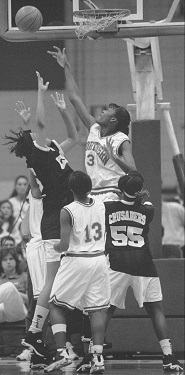
Tawana Towers: 1994 Class A Girls Basketball Final at Kellogg Arena, Battle Creek – Flint Northern, coached by Leteia Hughley and led by 6-4 freshman Tawana McDonald, defeated 1993 runner-up Detroit Martin Luther King, 46-32, for the Class A championship. McDonald batted down an MHSAA-record 10 shots, pulled down 13 rebounds and added five points and seven assists in a stellar performance.
Never Quit: 2008 Division 2 Football Semifinal, Spartan Stadium, East Lansing – Unbeaten, No. 1-ranked and heavily favored Muskegon trailed Davison by 22 late in the third quarter and 16 with less than five minutes to play. In perhaps the greatest comeback in playoff history, Muskegon recovered two onside kicks and scored 19 points in the final 4:31 to escape with a 38-35 victory and its third trip in five years to an MHSAA Final.
MHSAA Legends: 1998-2008 – For 10 years, the MHSAA showcased great teams from the past with their Legends of the Game series. From a historian’s perspective it was a chance to meet and learn more about folks I had often known only from the pages of microfilm. It was quite the treat to see years fall away as coaches, team managers and players reunited, in many cases for the first time after decades apart.
The MHSAA Record Books: Online, 1994 – One of my first efforts as state historian was to expand the record books beyond their primary focus on football, basketball, track & field and swimming & diving. With the arrival of the internet, an enhanced version of the record books was brought online. Coaches and fans were quick to respond with letters and e-mails, happily listing entries that had been “missed.” Soon, five category headings in a sport grew to 20, then to 50 and beyond.
Kids: 2004 Football Finals, Pontiac Silverdome – (OK, this is No. 11 ... consider it an extra point). For the first time, my sons joined me for my annual excursion to Metro Detroit for a Thanksgiving Day football weekend. They got to see the Silverdome before the move of the MHSAA Football Finals to beautiful Ford Field. Future Big Reds, they also got to see their future alma mater win another title.
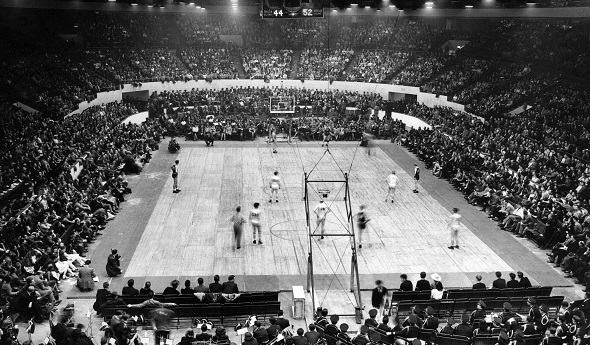
PHOTOS: (Top) An MHSAA boys basketball tournament game is played at Olympia Stadium in Detroit. (Middle) Flint Northern's Tawana McDonald blocks a shot during the 1994 Class A Final.

Retired MHSAA Executive Director Roberts Selected for NFHS Hall of Fame
By
Geoff Kimmerly
MHSAA.com senior editor
March 8, 2022
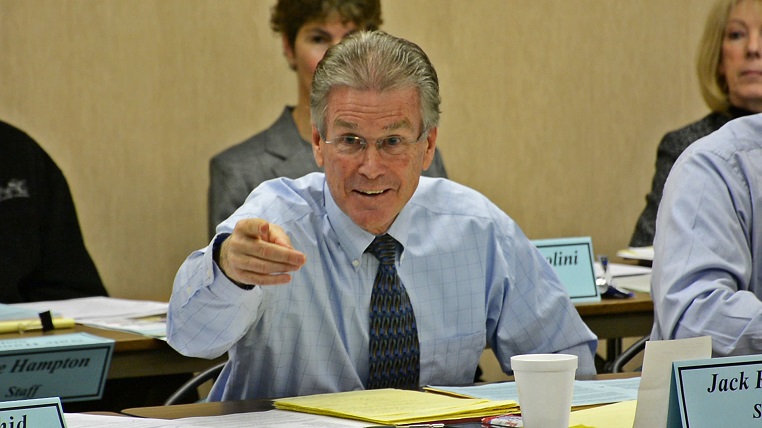
During an award introduction two years ago, MHSAA associate director Tom Rashid described his longtime close friend Jack Roberts as the leader who “took our darkest hours and problems and turned them into positives.”
The MHSAA has faced its share of challenging times, and those may have been among Roberts’ finest hours over 32 years as MHSAA executive director – and admittedly the times when his adrenaline flowed most. But there were many more good times and memorable advances for Michigan school sports under his leadership, and he will be recognized again this summer both for those and a lifetime of service to school sports in this state and across the nation.
John E. “Jack” Roberts was one of 12 honorees announced Tuesday as this year’s inductees into the National High School Sports Hall of Fame by the National Federation of State High School Associations (NFHS). He will be inducted as one of three former state association administrators selected for the 39th Hall of Fame class at a ceremony during the NFHS summer meeting July 1 in San Antonio, Texas.
He began his tenure as MHSAA executive director in 1986, and at the time of his retirement he was the nation’s longest-serving executive director of a state high school athletic association. He was the fourth person to serve the MHSAA in that leadership role full time, following Charles E. Forsythe (1931-42, 1945-68), Allen W. Bush (1968-78) and Vern L. Norris (1978-86).
Roberts will become the Hall of Fame’s ninth inductee from Michigan, joining Forsythe (inducted 1983), River Rouge boys basketball coach Lofton Greene (1986), Warren Regina athletic director, softball and basketball coach Diane Laffey (2000), Fennville basketball and baseball standout Richie Jordan (2001), Grosse Pointe Woods University Liggett boys and girls tennis coach Bob Wood (2005), Bloomfield Hills Cranbrook hockey standout Jim Johnson (2007), Owosso football, basketball and baseball all-stater Brad Van Pelt (2011); and Vermontville Maple Valley baseball national record holder Ken Beardslee (2016).
Roberts also follows in the footsteps of his late father, John Roberts, who served as executive director of the Wisconsin Interscholastic Athletic Association from 1957-85 and was inducted into the National High School Hall of Fame in 2000. They will be the first father-son team in the Hall of Fame.
Jack Roberts began his career serving as an assistant director for the National Federation from 1973-80. He was involved with the implementation of Title IX at the local and state levels and made immense contributions as the NFHS representative to the landmark Amateur Sports Act of 1978, and also played a significant role in the NFHS rules-writing process as the organization started writing and publishing rules for a number of new sports during the 1970s.
The MHSAA enjoyed continued growth under Roberts’ guidance, particularly in the number of Michigan students participating in athletics and in the number of MHSAA-sponsored tournament sports available to them. Several key rules changes came under Roberts’ watch and direction, and he made the MHSAA a national leader in health and safety efforts particularly in the areas of head injury care, heart safety initiatives and heat management strategies.
“I had a head start in this work. Growing up in the home of the executive director of the Wisconsin Interscholastic Athletic Association and then spending most of my 20s working for the National Federation office, and much of it with (longtime NFHS executive director) Cliff Fagan, was a jumpstart on this career,” Roberts said. “But I’m also satisfied at this point that, to paraphrase Hamilton in the musical ‘Hamilton,’ I didn’t give up on my shot. I was given a shot, I took it and I didn’t waste the chance.
“The job fit me, and I think I maxed the opportunity I had to serve educational athletics in this job, and that’s satisfying to think about at this time.”
 Under Roberts’ leadership, overall participation in high school athletics in Michigan increased 10 percent, and the MHSAA added more than 200 schools in increasing its membership by more than 15 percent at the high school and junior high/middle school levels combined. His tenure saw the addition of girls competitive cheer (1994), girls & boys bowling (2004) and girls & boys lacrosse (2005) to the MHSAA Tournament sport lineup, the creation of a separate wrestling tournament to determine champions by team format (1988), and 8-player football (2010, first playoffs 2011) as many small schools across the state began having trouble fielding 11-player teams because of enrollment and population decreases. Meanwhile, also under his leadership, the 11-player Football Playoffs expanded, doubling to 256 teams in 1999.
Among rules changes put in place during Roberts’ tenure was the addition of opportunities for multiple schools to create cooperative teams in sports where participation is lagging. He also helped Michigan become a national leader in improving sportsmanship; a comprehensive package enacted in 1996 set a statewide tone for appropriate behavior and perspective that continues to make an impact today.
Perhaps the most significant influences by Roberts came on the topics of health and safety. The MHSAA has led nationally in concussion care with its first programming in 2000 and return-to-play protocols enacted in 2010, and with mandated concussion reporting and insurance for those who suffer head injuries rolled out in 2015. A heat management policy and CPR requirements for coaches were introduced in 2013.
Also under this leadership, the first program for coaches education was launched in 1987 and evolved into the Coaches Advancement Program, with nearly 34,000 courses administered as part of CAP since 2004-05. The Women in Sports Leadership Conference was created in 1989 and remains the first, largest and longest-running program of its type in the country, regularly drawing upwards of 500 participants. The first of now-annual statewide Athletic Director In-Service Programs was conducted in 1992, and Michigan also remains a national leader in student services thanks to a variety of programs that were introduced under Roberts’ leadership.
Internally, he put the MHSAA on the leading edge nationally when it came to use the technology, especially in the realm of communications, where he put special emphasis on telling the story of school sports. “I think I was considered a conservative as to rules for eligibility and competition, and a progressive in how we delivered services to schools and school sports,” Roberts said.
In addition to his work specifically in Michigan, Roberts carried significant influence at the national level. He served as part of the NFHS Board of Directors and led the creation of the NFHS Network for video productions in 2012, serving as that board’s chairperson. He also has served on the board of directors of the National Association of Sports Officials (NASO).
“For 32 years, Jack Roberts was the epitome of what leadership looks like. He was the strongest advocate for high school sports that anyone could ever hope for,” said MHSAA Executive Director Mark Uyl, who succeeded Roberts in 2018. “He is without question one of the preeminent pioneers and difference-makers in the world of high school sports over the past 100 years.
“And other than my father, there has not been a man who has had a bigger impact and positive influence on my life personally than Jack Roberts.”
The National High School Hall of Fame was started in 1982 by the NFHS, and the rest of this year’s class is made up of athletes, coaches, administrators and an official. The 12 individuals were chosen after a two-level selection process involving a screening committee composed of active high school state association administrators, coaches and officials, and a final selection committee composed of coaches, former athletes, state association officials, media representatives and educational leaders. Nominations were made through NFHS member associations. Also chosen for this class were athletes Notah Begay (New Mexico), Walter Payton (Mississippi), Sanya Richards-Ross (Florida) and Thurman Thomas (Texas); sport coaches Ray Crowe (Indiana), Ron Kordes (Kentucky) and Lamar Rogers (Tennessee); administrators E. Wayne Cooley (Iowa) and Becky Oakes (Missouri), official Jeff Risk (North Dakota) and speech/debate coach Susan McLain (Oregon). (Click for more.)
Roberts came to the MHSAA in 1986 from the Fellowship of Christian Athletes, which he served as executive vice president. He is a 1970 graduate of Dartmouth College and taught English and coached football at high schools in Milwaukee and Denver before joining the NFHS staff.
He and his wife Peggy reside in East Lansing, and in retirement they together have increased their contributions to environmental matters and international refugee issues while both serving in leadership roles. Jack Roberts has served as board president for the Refugee Development Center in Lansing for 13 years, and Peggy Roberts served six years as chairperson of the board for Lansing’s Fenner Nature Center. As part of their environmental work, the Roberts are working within a small group of organizations to help them acquire and preserve land.