

MHSAA Historian Picks 10 to Remember
August 9, 2016
By Rob Kaminski
MHSAA benchmarks editor
It sounded simple and fun, the theme for the MHSAA's spring issue of benchmarks: a history of MHSAA tournaments.
It certainly was the latter, but simple? Not so much.
There’s no way to do justice to nearly a century’s worth of history in some sports. Complicating matters was the abundance of information and photographs for some, and the scant amount of detailed data and images for others.
MHSAA historian Ron Pesch was given an equally challenging task: recount a “Top 10” list from his days covering various MHSAA Finals. He shares them here and, he adds, they are in no order of favorites.
The Shot: 1986 Class B Boys Basketball Final at Crisler Arena – Saginaw Buena Vista’s Chris Coles’ desperation shot, launched at the buzzer from well beyond half court, dropped through the hoop to give the Knights a 33-32 win over defending champion Flint Beecher in a rematch of the 1985 Class B title game. The shot was Coles’ first of the second half and his only points in the contest.
The Smurfs: 1986 Class A Football Final at the Pontiac Silverdome – The "Smurfs" – Muskegon Coach Dave Taylor's nickname for his small, quick swarming defensive linemen – limited heavily favored Sterling Heights Stevenson to four yards rushing and 73 yards of total offense in a 10-0 win. As a 1979 graduate of Muskegon High School, I was elated.
The Drive: 1989 Class B Football Final at the Pontiac Silverdome – I slid down from the press box into the stands at the Silverdome for the end of this one. With 2:20 remaining, the atmosphere was simply electric, as Farmington Hills Harrison’s lauded quarterback Mill Coleman took the reins with his team down 27-21 to DeWitt. The senior executed a flawless two-minute drill, guiding his team to the DeWitt 9 before scampering into the end zone for the tying points. Steve Hill added his fourth PAT for the lead, then secured the victory with an interception on the next series.
King Kool: 2005 Class B Boys Basketball Final, Breslin Center, East Lansing – David Kool was a flawless 20 for 20 from the free-throw line and scored 43 points as Grand Rapids South Christian downed Muskegon Heights 67-60.
The Parade: 2004 Individual Wrestling Finals, The Palace of Auburn Hills – In 2004, I traveled to Auburn Hills to watch the MHSAA Individual Wrestling Finals for the first time. The pageantry of the Grand March, the skills on display, the roar of the massive crowd, and the ensuing beauty and chaos of a wrestling extravaganza of this scale is truly a sight to see.
 A Marathon: 2007 Division 3 Football Final, Ford Field, Detroit – East Grand Rapids and Orchard Lake St. Mary’s ended regulation tied 14-14, and this would turn into a five overtime battle that required an extra hour of play. No previous football playoff game, from Districts up, had ever gone beyond four overtimes. After exchanging field goals, touchdowns, extra points and two-point conversions, East Grand Rapids emerged with a 46-39 victory.
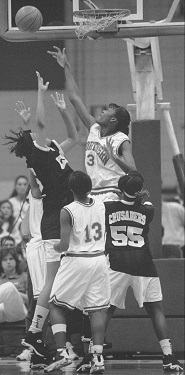
Tawana Towers: 1994 Class A Girls Basketball Final at Kellogg Arena, Battle Creek – Flint Northern, coached by Leteia Hughley and led by 6-4 freshman Tawana McDonald, defeated 1993 runner-up Detroit Martin Luther King, 46-32, for the Class A championship. McDonald batted down an MHSAA-record 10 shots, pulled down 13 rebounds and added five points and seven assists in a stellar performance.
Never Quit: 2008 Division 2 Football Semifinal, Spartan Stadium, East Lansing – Unbeaten, No. 1-ranked and heavily favored Muskegon trailed Davison by 22 late in the third quarter and 16 with less than five minutes to play. In perhaps the greatest comeback in playoff history, Muskegon recovered two onside kicks and scored 19 points in the final 4:31 to escape with a 38-35 victory and its third trip in five years to an MHSAA Final.
MHSAA Legends: 1998-2008 – For 10 years, the MHSAA showcased great teams from the past with their Legends of the Game series. From a historian’s perspective it was a chance to meet and learn more about folks I had often known only from the pages of microfilm. It was quite the treat to see years fall away as coaches, team managers and players reunited, in many cases for the first time after decades apart.
The MHSAA Record Books: Online, 1994 – One of my first efforts as state historian was to expand the record books beyond their primary focus on football, basketball, track & field and swimming & diving. With the arrival of the internet, an enhanced version of the record books was brought online. Coaches and fans were quick to respond with letters and e-mails, happily listing entries that had been “missed.” Soon, five category headings in a sport grew to 20, then to 50 and beyond.
Kids: 2004 Football Finals, Pontiac Silverdome – (OK, this is No. 11 ... consider it an extra point). For the first time, my sons joined me for my annual excursion to Metro Detroit for a Thanksgiving Day football weekend. They got to see the Silverdome before the move of the MHSAA Football Finals to beautiful Ford Field. Future Big Reds, they also got to see their future alma mater win another title.
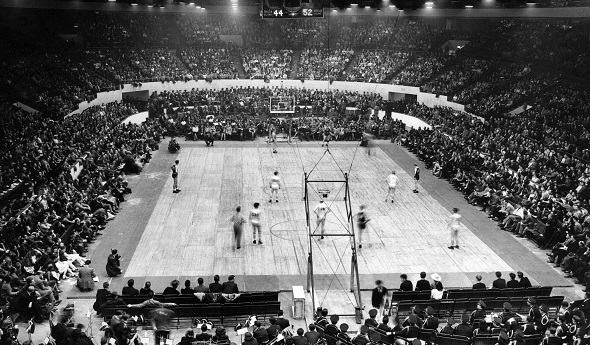
PHOTOS: (Top) An MHSAA boys basketball tournament game is played at Olympia Stadium in Detroit. (Middle) Flint Northern's Tawana McDonald blocks a shot during the 1994 Class A Final.
The Official View: The Crossroad We Face
By
Brent Rice
MHSAA Assistant Director
December 20, 2021
It’s time to call it what it is … a major crossroad and tipping point.
For more than a decade, the numbers of registered MHSAA officials have steadily declined from a high of about 13,000 to, today, around 7,700. While the COVID pandemic has certainly exacerbated those figures over the last two seasons, two of the top reasons officials give for leaving the avocation remains adult spectators and coach behavior.
School sports and traditional recreational programs have been supplemented, and in some cases, supplanted, by travel and club programs that, more often than not, do not share the same values and standards expected in education-based athletics. Many of these non-school programs require parents to spend exorbitant amounts in registrations fees, travel, lodging and meals with the implicit suggestion that this is the gateway to Division I college and professional sports. The result is that the criticisms hurled at the officials are more than an overzealous parent wanting a fair-called game – it is stakeholders defending their investments.
While we are often disturbed by some of the events documented during these club and travel contests, the real concern is that this permitted conduct has begun to seep into the school sports world. The result is that officials are simply walking away, leaving increasingly more games being moved or cancelled due to the lack of officials. The games that are being played are often staffed with smaller crews – perhaps two officials instead of three. Officials are in place to provide athletes with safe and fair opportunities to play sports, and shorthanded crews may reduce the ability for officials to see and call plays and fouls. These potential missed calls incite more disparaging comments from spectators, thus pushing more officials away from sports. This cycle cannot be sustainable much longer.
So, what are the solutions, and who do they come from?
The first is spectators. We refer to this as the difference between the whistle and the airhorn. When spectators just feel compelled to be vocally critical, they should make certain that their criticisms are infrequent, brief and not personal. Spectators should be the whistle and not the airhorn. Other spectators have a responsibility to set a good example and call out those who are going overboard.
School administrators also play a critical role in ensuring that officials are able to do their job in a safe and secure setting. Administrators should look for escalating situations in the stands and diffuse them before they become abusive. No one wants to remove parents and other spectators from events; but frankly, more of that needs to be done to show that inappropriate conduct and behavior will not be tolerated.
Finally, MHSAA officials need to be the first line of defense against unsportsmanlike behavior. This should be penalized when observed from coaches or players, without concern to the consequences that student or coach will later face. In short, bad behavior cannot be tolerated. Conduct found in the MHSAA Personal Attack Policy should result in an immediate ejection/disqualification, and similar conduct that occurs after the game should be handled as provided in the Post-Contest Ejection Policy. Unaddressed bad behavior by coaches and players encourages the same from spectators.
MHSAA game officials should focus their attention to the competition on the playing surface. This means that most comments from the stands should be ignored, and an official should never engage with critical spectators. This is not to say that officials must take abuse from spectators. If the language or behavior becomes a distraction to the contest, or personal and vulgar language is directed at the officials, the officials have the authority to have spectators removed from the facility (and should do so). No need for a big spectacle, ejection mechanic or yelling into the stands to engage fans. They should simply stop the contest and have the administrator on site remove the unruly spectator from the game.
There are a number of other factors contributing to the decline of officials that also need to be addressed. Low game fees, substandard locker room accommodations, unmanageable game times, and assigner and association politics all play a part. Those all pale in comparison to the main reason cited: Misbehavior by adults. MHSAA officials will inevitably continue to miss calls. That’s the nature of what they do. However, without them the games cannot be played, which means opportunities for Michigan students will also decline. We all have a responsibility to see that school sports remain closely tied to the values of educational athletics and maintain scope and perspective. We all must do better; otherwise, the crossroads of the officials shortage will only get worse.
It’s Official!
Postseason Assignments: Winter sport officials need to pay close attention to the changes for postseason consideration in effect this school year. Officials in most sports must opt into tournament consideration. This means officials this season for basketball, competitive cheer, gymnastics, ice hockey and wrestling must submit their availability on the MHSAA website – otherwise, the default is that they are unavailable. This is in addition to other postseason requirements such as completion of the rules meeting, the tournament exam and submission of the official’s regular-season schedule through the MHSAA website. These requirements are due by Dec. 15 for wrestling, Jan. 5 for basketball, Jan. 12 for competitive cheer and ice hockey, Jan. 19 for gymnastics and Jan. 26 for boys swimming & diving.
Seeking Committee Members: We are reconvening an ad hoc committee of educators/officials to assist with the development of curriculum that can be utilized by school districts for officiating classes in conjunction with the MHSAA Legacy Officials Program.
If you’re interested in serving on this committee (some in-person, but mostly virtual) and have a background as an educator, please reach out to [email protected].
Know Your Rules
BASKETBALL As Team A is preparing to make a throw-in from the end line, Team A players #15, #20 and #3 stand shoulder-to-shoulder next to each other immediately in front of the thrower. Team B player #11 requests to stand between two of the A players before the throw-in.
RULING Within three feet on the court from the throw-in, Team B players will be permitted to stand between the Team A players, if requested. If the Team A players were positioned more than three feet from the throw-in, this request would be denied.
It’s Your Call
REVIEW The play from the last It’s Your Call (found here) involved ball-handling by a back row volleyball player. Following a good dig by her teammate, the back row player appears to make contact with her left hand then right hand with her overhead pass. Since this is not the first contact on her side, the contact with the ball must be simultaneous with both hands. This is a multiple contact and a loss of point against white.
WRESTLING For the first time, the MHSAA will introduce a Girls Division into this year’s Individual Wrestling Finals. The following “It’s Your Call” takes place in a girls match but is applicable to the sport as a whole. Review the brief clip and let us know your thoughts. What’s the call?